Blog Artificial Intelligence
DeepSeek Super-agent: An Open-Source Coding Agent for Teams
On this page· 7 sections
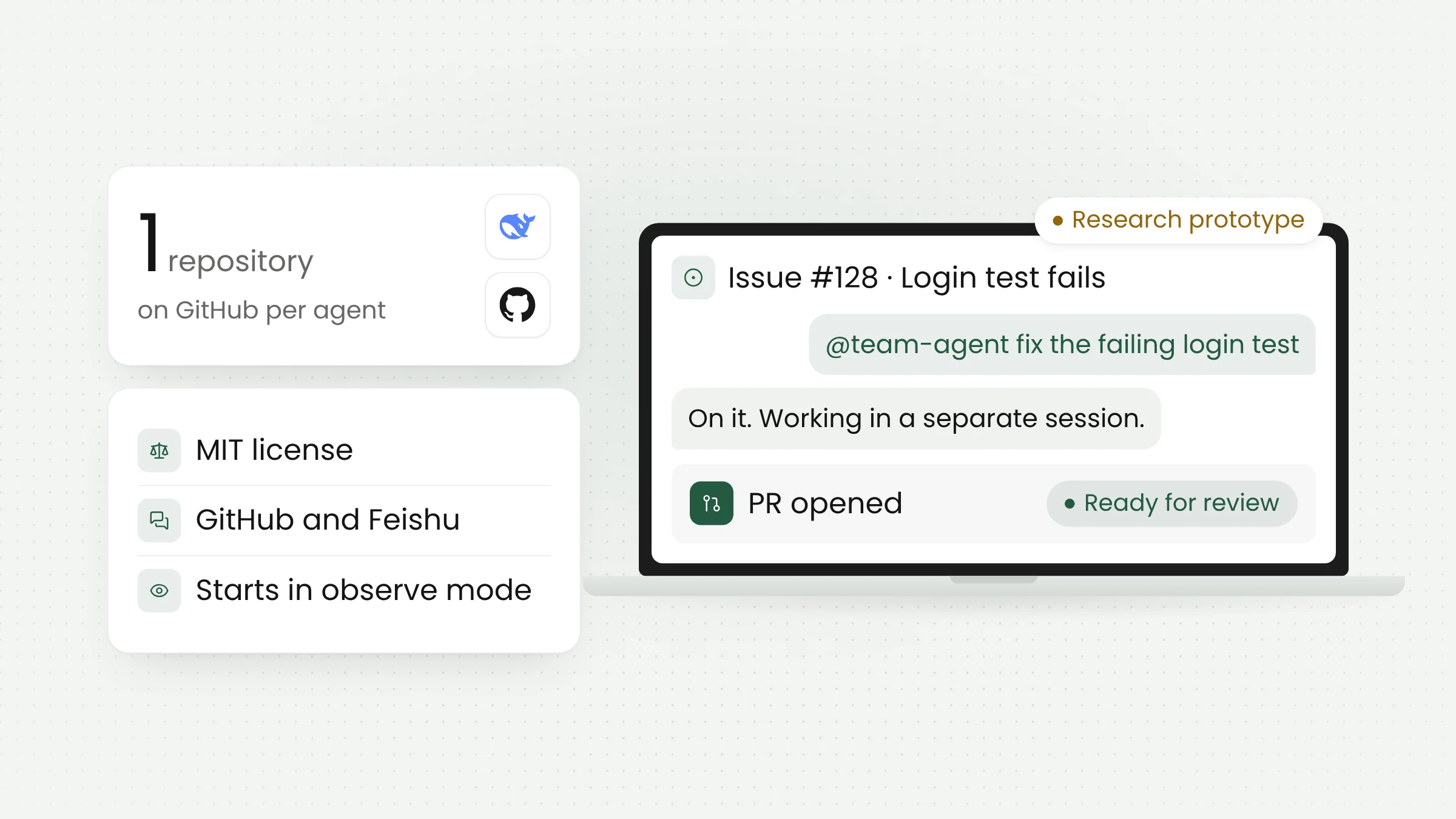
DeepSeek has published the code for DeepSeek Super-agent, an open-source coding agent that works on a single GitHub repository. It takes requests from teammates on GitHub or in workplace chat, does the work in its own session and answers in the original thread, often with a pull request. DeepSeek describes it as a research prototype.
What DeepSeek released
The DeepSeek Harness team introduced Super-agent in a WeChat post on Saturday, October 31, 2026, according to ShiftDelete.Net. The code is on GitHub as dsh-superagent under the MIT license, which allows anyone to use, modify and redistribute it. ShiftDelete.Net reported that the repository passed 4,000 stars within a day of going public.
Super-agent does not run on its own. It is a bundle for DeepSeek Harness, DeepSeek’s open-source agent framework, which is currently in public preview. Harness provides the runtime for agents, and Super-agent adds the ability to listen for team requests and turn them into units of work.
The README describes the project as a research prototype meant only as a reference and states that it is not an official DeepSeek product. The public code was adapted for release and differs from the version DeepSeek’s team uses internally. Some ideas in the companion article, Exploring Super-agent Design: Towards a More Autonomous Agent System, are not implemented yet. DeepSeek also says much of the engineering was done by coding agents and asks users to review and adapt the code before running it.
The release lands in a crowded market for coding agents. Bloomberg, as cited by The Next Web, framed it as a challenge to Anthropic’s Claude Code. DeepSeek set up its Harness team earlier this year to compete with American coding tools. The Next Web also noted that US civilian federal agencies were told last month to remove DeepSeek, context that organizations should keep in mind when they evaluate the tool.
From request to pull request
Super-agent listens to two sources: GitHub and, optionally, Feishu, the workplace chat app owned by ByteDance. A teammate on the allowed list mentions the agent’s account on an issue, for example by writing @agent-name followed by the request. The agent opens a work item, handles it in its own session and directory, and posts the result back to the same conversation.
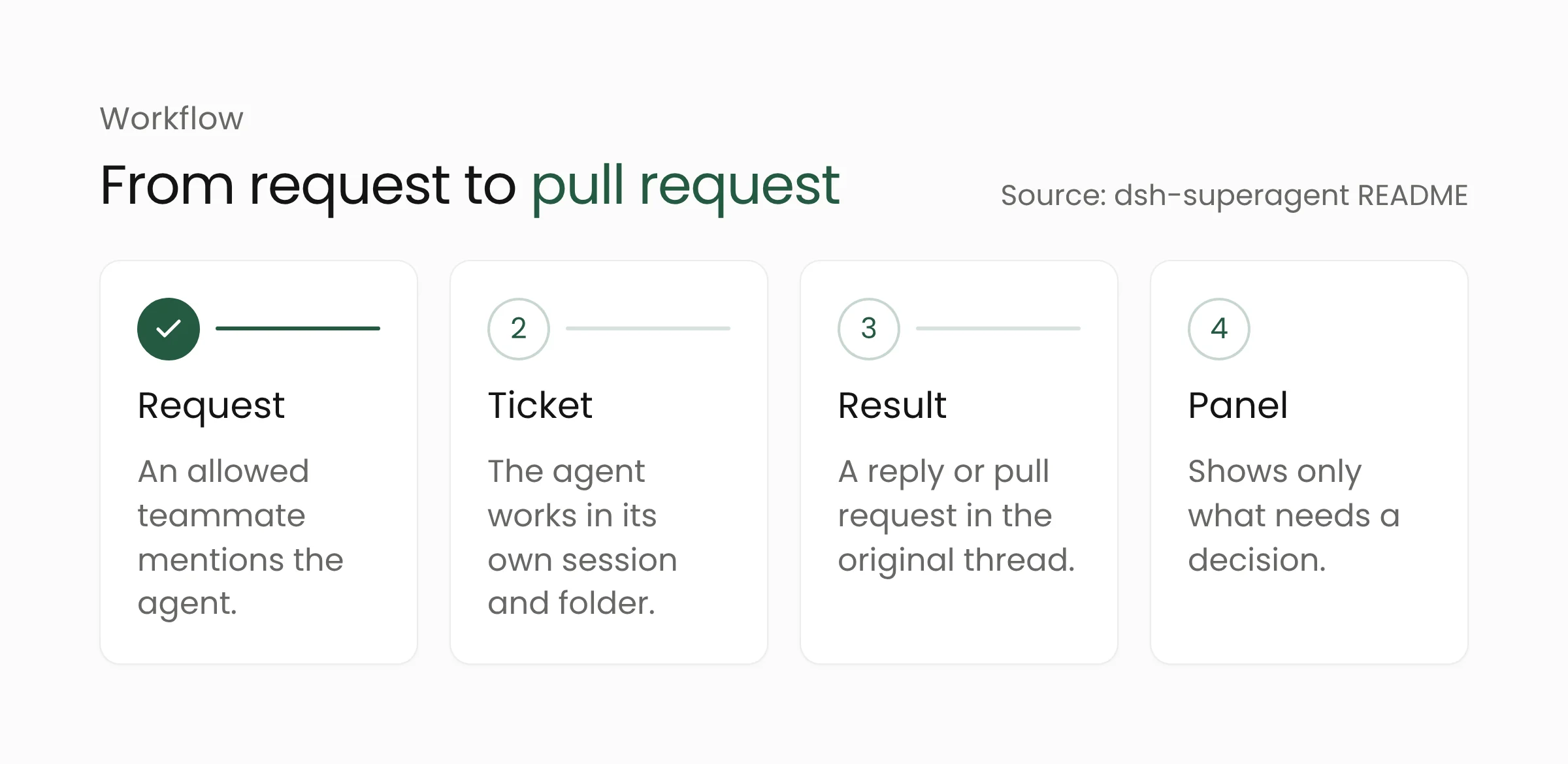
According to the domain model documentation, every incoming message first goes through an evaluation layer. That layer checks who sent it, whether it addresses the agent and which team rules apply. Only accepted requests become tickets. ShiftDelete.Net explains that a persistent “Router” session handles communication, parallel “Worker” sessions carry out tasks, and a Watchdog process detects failures and stalled loops.
The agent can respond with a reply, a question or a pull request. Later comments on the same issue or pull request reach the agent that owns the ticket automatically, so nobody has to mention it again. A local web panel lists only items waiting on a person, such as a pull request ready for review or a failed ticket.
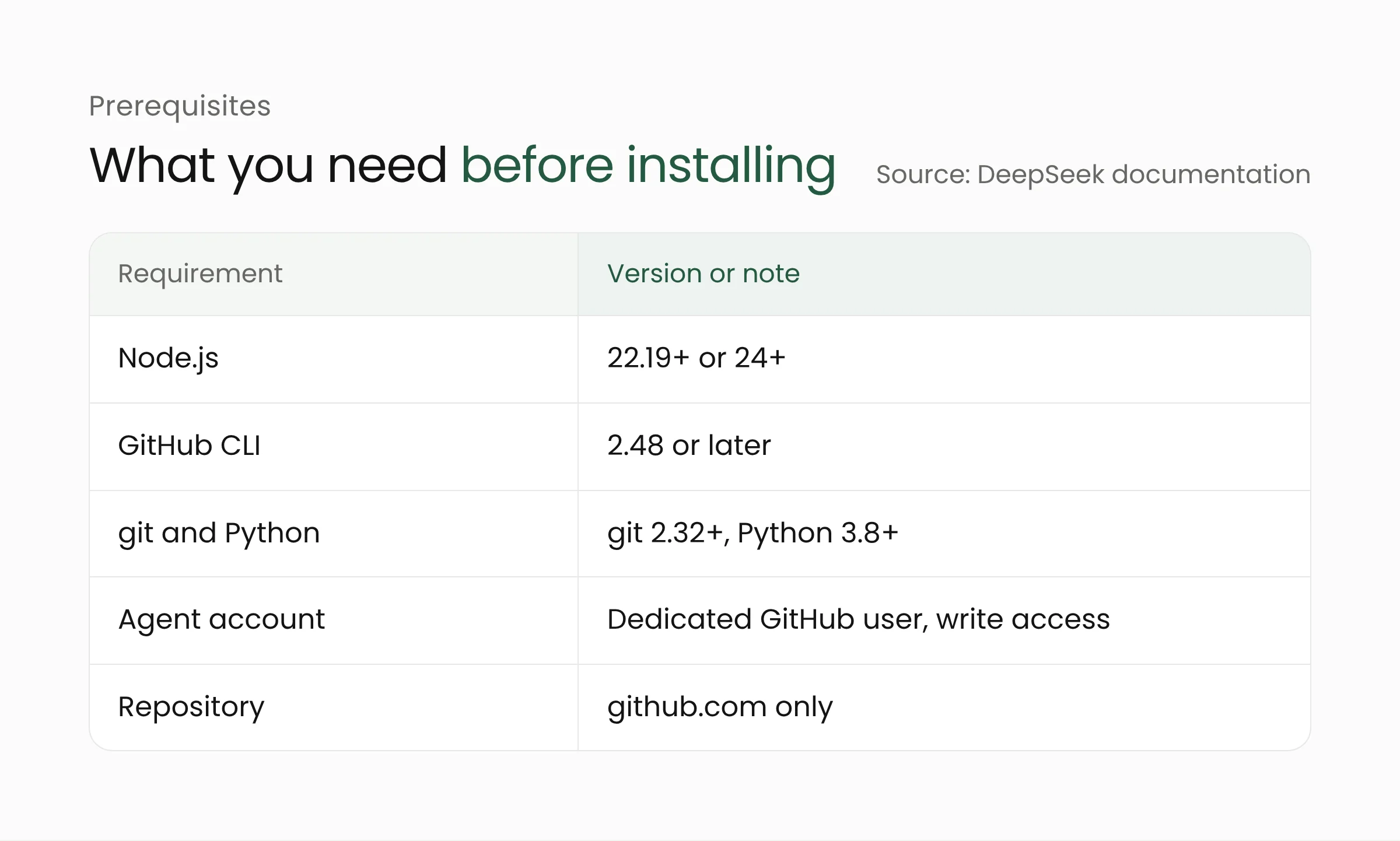
On the technical side, the agent needs a dedicated GitHub user account with write access to the repository. The documentation says a GitHub App cannot serve as the agent because Super-agent reads the account’s notifications. The repository must be hosted on github.com; GitHub Enterprise Server is not supported.
Full access, balanced by an attention budget
The section system administrators should read first covers permissions. The deployment guide states that agent sessions run with full access as the operator’s operating system user. A worker can execute programs and read the operator’s home directory. The account wrappers only choose which GitHub credentials are used; they do not isolate the process. DeepSeek recommends a dedicated OS account that holds only the agent’s credentials when isolation is needed.
In practice, the agent belongs on a machine or account prepared for it, away from production keys and developers’ personal data. The risk echoes what we covered in fake AGENTS.md files and how to secure AI agents: an agent that can run commands will run whatever slips into its instructions.
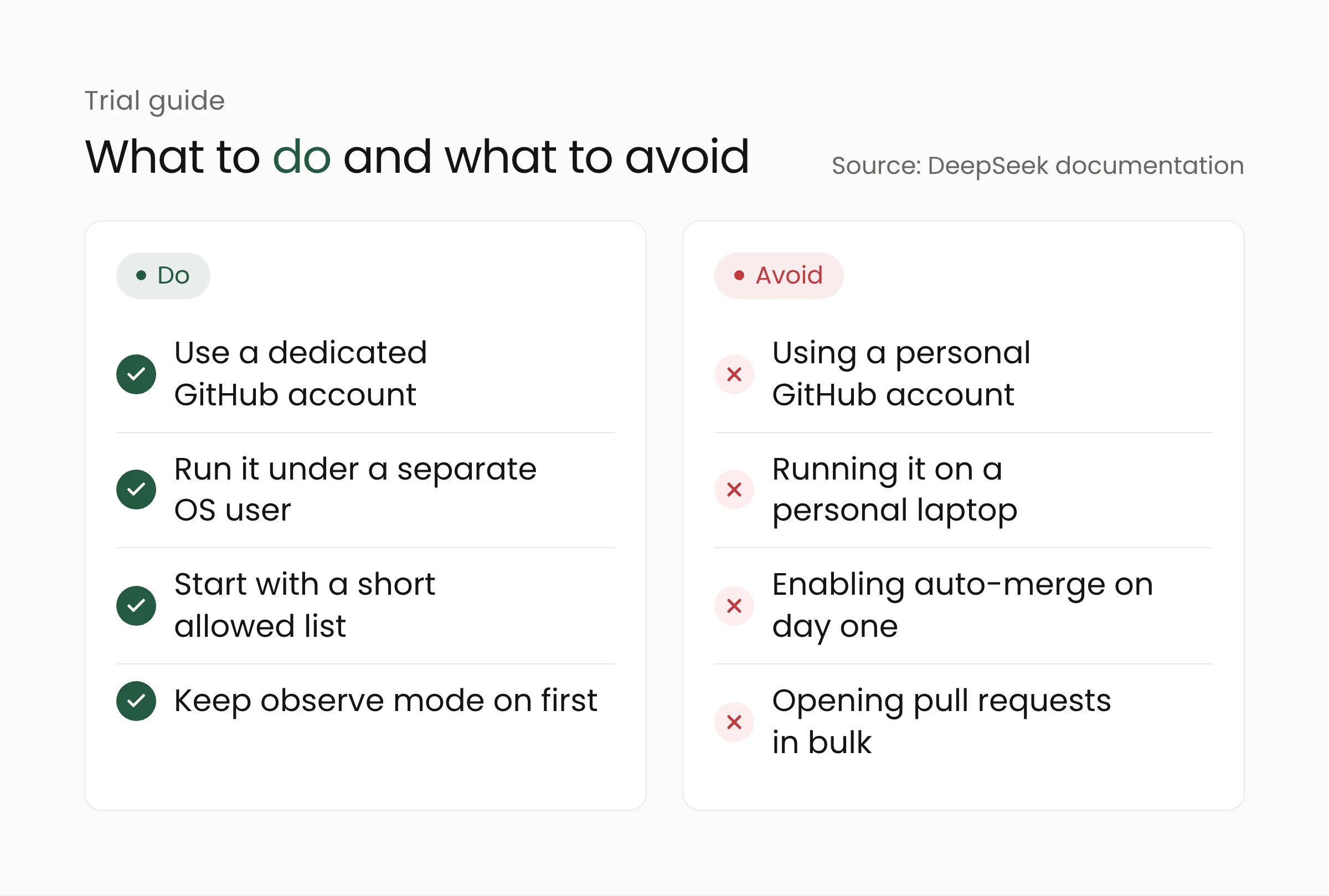
DeepSeek balances that broad access with behavioral rules. The core principle in the README reads: “take as little human attention as possible, and give as much value as possible.” The agent acts only when an allowed person asks or when a rule written by the team permits it. It confirms a request once, stays quiet while it works, and speaks again only when a result is ready, when it needs a decision or when it cannot finish.
Proactive work, meaning work nobody asked for, starts in observe mode, where the agent records what it would have done without doing it. The setup guide also recommends a short allowed list, an agent account separate from the operator’s own, and auto-merge switched off until the agent’s pull requests have been right for a while.
The philosophy document ends with four duties for the operator: start narrow, tune for less noise, do not use the agent to produce volume such as mass pull requests, and own everything the agent says on the team’s behalf.
What this means for development teams
For software agencies, government IT units and product teams at banks or retailers, Super-agent offers a license-free way to study how a team agent might work. Because the code is open, teams can read exactly how permissions, request evaluation and execution are designed. That design is a useful reference even for teams that end up choosing a different tool.
Test on a non-production repository first
Start with a sandbox repository or an internal project that holds no secrets. Set up a dedicated GitHub account with limited access, keep observe mode on, and compare the agent’s log with the decisions your team would have made. This shows quickly whether the agent adds value or only adds noise.
Check where code and conversations go
Super-agent uses the model configured in DeepSeek Harness, so your code and team conversations are sent to whichever model provider you choose. For projects that handle personal data about citizens, patients or customers, confirm that the provider and its processing location fit your organization’s policies and Indonesia’s Undang-Undang Pelindungan Data Pribadi (Personal Data Protection Law).
Decide who reviews the agent’s work
Pull requests from an agent still need human review before they are merged. The Next Web cited a January CooperBench study which found that coding agents working as a team had success rates about 30% lower on average than when they worked alone. The study did not test DeepSeek’s agent, but it is a reminder that coordination between agents remains difficult.
Teams considering this kind of agent in their web development workflow should write the rules down first: who may give the agent instructions, which repositories it may touch, and who is accountable for its pull requests. Those rules also deserve a cybersecurity review, especially around credential handling and account separation.
Frequently asked questions
Is DeepSeek Super-agent free?
The code is free and MIT-licensed. The agent still needs a model provider configured in DeepSeek Harness, and model usage is billed by whichever provider you choose.
Does Super-agent work with Slack or WhatsApp?
The released version supports GitHub and Feishu only. The documentation includes a guide for adding new sources, but official integrations with other chat apps have not been announced.
Is Super-agent ready for production?
No. DeepSeek calls it a research prototype that may still contain bugs and asks users to review the code before using it. The agent also runs with full access under the operator’s OS account, so isolation has to be set up separately.
Closing thoughts
Super-agent points to a new direction for coding agents: from an assistant waiting in the editor to a teammate that listens to conversations and opens pull requests on its own. For teams in Indonesia, its greatest value is a permission model and an attention budget that anyone can study in the open. If your team wants to trial AI agents in its development process with clear safeguards, the Merakit team can help plan the first steps.
Sources
- dsh-superagent (README, SETUP and documentation), DeepSeek on GitHub, October 31, 2026
- DeepSeek Harness, DeepSeek
- DeepSeek open-sources Super-Agent, a coding agent that reads team chats, The Next Web, November 1, 2026
- DeepSeek Coding Agent Super-agent Takes Aim at Claude Code, ShiftDelete.Net, November 1, 2026