Blog Cybersecurity
Binance Hack: Lessons from a Compromised Engineer Laptop
On this page· 7 sections
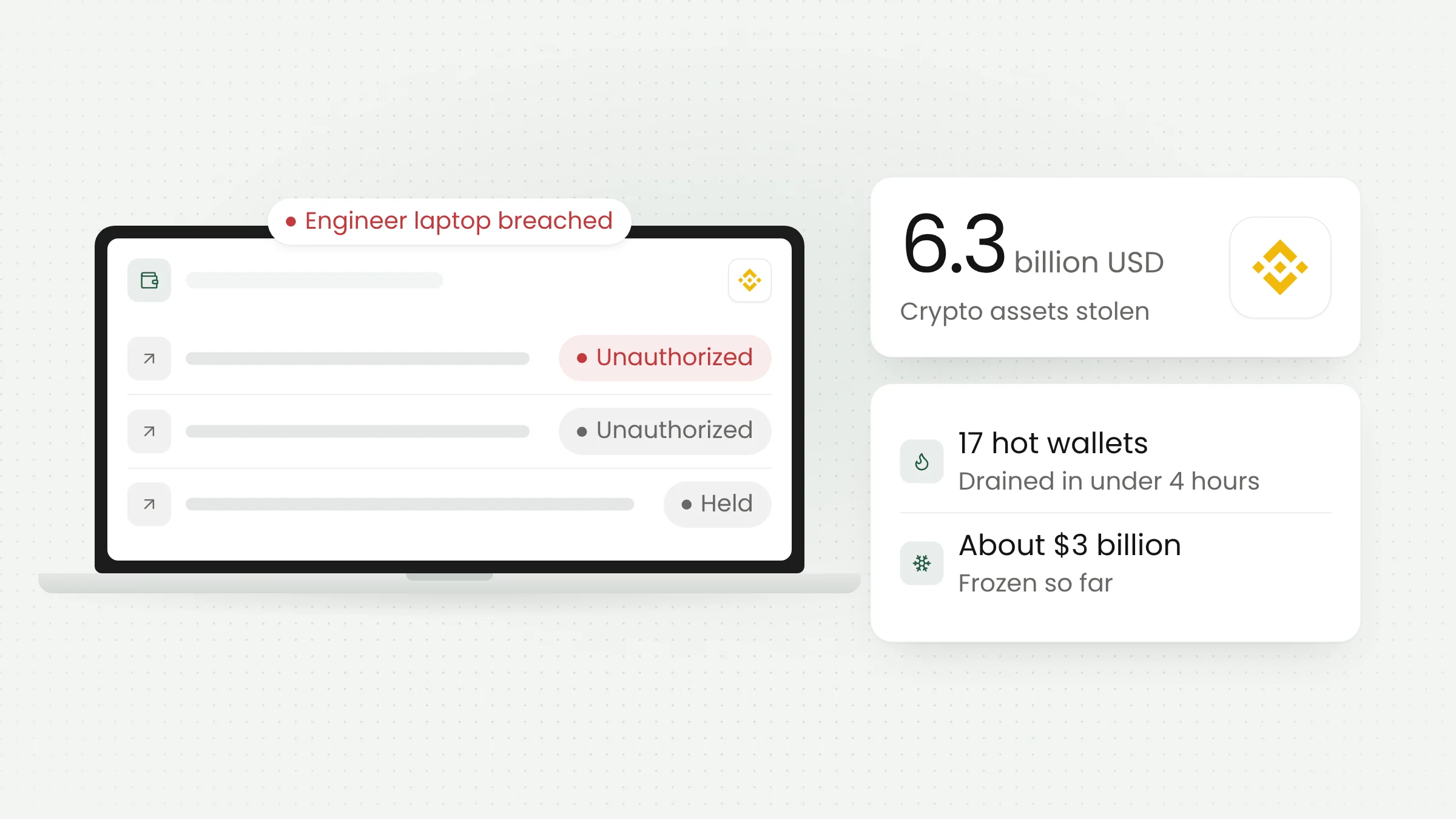
The Binance hack on October 29, 2026 drained crypto assets worth about $6.3 billion from the exchange’s wallets. Binance’s preliminary findings point to a compromised laptop belonging to one of its DevOps engineers as the entry point. For crypto exchanges and fintech companies in Indonesia, the case offers immediate lessons.
How the Binance hack unfolded
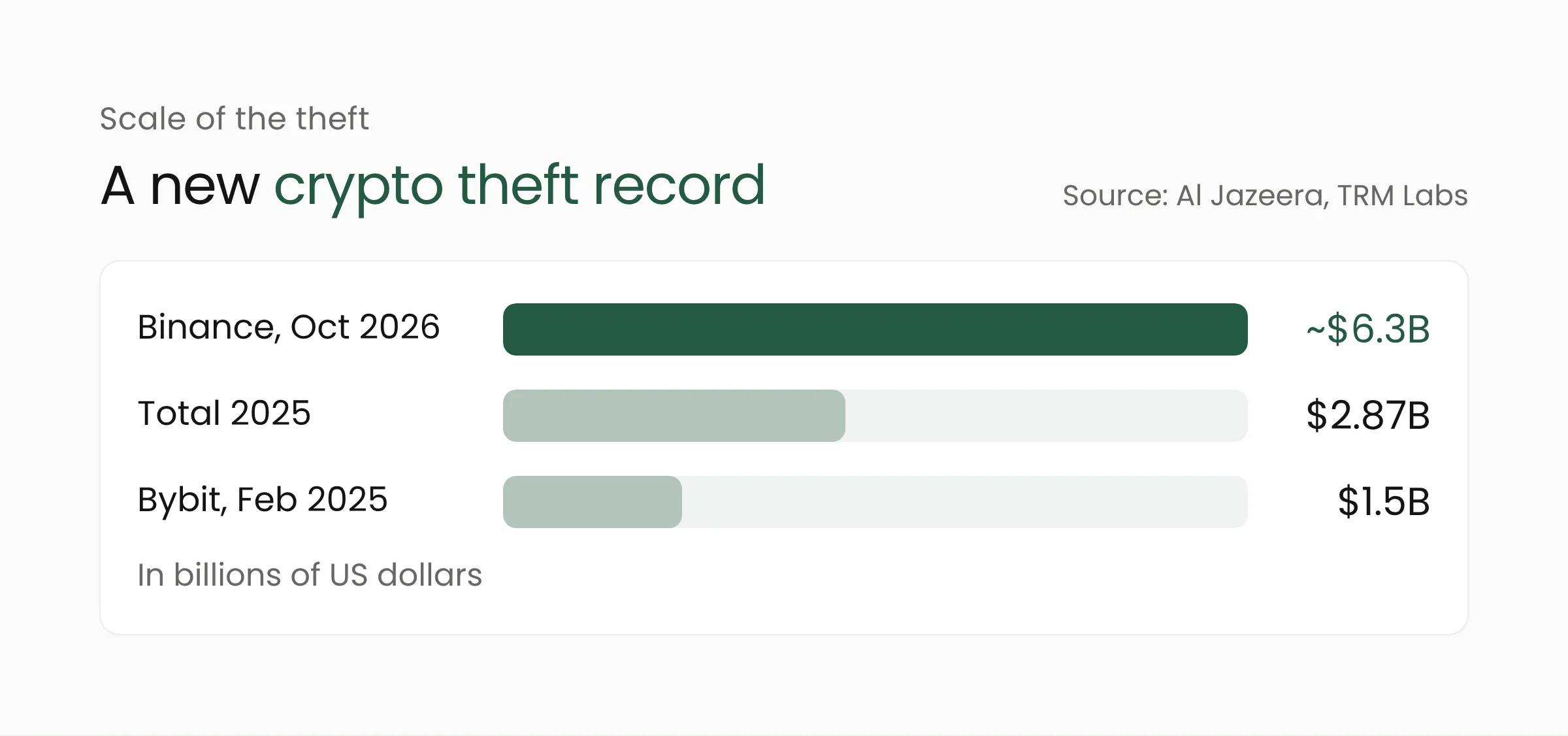
Binance said about $6.3 billion was stolen in a “security incident,” Al Jazeera reported. That makes it the largest crypto theft on record. The previous record was the $1.5 billion Bybit hack in February 2025. For scale, TRM Labs’ crypto crime report puts total thefts in 2025 at $2.87 billion across nearly 150 incidents.
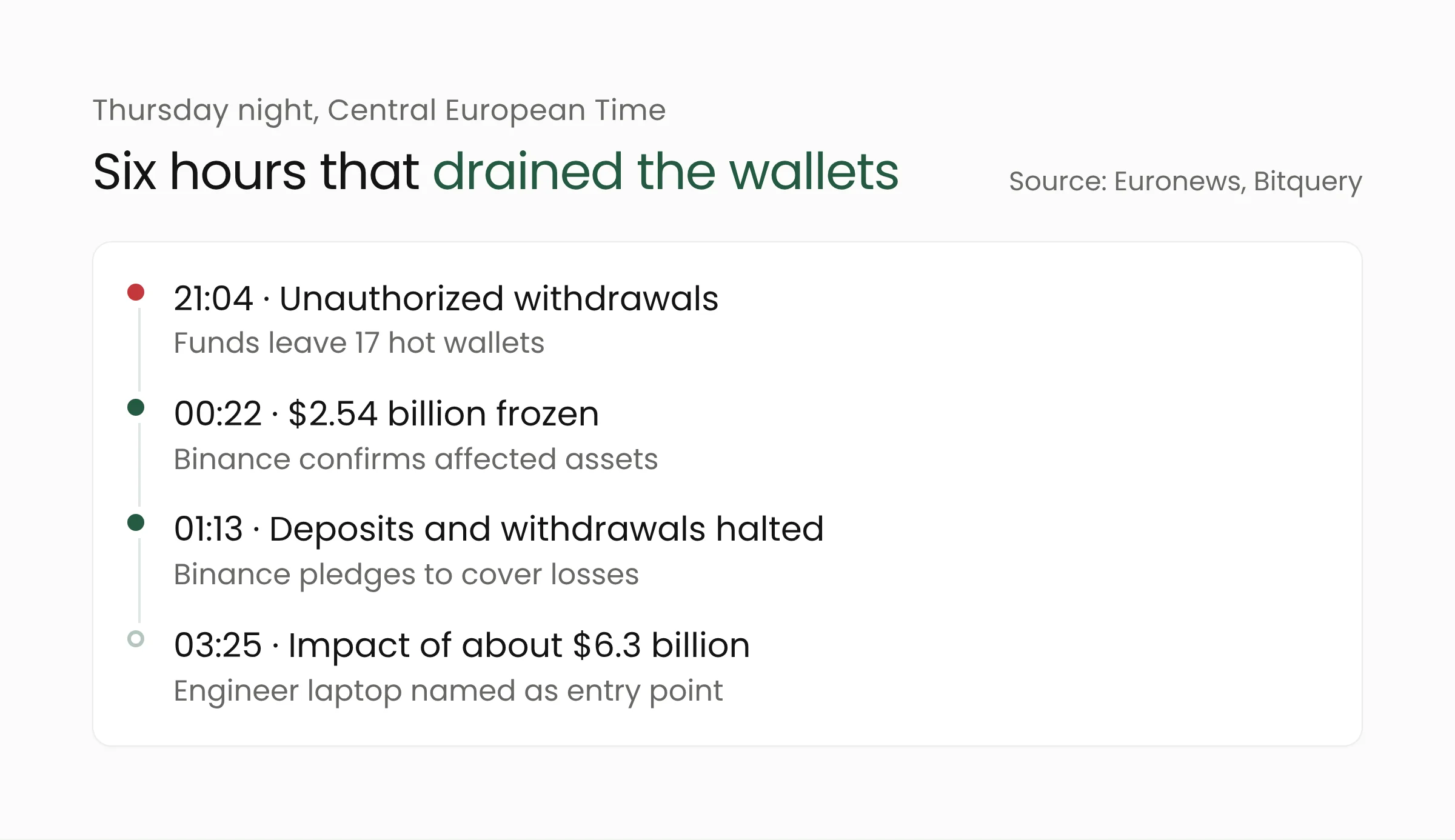
The attack took place on Thursday evening, European time. Bitquery data cited by Euronews shows Binance’s withdrawal system sending funds out of 17 hot wallets in less than four hours. A hot wallet is connected to the internet so it can serve day-to-day withdrawals, while a cold wallet is kept offline.
Blockchain analytics firms report slightly different figures. TRM Labs, quoted by CNBC, estimated that about $6.36 billion moved from Binance wallets across 10 blockchains, most of it within roughly 20 minutes. Bitquery counted funds sent to new addresses on nine blockchains, with Ethereum, Bitcoin, and TRON hit hardest.
Binance then suspended all deposits and withdrawals. Working with stablecoin issuers and other partners, the exchange froze about $3 billion of the affected assets. Freezes work best on stablecoins such as USDT and USDC, because the issuers can freeze tokens. Bitcoin and Ether cannot be frozen that way, so they have to be traced to exchanges willing to hold them.
On Saturday, October 31, Binance said it had covered up to 90 percent of the stolen assets, according to CNBC. The money came from its Secure Asset Fund for Users (SAFU), part of its Futures insurance fund, and its corporate treasury. “Binance will absorb the financial impact of these stolen funds, not our users,” the company said. It aimed to resume withdrawals on Sunday, November 1, subject to security checks.
On Saturday night, the FBI said North Korea was responsible. TRM Labs and Chainalysis had earlier linked the attack to TraderTraitor, a hacking group the FBI also tied to the Bybit theft.
The way in: a DevOps engineer’s laptop
DevOps engineers manage the path between code and production: servers, containers, and the release process. Because of that role, their laptops often hold access to many critical systems at once.
According to Binance’s preliminary findings, a compromised laptop belonging to a DevOps engineer gave the attacker access to a service container. From there, the attacker sent unauthorized withdrawal transactions. Binance said it found no evidence that any wallet private keys were leaked. In other words, the attacker appears to have used Binance’s own withdrawal pipeline without needing to steal wallet keys.
In later updates, Binance said multiple factors contributed and that investigators had found additional breach points in what it called a complex attack. Co-CEO Richard Teng, according to CNBC, said the attack involved a more complex process than the misuse of a single engineer’s permissions. Binance has not said how the laptop was compromised or which controls failed. It has promised a detailed technical post-mortem once the investigation is complete.
TRM Labs also found that preparations began at least 36 hours before the theft. The attacker funded wallets through Tornado Cash, a crypto mixing service, and obtained transaction signatures in advance.
Other industries know this pattern well. In many cases, attackers do not break into the vault directly. They get in through the device of someone who holds access, then use legitimate internal tools to move money or data. A related supply chain angle came up in our piece on the Ledger hardware implant, where trusted devices became the weak point because their origin was not checked.
The impact in Indonesia and the OJK response
Local exchanges were also disrupted. Indodax paused deposits and withdrawals in both rupiah and crypto on Thursday, October 29, 2026. CEO William Sutanto, as reported by CNN Indonesia, described the move as a security measure after the company detected a rise in cyberattack attempts. Indodax said it had found no unauthorized withdrawals or signs of a data leak, and that user balances were safe. No official statement has linked the Indodax pause to the Binance hack.
Indonesia’s Financial Services Authority (OJK) urged the public to stay calm and alert. Adi Budiarso, who heads OJK’s supervision of financial technology innovation, digital financial assets, and crypto assets, said in comments quoted by InvestorTrust that platform size and brand reputation alone do not guarantee asset security. Governance, asset protection, risk management, and incident readiness matter more, he said.
Adi also pointed to Indonesia’s custody rules for consumer crypto assets. Seventy percent must be held with a licensed custodian and 30 percent with the trader. Of the trader’s share, 70 percent must sit in cold wallets and 30 percent in hot wallets. He advised investors not to keep all their assets in one place.
For individual users, the practical advice matches OJK’s guidance: use exchanges licensed by OJK, turn on two-factor authentication, keep passwords and private keys private, and watch for scams that exploit news of the hack. Binance itself warned users about scams from the first hours of the incident.
What this means for crypto exchanges and fintech
The Binance case shows that money can leave through a legitimate withdrawal system once a single insider device falls into an attacker’s hands. Crypto exchanges, e-wallets, online lenders, and digital banks share this risk profile, because each runs services that can move money automatically. Four steps belong on technology teams’ to-do lists this week.
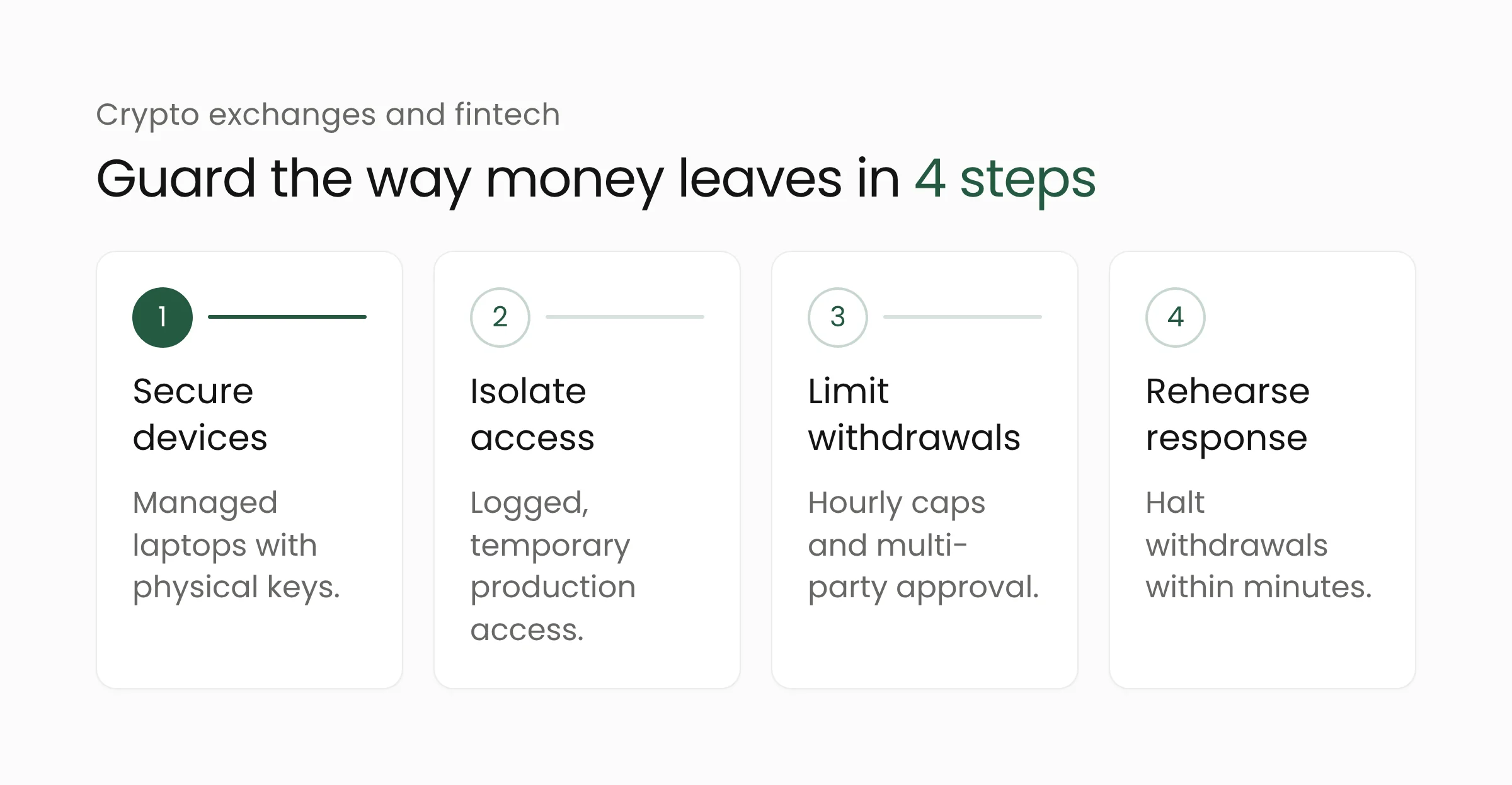
- Secure engineer devices. Laptops with production access should be centrally managed, monitored with threat detection software, and require a physical security key to sign in. Personal laptops should not be used to reach production systems.
- Isolate production access. Access to production containers and servers should go through a dedicated, logged path, be granted only when needed, and expire automatically. One compromised laptop should not be enough to reach a service that moves funds.
- Limit the withdrawal service. Set value and velocity caps on withdrawals per hour, require approval from more than one party for large hot wallet withdrawals, and add monitoring that halts transactions when patterns look abnormal. Keep hot wallet balances as low as OJK rules allow.
- Rehearse incident response. Prepare procedures to halt withdrawals within minutes, contacts at stablecoin issuers and tracing partners, and a schedule for public updates. Binance posted regular updates from the first night, which helped contain panic.
These steps apply beyond crypto. QRIS payments, interbank transfers, and loan disbursements all have a “send money” button that needs the same protection. Teams building financial services solutions can use this case to review who can trigger transactions, and from which devices.
Frequently asked questions
Did Binance users lose their funds?
Binance says it will cover all losses with its own funds and, as of October 31, had covered up to 90 percent of the stolen assets. The remaining 10 percent consists of tokens outside the top ten, which Binance says are harder to buy in large amounts. Withdrawals were set to reopen on November 1 after security checks.
Were Indonesian crypto exchanges hacked too?
So far there are no official reports of a local exchange being breached as a result of the Binance incident. Indodax paused deposits and withdrawals after detecting more attack attempts, but said it had found no unauthorized withdrawals.
Is a personal cold wallet safer?
A cold wallet reduces exposure to exchange hacks, but the owner carries the risk of losing the device or keys. OJK advises against keeping all assets in one place and recommends licensed exchanges that hold most assets with a custodian.
Conclusion
The Binance hack shows that an exchange’s security also depends on the devices of the people who run it. Binance’s full technical report is still pending, but the lessons on engineer access, withdrawal limits, and incident response can be applied now. If your team wants to review production access or test its incident readiness, Merakit’s cybersecurity services can help.
Sources
- Al Jazeera: Binance says $6.3bn stolen in biggest crypto heist in history (October 30, 2026)
- CNBC: Binance’s $6.3 billion hack, what we know and what comes next (October 30, 2026)
- Euronews: How the Binance hack happened and who was behind it (October 30, 2026)
- CNBC: Binance says 90% of $6.3 billion hack losses are now covered, plans to resume withdrawals Sunday (October 31, 2026)
- CNN Indonesia: Indodax temporarily halts crypto transactions after detecting cyberattacks (October 30, 2026, in Indonesian)
- InvestorTrust: Binance hacked, local exchanges disrupted, OJK and analysts comment (October 30, 2026, in Indonesian)