Blog Carbon-X
Carbon-X: An Open Model That Answers DNA Questions
On this page· 7 sections
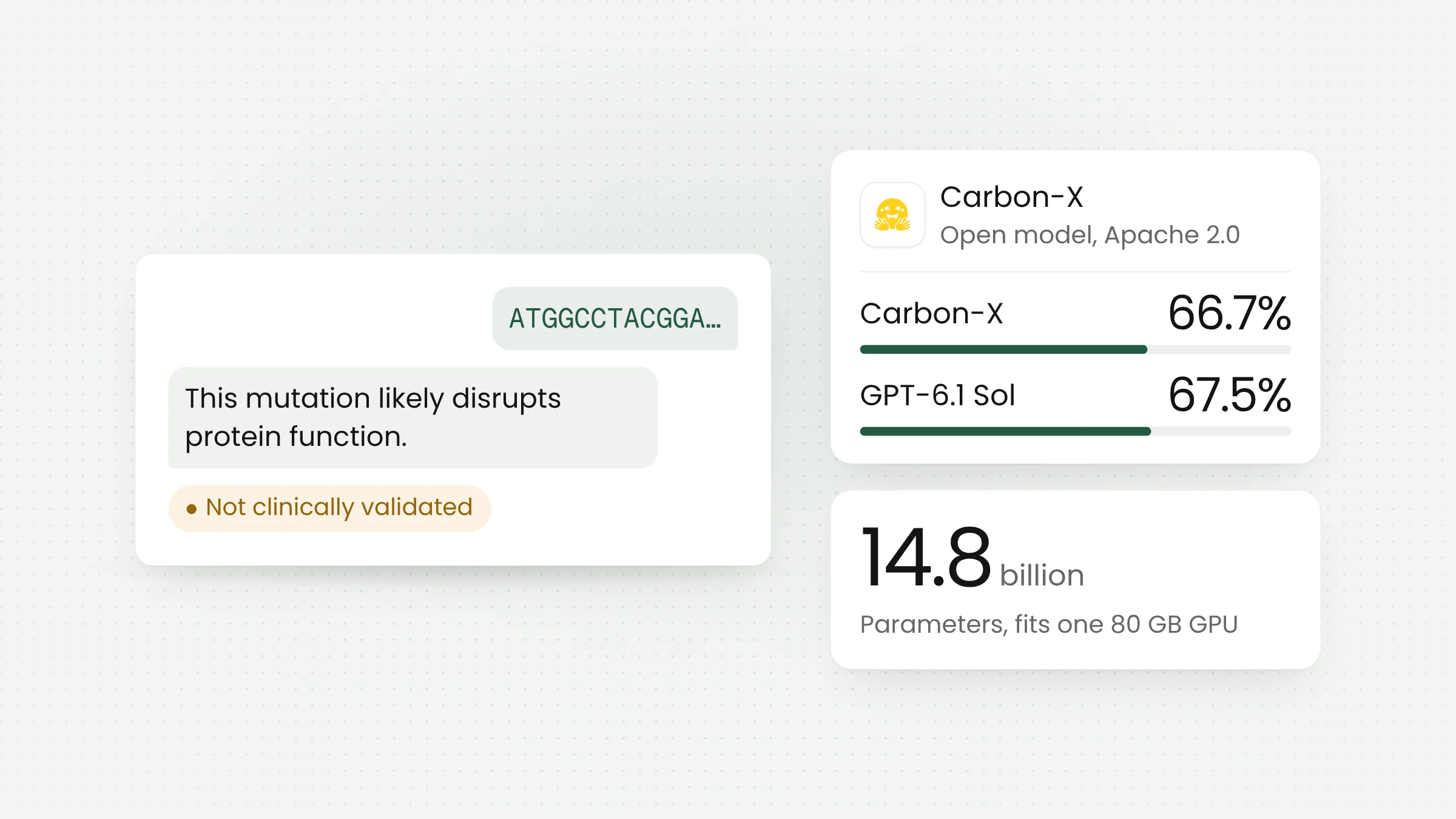
Hugging Face has released Carbon-X, an open AI model with 14.8 billion parameters that answers questions about DNA in plain language. Media reported the release on October 22, 2026. By the developers’ own tests, Carbon-X averages 66.7%, just behind GPT-6.1 Sol. The model has not been clinically validated.
What Carbon-X is and how it works
Carbon-X is a chat model that reads DNA sequences and ordinary text in a single stream. A user pastes a genetic sequence into the chat and receives an answer with an explanation. According to the model card, it can predict the effect of a genetic variant, identify features of a sequence, classify groups of organisms, predict the next bases and explain its reasoning.
The model is built on Alibaba’s Qwen3-14B. Hugging Face expanded its vocabulary to handle DNA, then trained it on about 302 billion tokens of DNA, English text and biology material. ForkLog reports that more than half of those tokens were DNA sequences and that nucleotide letters are read in groups of six characters. The model was then tuned on instruction examples and reinforcement learning for biology tasks.
The model card adds that the first stage used roughly 10 billion tokens to extend the vocabulary while the transformer body stayed frozen. Mid-training on 302 billion tokens followed, then three epochs of supervised fine-tuning and two rounds of reinforcement learning. The context window is 40,960 tokens, far shorter than a full genome, so the model is meant for fragments.
The developers left viral sequences out of the training data to reduce the risk of misuse, Hugging Face’s Lewis Tunstall told Business Insider, as cited by The Next Web. Researchers from Zhongguancun Academy, the Telethon Institute of Genetics and Medicine and the University of Naples Federico II took part. Tunstall described the aim this way: “We wanted to provide the open research community with tools.”
Open and runnable in-house
The weights are released under the Apache 2.0 license and fit on a single 80 GB graphics card. A laboratory can therefore run the model on its own servers without sending data to an outside provider. The Next Web notes that this matters when patient data is sensitive. The model card itself warns that the protection of genetic data depends on how the model is accessed.
Benchmark results and cost claims
Hugging Face tested Carbon-X on five sets of DNA questions. In the model card, Carbon-X (without reasoning mode) averages 66.7%, GPT-6.1 Sol 67.5%, Claude Opus 5.5 60.9% and Gemini 4 Argon 49.8%. According to ForkLog, the base Qwen3-14B scores only about 40%. Among the open models tested, Carbon-X ranks highest.
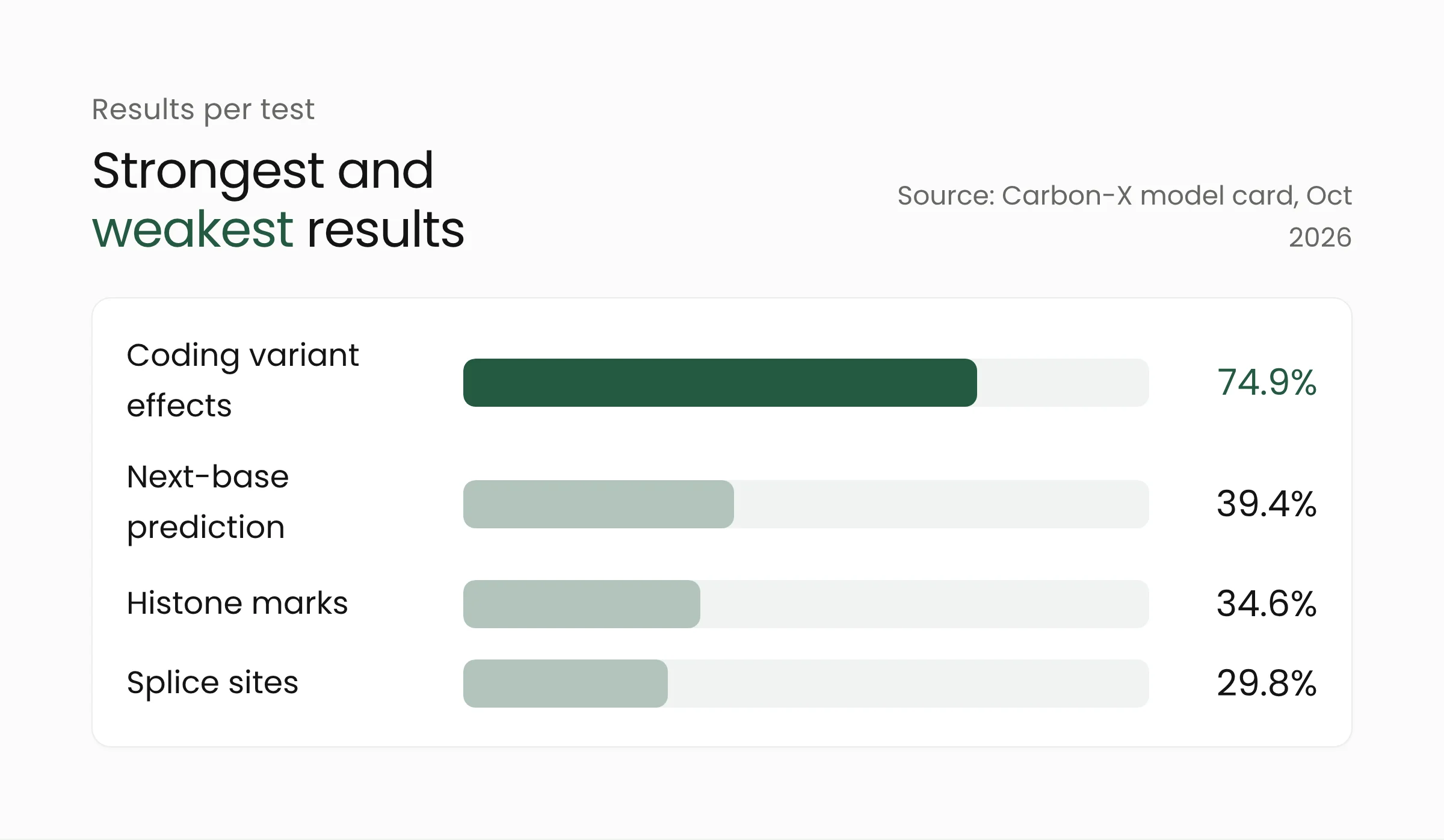
Results vary by task. Carbon-X leads on variant effects in protein-coding regions with 74.9%, against 71.0% for GPT-6.1 Sol, and on next-base prediction with 39.4% against 32.9%. Opus 5.5 leads on two other tasks, complex variant effects (94.8%) and FrontierVEP (76.2%), while GPT-6.1 Sol leads on GenomeQA (67.2%).
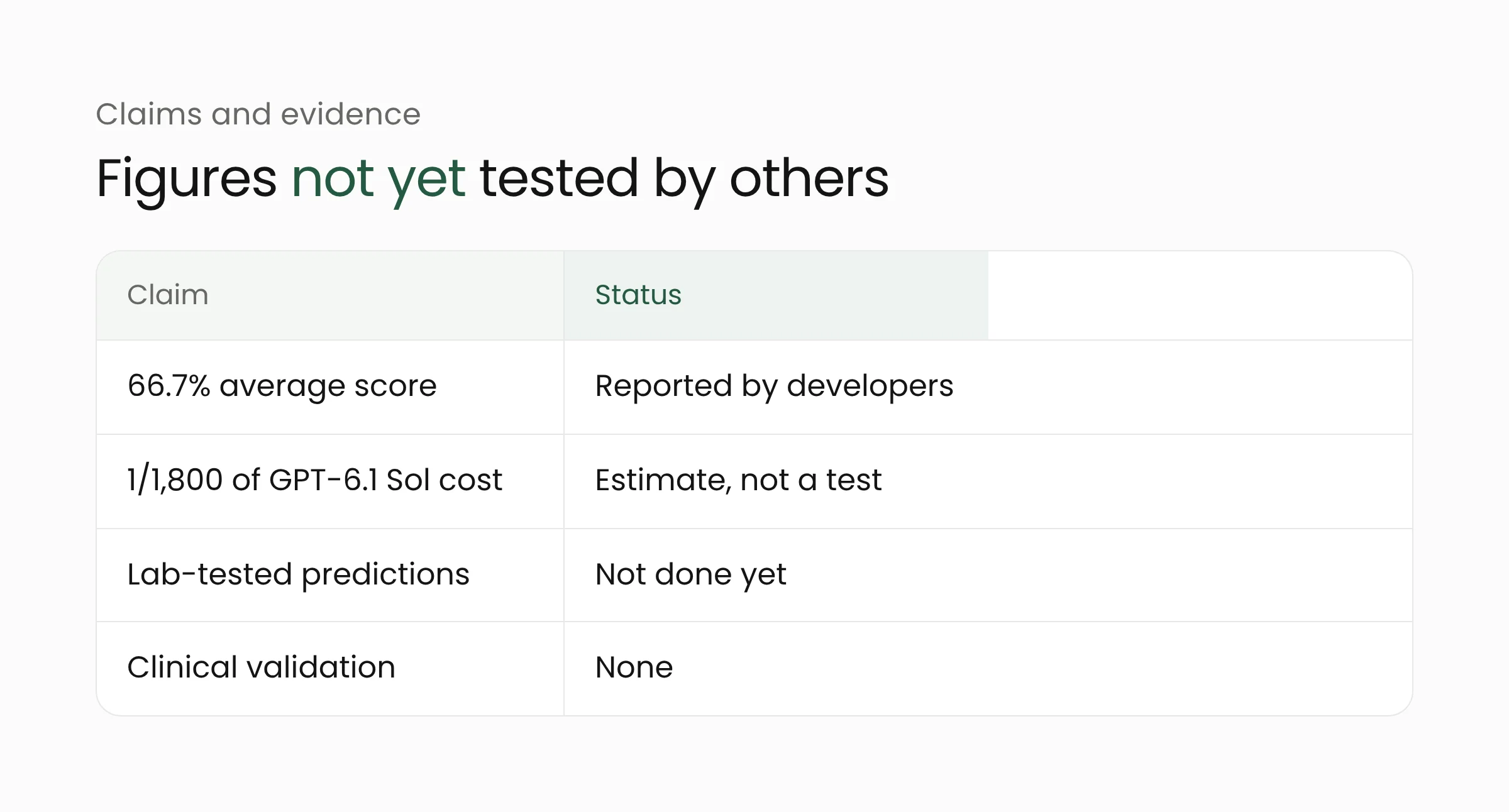
The developers ran and reported all of these figures. An explainx review that draws on the model card says two of the five benchmarks were built by the model’s authors and that no independent replication exists. The Next Web also says it has not verified the results.
A cost claim that is still an estimate
Hugging Face estimates that one task costs about 1/1,800 as much with Carbon-X as with GPT-6.1 Sol. The calculation uses measured throughput on an H200 GPU at $5 per hour for Carbon-X, compared with standard API prices for rival models. For analyzing 2.4 million ClinVar variants of uncertain significance, ForkLog reports about $300 with Carbon-X, $32,000 with GPT-6.1 Sol and up to roughly $4 million with other leading models.
Those figures are an extrapolation, not an analysis that was actually run. Explainx points out a key caveat: rival models ran at their highest reasoning effort, while Carbon-X answered without extended reasoning. The cost comparison is best read as an order of magnitude, not a guaranteed saving.
Limitations stated by the developers
The model card states that Carbon-X has not been clinically validated and must not be used for medical decisions. Wired, as cited by The Next Web, reports that its predictions have not yet been tested in laboratory experiments.
Results are weakest on splice sites (29.8%) and histone modification regions (34.6%). The model can miscount bases, misstate coordinates and guess the origin or function of a sequence when context is thin. Training used fragments of up to about 49,000 base pairs, so much longer inputs have not been evaluated. Quality also drops when the model is asked to generate long DNA, and the model card stresses that it is built to read and explain, not to design sequences.
On October 8, ForkLog reports, Hugging Face also released Carbon-A, a 1.2-billion-parameter model for finding protein-coding regions. ForkLog says Carbon-A produced a database of 566 million putative genes from 22,617 species, most of whose predictions still await experimental validation. ForkLog also points to Evo 2 from the Arc Institute and Nvidia (February 2025), trained on DNA from more than 100,000 species. Carbon-X adds to a growing list of AI genomics tools whose weights anyone can download.
What this means for hospitals and research institutions
Carbon-X is a research tool, not a diagnostic one. Hospitals, universities and health startups in Indonesia can try it to explore genetic data, but its output does not belong in a medical record or a treatment decision. For teams weighing AI for healthcare solutions, the release shows that an open model running on in-house servers is now a realistic option for sensitive data.
On the technical side, data teams and machine learning services need to build their own test harness. A developer-reported average does not guarantee good performance on local data. The training data spans many groups of organisms, and the sources reviewed do not detail how well specific human populations are represented. Testing on local data is therefore a step that cannot be skipped.
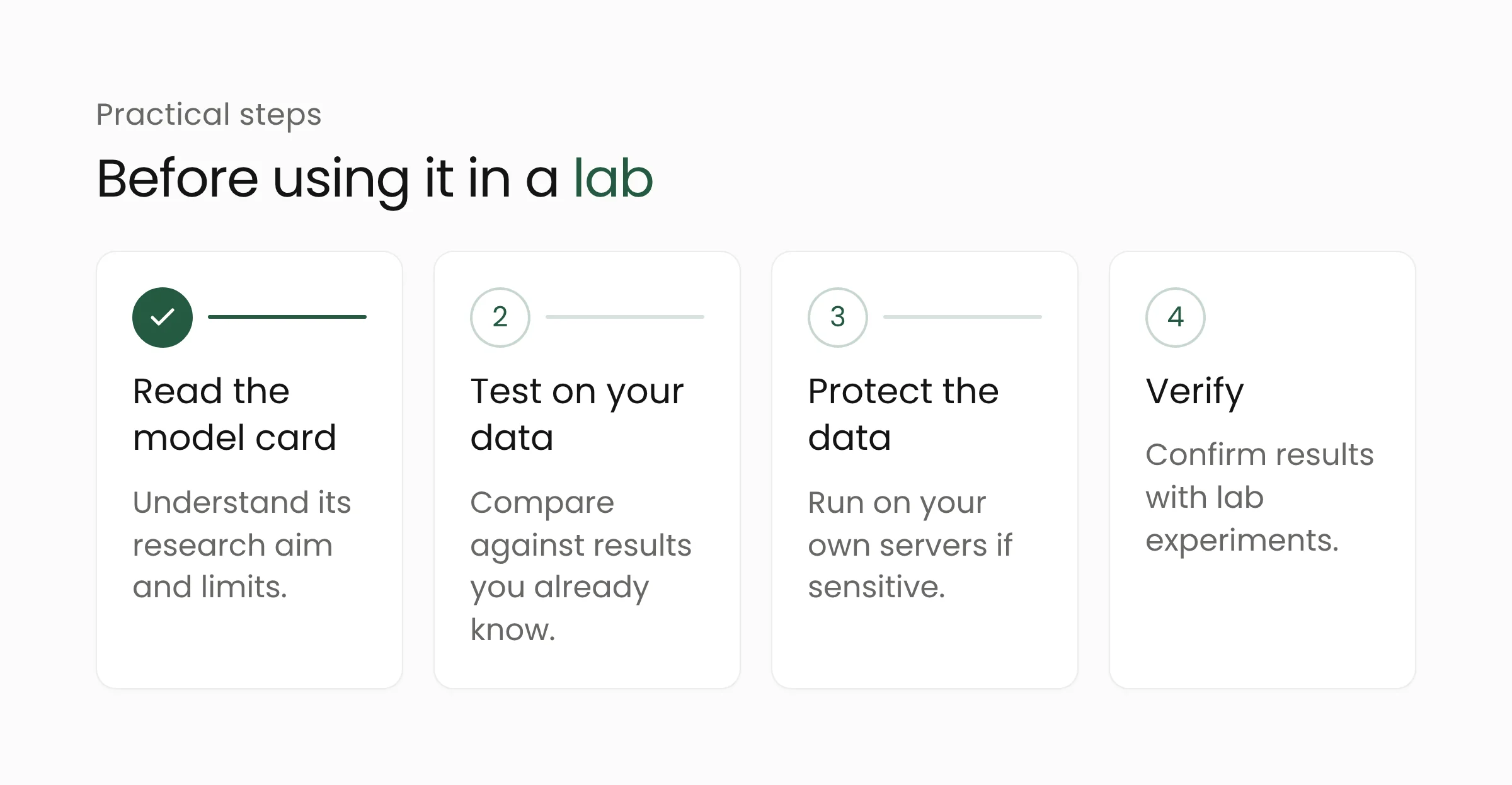
Practical steps that make sense:
- Read the model card and note that its purpose is research.
- Test on data with known results before using it on new data.
- Run it on your own servers if the data is sensitive, and review the personal data protection rules that apply.
- Confirm every important finding through laboratory experiments.
Our article on health AI assistants and patient data covers a related question about handling patient data.
Frequently asked questions
Is Carbon-X free to use?
The weights are released under the Apache 2.0 license on the Hugging Face Hub, so anyone can download and run them. Hardware still costs money. According to the model card, running the model uncompressed takes a single 80 GB GPU.
Can Carbon-X be used for diagnosis?
No. The model card states that Carbon-X has not been clinically validated and must not be used for medical decisions. Its predictions have also not been tested in the lab, according to Wired.
How accurate is Carbon-X compared with commercial models?
On the five tests Hugging Face ran, it averages 66.7%, while GPT-6.1 Sol averages 67.5%. No independent party has replicated the result, and two of the five tests were built by the developers.
Conclusion
Carbon-X shows that AI models for genomics can now be downloaded and run on your own servers. Its value as a research tool is clear, while its clinical readiness still has to be proven by independent tests and laboratory experiments. If your organization is exploring AI for sensitive data, Merakit’s artificial intelligence services team can help design a measurable pilot.
Sources
- Hugging Face releases Carbon-X, an AI model for questions about DNA, The Next Web, October 22, 2026
- Hugging Face launches Carbon-X, an open AI model for natural-language DNA analysis, ForkLog, October 22, 2026
- Carbon-X model card, Hugging Face
- Carbon-X: Open 14B DNA Chat Model, 1/1,800 the Cost, explainx.ai, October 2026