Blog Nvidia
Nvidia Takes Minority Stake in Doctolib to Speed Health AI
On this page· 7 sections
Nvidia is becoming a minority shareholder in Doctolib, the French appointment and health services platform, Jensen Huang announced in Paris on 13 October 2026. Doctolib says the money will speed up AI assistants for patients and clinicians. The size of the investment has not been disclosed.
What Nvidia and Doctolib announced
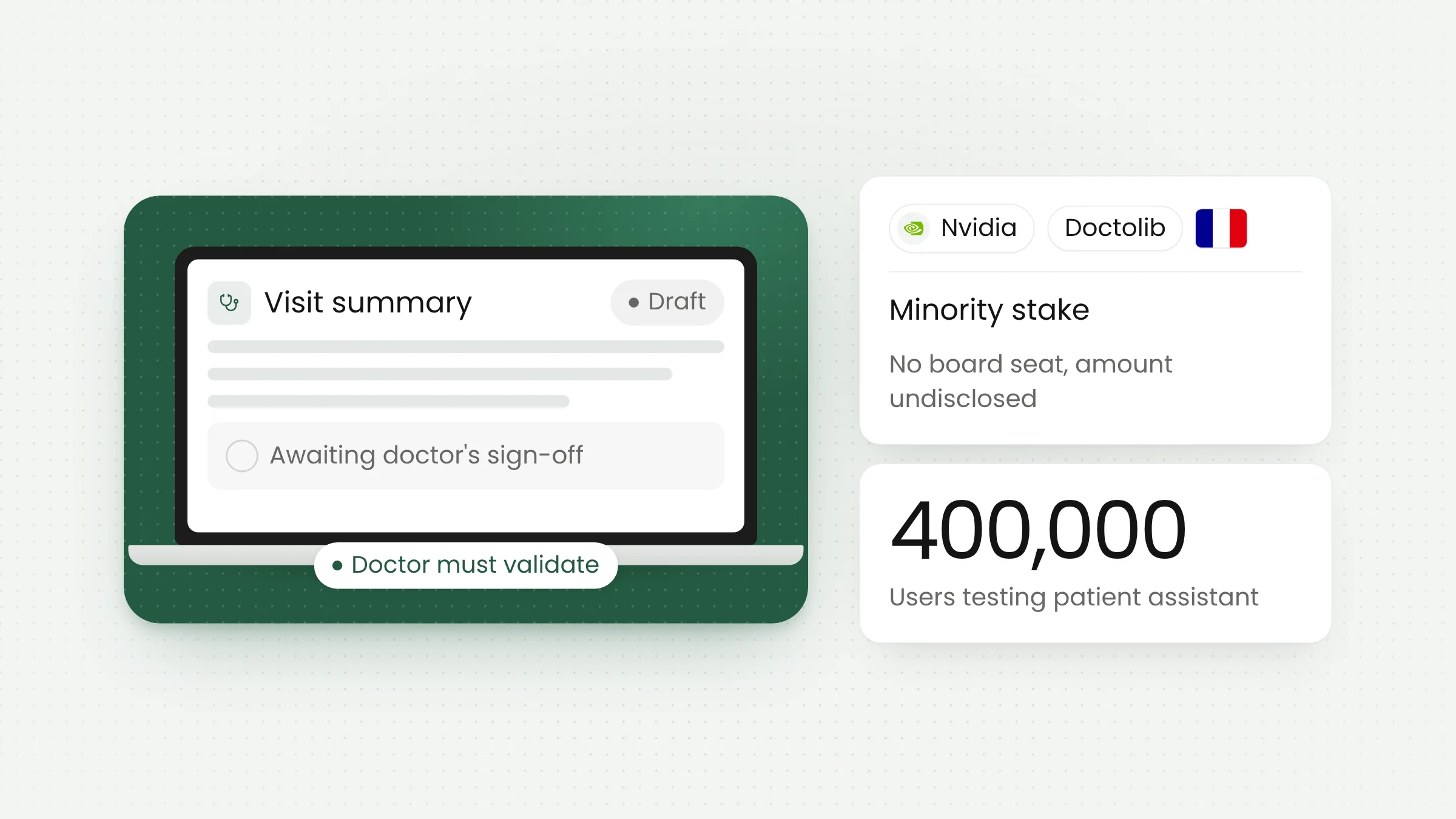
Huang, Nvidia’s CEO, announced the stake at a press conference in Paris during a European tour. According to the AFP news agency, Nvidia will hold a minority stake with no seat on Doctolib’s board, which Doctolib CEO Stanislas Niox-Château confirmed. No amount was given. Doctolib’s last valuation was reported at about 3.6 billion euros.
On the same day, AFP reported, Nvidia also announced stakes in three French startups: Genesis AI (robotics), Pigment (business planning software), and Entalpic (AI for discovering chemical materials). Huang said Nvidia invested at least $8 billion in Europe last year and plans to add $2 billion this year.
Nvidia is widening its European footprint in other ways too. AFP noted that in September Nvidia said it would take control of Hugging Face, a Franco-American AI platform, for $12.9 billion. The Doctolib stake strengthens ties with a company that, according to Next, has used Nvidia technology for about a year to design its own AI models.
Doctolib is the platform patients use to book appointments and clinicians use to run their practices. According to e-sante.fr, it serves about 100 million patients and 580,000 health professionals across several European countries.
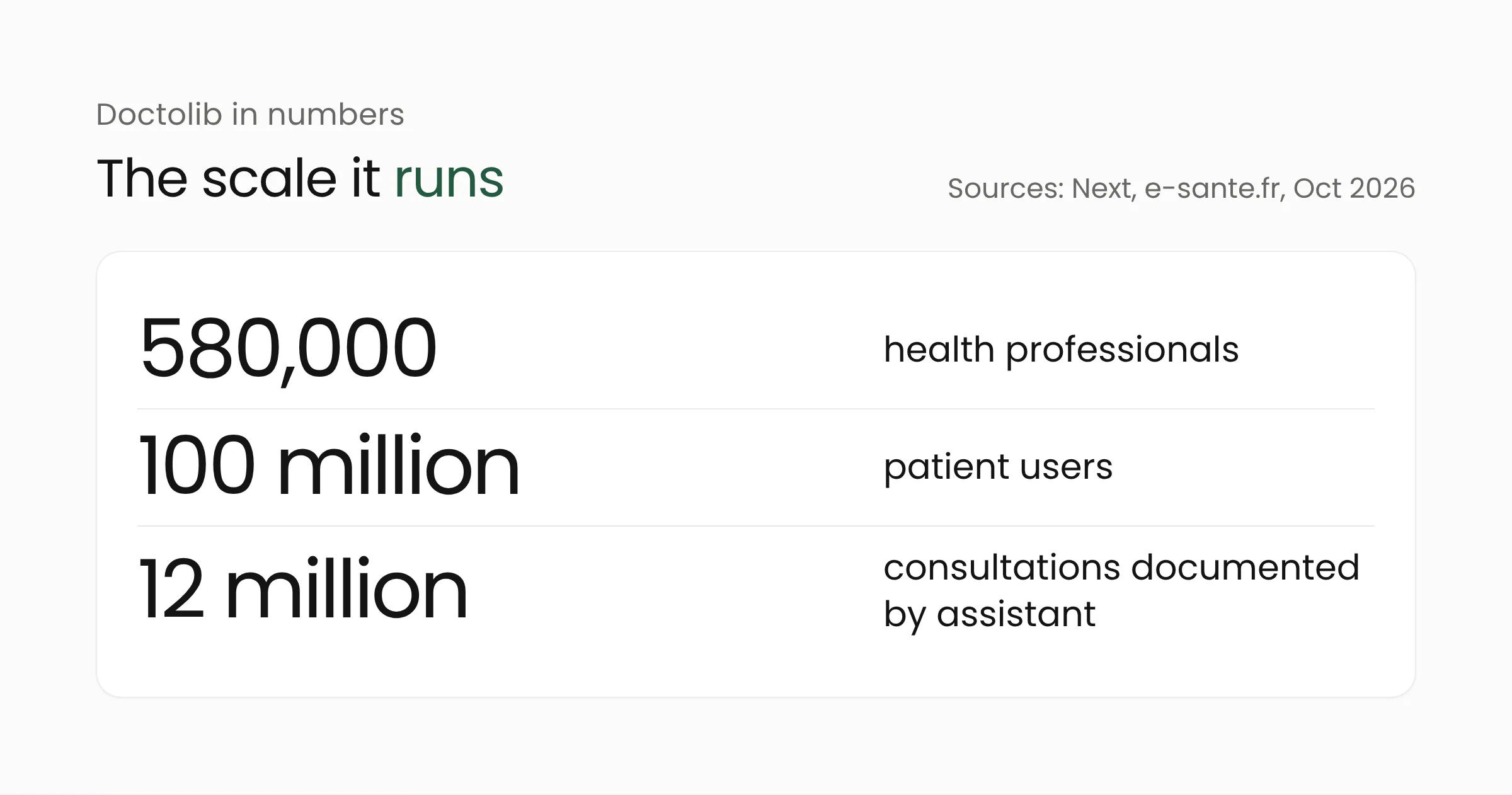
Niox-Château said the funds will go toward faster hiring and development of Doctolib’s own AI models. Next reports that Nvidia experts will support the roughly one hundred scientists, engineers, and designers building Doctolib’s AI products. Doctolib also said it will invest more in the European infrastructure that runs those models.
Three AI assistants in development
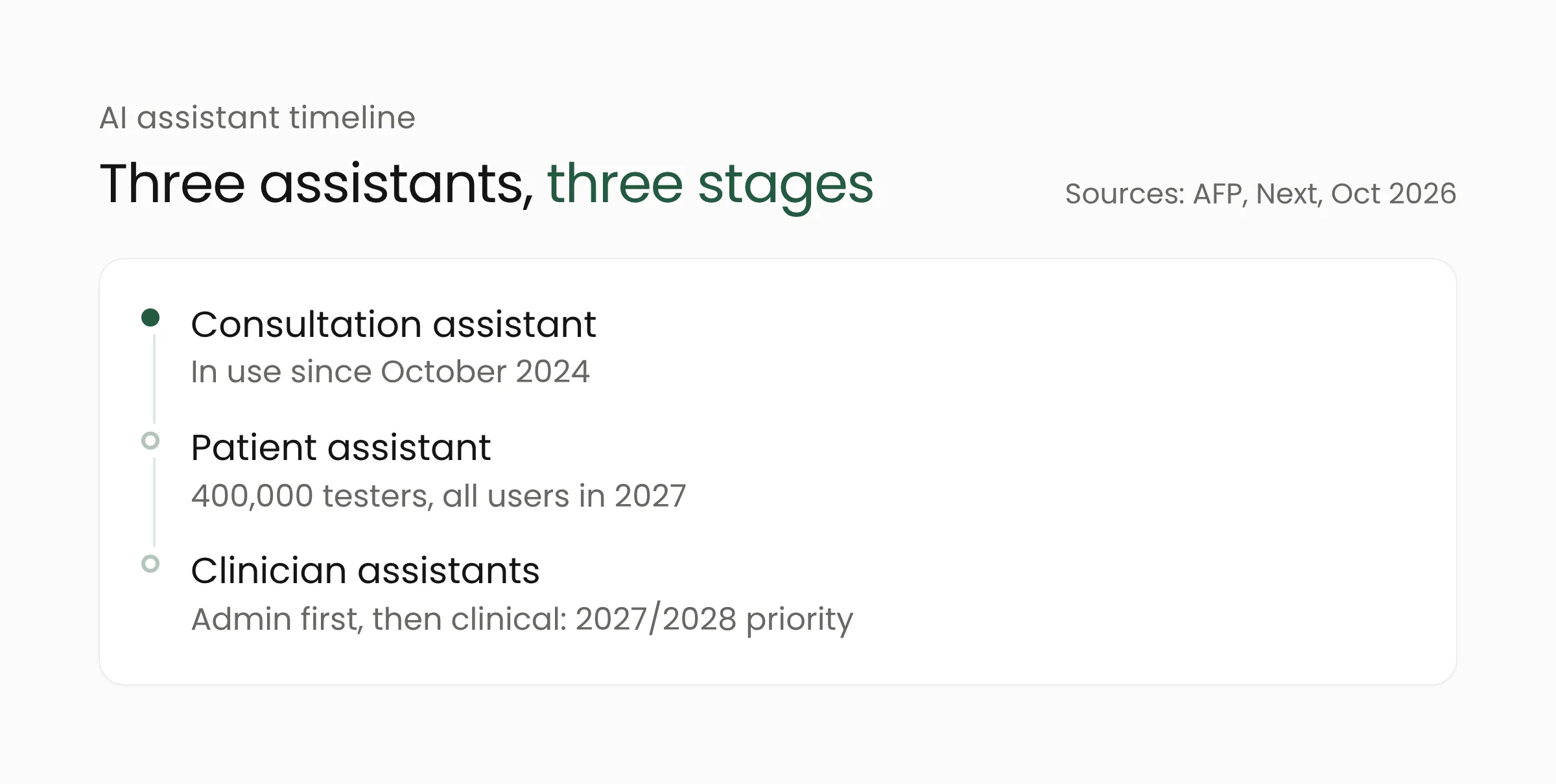
Based on reporting by Next and e-sante.fr, Doctolib is working on three groups of assistants, each at a different stage.
The first is the consultation assistant, launched in October 2024. It helps doctors document the conversation with a patient and draft a summary. Next says it relies on a French-language speech recognition model with medical vocabulary and has documented more than 12 million consultations. According to e-sante.fr, the clinician must check and validate the summary before it enters the medical record.
The second is a personal assistant for patients. Next reports it is being tested by 400,000 users in France and is planned for all users in 2027. E-sante.fr says it is meant to provide health information and support patients through their care pathway.
The third covers assistants for health professionals. Next lists billing, secretarial work, document management, and medical coding. Niox-Château told AFP that tools for administrative and then clinical tasks are a major priority for 2027 and 2028.
Patient data and sovereignty
Doctolib frames the investment around sovereignty. Niox-Château told AFP the company will use Nvidia chips and open software to build a sovereign AI trained on Doctolib’s own models and data and controlled by Doctolib. The company also says it will speed up work on open-weight and open-source models.
An open-weight model is one whose parameters can be accessed by outsiders. According to e-sante.fr, that does not mean its training data is public or that privacy is automatically protected. The distinction matters when a vendor uses the word “open” in marketing.
Several outlets pointed to the other side of the story. Next wrote that a direct Nvidia investment raises questions about sovereignty and data handling. In August, AFP reported, Doctolib launched a scientific research program using personal data from its 50 million users, and the program drew criticism, including from the Ligue des droits de l’Homme. Next also noted that in June Doctolib said it did not hand user data to major US AI companies.
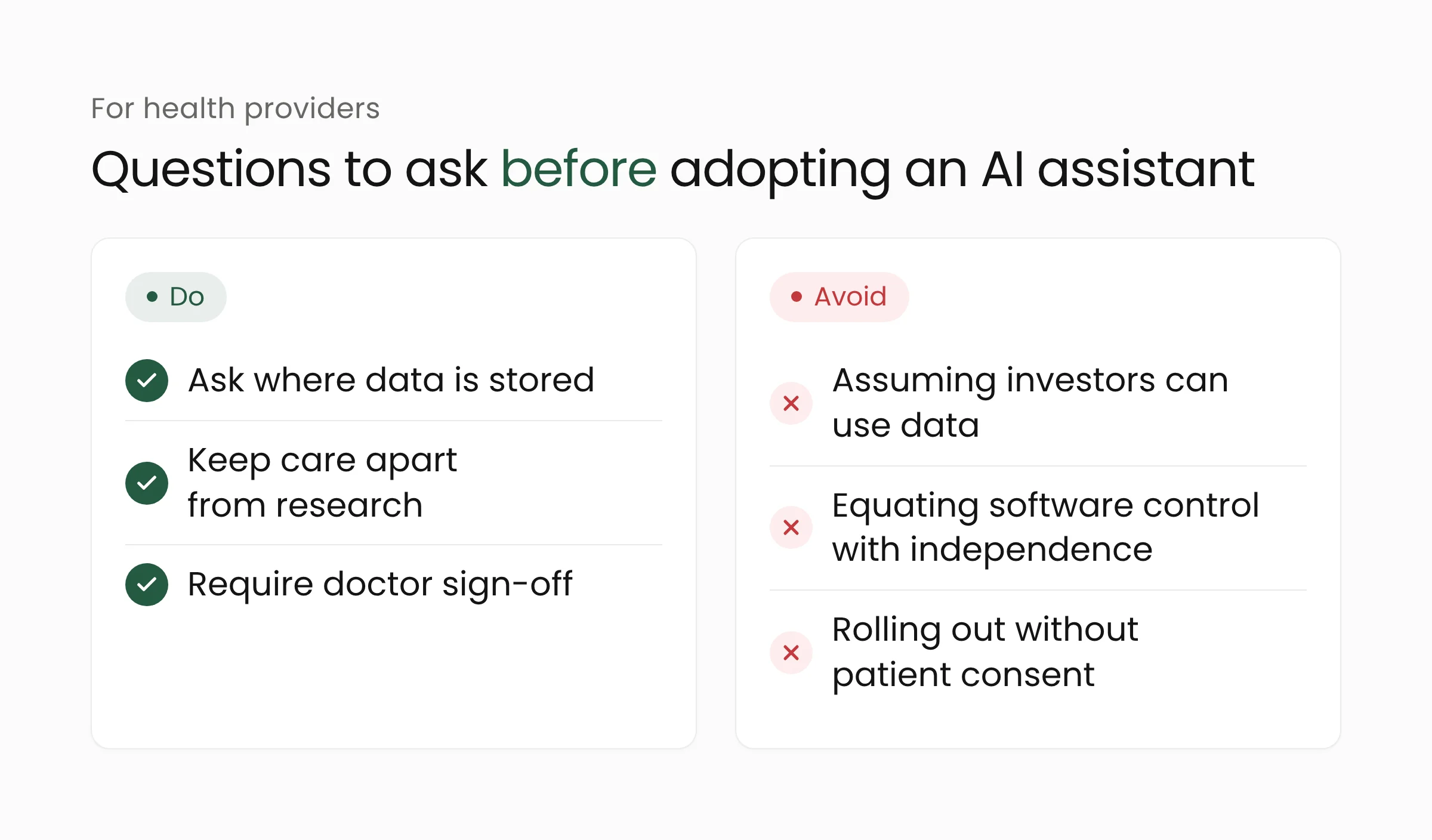
E-sante.fr offers several cautions, which are the author’s own analysis rather than any party’s statement. An investor’s arrival does not by itself authorize use of medical records. Using personal health data to develop AI must follow a specific framework covering purpose, security, and individuals’ rights. Controlling the software does not mean independence from hardware suppliers, and Nvidia is one of them. Hosting data in the EU and UK is also not an absolute guarantee, because who can access the data, for what purposes, and through which subcontractors still has to be answered.
Doctolib says its models meet the highest standard of medical accuracy. That is the company’s claim, and the reports reviewed do not point to an independent evaluation.
What this means for hospitals and clinics
Doctolib operates in Europe, and the sources do not mention plans for Indonesia. Even so, the direction is relevant to health facilities elsewhere: health software providers are racing to build AI assistants into the workflows of doctors and patients, and chip suppliers are joining as investors.
Facilities weighing a similar assistant, from a foreign or local vendor, can put a few questions to the vendor first. Where is patient data stored, and who can access it? Is service data kept apart from data used for research, and can patients opt out? Does a doctor always review and sign off the AI-written summary before it enters the medical record, as with Doctolib’s consultation assistant?
The legal side is clear. Indonesia’s Law Number 27 of 2022 on Personal Data Protection treats health data as specific personal data, so handling it requires a lawful basis, consent, and adequate safeguards. Working with an AI vendor does not shift that responsibility away from the facility that collects the data.
On the technical side, an AI assistant is only as good as the data it receives. Facilities whose records are already well kept and connected to national systems are better placed to try such tools. Our article on SATUSEHAT EMR and JKN claims covers hospital readiness for the national electronic medical record.
Start with low-risk tasks, such as tidying administrative notes, before touching clinical summaries. Involve doctors and medical records staff from the beginning and test with a small group. Track how many summaries doctors have to correct, because that number is more honest than any vendor claim.
Frequently asked questions
How much is Nvidia investing in Doctolib?
It has not been disclosed. Neither company gave a figure, and AFP reported only that Nvidia will hold a minority stake with no board seat.
Are Doctolib’s AI assistants available to all users?
Not yet. The consultation assistant for doctors has been in use since October 2024, while the patient assistant is being tested by 400,000 users in France and is planned for all users in 2027, according to Next.
Do doctors still review what the AI produces?
Yes, for the consultation assistant. According to e-sante.fr, the clinician must check and validate the summary before it enters the medical record.
Closing
Nvidia’s move into Doctolib shows that competition over health AI now involves chip suppliers, service platforms, and data regulators at once. Health facilities that want to try AI for documentation, appointments, or patient services can talk to the Merakit team through the healthcare solutions page, and explore the artificial intelligence and cloud computing services for their data infrastructure needs.
Sources
- Next: NVIDIA entre au capital de Doctolib, Entalpic, Genesis AI et Pigment, 13 October 2026
- e-sante.fr: Doctolib et Nvidia, ce que leur alliance pourrait changer pour les patients, 14 October 2026
- Sud Radio (AFP): Le géant américain Nvidia entre au capital du français Doctolib, 13 October 2026
- L’Info Durable (AFP): Le géant américain Nvidia investit dans Doctolib et trois start-up françaises d’IA, 13 October 2026