Blog Data Privacy
Meta Fined €805 Million Over Android Photo Gallery Access
On this page· 7 sections
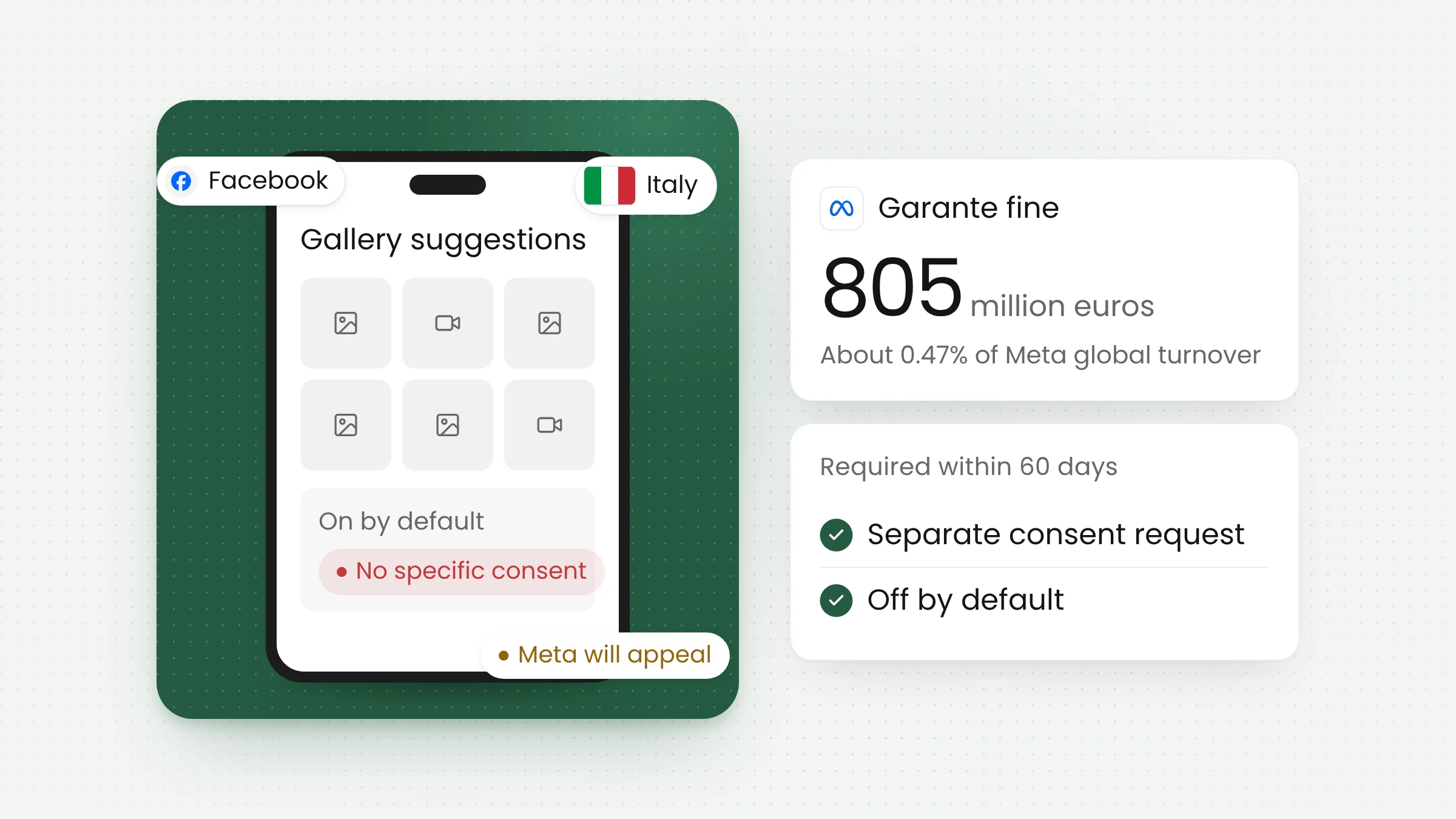
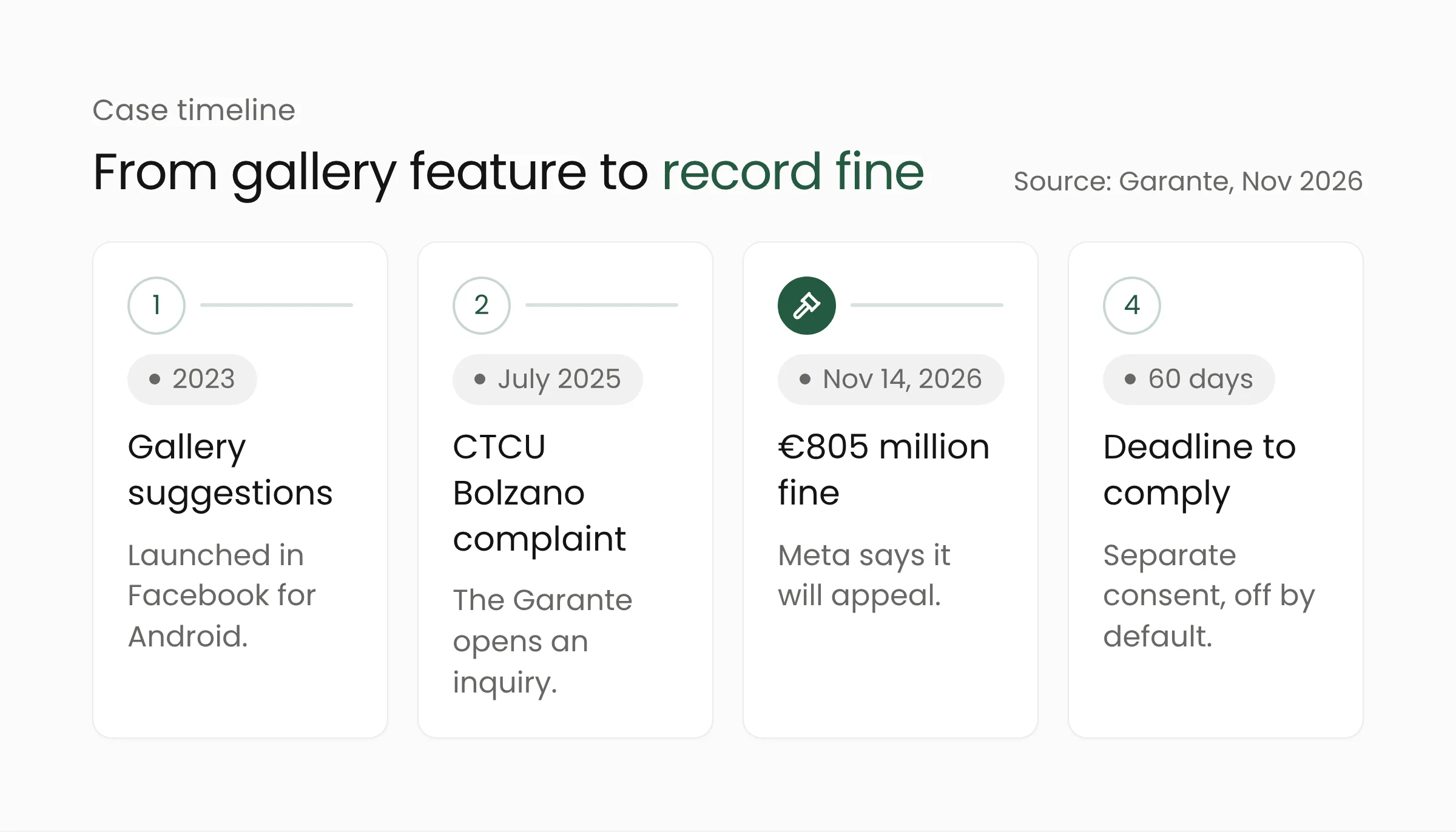
Meta has been fined €805 million by the Garante, Italy’s data protection authority. The regulator said on November 14, 2026 that the Facebook app for Android accessed photos, videos and metadata on Italian users’ phones without specific consent and without telling them clearly what it was doing.
Al Jazeera put the figure at about $887 million and reported that it is the largest fine the Garante has ever imposed. The case turns on something every smartphone user has seen: a single permission prompt. That makes it relevant to any Indonesian organization whose app asks for gallery access.
The gallery suggestion feature at issue
The case centers on a feature called “Get suggestions from gallery when browsing Facebook” (in Italian, Ottieni suggerimenti dalla galleria quando navighi su Facebook). Available since 2023, it suggests photos and videos from the camera roll as post ideas while people scroll.
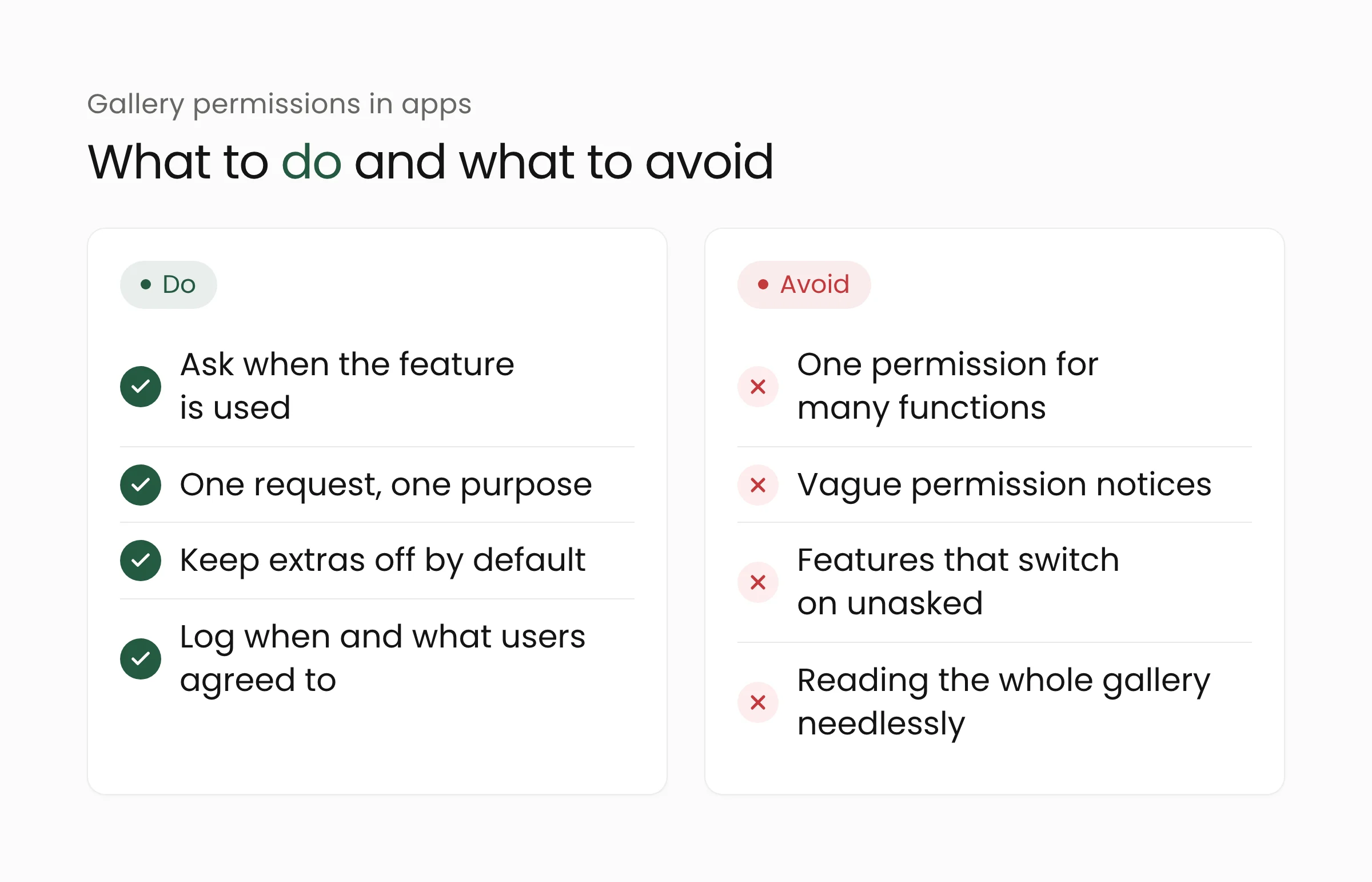
In its official press release, the Garante set out three findings from its technical analysis. Gallery access was requested through a single, app-wide permission that covered several functions with different purposes. The request was preceded by a vague notice that referred only to enabling other functions, so users could not tell they were also switching on gallery suggestions. And the feature was turned on by default.
The regulator also pointed to how broad that permission is. Once fully granted, it lets the app read the device’s entire photo library, generally on a permanent basis. Neither the user nor the authority can verify which data is actually used.
According to Adnkronos, the investigation began in July 2025 after a complaint from the Centro Tutela Consumatori Utenti (CTCU), a consumer protection group in Bolzano.
The legal basis and how the fine was set
The Garante relied on Article 122 of the Italian Privacy Code, which implements the EU ePrivacy Directive. In the authority’s view, a smartphone is part of a person’s private sphere, so any access to its contents requires free and informed consent, whether or not data leaves the device and whether or not harm results.
That choice of law also settled who had jurisdiction. Meta’s lawyers argued that the case belonged with Ireland’s data protection authority, since the fined entity, Meta Platforms Ireland Limited, is based there. The argument relied on the GDPR’s one-stop-shop mechanism. The Garante rejected it, noting that the ePrivacy rules contain no such mechanism.
The fine equals roughly 0.47% of the Meta group’s worldwide turnover. The Garante listed four aggravating factors:
- the large number of people involved, about 20 million Android users in Italy;
- a violation that is still ongoing for users who have not updated the app or who already granted access;
- a previous 2019 decision against the company;
- limited cooperation during the investigation.
Changes Meta made after the complaint counted in its favor, though the Garante said they came late and only reach users who update the app.
Beyond the fine, Meta has 60 days to ask for consent through a separate request specific to this feature. The request must explain what the feature does, that it needs gallery access, and how to switch it off. The feature must also stay off by default, including for users who previously granted permission. If Meta misses the deadline, the feature cannot run for anyone who has not given valid consent. Meta must report its initial steps within 30 days and adopted measures within 90 days.
Two questions sit outside this case. The proceedings did not examine whether gallery content is used to train AI models, which Meta denies. The Garante will also assess separately a newer feature, launched in 2026, that processes gallery content in the cloud. We covered the wider question of personal data in AI training in our piece on AI developers’ commitments to the UK regulator.
Meta’s response
Meta said it will appeal. In a statement reported by the Italian outlet Open, a spokesperson said the company strongly disagrees with the Garante’s assessment of the facts and its application of the law, and considers the fine disproportionate. Meta described the feature as a simple tool that helps people post photos and videos.
The company added that users must grant a device permission before the feature works and can change it at any time. That goes to the heart of the dispute. Users do grant the Android system permission, but the Garante found that the request never explained that the same access would also feed gallery suggestions. The appeal will test those two positions.
How Android limits photo access
For developers, the case shows the gap between a technically valid permission and legally valid consent. Android already offers narrower options.
Since Android 13, photo and video access has used the READ_MEDIA_IMAGES and READ_MEDIA_VIDEO permissions. Android 14 added Selected Photos Access, which lets users share only specific photos and videos with an app. Android Developers documentation recommends the photo picker, the system’s built-in selection screen. With it, an app receives only the files the user chooses and does not need to request storage permissions at all.
Google Play has tightened its rules as well. Under its Photo and Video Permissions policy, apps may request broad media access only when their core functionality depends on it, such as gallery or media management apps. Other apps are expected to use a system picker. Full compliance became mandatory for all developers on May 28, 2025.
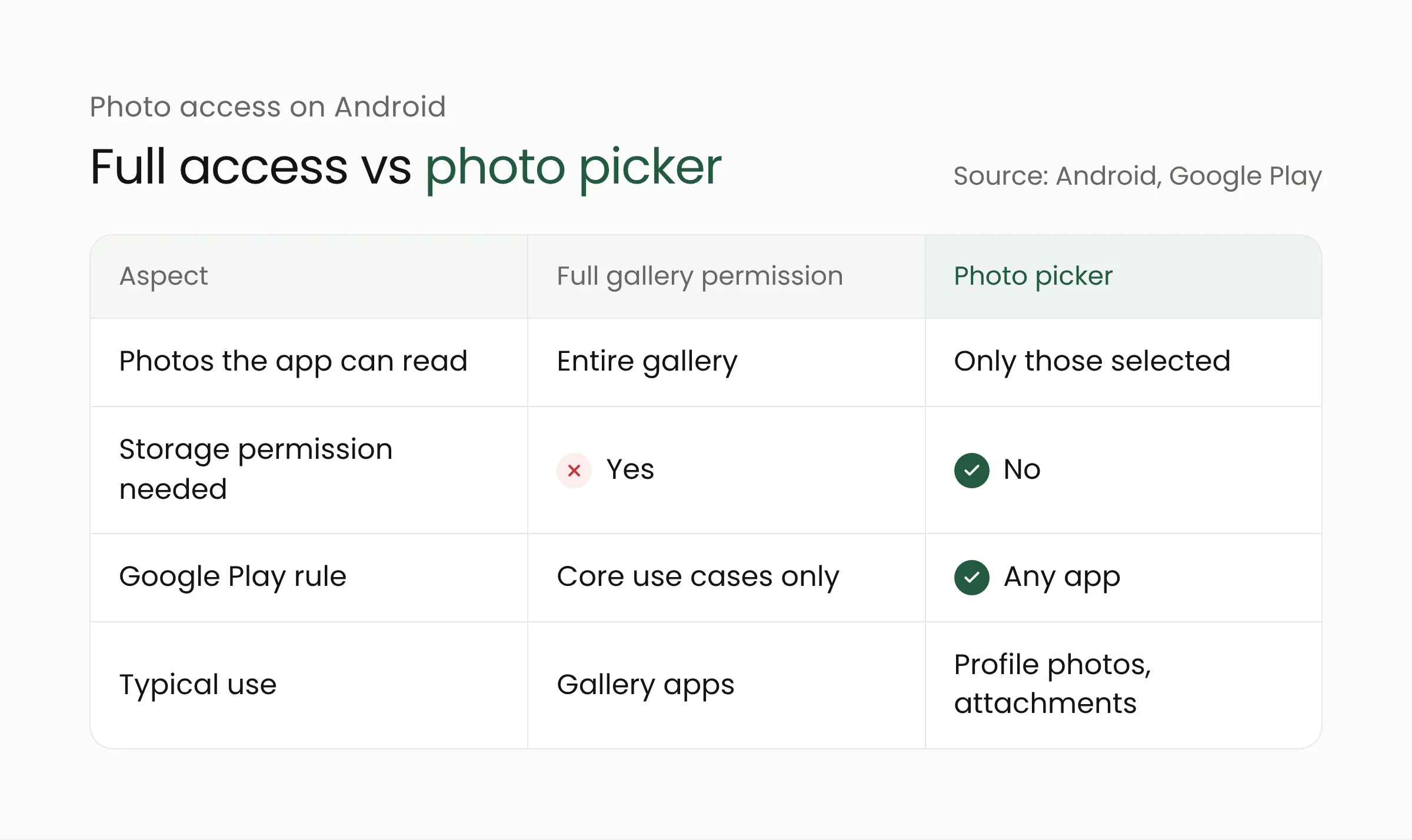
An app that only receives the photos a user picks also holds less data to explain, protect and answer for.
What this means for organizations that run apps
The Garante’s decision applies in Italy, but its logic lines up with Indonesia’s Undang-Undang Nomor 27 Tahun 2022 tentang Pelindungan Data Pribadi (Law No. 27 of 2022 on Personal Data Protection, or the PDP Law), available in full on Pasal.id. Article 20 requires data controllers to have a legal basis for processing, including explicit, valid consent for one or more specific purposes. Article 22(4) adds that when a consent request also covers other purposes, it must be clearly distinguishable, easy to understand and written in simple language. Consent that fails those tests is void by law.
Controllers that breach their obligations face administrative sanctions, including fines of up to 2% of annual revenue under Article 57(3). The stakes are higher because phone galleries often hold photos of ID cards, prescriptions, lab results or payment receipts. Some of that falls under the law’s category of specific personal data, such as health data and personal financial data.
Banks, hospitals, online stores and government agencies with their own apps can start with these steps:
- Map every permission the app requests. List each permission in the Android manifest and iOS settings, along with the feature and purpose behind it. Remove any permission without a clear owning feature.
- Use the system photo picker where possible. Profile photos, attachments and payment receipts rarely need more than the photo picker.
- Separate consent by purpose. Precede each system prompt with an in-app explanation that names the feature and how to turn it off. Do not reuse one permission for other functions without telling users.
- Keep optional features off by default. Anything that reads personal data beyond the app’s main job should wait for users to switch it on.
- Keep a record of consent. The PDP Law recognizes written or recorded consent, so log the time, the version of the wording and the user’s choice.
- Reach users on older versions. The Garante treated the violation as ongoing for people who had not updated the app, so permission changes should come with a fresh consent request.
This review touches design, code and consent wording at once, so cybersecurity and mobile app development teams should work on it together from the design stage, especially for banking, health and public service apps.
Frequently asked questions
Are Facebook users in Indonesia affected by this decision?
The Garante’s order binds Meta only with respect to users in Italy. Meta has not announced whether it will change the gallery suggestion feature worldwide. Users elsewhere can still change Facebook’s permissions in their phone’s settings.
Are gallery photos used to train Meta’s AI?
The Garante stressed that the case did not cover AI training, and Meta denies using gallery content for that purpose. The cloud-based gallery processing feature launched in 2026 will be assessed by the Garante separately.
How can I limit an app’s access to my gallery on Android?
On Android 14 and later, users can choose to allow access to selected photos and videos only when an app asks for permission. Permissions that have already been granted can be changed at any time in the phone’s app permission settings.
Closing thoughts
Meta’s €805 million fine grew out of something that looks minor: one gallery permission used for more than one purpose, and a feature that switched on without being asked. Meta will appeal, but the regulator’s direction is clear. Consent needs to be specific to each function, and apps should ask for the narrowest access they need.
Merakit Indonesia can help review the permissions, consent flows and data storage in your app so they line up with the PDP Law. Get in touch to discuss what your team needs.
Sources
- Facebook: il Garante Privacy sanziona Meta per 805 milioni di euro, Garante per la protezione dei dati personali, November 14, 2026
- Italy fines Meta $880m over photo privacy, Al Jazeera, November 14, 2026
- Meta, maxi multa da 805 milioni dal Garante Privacy, Open, November 14, 2026
- Meta, multa da Garante Privacy per 805 milioni di euro: il motivo, Adnkronos, November 14, 2026
- Selected Photos Access in Android 14, Android Developers
- Photo and Video Permissions policy, Play Console Help
- Undang-Undang Nomor 27 Tahun 2022 tentang Pelindungan Data Pribadi, Pasal.id