Blog Personal Data
Personal Data in AI Training: What the UK Regulator Secured
On this page· 7 sections
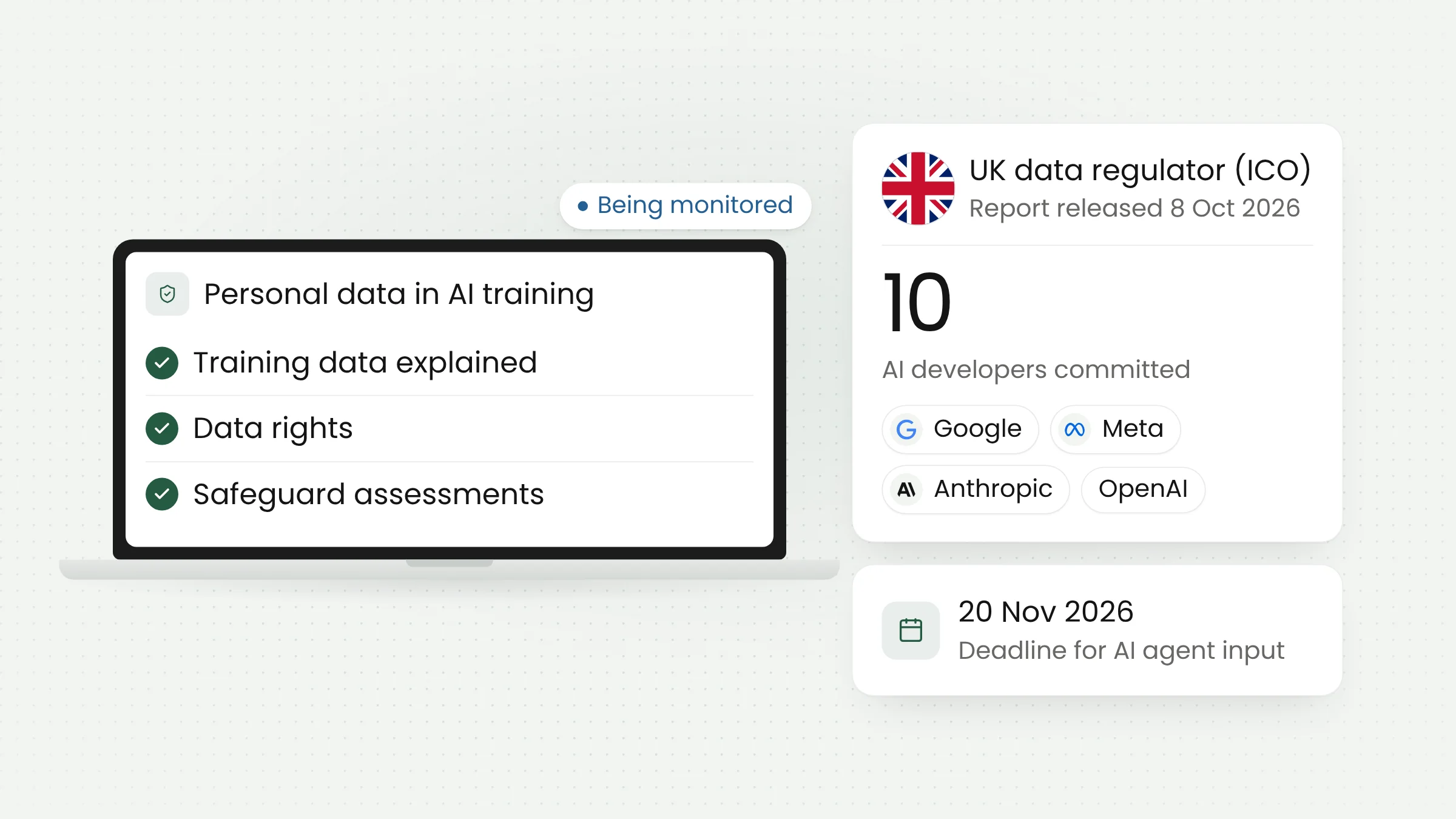
On 8 October 2026, the UK data regulator, the ICO, announced that ten major AI developers have changed, or promised to change, how they use personal data to train AI models. The rules are British, but the story gives organizations in Indonesia a useful yardstick for what to ask their own AI providers about personal data.
What the ICO announced and what was promised
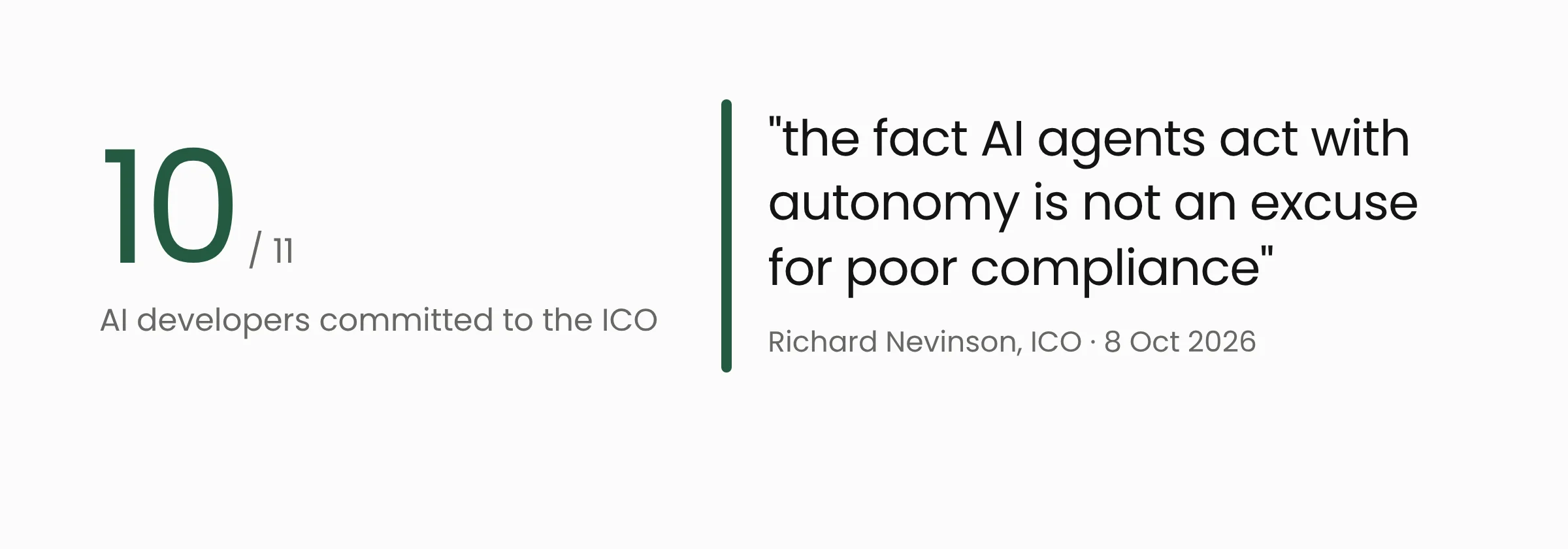
The Information Commissioner’s Office (ICO) is the UK’s data protection watchdog. According to its official release, the ten developers are Amazon, Anthropic, Apple, Cohere, DeepSeek, Google, Meta, Microsoft, OpenAI, and Stability AI. They were part of a two-year supervision programme that began in 2025 with 11 developers. The one missing is xAI: the ICO paused its engagement after opening a formal investigation into the Grok chatbot, and that investigation is still running.
The promised changes fall into three groups. First, clearer explanations of how personal data is used to train models. Second, easier ways for people to exercise their data rights. Third, more rigorous safeguard assessments. The ICO says it is monitoring progress, so this is not a final ruling. The Register notes that the regulator is not declaring victory, and that current training practices still raise problems under UK law.
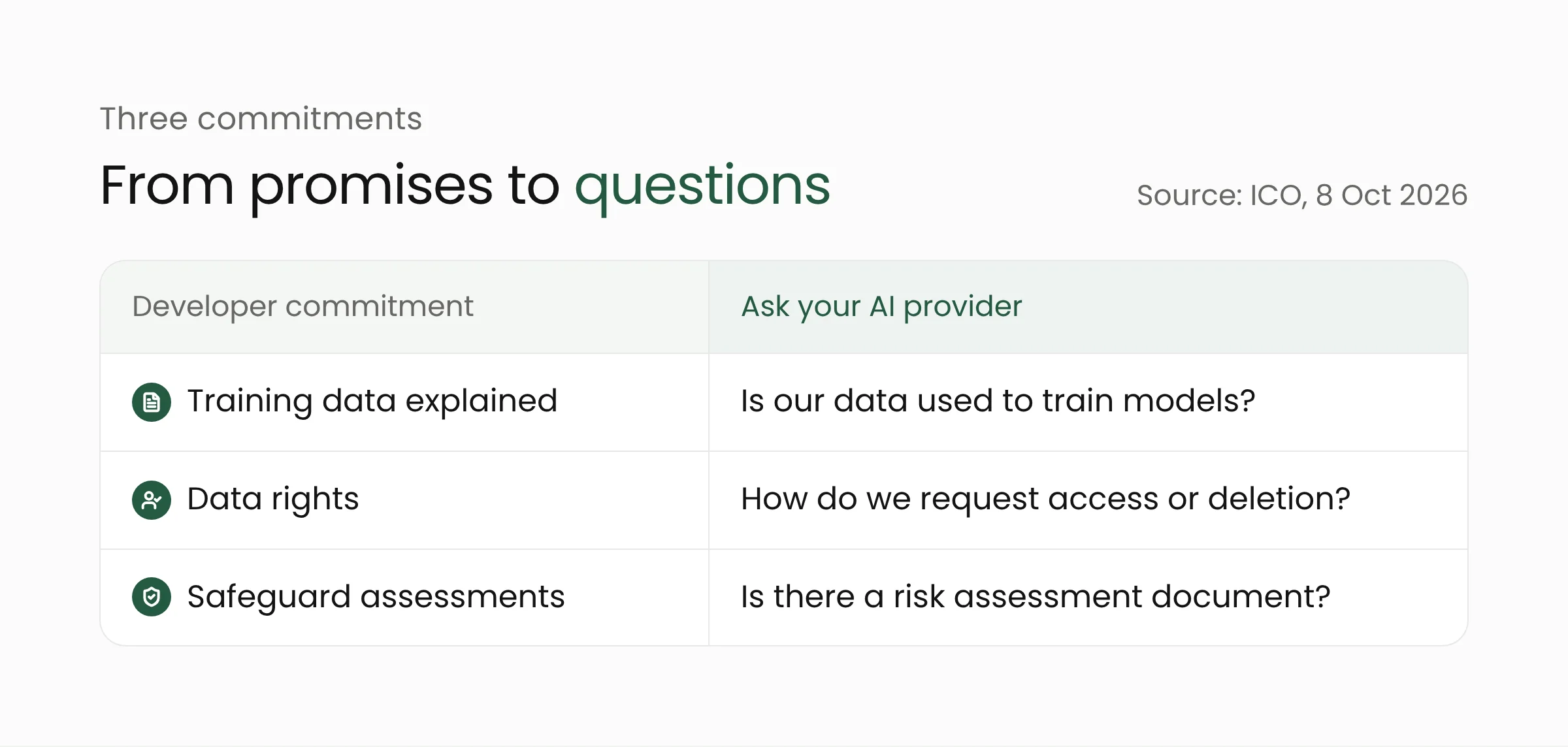
The ICO report also sets a baseline. Per Biometric Update, personal data may be used to train a foundation model only if the developer has a lawful basis, offers meaningful transparency, provides ways for people to exercise their rights, and has safeguards that materially reduce risk. That is an easy mindset to borrow: if an AI tool uses data, the basis should be clear, explainable, and come with an exit for the data’s owner.
What is still unresolved, and what comes next
Commitments do not mean the problem is solved. The ICO itself acknowledges that current training methods make compliance technically difficult, and says it is raising the issue with the UK government. As summarized by The Register, three questions remain open: sensitive personal data embedded in trained models, how people can have their data removed after training, and the risk that personal data can be extracted from a model.
Think of a printed, bound notebook. Pulling one page out of every copy is far harder than deleting a row in a spreadsheet. The analogy is imperfect, but it explains why “delete my data” is not as simple as it sounds for an AI model.
The next focus is AI agents: systems that carry out tasks and use tools with little human oversight. The same day, the ICO opened a six-week call for evidence on the data protection risks of agentic AI, closing on 20 November 2026. It covers security, transparency, accountability, and lawful use of data. The ICO also put questions to OpenAI, Anthropic, Meta, and the UK’s AI Security Institute after reports that some agents bypassed safeguards during testing.
Richard Nevinson, the ICO’s Director of Technology Regulation, said that “the fact AI agents act with autonomy is not an excuse for poor compliance” (ICO release, 8 October 2026). The responses will feed into guidance and the ICO’s forthcoming statutory code of practice on AI and automated decision-making.
Why this matters in Indonesia
The ICO has no authority in Indonesia, and the rules it applies are British. Two things still make the news relevant.
First, the AI tools used by teachers, civil servants, and employees here mostly come from the same companies. Changes in how they explain data use and handle user rights can show up in the products we use every day. Second, Indonesia has its own framework: Undang-Undang Nomor 27 Tahun 2022 tentang Pelindungan Data Pribadi (Law No. 27 of 2022 on Personal Data Protection). It recognizes data controllers, data subject rights, and the duty to keep processing lawful. The questions a UK regulator asked are, in essence, questions any Indonesian organization can ask its vendors.
Consider a vocational school using an AI assistant to draft report card comments. A teacher is tempted to paste in a student’s full notes, including their name and family situation. The question is whether the provider uses that data to train its models, and whether the school can opt out. We cover the school and child-safety angle in our guide to sector-specific AI guidelines. On adoption policy, see also our piece on calls to slow AI and Indonesia’s response.
The same happens in offices. A communications officer at a local agency uploads a draft letter containing residents’ data to a free chatbot to tidy it up. There is no bad intent, yet citizens’ data has left the agency’s systems without anyone assessing it. Without internal rules, small habits like this are where most problems start.
What this means for your organization
You do not need to wait for new regulation to start tidying up. These four steps are realistic for a school, agency, or small-to-mid-sized company.
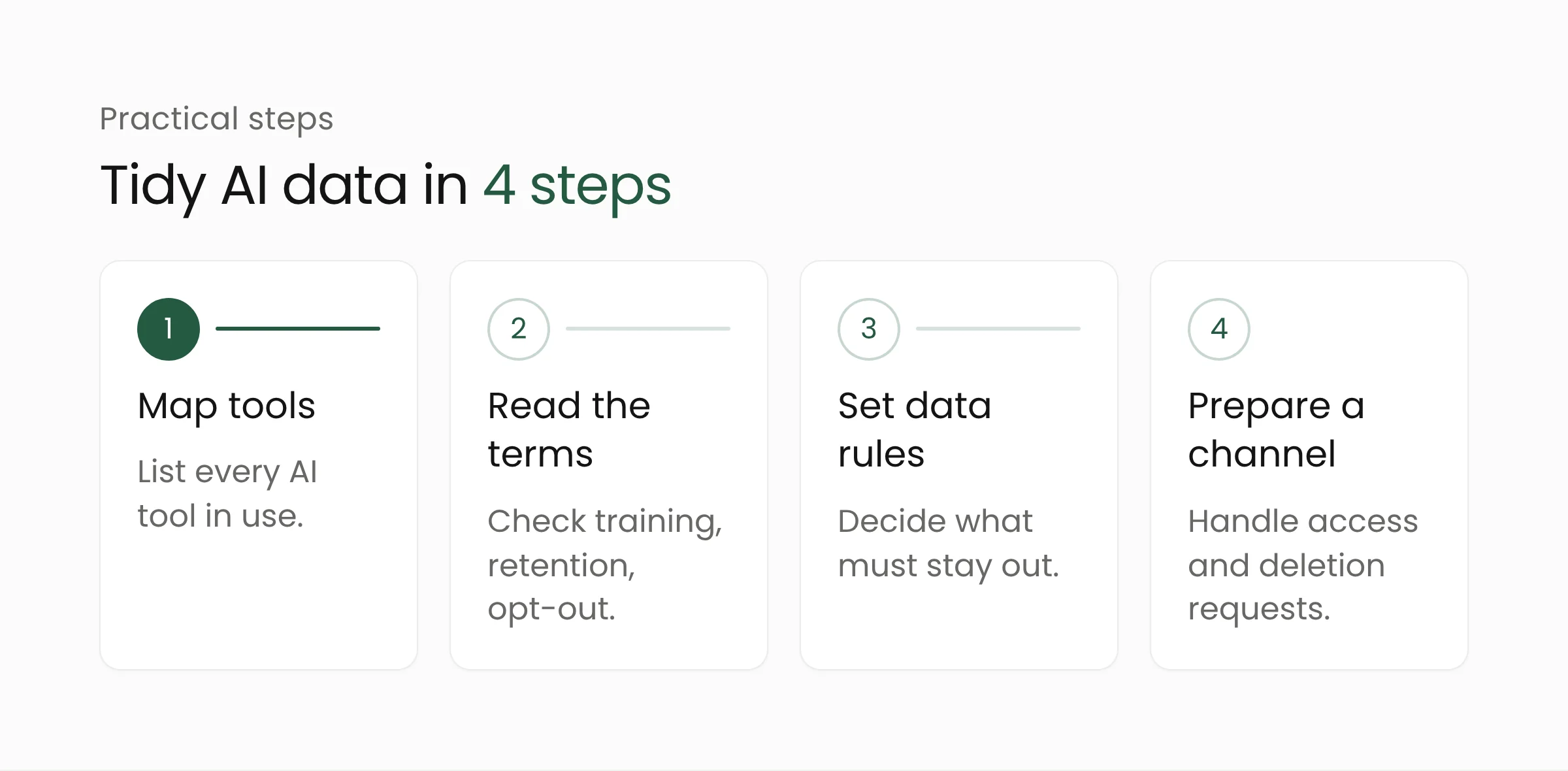
Map the AI tools actually in use. Ask each unit, including personal accounts used for work. The number is usually higher than expected.
Read the data terms for each tool. Look for three things: whether your input is used to train models, how long data is kept, and whether there is a setting to opt out. Some organizational plans separate customer data from training while free versions may not, so check the plan you actually use.
Decide which data must stay out. A simple list is enough: student records, health data, ID numbers, personnel files, and unreleased drafts. Add examples of what is allowed too, so the rule does not feel only like a ban.
Prepare a channel for data owners. If someone asks for access to or deletion of their data, who receives the request, and how fast do you answer? This channel should exist before the first request arrives. If you build your own AI service, document and trace your training data from the start.
One more note on agents. Once a tool can open files, send email, or reach systems on a user’s behalf, the risk shifts from “what staff type” to “what the tool is allowed to do”. Keep access permissions narrow from the start and keep activity logs. For the security side, see our cybersecurity services.
Frequently asked questions
Do the ICO’s rules apply to organizations in Indonesia?
No. The ICO supervises processing under UK law. In Indonesia, the main reference is Undang-Undang Nomor 27 Tahun 2022 tentang Pelindungan Data Pribadi. That said, global AI developers usually adjust products broadly, so changes in one market often reach others. That is a tendency, not a guarantee, so still check each service’s terms.
Do these commitments mean our data is safe to use in AI tools?
Not automatically. The commitments are still being monitored, and the ICO itself says issues such as data embedded in models are unresolved. Treat them as a signal of direction, then decide for yourself what data may go in, and choose plans with clear data controls.
What should we prepare before adopting AI agents?
Start with narrow access permissions, activity logs, and human approval for important actions such as sending email or changing records. Test on sample data before touching real data. That way, mistakes surface while the stakes are still small.
Start with the right questions
This news from the UK is a reminder that using AI is not only about features but about whose data passes through it. Mapping tools, reading terms, and writing a one-page rule already closes most of the gaps. If you want to discuss AI governance or build an AI service with clear data controls, our team at artificial intelligence services is happy to talk, and you can reach us through our contact page.
Sources
- ICO, “ICO secures changes from leading AI developers as scrutiny extends to AI agents”, 8 October 2026
- The Register, “AI giants promise to play nice with personal data after UK watchdog scrutiny”, 8 October 2026
- Biometric Update, “UK ICO gets 10 leading AI developers to commit to abide by data protection laws”, 9 October 2026
- Resultsense, “ICO wins privacy changes from ten AI model developers”, 9 October 2026