Blog Cybersecurity
NGINX2Root Flaw CVE-2026-123007: How to Patch nginx Today
On this page· 7 sections
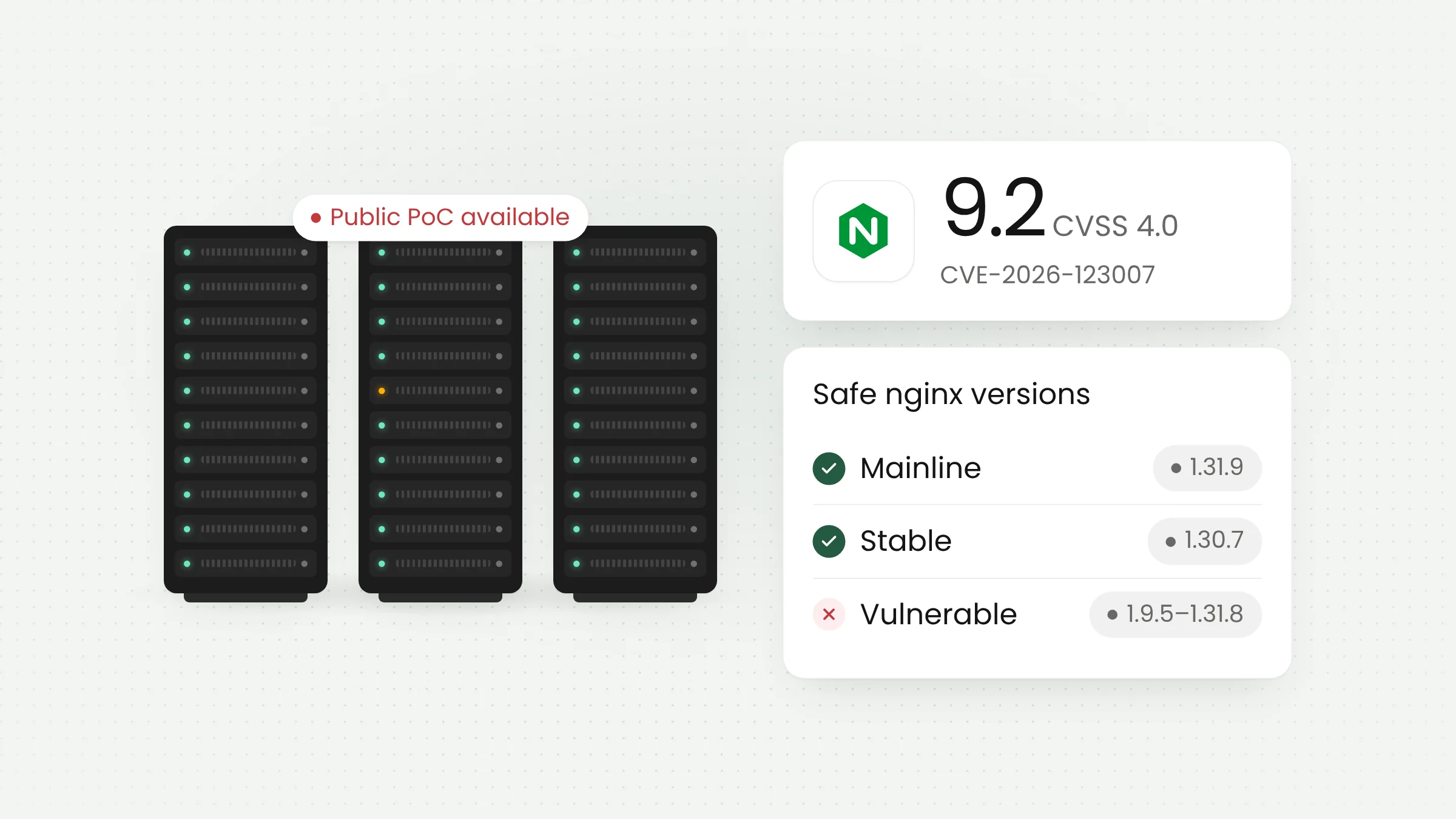
The NGINX2Root flaws in nginx let an unauthenticated attacker run commands on a web server over an HTTP/2 connection. The most serious one, CVE-2026-123007, is rated 9.2 on CVSS 4.0. nginx shipped fixed versions 1.31.9 and 1.30.7 on November 18, 2026, and Rapid7 published exploit code on GitHub the same day.
Five flaws behind the NGINX2Root name
NGINX2Root is the name security research firm Xint gave to five flaws in nginx, the web server and reverse proxy that sits in front of a large share of websites and applications. According to Xint’s technical write-up, the flaws were found on October 11, 2026, reported to nginx maintainer F5 through HackerOne on October 16, and disclosed alongside the fixed releases on November 18.
The most serious flaw, CVE-2026-123007, sits in HTTP/2 flow control, the mechanism that regulates how much data each side may send. An arithmetic error there causes nginx to copy data past the end of an allocated memory buffer. The vulnerable code dates back to nginx 1.9.5, the 2015 release that first added HTTP/2, so almost every version in use today is affected. Xint says one of its researchers found CVE-2026-123007 while preparing for the ZeroDay Cloud 2026 competition, and its automated scanner found the other four.
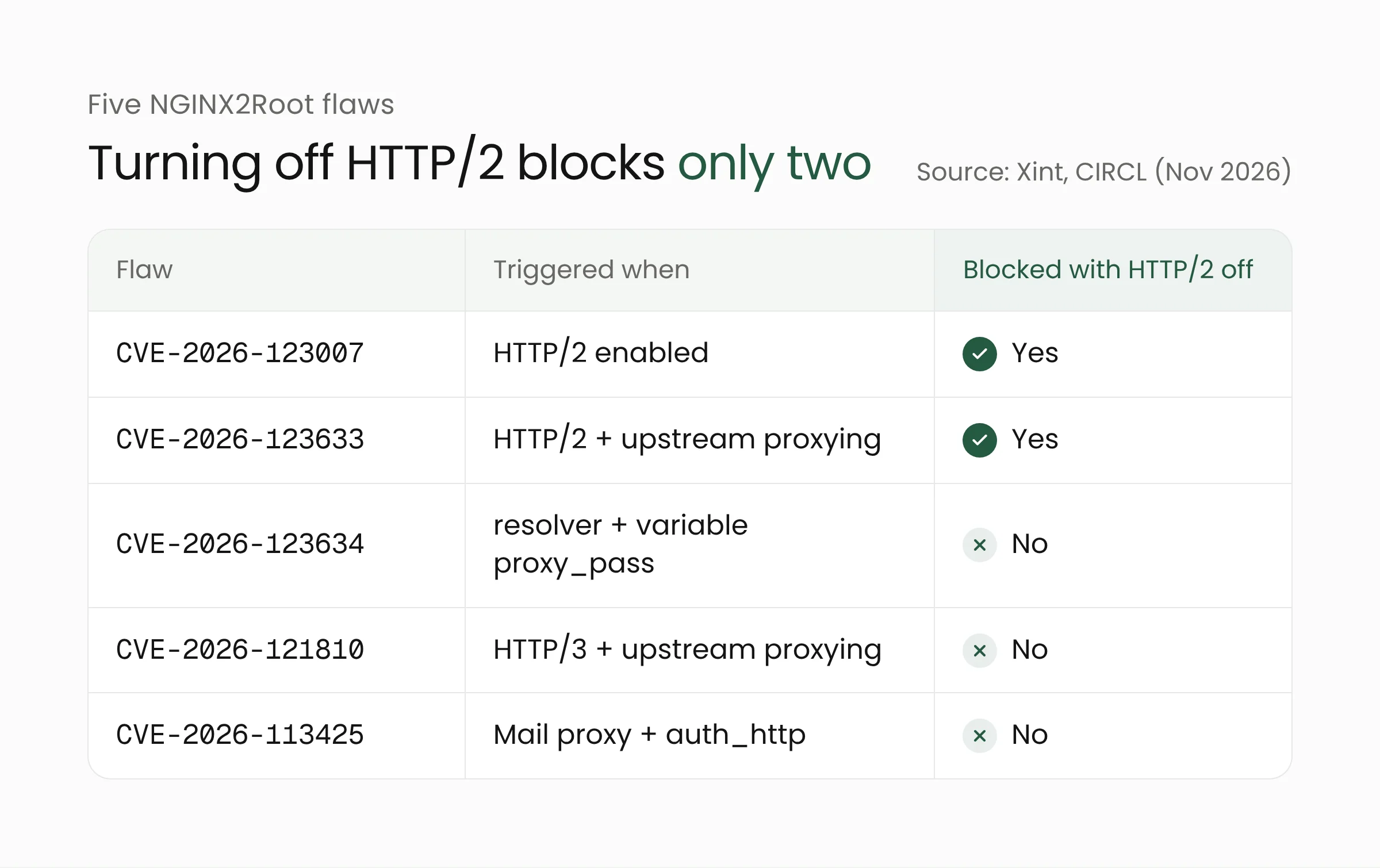
The remaining four flaws depend on specific configurations. CVE-2026-123633 requires HTTP/2 with requests forwarded to a backend (upstream) server. CVE-2026-123634 sits in the DNS resolver when the proxy_pass destination is built from variables. CVE-2026-121810 involves HTTP/3 with upstream proxying, and CVE-2026-113425 affects the mail proxy module when it uses auth_http.
From worker process to root
A successful exploit gives the attacker the privileges of an nginx worker, the process that handles visitor requests. Those privileges are usually limited. Xint, however, also found a bug in the Linux kernel’s SCTP module, present since kernel 4.15 (2018), which according to CIRCL’s report had no CVE number as of November 18, 2026. Chained with any of the nginx flaws, the kernel bug can lift the attacker to root, including from inside a Docker container in Xint’s tests. That chain is where the NGINX2Root name comes from.
Affected nginx versions and fixed releases
The nginx security advisories page lists CVE-2026-123007 as “major” severity, with versions 1.9.5 through 1.31.8 vulnerable. The safe versions are 1.31.9 on the mainline branch and 1.30.7 on the stable branch. The November 18 releases fix ten CVEs in total, including the five NGINX2Root flaws.
F5 scores the flaw 9.2 on CVSS 4.0 and 8.1 on CVSS 3.1. Both figures also appear on Ubuntu’s CVE page, which rates the priority as high. The two scores come from different scoring methods, and both describe an attack that works over the network without credentials.
On the commercial side, The Hacker News reports that F5 released NGINX Plus 37.3.0.1 and 37.0.8.1. No fix is listed for NGINX Plus R34 through R36.
Linux distribution packages lag behind
Many servers install nginx from their operating system packages. As of November 18, 2026, Ubuntu marked its nginx package as vulnerable on every release from 16.04 to 26.10. The Debian security tracker also lists bookworm, trixie, forky, and sid as unfixed. According to a live update page by Precursor Security, Alpine 3.24 was the first distribution to ship a fixed package (1.30.7-r0), while the official nginx Docker images had already moved to 1.31.9 and 1.30.7.
Distributions often backport fixes into older versions without changing the number shown by nginx -v. To confirm a server is patched, check the full package revision against your distribution’s advisory.
Exploitation status after the Rapid7 PoC
Rapid7 published a proof of concept (PoC), code that demonstrates the flaw can be exploited, for CVE-2026-123007 on GitHub on November 18. According to its repository notes, the PoC was demonstrated against nginx 1.31.8 in a freshly started Docker container. It is likely to fail if the server is handling many clients, if earlier requests have left its memory layout disordered, or if bandwidth is insufficient. The Hacker News notes that Rapid7’s version needs roughly 128 GB of HTTP/2 traffic.
As of November 18, 2026, F5, Wiz, and Rapid7 had not reported any attacks in the wild, and the flaw was not in CISA’s Known Exploited Vulnerabilities catalog. CIRCL warns that address space layout randomization (ASLR) is no reason to delay patching, because the researchers have documented ways around it.
The potential exposure is large. Xint counted 56.7 million hosts identified as nginx on the Shodan device search engine as of November 10, 2026. Of the hosts that reported a version number, 98.9% fell within the 1.9.5 to 1.31.8 range. Xint adds that these figures rely on version banners and do not prove every host is vulnerable. Last week a similar HTTP/2 flaw hit another web server, covered in our article on the Apache HTTP/2 flaw CVE-2026-119618.
What this means for web server operators
nginx runs at many layers, from online store websites and local government service portals to university information systems and the API gateways of banks and fintech companies. A single nginx server often fronts several applications as a reverse proxy, so one flaw at this layer can affect every application behind it.
Inventory every running nginx
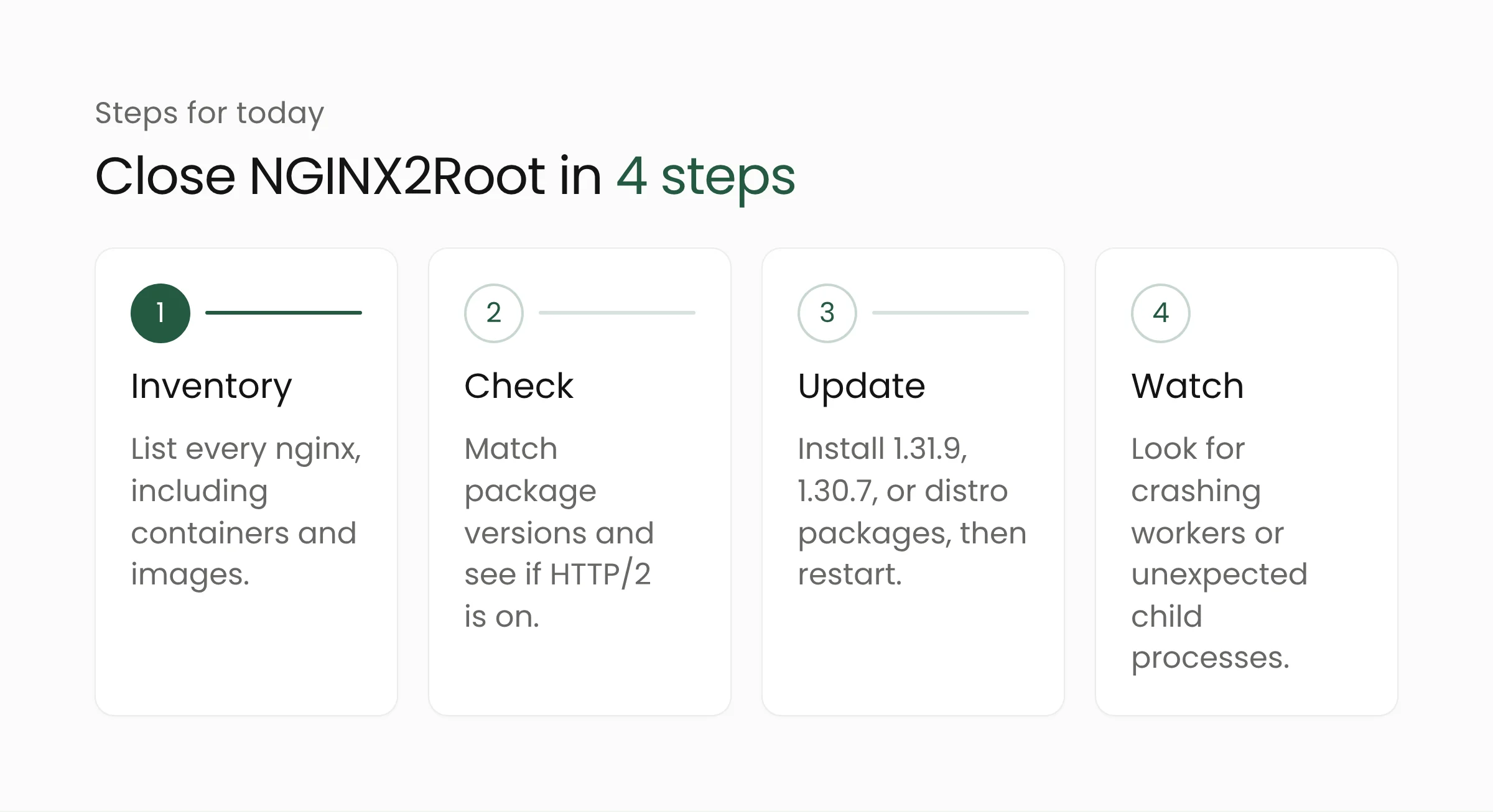
Record every server, virtual machine, and container that runs nginx. Include container images that bundle their own nginx, internal load balancers, and third-party software that ships with nginx. Start with anything reachable from the internet.
Check the version and HTTP/2 status
nginx -v prints the version, and nginx -V shows whether the HTTP/2 module was compiled in. Xint recommends reviewing the active configuration with sudo nginx -T and searching for listen ... http2 or http2 on; directives. For servers behind a CDN, test nginx directly with openssl s_client -alpn h2 as well. For distribution packages, compare the output of dpkg-query or rpm -q nginx with the official advisory.
Update, then restart the service
Install 1.31.9, 1.30.7, or your distribution’s fixed package, then fully restart nginx. CIRCL and Xint both stress that nginx -s reload does not replace the running binary, and old worker processes can keep serving existing connections. For containers, rebuild images on a patched base image and redeploy them.
Temporary mitigation if the update is delayed
If a distribution package is not yet available, disable HTTP/2 on affected listeners. On nginx 1.25.1 and later, set http2 off; and remove http2 from the listen directive. On older versions, remove http2 from listen. This closes only CVE-2026-123007 and CVE-2026-123633, and it can break services that require HTTP/2, such as gRPC. For the other flaws, turn off HTTP/3 if you do not need it, use fixed upstreams instead of variable-based proxy_pass, and restrict mail proxy access to trusted networks. On hosts that do not use SCTP, CIRCL suggests adding install sctp /bin/false to a file in /etc/modprobe.d/.
Watch for signs of an attempted attack
CIRCL lists several signs worth investigating: nginx workers spawning unfamiliar programs, workers exiting unexpectedly (search error.log for “signal 11” or “segfault”), and long-lived HTTP/2 connections with very large inbound traffic but few logged requests. These are heuristics and do not prove an attack on their own. Teams that need help setting up monitoring and a regular patch schedule can start with Merakit’s cybersecurity services.
Frequently asked questions
Is my server safe if HTTP/2 is turned off?
Not necessarily. Turning off HTTP/2 blocks two of the five NGINX2Root flaws. The other three involve the DNS resolver, HTTP/3, and the mail proxy, so updating to 1.31.9, 1.30.7, or a fixed distribution package is still required.
Is a reload enough after updating the package?
No. A reload only rereads the configuration, while the old nginx binary keeps running in memory. Restart the service completely, then confirm that no old worker processes marked “shutting down” are still alive.
Has NGINX2Root been used in attacks?
As of November 18, 2026, no attacks in the wild had been reported, and the flaw was not in CISA’s KEV catalog. That can change quickly now that Rapid7’s PoC is public.
Conclusion
NGINX2Root affects a layer many teams rarely touch because it has seemed stable for years. Start with internet-facing nginx servers, make sure they run 1.31.9, 1.30.7, or a fixed distribution package, and restart the service. If your team wants to move server workloads onto infrastructure that is easier to keep updated, Merakit’s cloud computing team can help plan the move.
Sources
- nginx: Security Advisories and the nginx-1.30.7 and nginx-1.31.9 release announcement (November 18, 2026)
- Xint: NGINX2Root, New Remote Code Execution Vulnerabilities in nginx Require Urgent Patching (November 18, 2026)
- CIRCL TR-105: NGINX2ROOT (November 18, 2026)
- Ubuntu: CVE-2026-123007 (November 18, 2026)
- Debian Security Tracker: CVE-2026-123007 (accessed November 19, 2026)
- The Hacker News: 10-Year-Old NGINX HTTP/2 Flaw Lets Unauthenticated Attackers Execute Code on Servers (November 18, 2026)
- Precursor Security: NGINX2Root live updates (November 18, 2026)
- Rapid7: CVE-2026-123007 PoC on GitHub (November 18, 2026)