Blog Cybersecurity
PHP 8.5.13 Fixes Seven Critical Flaws: What to Update
On this page· 7 sections
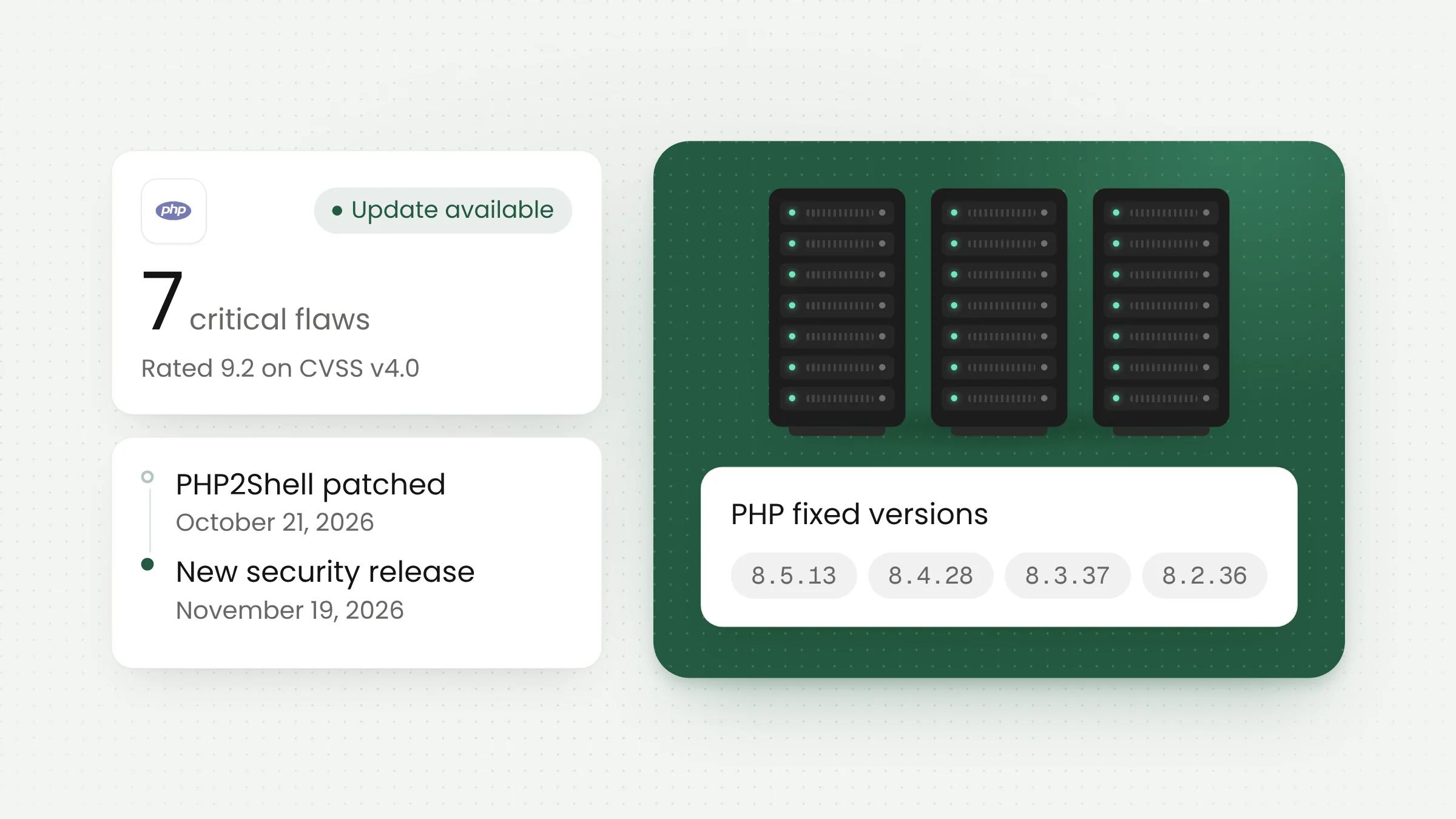
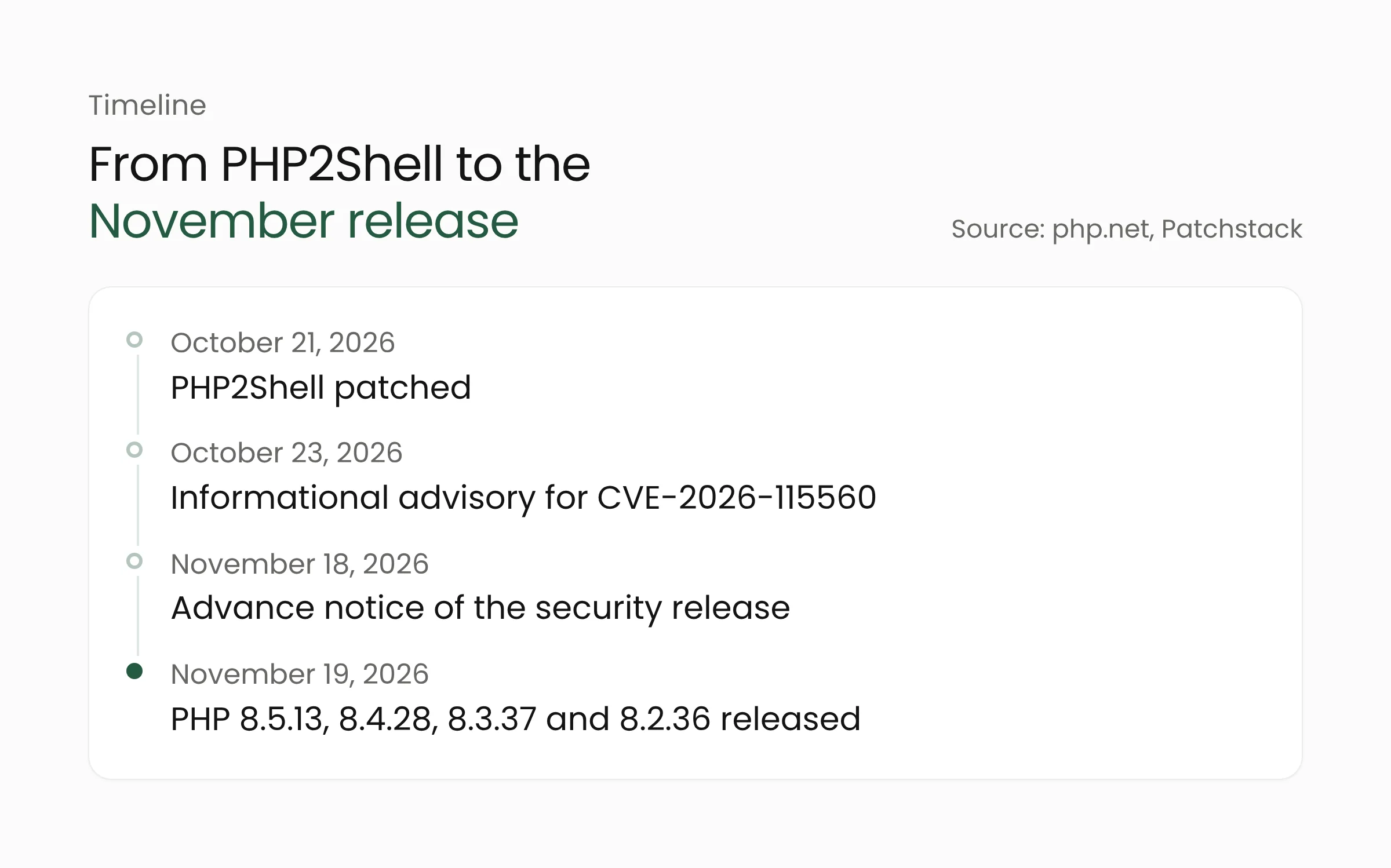
The PHP development team released PHP 8.5.13, 8.4.28, 8.3.37 and 8.2.36 on November 19, 2026. The PHP security release fixes seven critical flaws rated CVSS 9.2, including phpAfterShell (CVE-2026-126714) in session storage. Teams running PHP web servers should schedule the update promptly.
What the November 19 PHP security release contains
The announcements on php.net share one wording per branch. For 8.5: “All PHP 8.5 users are encouraged to upgrade to this version.” PHP 8.6.0, a new major version, shipped the same day, and The Hacker News reports that it carries all of the fixes.
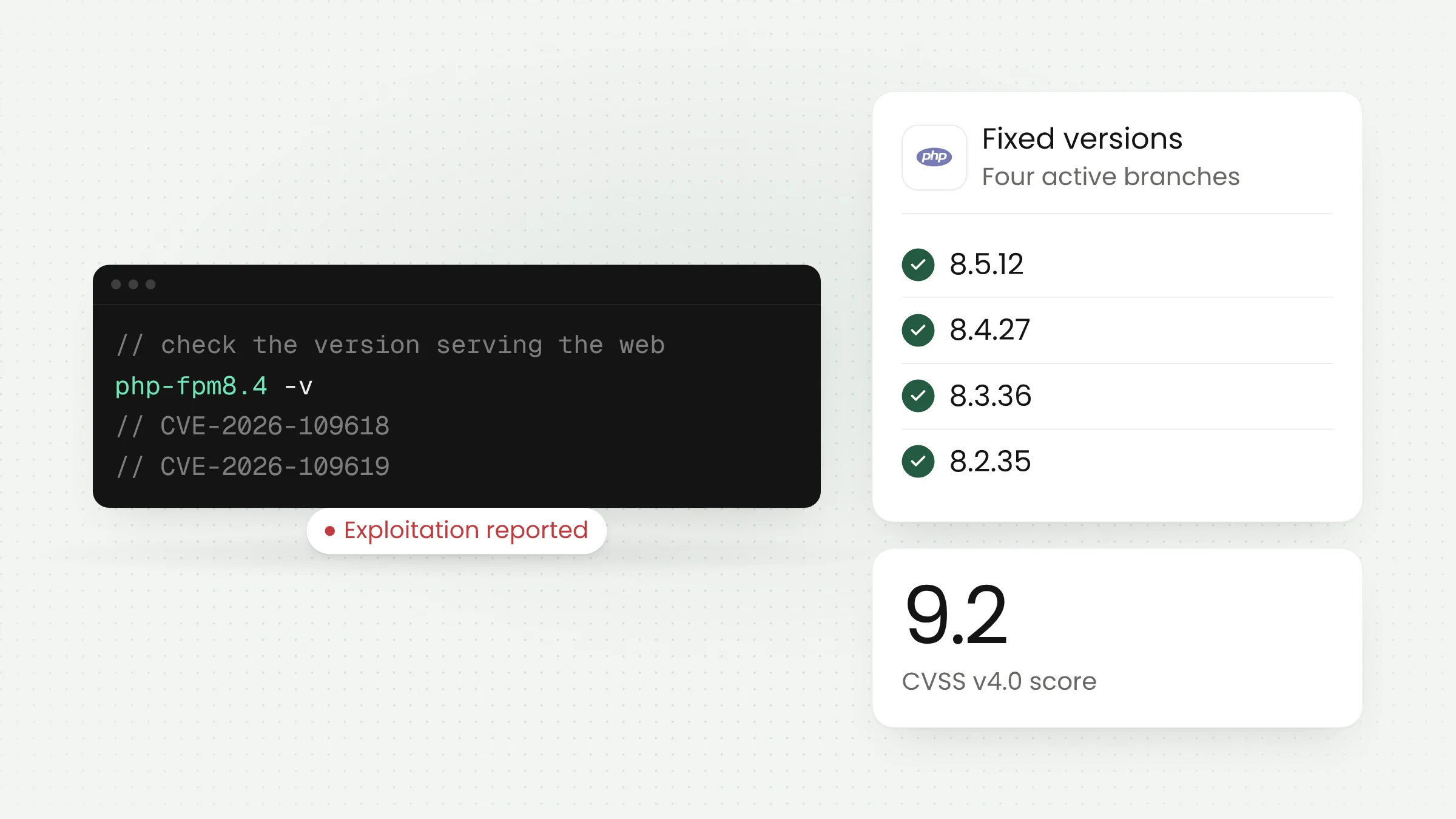
Sources count the fixes differently. Patchstack lists 18 CVEs: 17 with php-src security advisories and one from an upgrade of the bundled uriparser library. Chainguard counts 17, split into 7 critical, 4 high and 6 medium. All seven critical flaws score 9.2 on CVSS v4.0.
The PHP security team gave notice a day earlier that the highest severity would be critical. According to Patchstack, the notice said the critical issues need non-default configurations or uncommon setups.
On October 21, PHP fixed two flaws known as PHP2Shell, covered in our guide to the PHP2Shell patch versions. Two days later PHP published an informational advisory for CVE-2026-115560 and promised a fix in the next release. Chainguard notes that the October update does not cover these issues.
Four critical flaws closest to everyday web servers
Four of the seven critical flaws sit in components that almost every PHP site uses: sessions, PHP-FPM and error logging. Of the other three, The Hacker News reports that CVE-2026-129481 affects branches 8.3 to 8.5, while CVE-2026-129474 and CVE-2026-129182 affect PHP 8.5 only.
phpAfterShell in session files (CVE-2026-126714)
By default, PHP stores session data, such as login state and cart contents, in files on the server. The official PHP advisory explains that an interrupted rewrite can leave a session file holding part of the new data followed by the tail of the old. Read back, that mix can be interpreted as an object the application never intended to create.
Research firm Depthfirst named the flaw phpAfterShell in its research write-up. The advisory says an attacker must be able to influence session contents, interrupt the write at a useful point, and find a chain of application classes that can be abused when the data is read (a gadget chain). The affected code is believed to date back to PHP 4.1.0. The fix empties the session file before the replacement data is written.
Session serializer mismatch (CVE-2026-115560)
The advisory for the second session flaw names two conditions. The upload progress feature (session.upload_progress.enabled) must be on, and the same session data must be written in one format and read in another. That happens when an application changes session.serialize_handler at runtime, or when applications with different settings share a session directory.
The new versions switch upload progress off by default. The advisory warns that an explicit setting in existing configuration still overrides the new default.
Request smuggling in PHP-FPM (CVE-2026-129289)
PHP-FPM is the process manager that runs PHP behind a web server such as nginx. According to its advisory, the flaw can be used when two things are true. The web server keeps its connection to PHP-FPM open for reuse, and the application opens php://input without reading it to the end.
The unread bytes are then parsed as a new request, and an unauthenticated attacker can run PHP code as the worker process. Settings that meet the first condition include fastcgi_keep_conn on in nginx and enablereuse=on with Apache mod_proxy_fcgi. The advisory states that standard nginx and Apache configurations, which close the connection after each request, are unaffected by the demonstrated attack.
Patchstack adds a point for WordPress operators. The WordPress REST API reads php://input on every request, so a site’s exposure comes down to the web server configuration in front of it.
Use-after-free in the timezone cache (CVE-2026-129496)
The fourth flaw comes from how PHP timestamps file-based error logs. Its advisory explains that a warning raised while PHP starts up, for example because of an invalid date.timezone value, can leave a pointer to memory that has already been freed.
Researchers crashed a PHP-FPM worker with a single HTTP request under the default max_input_vars setting. Code execution has only been demonstrated locally, with known memory addresses. The advisory calls a complete remote attack plausible but says it has yet to be fully demonstrated.
One more flaw matters to teams that run containers. CVE-2026-129291 is rated 8.8 and turns access inside a worker into access as the PHP-FPM master process. It requires catch_workers_output, which Patchstack notes is enabled in the official PHP-FPM Docker images.
Fixed versions and exploitation status
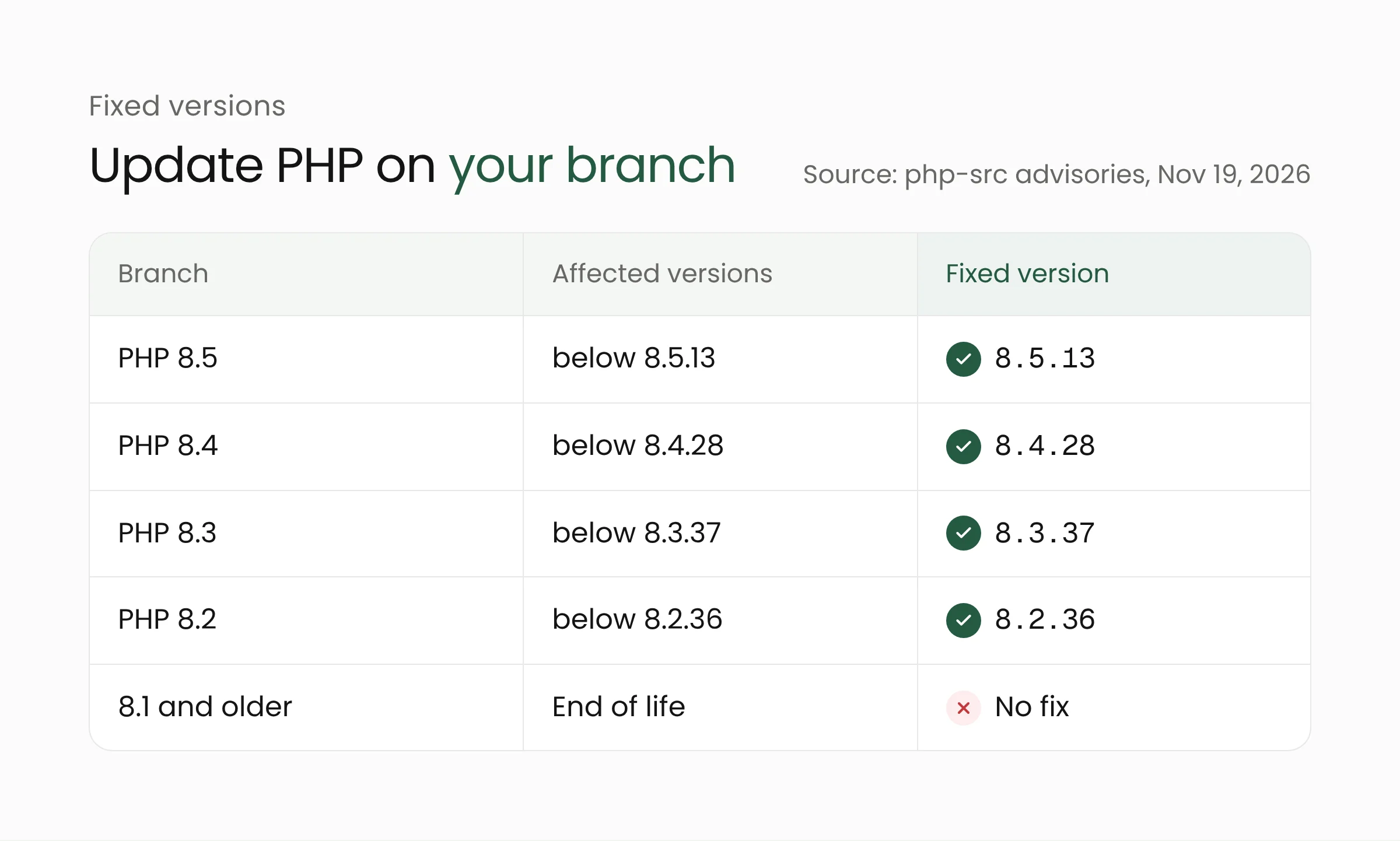
The official advisories list the same fixed versions for all four flaws above: 8.5.13, 8.4.28, 8.3.37 and 8.2.36. Earlier versions on each branch are affected.
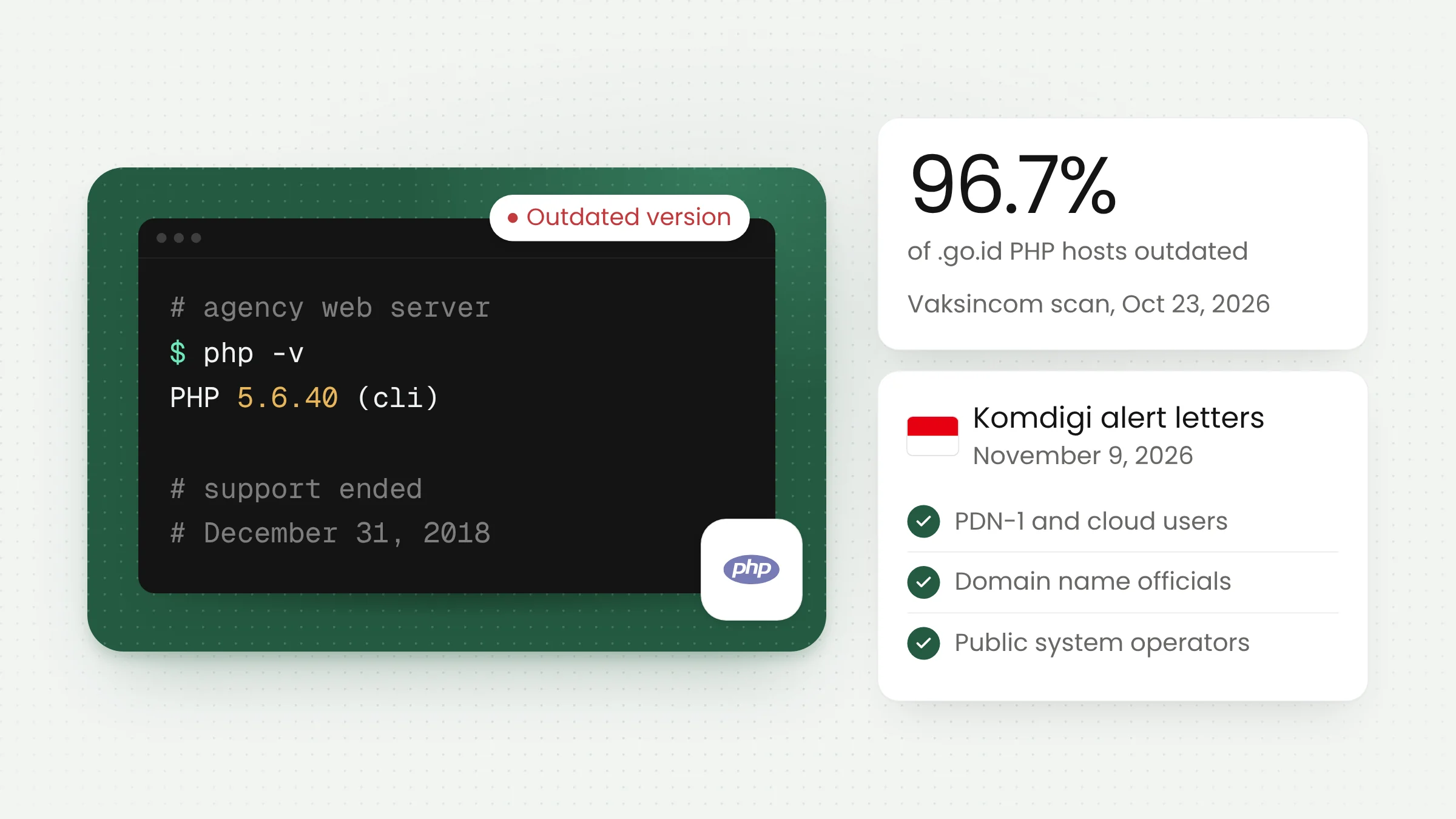
PHP 8.1 and older receive no fixes because they are past end of life. The 8.2 branch is patched this time, but Chainguard notes that its support ends on December 31, 2026. Agencies still running older versions can revisit our report on the Komdigi alert about outdated PHP servers.
No attacks reported as of November 19
SOCRadar wrote that as of November 19, 2026, no attacks using phpAfterShell had been reported and the flaw was absent from CISA’s Known Exploited Vulnerabilities catalog. Patchstack reports no in-the-wild exploitation for any CVE in the release.
The proof-of-concept code Depthfirst published is limited. According to SOCRadar, it only writes a harmless object into a session file. The full attack chain appears only in a video, and Depthfirst is withholding the details for coordinated disclosure.
The two sides describe the requirements differently. Depthfirst says its chain needs no application-defined class, while the PHP advisory says code execution requires a suitable gadget chain in the application. SOCRadar writes that Depthfirst’s claim cannot be confirmed yet. PHP has published no indicators of compromise.
What this means for PHP server administrators
Many online stores, government service portals, clinic registration systems and internal business applications in Indonesia run on PHP. Because most flaws in this release depend on configuration, administrators have two jobs: install the update and review server settings.
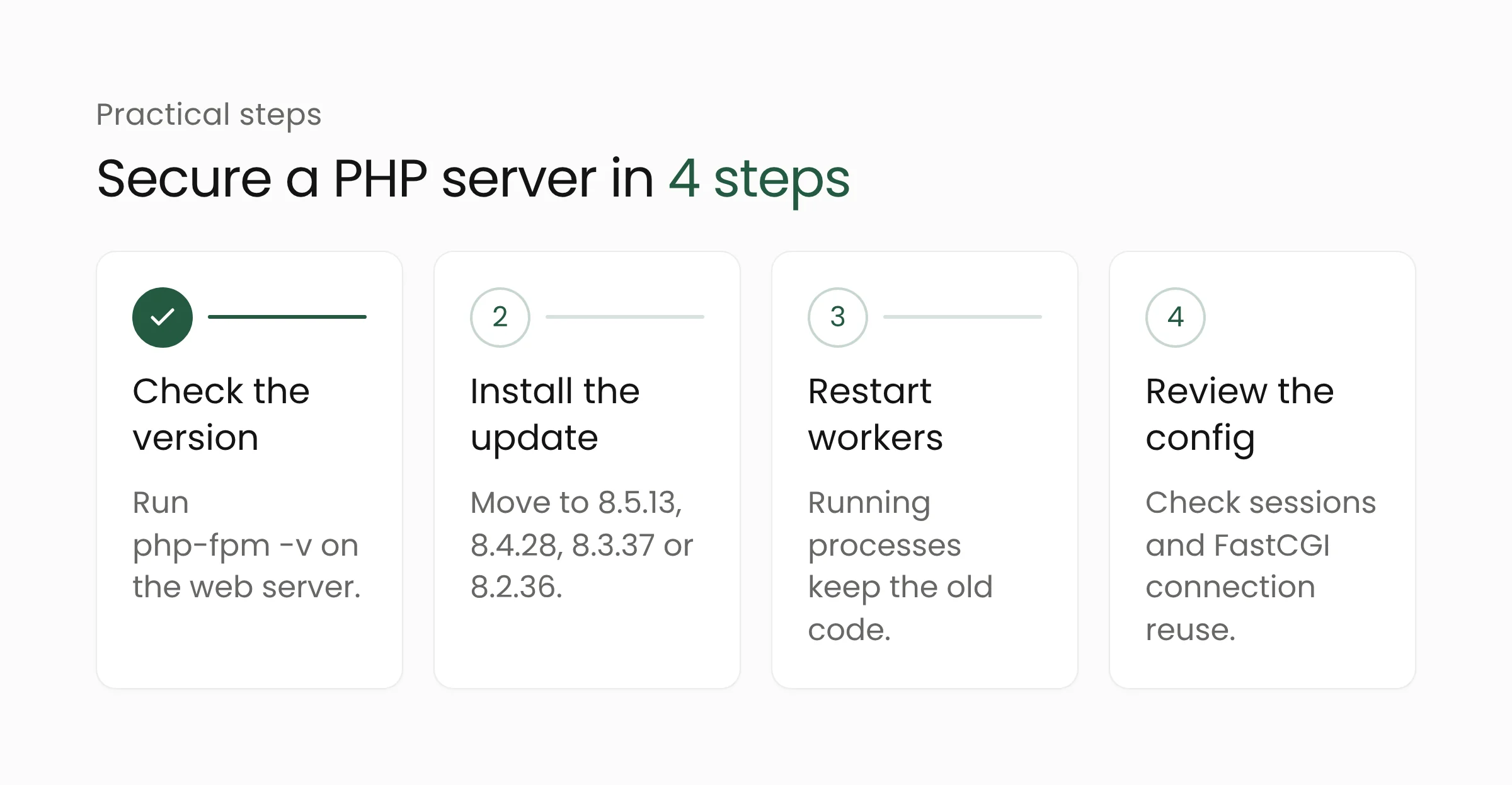
- Check the version that serves web traffic. Run
php-fpm -von the server or inside the running container. Chainguard warns thatphp -vreports the command-line binary, which can differ from the one serving visitors. Distribution packages sometimes carry fixes without a version change, so check the distribution’s security tracker too. - Install the update for your branch. Move to 8.5.13, 8.4.28, 8.3.37 or 8.2.36. A move to PHP 8.6 is optional. For containers, rebuild the image and redeploy.
- Restart every worker. Running PHP-FPM or Apache processes keep the old code until they restart.
- Review the configuration. Check whether
session.upload_progress.enabledis switched on explicitly, whetherfastcgi_keep_connorenablereuseis active, and whether several applications share onesession.save_path. Patchstack recommends a separate session directory per tenant andcatch_workers_output = noon pools that do not need it.
If the update cannot go in today, the PHP advisories offer temporary mitigations. Set session.upload_progress.enabled=0 in php.ini or the pool configuration, then restart the workers. Calling ini_set() from application code is too late, because PHP has already processed the input by then. Turn off FastCGI connection reuse on the web server. Fix the settings that produce warnings at PHP startup, or send error logs to syslog.
Site owners on shared hosting do not control these settings. They should ask the provider which PHP version is running and when the November 19 update was installed. Organizations that want a configuration audit and post-update testing can work with Merakit’s cybersecurity services.
Frequently asked questions
Is my WordPress site affected?
The flaws are in PHP, so WordPress or plugin updates do not close them. Patchstack rates the timezone cache bug and PHP-FPM request smuggling as most relevant to WordPress sites, and the session flaws as rarely reachable because few plugins call session_start(). The fix is to update PHP on the server.
Have attackers used these flaws yet?
None had been reported as of November 19, 2026, according to SOCRadar, and Patchstack found no reports of exploitation. That can change quickly now that the advisories describe the flaws in detail, so the update should go in ahead of the next maintenance window.
Do I have to move to PHP 8.6?
No. According to Chainguard, the branch updates are drop-in. PHP 8.6.0 is a major release with language changes, so moving to it calls for separate application testing. PHP 8.2 users are the exception: support ends on December 31, 2026, so they should plan a migration.
Closing
Most flaws fixed on November 19 open up only under specific configurations, yet those configurations are common on production servers. Installing the fixed version, restarting workers and reviewing session and FastCGI settings closes the known attack paths. If your application depends on a PHP version past end of life, Merakit’s web application development team can help plan the migration.
Sources
- PHP 8.5.13 Released, php.net, November 19, 2026
- Partially overwritten session files can lead to remote code execution (CVE-2026-126714), php-src advisory, November 19, 2026
- Session serializer mismatch can lead to remote code execution (CVE-2026-115560), php-src advisory, November 19, 2026
- PHP-FPM request smuggling through an unread HTTP request body (CVE-2026-129289), php-src advisory, November 19, 2026
- Timezone cache use-after-free can lead to remote code execution (CVE-2026-129496), php-src advisory, November 19, 2026
- PHP Fixes 7 Critical Flaws, Including Bugs That Could Allow Remote Code Execution, The Hacker News, November 19, 2026
- PHP’s November 2026 Security Release: What Reaches WordPress, Patchstack, November 19, 2026
- phpAfterShell, Depthfirst, November 19, 2026
- phpAfterShell (CVE-2026-126714) Slips Past PHP2Shell Patch, SOCRadar, November 2026
- PHP’s November security release: What it is and what to update, Chainguard, November 19, 2026