Blog Smart Home
Amazon Echo Time and the Case for Camera-Free IoT Sensing
On this page· 7 sections
Amazon has introduced Echo Time, a smart alarm clock that tracks its owner’s sleep phases with an ultrasonic sensor and no camera. The $199.99 device, announced on October 28, 2026 alongside four other Alexa+ devices, points to a new direction for home IoT: sensors that understand a room without capturing images of it.
Five Alexa+ devices in one announcement
In its official announcement, Amazon unveiled five devices that all run Alexa+, the generative AI version of its voice assistant. Alexa+ is included with a Prime membership. Amazon did not list the countries where the devices will be sold.
The five devices are:
- A new Echo Dot priced at $99.99, built on Amazon’s AZ3 chip with an AI accelerator for on-device processing. According to Engadget, it also works as a smart home hub for Zigbee, Thread, and Matter devices.
- Echo Studio with Home Camera at $249.99, the first Echo Studio speaker with a camera. The regular camera-free Echo Studio remains on sale at $219.99.
- Echo Time at $199.99, an alarm clock with a 2.3-inch round display and a camera-free design.
- Alexa Photo Frame, a 10-inch touchscreen frame that pulls pictures from Amazon Photos. Engadget and BGR put its price at about $200, while Amazon’s announcement page does not yet list a price or release date.
- Echo Show 16, a 16-inch smart display available for preorder from $499.99 and, according to Engadget, shipping before the end of 2026.
Of the five, Echo Time is the most interesting from a sensing point of view. It handles a job that usually requires a smartwatch or a camera: telling when someone is in deep sleep and when that sleep turns light.
How Echo Time reads sleep without a camera
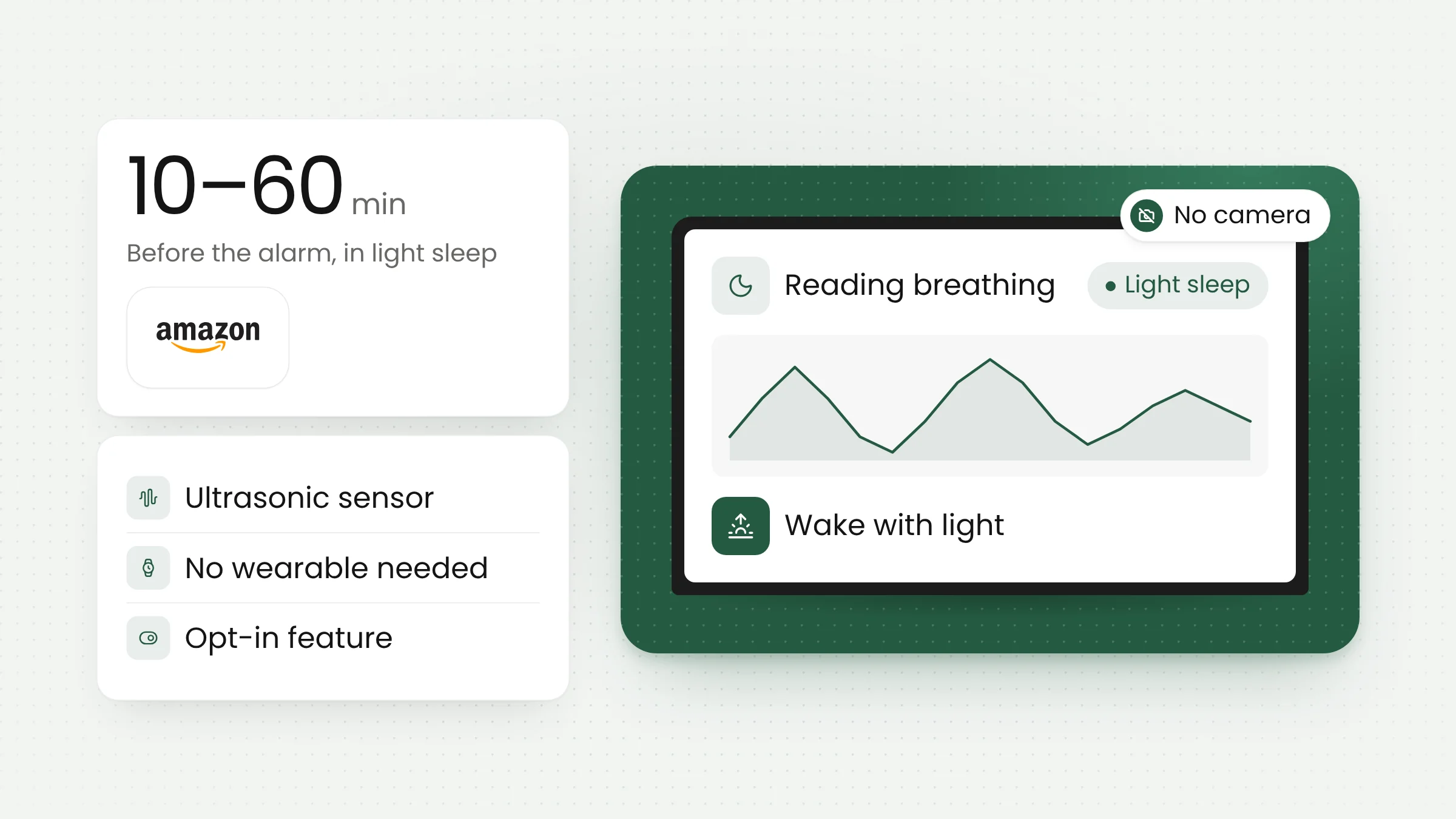
BGR reports that Echo Time uses an ultrasonic transducer. The component sends out sound pulses above the range of human hearing and reads the echoes, much like radar. From changes in those echoes, the device estimates whether someone is asleep and roughly which sleep phase they are in. The Next Web says the sensor picks up breathing.
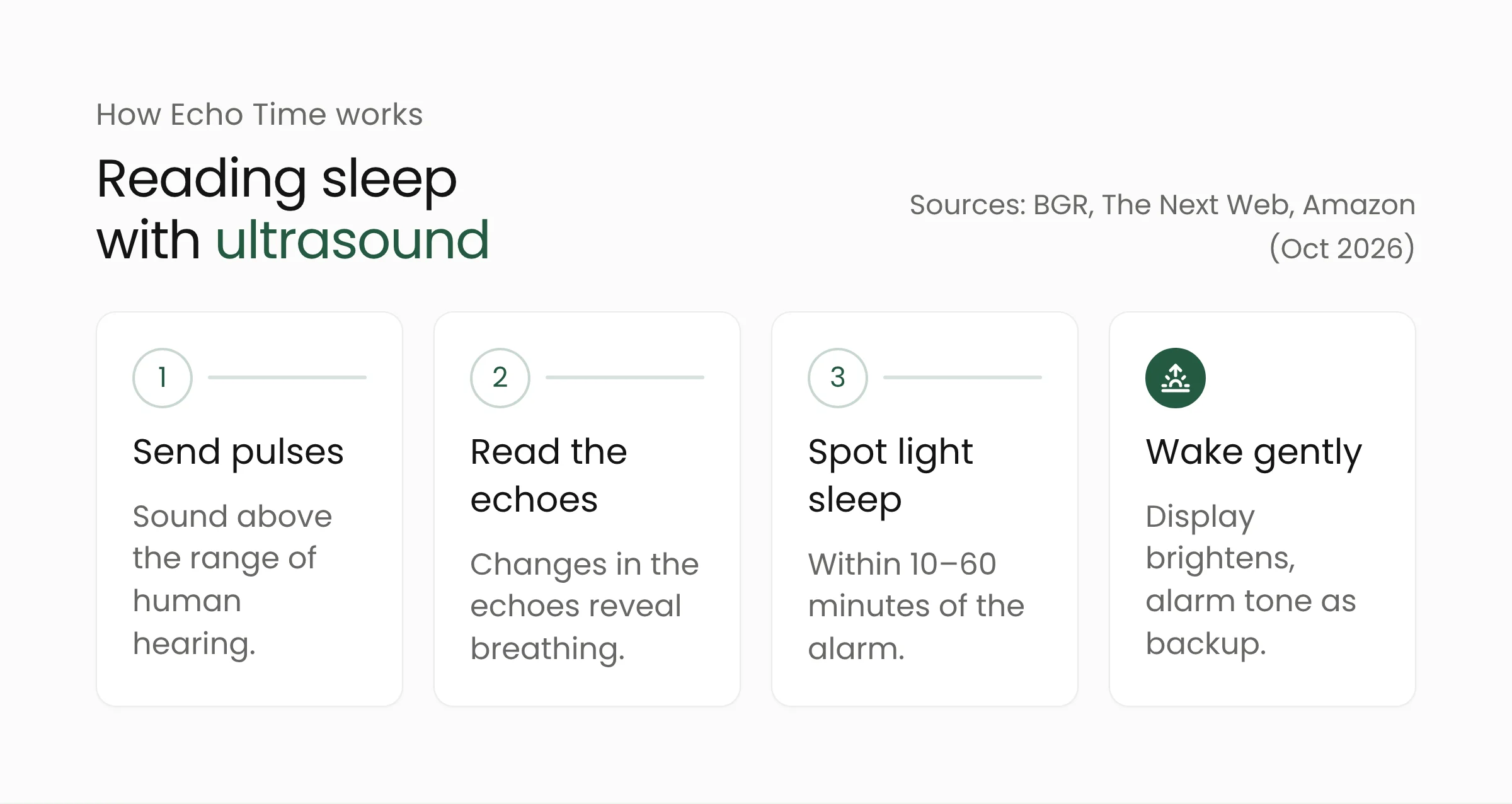
Users do not need to wear anything. When the sensor detects light sleep within a window of 10 to 60 minutes before the alarm, the Echo Time display brightens gradually to mimic a sunrise. If light alone does not work, BGR says the alarm tone still sounds as a fallback.
Amazon describes the capability as sleep sensing powered by Omnisense, the sensor platform it introduced in 2025 for the Echo Show 8 and Echo Show 11. In its India launch announcement, Amazon said Omnisense combines the camera, audio, ultrasound, Wi-Fi radar, an accelerometer, and Wi-Fi CSI to detect motion, presence, and temperature. Wi-Fi CSI is data on how Wi-Fi signals change as they pass through a room, which can be used to recognize movement.
Two caveats apply. The Next Web reports that sleep sensing is opt-in, so it only works once the user switches it on. Amazon also says Echo Time has earned the National Sleep Foundation’s SleepMark. Claims about how accurately it reads sleep phases still come from Amazon, and no independent test results have been published.
Cameras in the living room, and the privacy controls around them
Amazon’s sensing strategy varies by room. For the bedroom, it chose a camera-free Echo Time. For the living room, it added a camera.
Echo Studio with Home Camera uses its camera for several tasks. Alexa+ can answer questions about objects in front of the speaker, such as the rules of a board game or a product to reorder. Owners can also check on the room from the Alexa app while they are away. A feature called Advanced Room Adaptation counts the people in the room and where they sit, then tunes the audio.
Engadget cites Amazon as saying the camera will not record footage. Images can still go to the cloud when the live view is in use. The Next Web notes that a visual indicator lights up whenever the camera streams images or video to the cloud, and that a dedicated button turns off the microphones and camera.
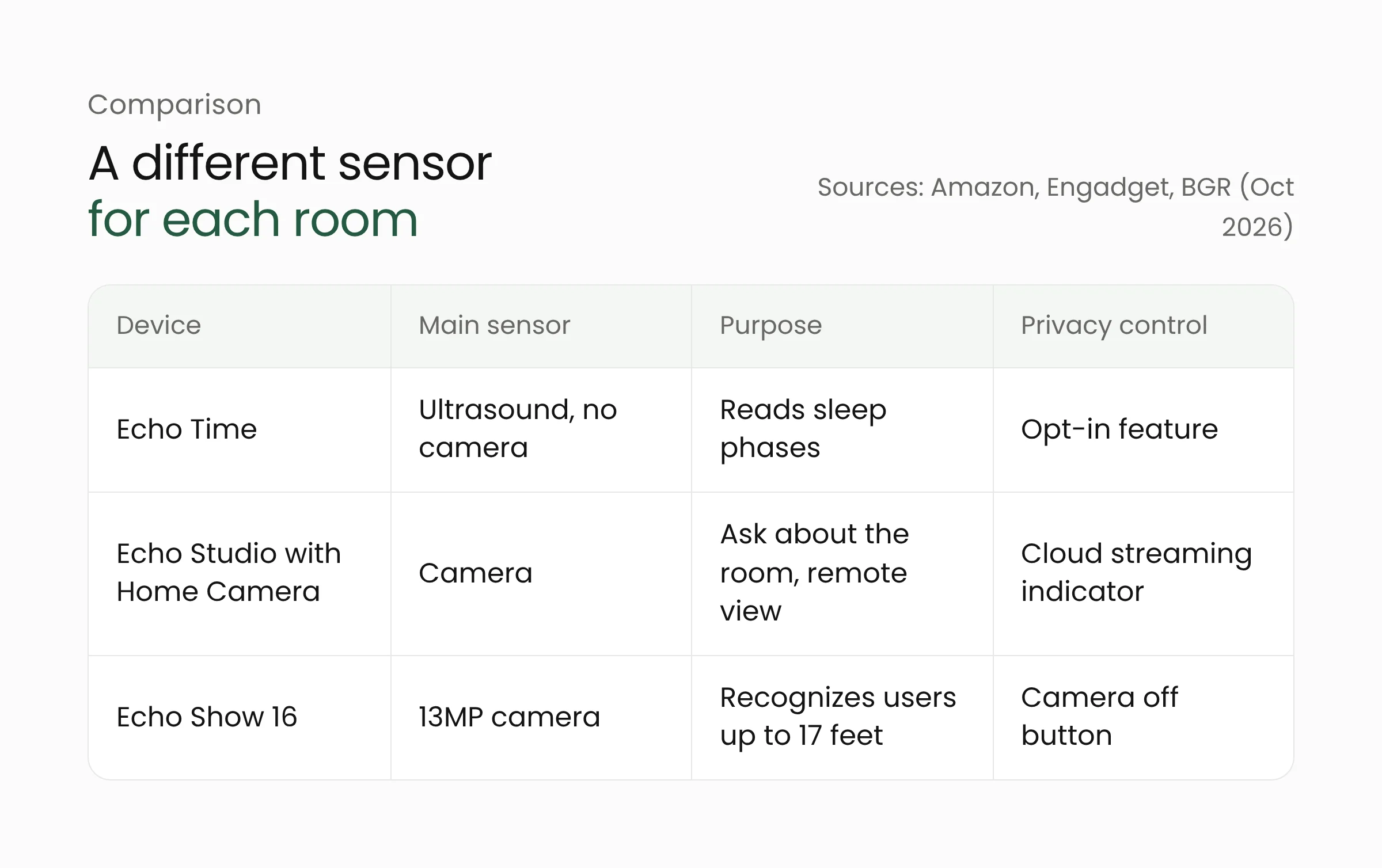
Echo Show 16 carries a 13MP camera, the highest resolution Amazon has used in an Echo Show. According to BGR, it can recognize users from up to 17 feet away and is the first Echo with night vision. A new feature, Alexa Home Map, uses the camera to map the home and show where smart devices sit. Omnisense on the Echo Show 16 detects when someone enters a room and can adjust lights or a thermostat. Like other Echo devices, it has a physical button that disables the camera and microphones.
The split shows how Amazon weighs function against the sensitivity of each room. Cameras go into shared spaces where the features are visual, while the bedroom gets a sensor that never produces an image.
What this means for IoT device builders
Amazon has not announced Echo Time sales in Indonesia, but its design choices matter for teams building IoT devices and systems there. Presence sensors, motion sensors, and room-condition monitoring are increasingly common in hotels, offices, hospitals, and elderly care homes. A few lessons apply directly.
Choose the sensor that collects the least data
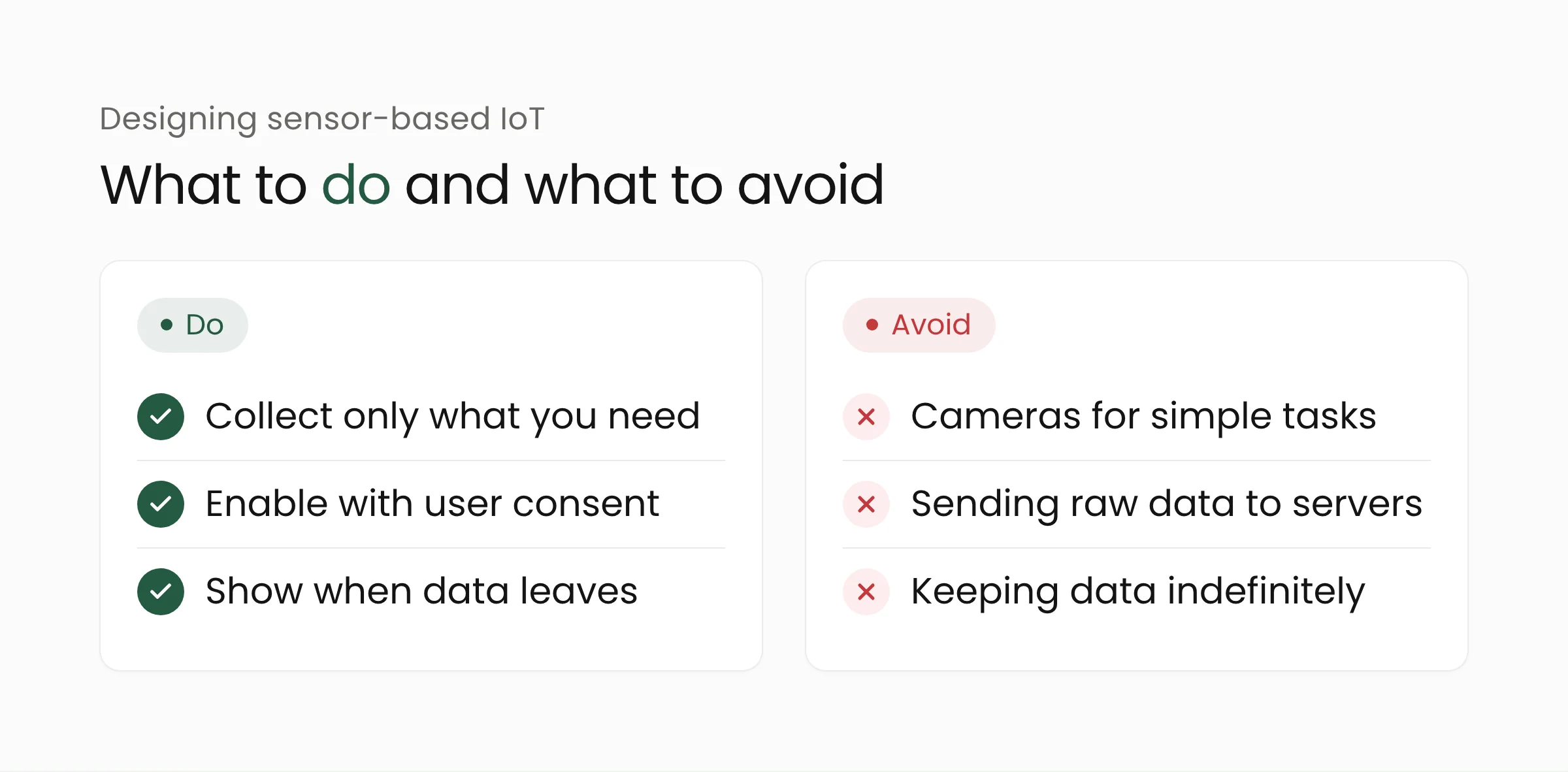
Start with a simple question: what data does this feature actually need? A hotel that wants to switch off air conditioning in empty rooms only needs a presence sensor, not a camera. An office tracking meeting room usage only needs a headcount, not faces. Ultrasonic sensors, millimeter-wave radar, and passive infrared sensors produce far less data than cameras, which also means less to leak.
Process on the device where possible
The AZ3 chip in the new Echo Dot includes an AI accelerator for on-device processing. The same approach works with microcontrollers or edge AI modules that process raw signals on site and send only the result, such as “room occupied” or “patient moving”, to the server. That saves bandwidth, keeps working when the connection drops, and limits how much personal data moves around.
Account for personal data protection rules
Sleep and breathing data can count as health data. Article 4(2) of Indonesia’s Undang-Undang Nomor 27 Tahun 2022 tentang Pelindungan Data Pribadi (Personal Data Protection Law) classifies health information and biometric data as specific personal data. Article 34 requires a data protection impact assessment for high-risk processing, including processing of specific personal data, systematic monitoring, and the use of new technology.
For developers, those obligations translate into simple practices. Turn on sensitive sensing features only with user consent, as Echo Time does with its opt-in sleep feature. Show a visible indicator when data leaves the device. Add a physical switch that disables the sensors, and set a retention limit for stored data. For a related discussion of consent in AI recording devices, see our piece on Amazon Bee Frontier and Eclipse.
Build on open standards
The new Echo Dot supports Zigbee, Thread, and Matter. Open standards such as Matter let devices from different brands work together, so building owners are not locked into a single vendor. For local manufacturers, supporting them means their devices can work with hubs from Amazon, Apple, or Google. Competition among smart home hubs is heating up, as Apple HomeView shows.
Merakit helps organizations design systems like these through its IoT services, from sensor selection and on-device processing to monitoring dashboards that comply with data protection rules.
Frequently asked questions
Can people hear the ultrasonic pulses from Echo Time?
No. According to BGR, Echo Time’s transducer emits pulses above the range of human hearing. The sensor also works without a camera or a wearable device.
Are Echo Time and Echo Studio with Home Camera sold in Indonesia?
Amazon did not name the countries where the devices will be sold, so official availability in Indonesia has not been announced. Current prices are in US dollars.
Does the Echo Studio camera record what happens at home?
Amazon says the camera does not record footage. Images can be streamed to the cloud when the owner uses the live view, and a visual indicator lights up whenever that happens. A dedicated button turns off both the camera and the microphones.
Conclusion
Echo Time shows that home devices can understand what their occupants are doing without having to see them. The right choice of sensor keeps a feature working with as little data as possible. If your organization is planning a sensor system for buildings, patient rooms, or public facilities, the Merakit team can help you shape the design.
Sources
- New Alexa devices 2026, Amazon, October 28, 2026
- All the Amazon Echo devices announced today, Engadget, October 28, 2026
- Amazon Revealed 5 New Smart Home Devices Today, BGR, October 28, 2026
- Amazon puts a camera in its Echo Studio so Alexa can see, The Next Web, October 28, 2026
- Amazon Echo Show 11 and Echo Show 8 launch in India, Amazon India
- Article 34, Law No. 27 of 2022 on Personal Data Protection, Pasal.id