Blog Retail
AS Watson Puts AI and Robots in 55-Plus Distribution Centres
On this page· 7 sections
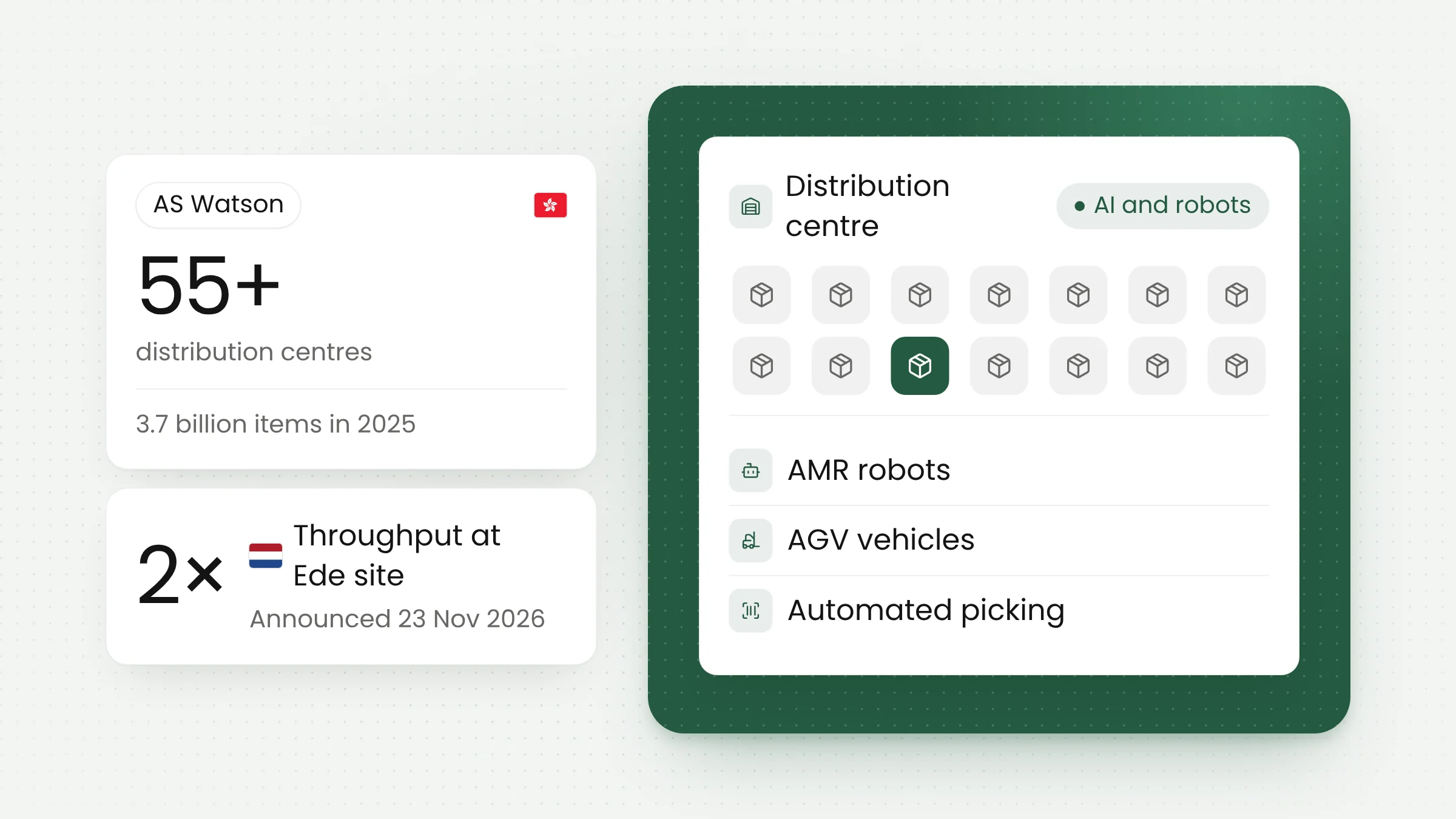
AS Watson, the Hong Kong group behind the Watsons health and beauty chain, said on 23 November 2026 that AI and robots now operate in more than 55 of its distribution centres. The company says throughput at one warehouse has doubled with the same number of staff.
Automation across more than 55 distribution centres
The announcement came in an AS Watson press release issued from Hong Kong. It describes a supply chain overhaul built on AI, robotics and automation. According to the company, the technology is deployed in over 55 distribution centres worldwide, and that network handled more than 3.7 billion pieces in 2025.
The size of the business explains the attention on warehouses. AS Watson was established in 1841 and is a member of CK Hutchison Holdings. The release lists more than 17,000 stores under 12 retail brands in 31 markets, 130,000 employees and revenue above US$26 billion for fiscal 2025. The Watsons brand also trades in Indonesia.
The group calls its strategy O+O, short for Offline plus Online. Customers can shop in a store, order in the app and pick up at a branch (Click & Collect), or have the order sent home (Click & Deliver). All three routes draw on the same stock, so warehouses and stores need an accurate view of where every item sits.
Steve Zandi, Group Supply Chain Director at AS Watson, said in the release that bringing AI, automation and human expertise together lets the company “move faster, improve availability for customers and create better opportunities for our people.”
How the robots and AI work in a retail warehouse
The release names six technologies and no vendors. They fall into three groups, depending on the job they support.
Robots that move and pick goods
Three pieces of physical equipment are mentioned: automated guided vehicles (AGVs), autonomous mobile robots (AMRs) and automated picking systems. An AGV is a driverless carrier that follows a fixed route laid out on the warehouse floor. An AMR does similar work but maps the space with sensors and chooses its own path, which lets it steer around obstacles.
Picking is the task of taking items off shelves to fill a store or customer order. In a manual warehouse, workers walk the aisles with a list. In an automated one, goods are brought to the worker or retrieved by machine, which cuts walking distance and lifting.
AI for demand forecasting and stock transfers
On the software side, AS Watson uses AI-powered demand forecasting. Models of this kind learn from sales data to estimate which products will sell in each store, and the output decides how much stock leaves the warehouse.
The most concrete example in the announcement concerns inter-store stock transfers. When one store holds too much of an item and another runs short, staff have to compile a list of what should move, from where and to where. AS Watson says AI shortened that compilation process from six hours to 15 minutes. It does not explain how the model works or which business unit measured the change.
Real-time stock for online orders
The last two technologies are real-time inventory visibility and intelligent order routing. The first tells the system how many units sit in warehouses and stores at any moment. The second picks a fulfilment location for each online order, such as the nearest branch that still has the item.
AS Watson links both to an on-shelf availability standard of nearly 99% for fast-moving products. The company does not state the period that figure covers.
Claimed results and their limits
The headline number comes from the Benelux distribution facility in Ede, in the Netherlands. According to AS Watson, automation doubled operational throughput there with the same workforce. Throughput is the volume of goods a warehouse processes in a given time. No absolute figure is given.
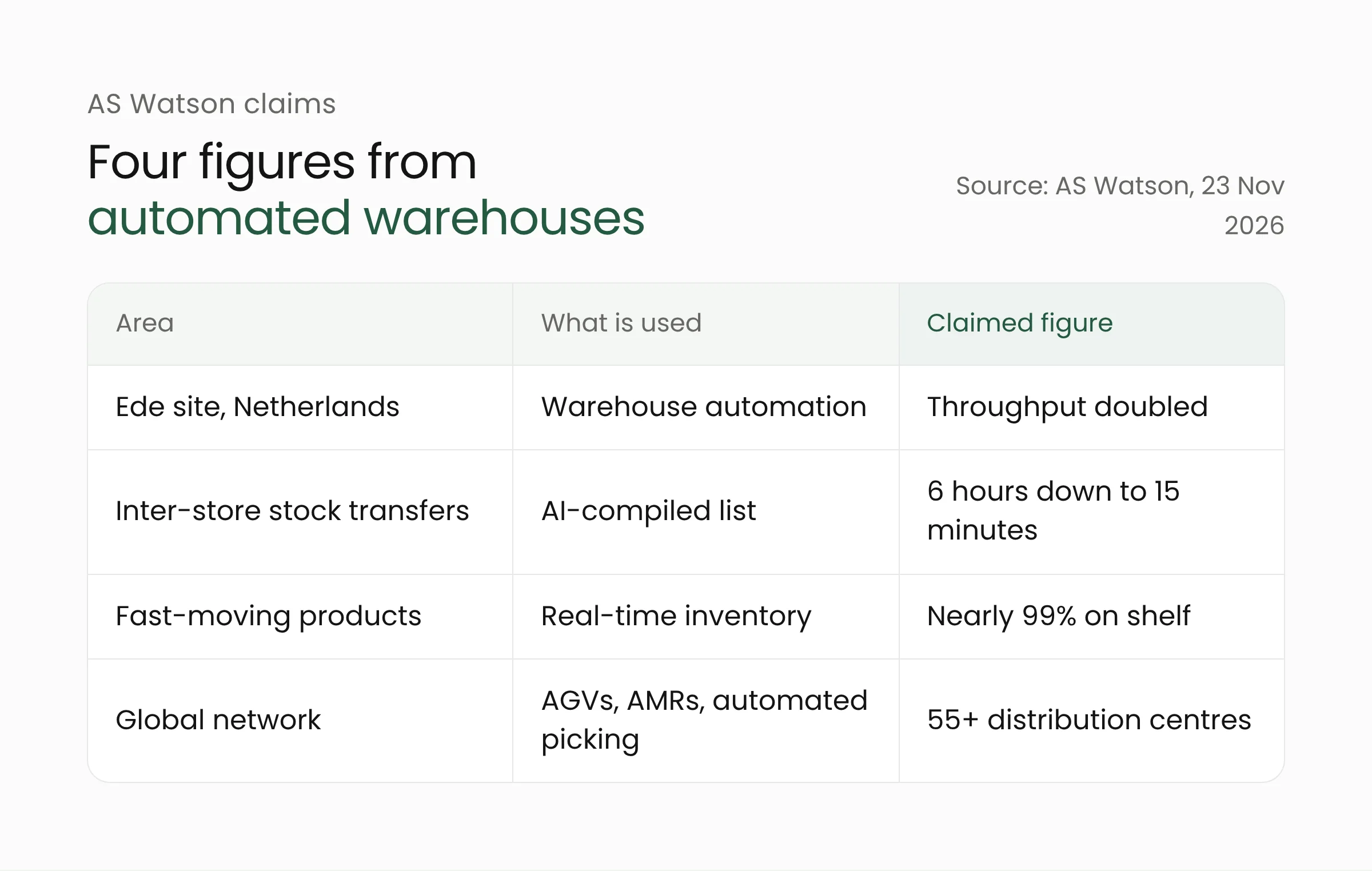
Every one of these figures comes from the company. TechNode Global notes that the operational data has not been independently audited. The cost of the programme was not disclosed, and the measurement method was not detailed.
Several other details are missing. The release names only two locations, Ede and the Watsons China distribution centre network. It says nothing about warehouses in Indonesia or elsewhere in Southeast Asia, the number of robots installed, or a schedule for further rollout. Retail Technology Innovation Hub, which also covered the announcement, adds no technical detail beyond the release.
More women in automated warehouses
Workforce data rarely appears in warehouse automation announcements, and this one includes some. AS Watson says women make up nearly 50% of the workforce at automated distribution centres, compared with around 30% at non-automated facilities. In the Watsons China distribution centre network, female representation in picking operations rose from 50% to 70% after automation was introduced.
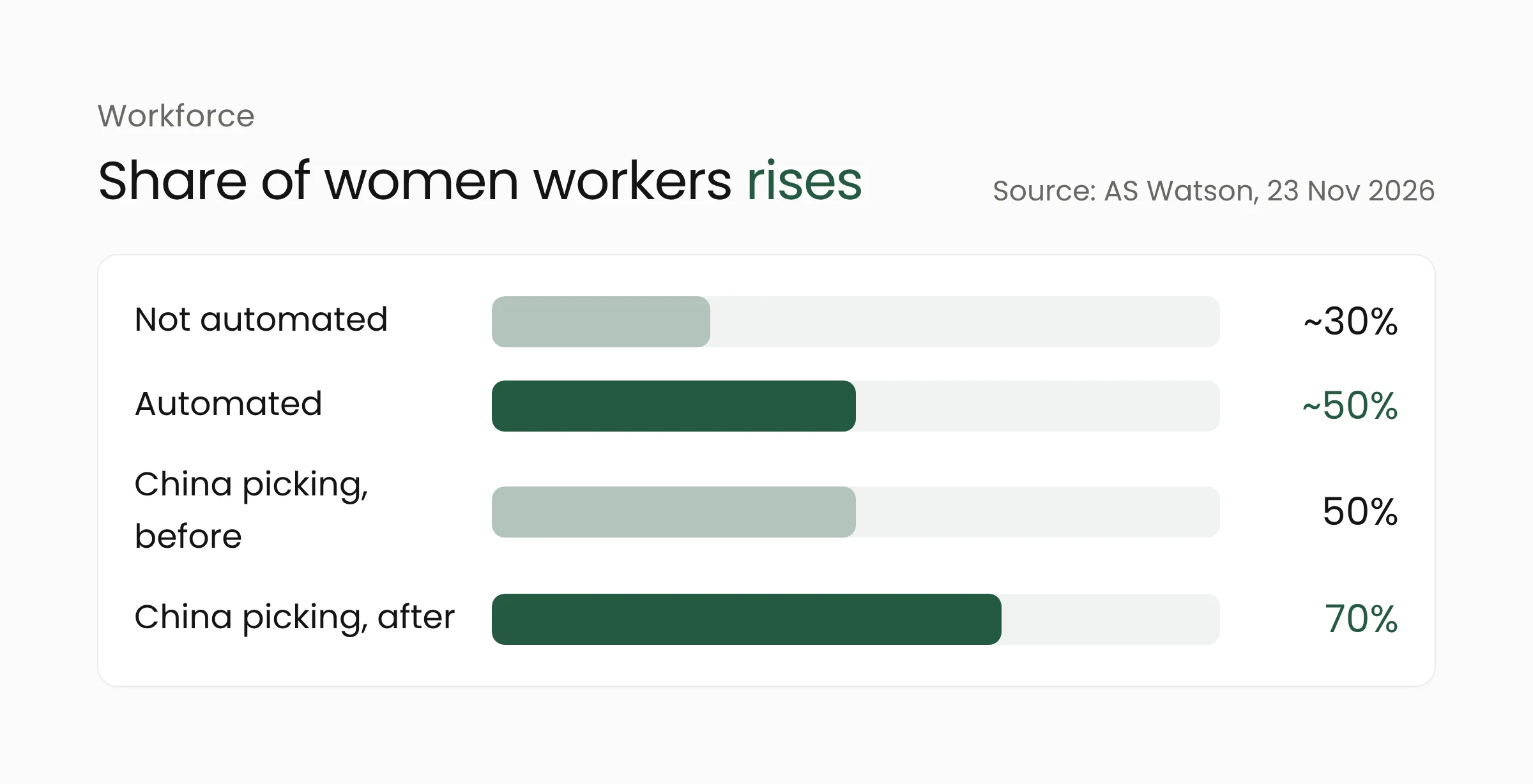
The company attributes the change to less repetitive and physically demanding work. When machines do the lifting and carrying, more people can fill warehouse roles. The data should still be read as a company claim, since other factors such as hiring policy are not described.
The AS Watson story also points in a different direction from the humanoid robots that have drawn headlines this year, such as Agility Robotics’ Digit for warehouses. The equipment here is carriers and picking systems the logistics industry has used for years, combined with software that manages stock.
What this means for retail businesses in Indonesia
Few Indonesian retailers run 55 distribution centres. Minimarket chains, pharmacies, cosmetics stores and consumer goods distributors still face the same problem on a smaller scale: stock piles up in one store while shelves in another stand empty.
Two of the four AS Watson claims need no robots at all. Compiling an inter-store transfer list and forecasting demand are data tasks. Both can start with clean sales and stock records, then grow through machine learning services once the sales history is long enough for a model to learn from.
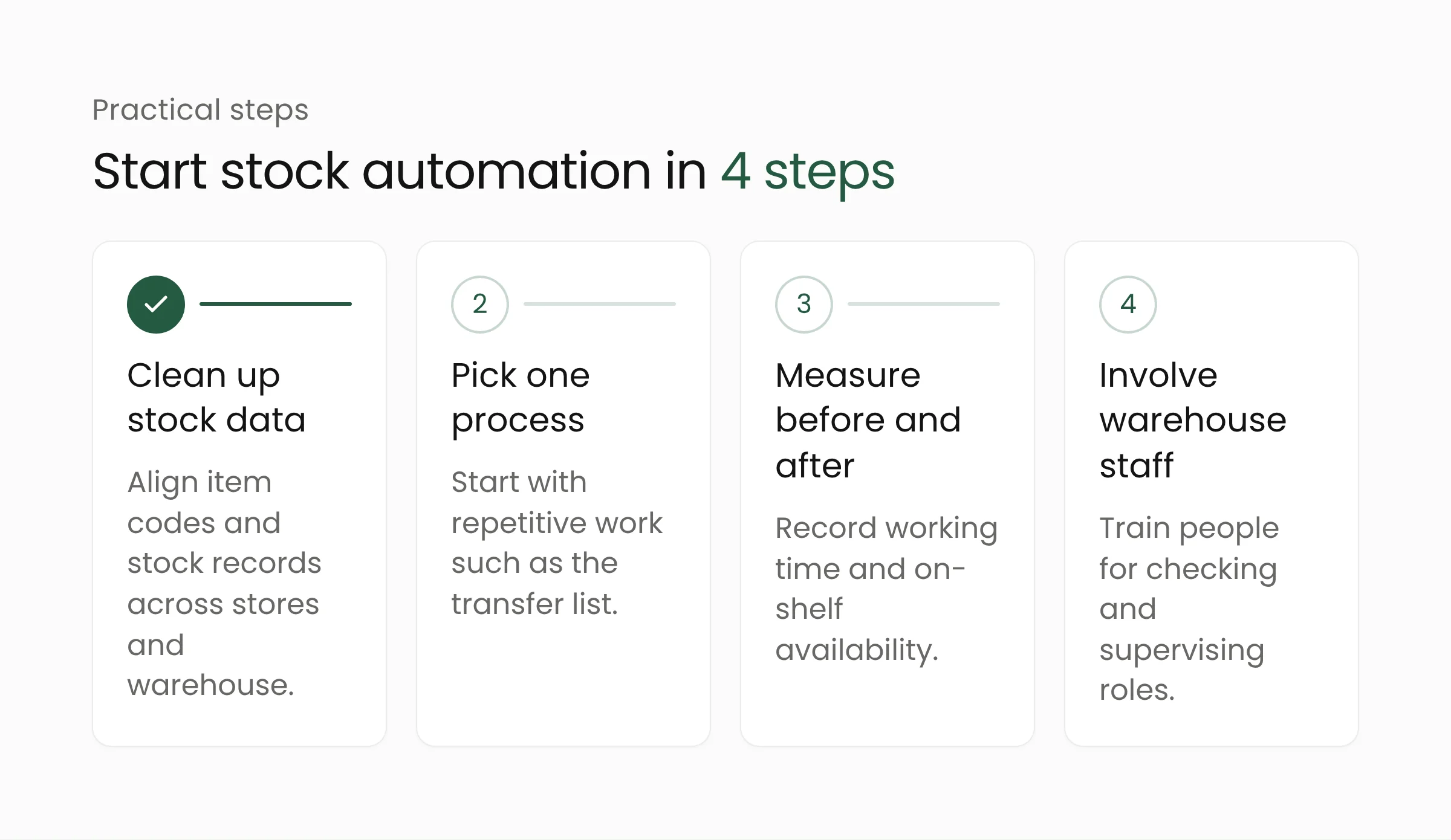
Store network owners and warehouse managers can weigh the following points.
- Clean up stock data first. Item codes that differ between store and warehouse will throw off any forecast. A retail management system that records stock for every branch in one database is the foundation.
- Pick one repetitive process. The inter-store transfer list, reorders to suppliers and delivery schedules are candidates with results that are easy to measure.
- Measure before and after. Record staff hours and on-shelf availability before the new system goes live. Without a baseline, savings claims cannot be proven.
- Cost the robots last. AGVs and AMRs require spending on equipment, a suitable warehouse layout and maintenance. They make sense once volumes are high and stock data can be trusted.
- Prepare new roles for the warehouse team. The AS Watson experience suggests the make-up of the workforce shifts too. Staff need training to check system output, handle exceptions and supervise machines.
For factories and distributors already considering automated vehicles on the warehouse floor, the sensors and control systems behind them belong to industrial automation. The first question stays the same: which process consumes the most time, and what data already exists to measure it.
Frequently asked questions
Do Watsons warehouses in Indonesia already use robots?
There is no official statement. The 23 November 2026 release names only the facility in Ede, in the Netherlands, and the Watsons China distribution centre network. A full list of the 55-plus automated distribution centres has not been published.
What is the difference between an AGV and an AMR?
Both are driverless carriers. An AGV follows a fixed, predefined route, for example along markers on the floor. An AMR maps its surroundings with sensors and can choose its own route, which makes it more flexible when a warehouse layout changes often.
Does automation reduce the number of warehouse workers?
AS Watson does not mention job cuts. Its claim for Ede is doubled throughput with the same workforce, and it says colleagues move to higher-value roles. That statement is not yet backed by data from outside the company.
Closing
The AS Watson announcement shows a sensible order of work for retailers: stock that is visible, planning supported by AI, then robots for physical tasks. The numbers remain company claims and deserve a careful reading. If your store network is tidying up stock data or weighing warehouse automation, the Merakit team is open to a conversation about a first step that fits the size of your business.
Sources
- AS Watson Uses AI to Boost Availability and Speed Up Retail Supply Chain, AS Watson press release via Media OutReach Newswire, 23 November 2026
- AS Watson expands AI and robotics across retail supply chain, TechNode Global, 23 November 2026
- AS Watson ramps up AI powered supply chain transformation push across 55+ distribution centres, Retail Technology Innovation Hub, 24 November 2026