Blog Personal Data Protection
Indonesia's DPO Association Launches as PDP Rules Near
On this page· 7 sections
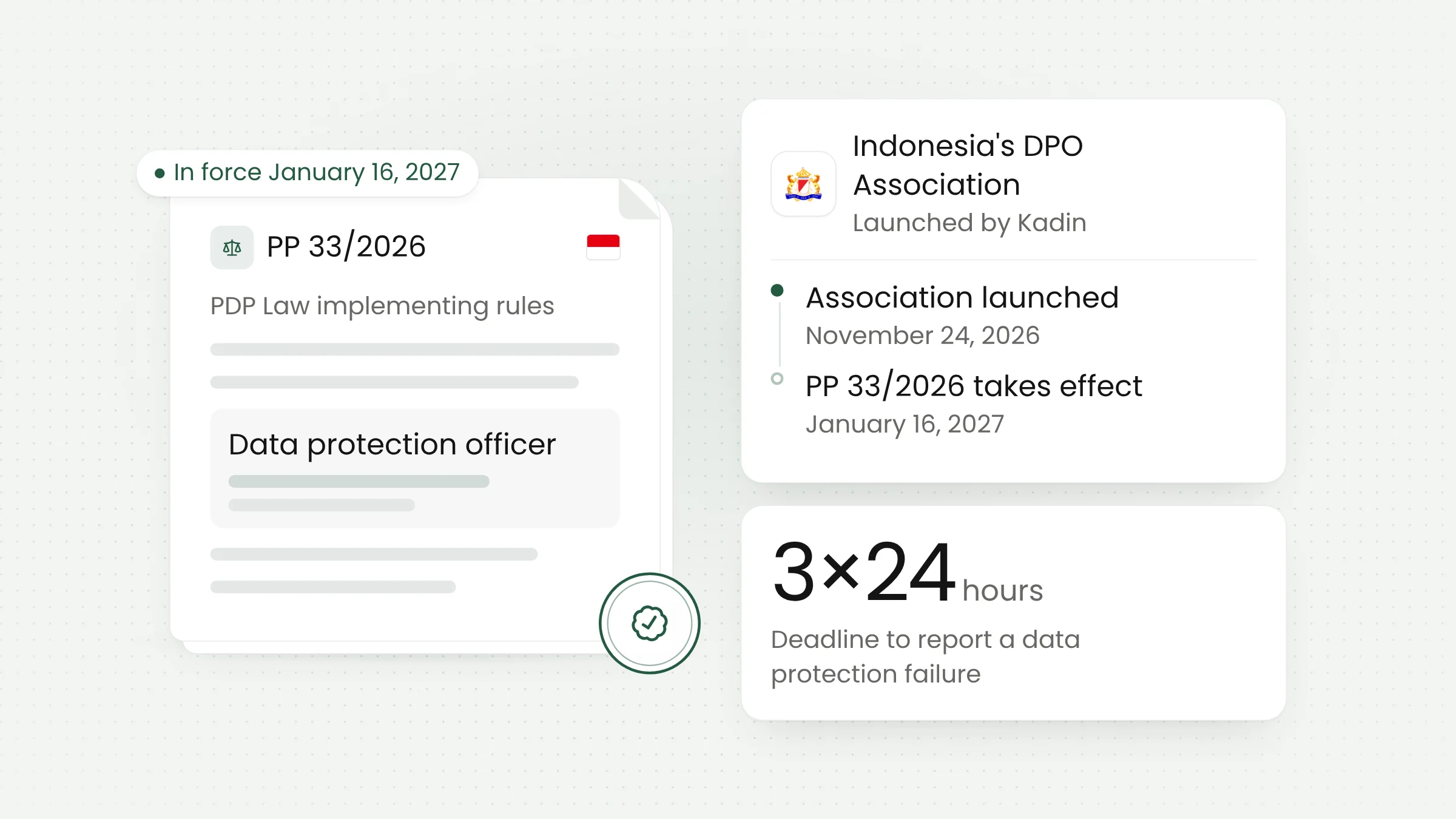
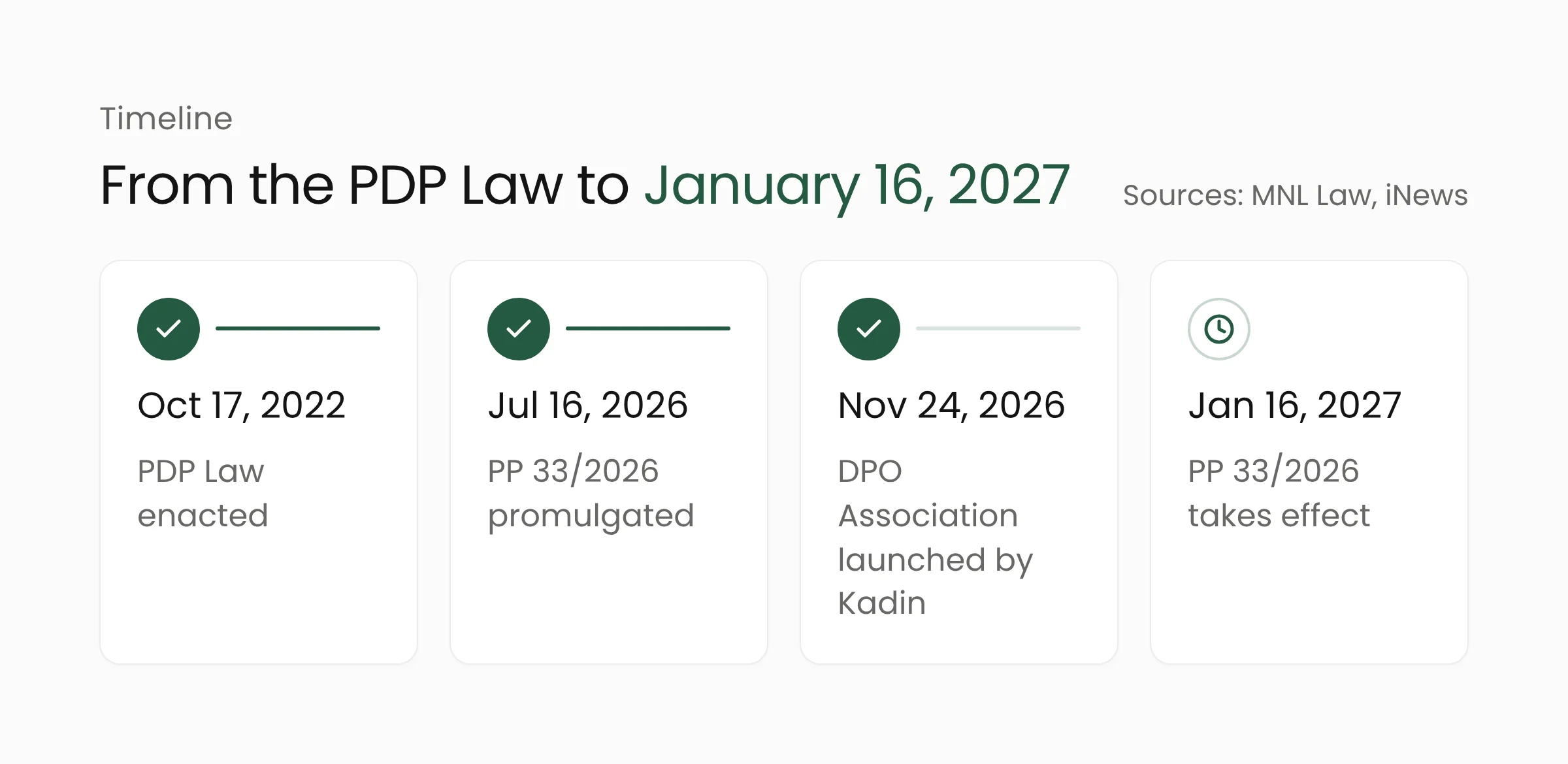
Indonesia’s DPO Association was launched by the Indonesian Chamber of Commerce and Industry (Kadin) in Jakarta on November 24, 2026. The launch comes less than two months before the implementing regulation of the country’s Personal Data Protection Law takes effect on January 16, 2027. That regulation sets out which organizations must appoint a data protection officer.
A launch at the DPO Summit in Jakarta
A data protection officer (DPO) is the person an organization assigns to make sure it complies with personal data rules. Indonesian regulations use a longer name for the role, Pejabat atau Petugas yang Melaksanakan Fungsi Pelindungan Data Pribadi, shortened to PPDP.
According to iNews, the Asosiasi Data Protection Officer Indonesia was introduced at the DPO Summit in Jakarta on Tuesday, November 24, 2026. Clarissa Tanoesoedibjo, Kadin’s vice chair for communication and informatics, spoke at the event. Kadin said the aim is to prepare businesses for tighter enforcement of data protection rules in early 2027.
Clarissa said data protection cannot be left to one person or one division. It needs the board of directors, business units, legal, risk management, IT and security teams, and the same standards have to be followed by vendors and partners. As quoted by iNews in Indonesian, she said a DPO turns the articles of a regulation into working processes, business decisions and real controls.
In a separate Okezone report from the same event, Kadin set out three priorities for government and business: regulatory certainty, fast incident handling, and equal application of the rules to all businesses.
The association’s membership numbers, any certification program and its formal relationship with Kadin have not been announced. The association’s website lists Eryk Budi Pratama as chairman. The DPO Summit 2026 event page shows the summit was held at the Shangri-La Hotel Jakarta and organized by DAMA Indonesia Jakarta.
What Government Regulation 33/2026 says about DPOs
The regulation in question is Peraturan Pemerintah Nomor 33 Tahun 2026 tentang Peraturan Pelaksanaan Undang-Undang Nomor 27 Tahun 2022 tentang Pelindungan Data Pribadi (Government Regulation 33 of 2026, the implementing regulation of the Personal Data Protection Law, known as the PDP Law). Several outlets covering the Kadin event called it a presidential regulation. The regulation’s own title and law firm commentary identify it as a government regulation, so this article refers to it as PP 33/2026.
According to commentary by MNL Law, PP 33/2026 was enacted and promulgated on July 16, 2026 and takes effect six months later, on January 16, 2027. The PDP Law itself was enacted on October 17, 2022, according to a summary by Cybersecurity.or.id.
Three conditions that make a DPO mandatory
A summary by Veritask of Article 142 lists three conditions:
- personal data is processed for the purpose of public services;
- the organization’s core activities require regular and systematic monitoring of personal data on a large scale;
- the organization’s core activities consist of large-scale processing of specific personal data or data related to criminal offenses.
The PDP Law classes health data, biometric data and personal financial data, among others, as specific personal data. By that measure hospitals, banks, lenders and platforms that track the behavior of millions of users are likely to fall under one of the conditions.
The sources we reviewed do not define “large scale” in numbers. An organization that is unsure should record its reasoning in writing.
The DPO’s position and duties
Article 145 lists the duties. The DPO advises on and monitors compliance, gives input on data protection impact assessments, and serves as the contact point for personal data matters.
The regulation also places obligations on the organization. Data controllers and processors must involve the DPO in processing activities, give the DPO access to top management, make sure the DPO works objectively and independently, and provide adequate resources.
Other obligations that apply from January 16, 2027
Several other obligations in PP 33/2026 will shape the DPO’s daily work.
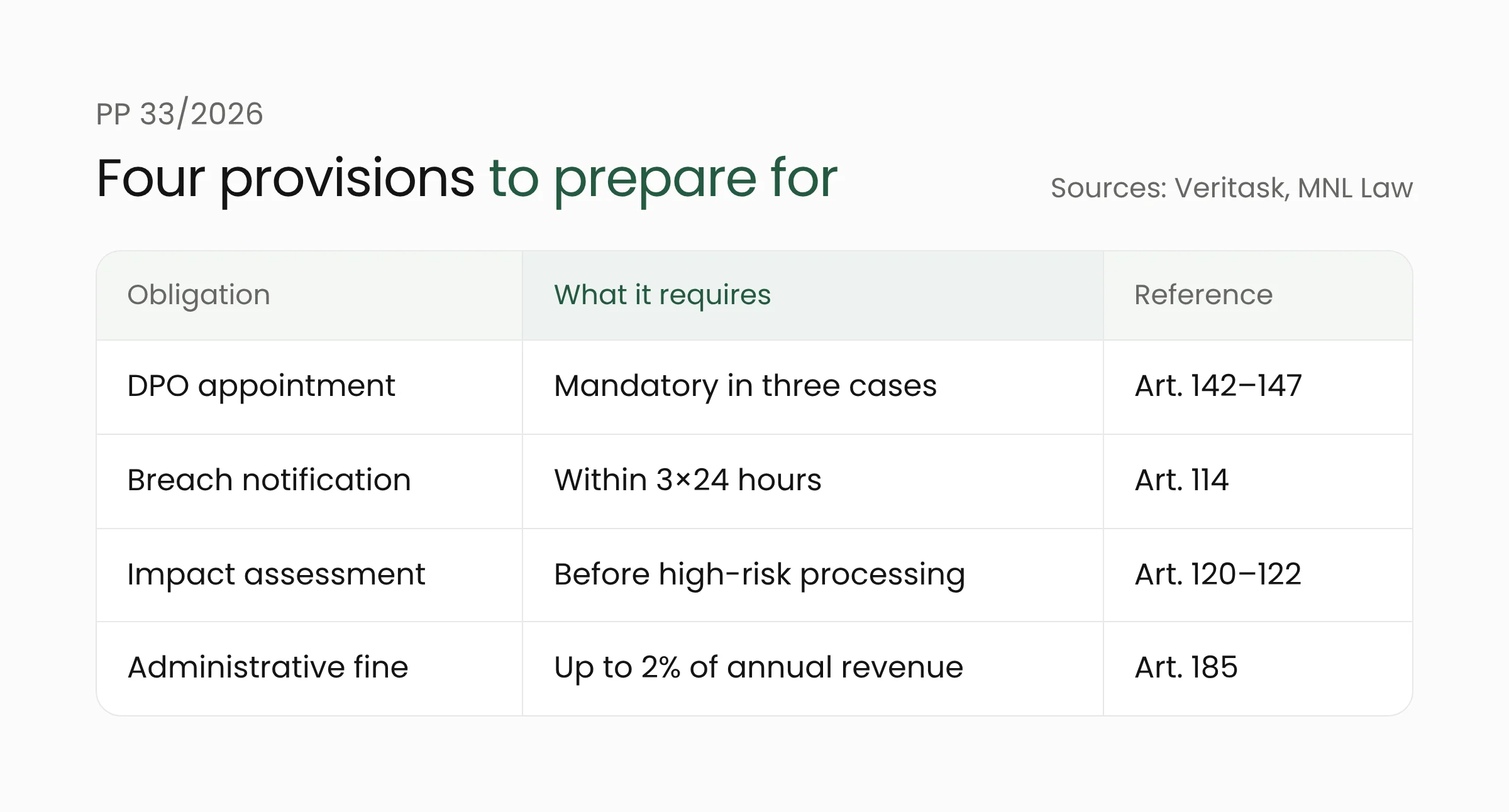
Breach notification. Article 114 requires written notice to data subjects and to the supervisory agency within 3×24 hours of the failure becoming known.
Impact assessments. Articles 120 to 122 require a data protection impact assessment before high-risk processing. Examples include large-scale processing, use of new technology, and automated decisions with a significant effect on a person.
Administrative sanctions. Article 184 provides for written warnings, temporary suspension of processing, deletion or destruction of data, and administrative fines. Article 185 caps fines at 2% of annual revenue.
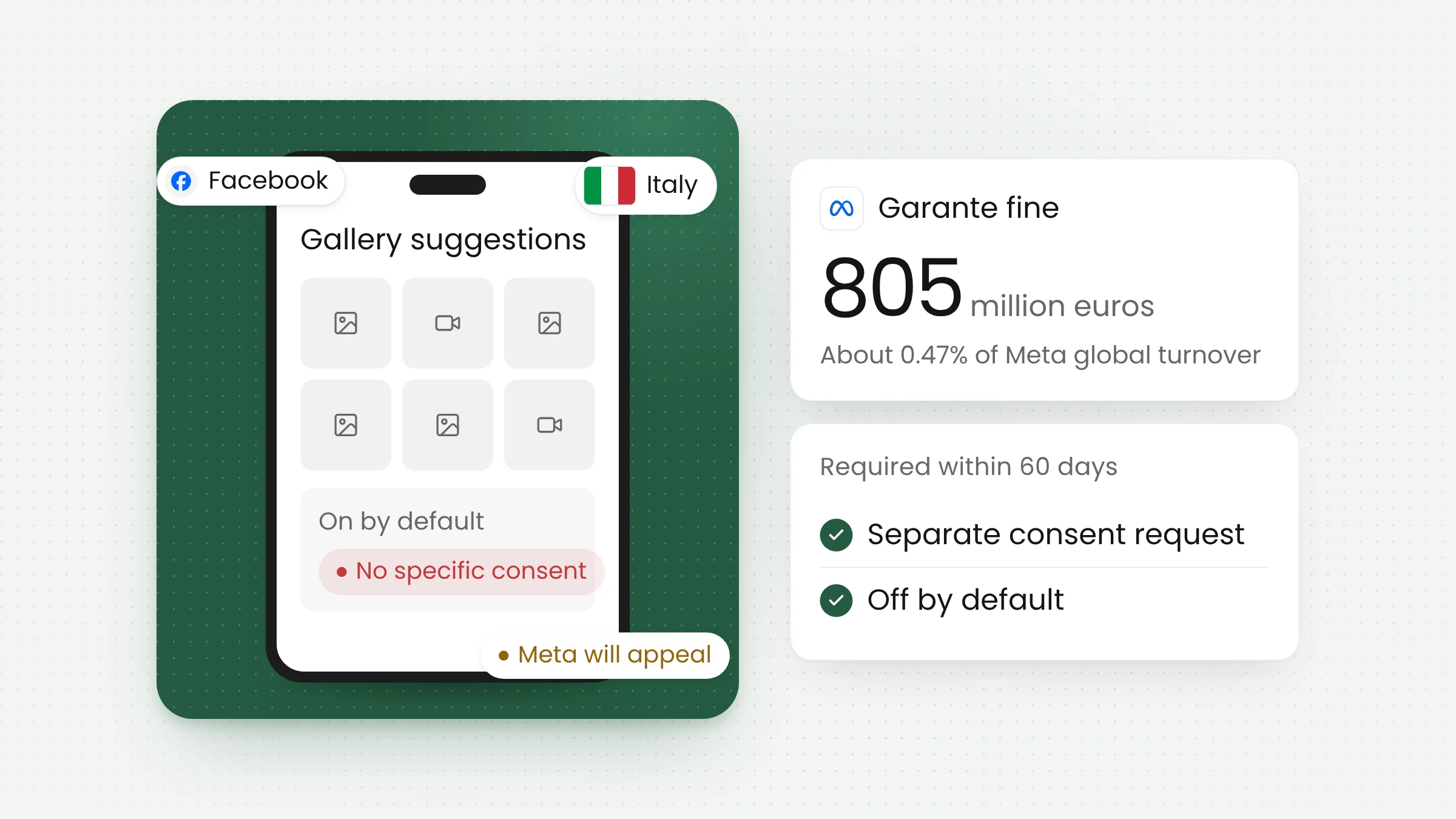
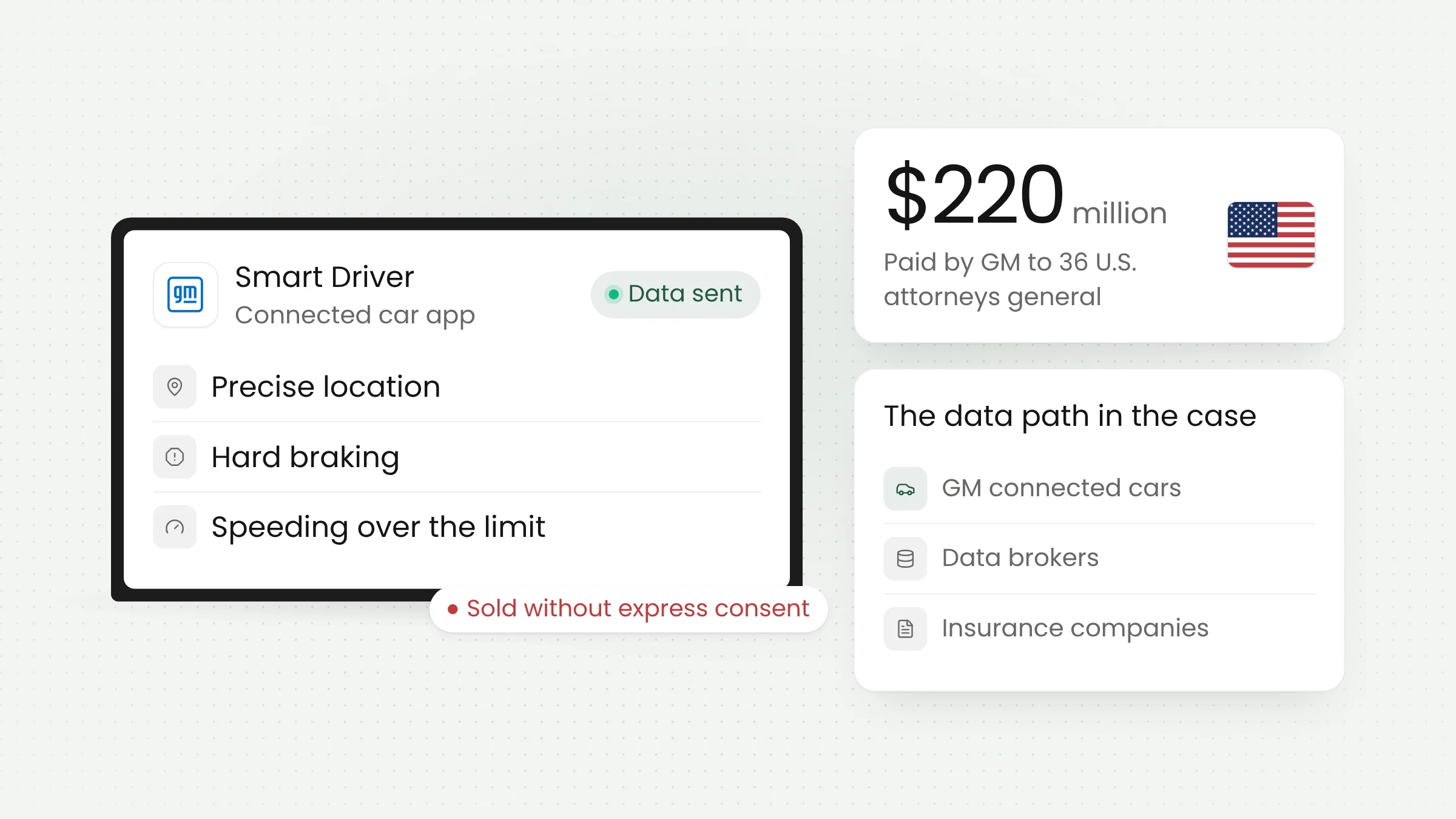
The consent requirements in the same regulation were covered in our earlier piece on the GM driver data settlement.
The supervisory agency is still waiting for a presidential regulation
PP 33/2026 gives wide powers to a personal data protection agency. It has not been established yet. ANTARA reported on November 4, 2026 that the draft presidential regulation establishing the agency had reached its final stage and had been submitted to the President through the Ministry of State Secretariat.
For the transition, the Ministry of Communication and Digital Affairs has prepared a dedicated task force to oversee incidents involving personal data. Article 223 of PP 33/2026 also states that controllers and processors may continue processing data until the agency issues its own rules, as long as the processing does not conflict with the regulation.
MNL Law notes that several provisions still depend on technical rules from the agency, including those on breach notification and administrative sanctions.
What this means for businesses
The duty to appoint a DPO is not limited to technology companies. A minimarket chain with millions of loyalty members, an online store that records purchase histories, a clinic that keeps medical records and a savings and loan cooperative all handle personal data in large volumes.
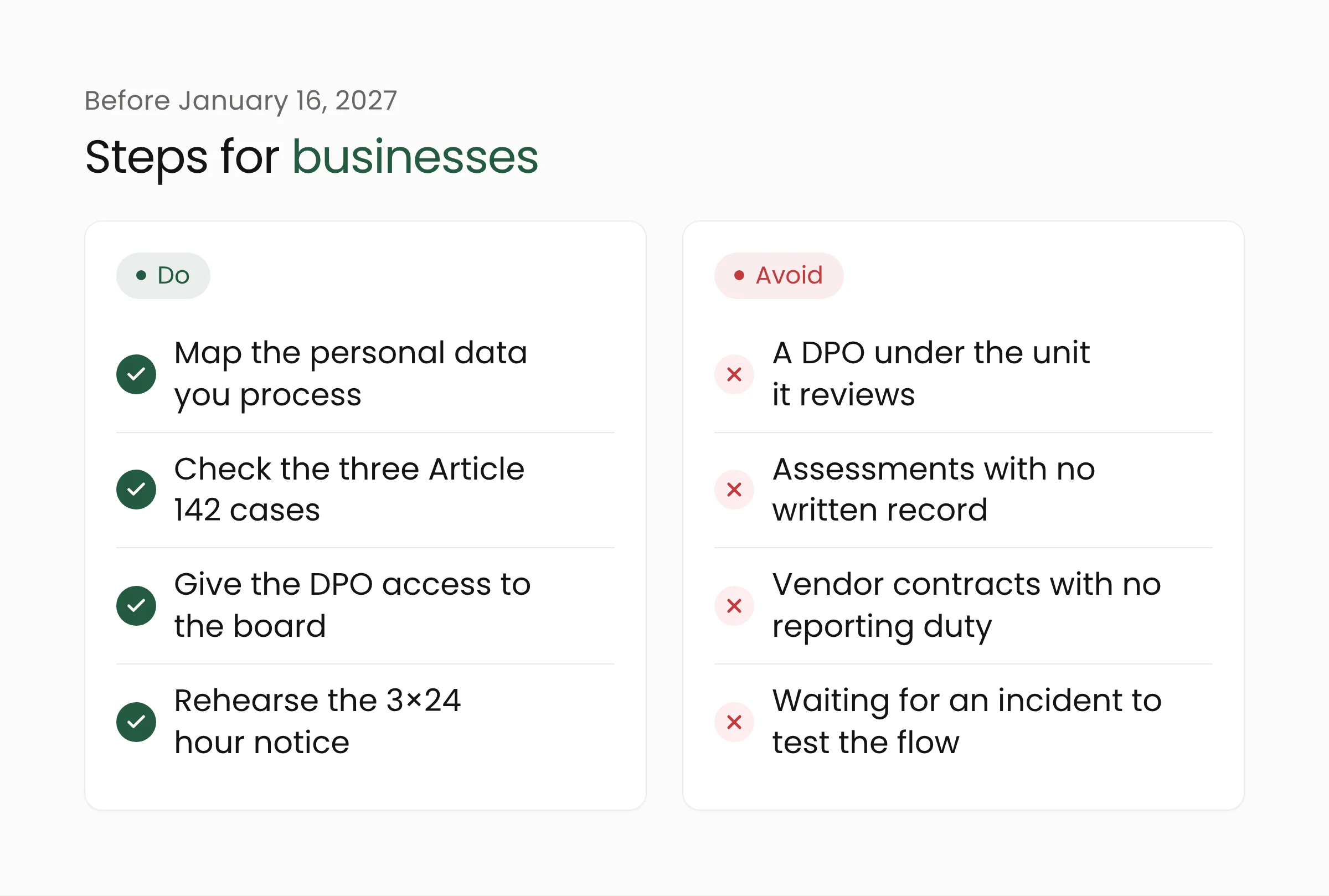
Several steps can be completed before January 16, 2027:
- Map the personal data you process. Record the types of data, where they come from, where they are stored and who receives them.
- Check the three conditions in Article 142. Decide whether your core activities involve large-scale systematic monitoring or processing of specific personal data.
- Appoint the DPO and set the reporting line. The DPO needs direct access to the board and a working budget. Avoid placing the role under a unit whose decisions it has to review, such as marketing.
- Rehearse the 3×24 hour notification flow. Decide who assesses an incident, who drafts the notice and who signs it.
- Review vendor contracts. Point-of-sale providers, bulk messaging services and cloud storage providers also hold your customers’ data. Make sure the contracts require them to report a data protection failure.
The first step is the one most often delayed, because customer data is spread across many applications. In retail management systems, a data map is far easier to produce when checkout, stock and membership share a single source of customer data. Registration forms and consent screens on websites and apps also need a review, and that work belongs in the design stage of any web application development project.
Small businesses that do not meet the three conditions are still bound by other obligations under the PDP Law, including breach notification.
Frequently asked questions
Does every company in Indonesia have to appoint a DPO?
No. Article 142 of PP 33/2026 makes a DPO mandatory in three cases: processing for public services, large-scale regular and systematic monitoring, and large-scale processing of specific personal data or data related to criminal offenses. Other organizations still have to comply with the rest of the PDP Law.
What is the difference between a DPO and a PPDP?
They refer to the same function. DPO is the term used internationally and among practitioners. PPDP is the official term in Indonesian regulations and stands for Pejabat atau Petugas yang Melaksanakan Fungsi Pelindungan Data Pribadi.
When does PP 33/2026 take effect, and what are the penalties?
PP 33/2026 was promulgated on July 16, 2026 and takes effect on January 16, 2027. Administrative sanctions include written warnings, temporary suspension of processing, deletion or destruction of data, and fines of up to 2% of annual revenue. The agency with the authority to impose them is still waiting for the presidential regulation that will establish it.
Closing
The launch of the DPO association shows that data protection work in Indonesia is being treated as a profession with its own standards. Some technical rules are still pending, but data mapping, naming a responsible person and incident rehearsals can start without them. If you would like to review how customer data flows through your point-of-sale system, website or app, the Merakit team is ready to talk.
Sources
- Kadin Resmikan Asosiasi DPO Indonesia, Perkuat Proteksi Data Pribadi Dunia Usaha, iNews, November 24, 2026
- Kadin Resmikan Asosiasi Data Protection Officer Indonesia, Perkuat Kepercayaan pada Dunia Usaha, IDX Channel, November 24, 2026
- Kadin Dorong Perlindungan Data Pribadi, Keamanan Bisnis Digital Jadi Sorotan, Okezone, November 24, 2026
- DPO Summit 2026, DAMA Indonesia Jakarta, accessed November 26, 2026
- Asosiasi Data Protection Officer Indonesia, official association website, accessed November 26, 2026
- Pengaturan Teknis Pelindungan Data Pribadi dan Kewajiban Pengendali serta Prosesor Akhirnya Terbit Lewat PP 33/2026, Veritask, September 3, 2026
- PP 33 Tahun 2026: Mengurai Risiko Hukum di Balik Kewajiban Pelindungan Data Pribadi, MNL Law, October 9, 2026
- Pelindungan Data Pribadi Berlaku 16 Januari 2027, Cybersecurity.or.id, October 26, 2026
- Kemkomdigi ungkap regulasi pembentukan Badan PDP masuki tahap final, ANTARA, November 4, 2026