Blog Robotics
Agility Robotics on Nasdaq: What Digit Means for Warehouses
On this page· 7 sections
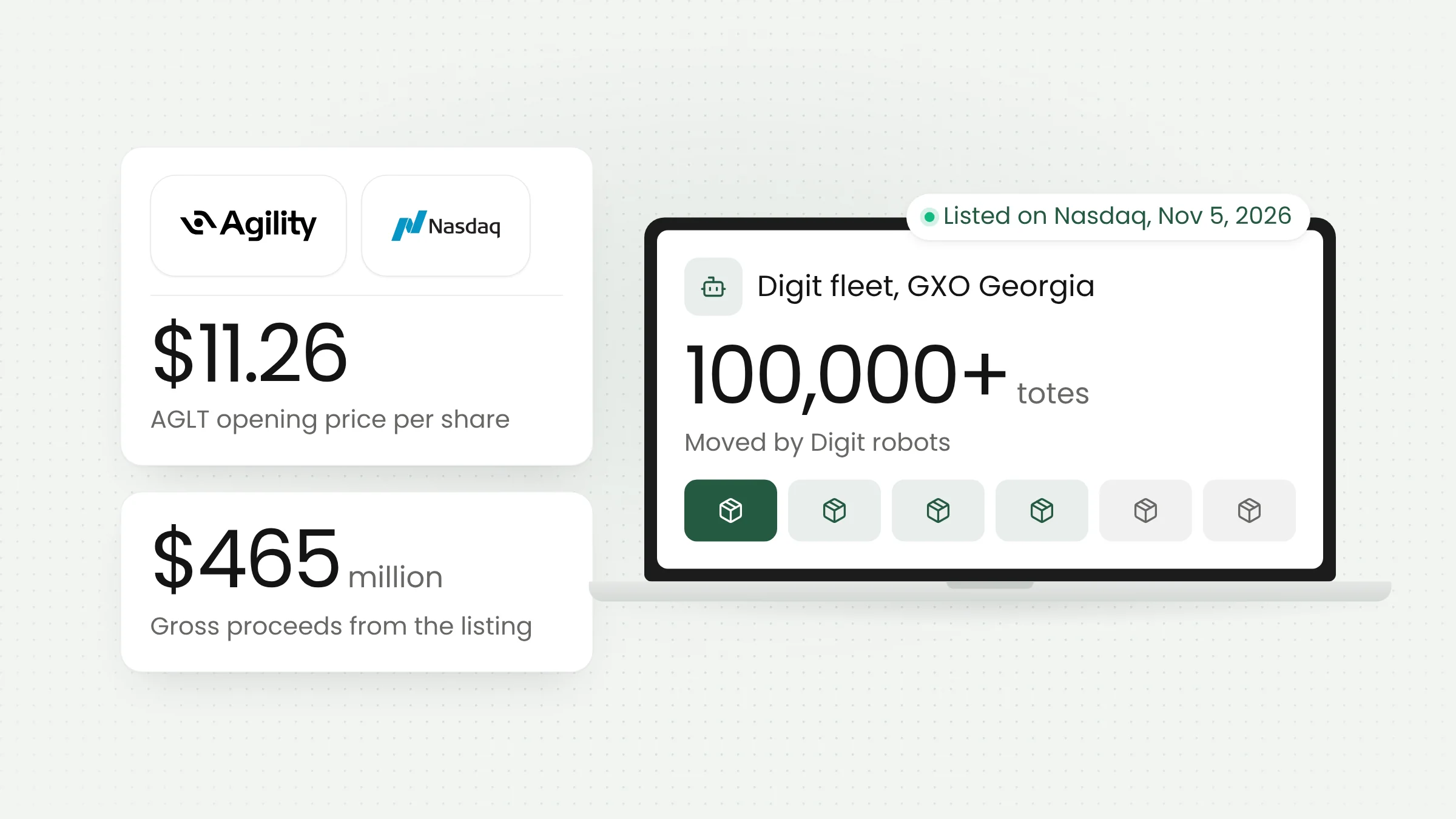
Agility Robotics, the company behind the Digit humanoid robot, began trading on Nasdaq on November 5, 2026, under the ticker AGLT. The listing follows a business combination with Churchill Capital Corp XI and brings in about $465 million in gross proceeds to build more of the robots already working in warehouses and factories.
Agility describes itself as the first pure-play humanoid robotics company listed in the United States. As a public company, its revenue, losses, and sales targets are now open to scrutiny. For warehouse and plant operators, those figures say more about the state of humanoid robots than any demo video.
Agility Robotics begins trading on Nasdaq
Churchill Capital Corp XI is a special purpose acquisition company (SPAC), a listed shell company set up to merge with a private business and take it public. According to Manufacturing Dive, the deal is valued at $2.5 billion and won the support of more than 84% of votes cast by Churchill XI shareholders.
The Robot Report said shareholders approved the deal on November 2 and the transaction closed on November 4. Agility’s common stock trades as AGLT and its warrants as AGLTW. On the first day, AGLT opened at $11.26, above the $10 per-share deal price, and was at $10.30 when the story was published. Shares held by existing Agility shareholders and the Churchill sponsor are subject to a 180-day lock-up.
The $465 million came from three places. About $164 million was left in Churchill XI’s trust account after redemptions. Another $201 million came from a private investment in public equity (PIPE) led by Foxconn, and $100 million was equity funding raised after the merger was announced in June.
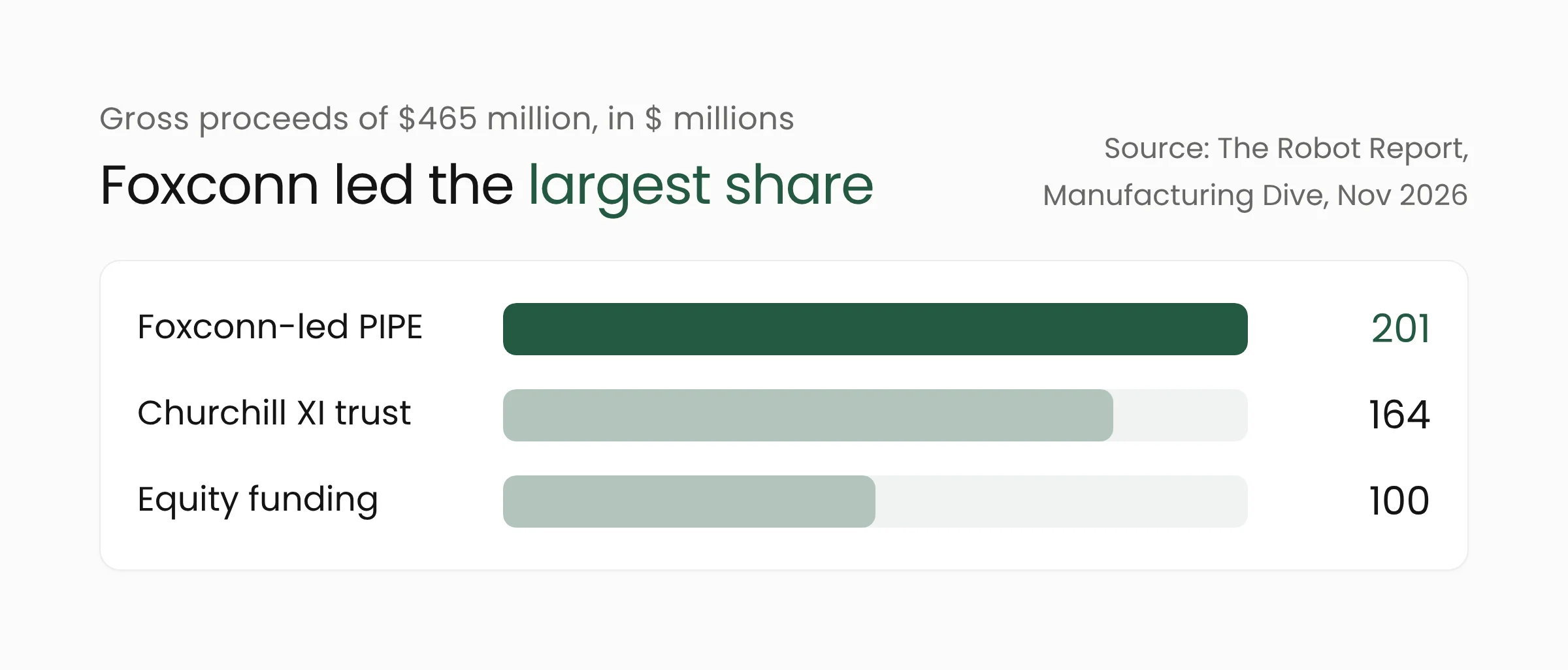
That total is well below the earlier projection. Agility had expected more than $620 million if no shareholders redeemed. In its official press release, the company said the money will fund customer orders, commercial deployments, scaled production of Digit, and platform development.
Digit is already at work in warehouses and factories
Digit is a two-legged humanoid robot designed to work in spaces built for people. Its main job today is moving totes, the plastic containers that carry goods through warehouses and production lines.
Agility says Digit is working with GXO, Schaeffler, and Toyota Motor Manufacturing Canada. At GXO’s site in Georgia, Digit has moved more than 100,000 totes, and GXO plans to add Digit at two more US logistics facilities in early 2027. Farm equipment maker AGCO has also signed an agreement for a Digit pilot expected to start in 2027.
In total, the company says Digit has logged more than 65,000 hours of real-world operation over nearly three years. The Robot Report put those hours across nine customer facilities. Manufacturing Dive reported Agility’s goal of reaching 25 facilities and 100 customers by the end of 2027.
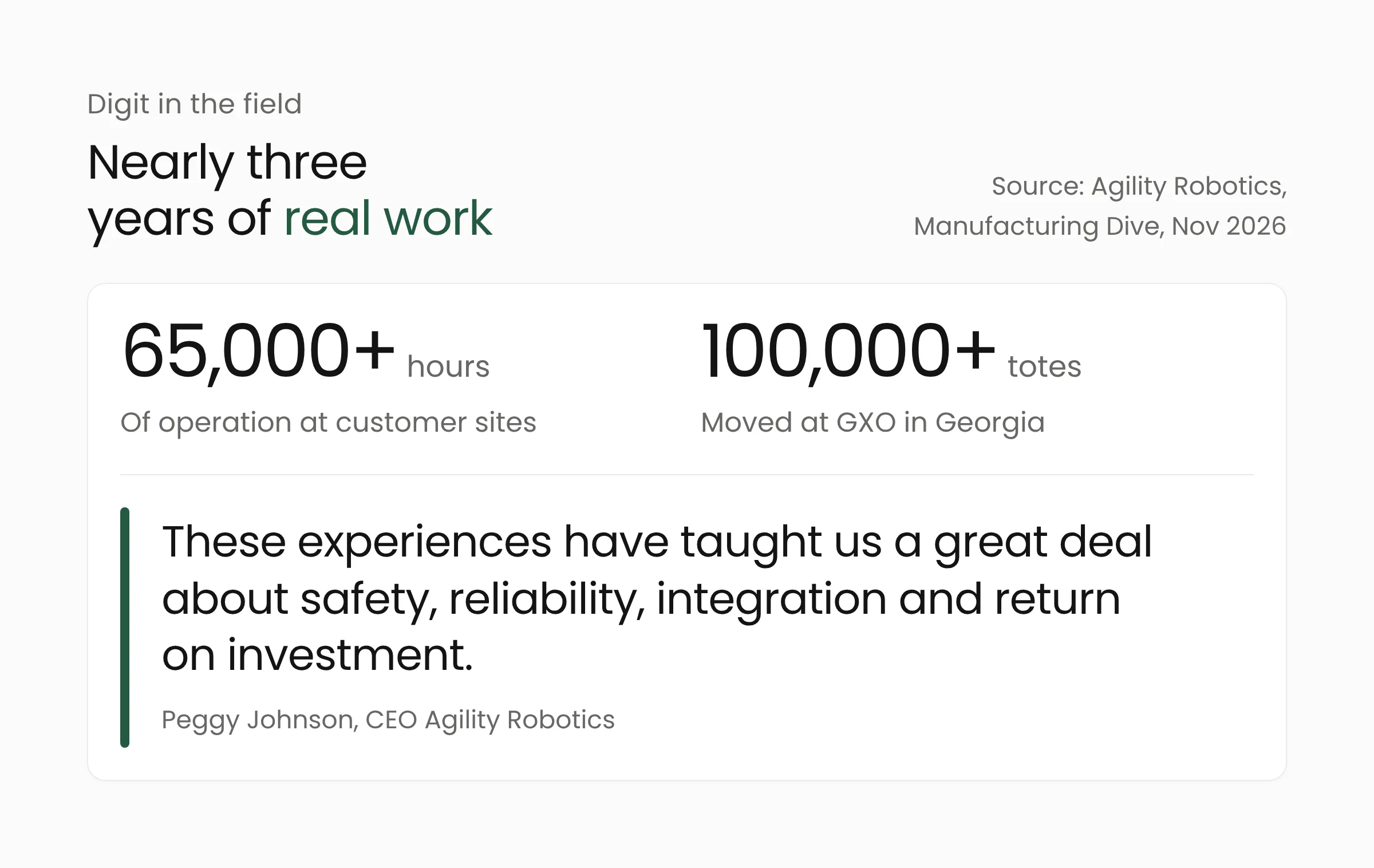
Agility CEO Peggy Johnson told Manufacturing Dive what those deployments have taught the company: “These experiences have taught us a great deal about safety, reliability, integration and return on investment.” Those are the same four questions any plant manager will ask before buying a robot.
Digit 5 and the RoboFab factory
The next generation, Digit 5, was unveiled in September 2026. Agility says it holds more than $300 million in committed multi-year orders for the robot, subject to contractual milestones, features, and specifications. Early customer access is planned for the first half of 2027, with general availability targeted for the end of 2027.
According to the company, Digit 5 is designed to lift up to 50 pounds repeatedly, uses interchangeable end effectors for different tasks, and runs on Nyobolt batteries that can recharge in nine minutes. Agility claims the robot can work more than 20 hours a day. These claims have not been independently tested.
The robots will be built at RoboFab, a 70,000-square-foot plant in Salem, Oregon, designed to produce up to 10,000 robots a year. That figure is design capacity rather than current output. Fleets are managed through Agility Arc, a cloud platform for monitoring and directing robots at customer sites. For safety, Agility plans to standardize on NVIDIA IGX Thor onboard computers, NVIDIA Halos safety technology, and systems from FORT Robotics.
Where humanoids fit among industrial robots
Humanoids are still a small slice of automation. The International Federation of Robotics (IFR) reported that 5 million industrial robots were operating in factories worldwide in 2025, up 9%. More than 600,000 new units were installed that year, with China accounting for about 59% of installations. The IFR expects installations to rise to 655,000 units in 2026.
Most of those machines are robot arms working inside fenced cells, repeating the same motion. Humanoids target the work between those machines: pulling totes from racks, placing them on conveyors, or feeding production lines. Because they share a human form, they can operate in existing facilities without a redesign of the floor plan.
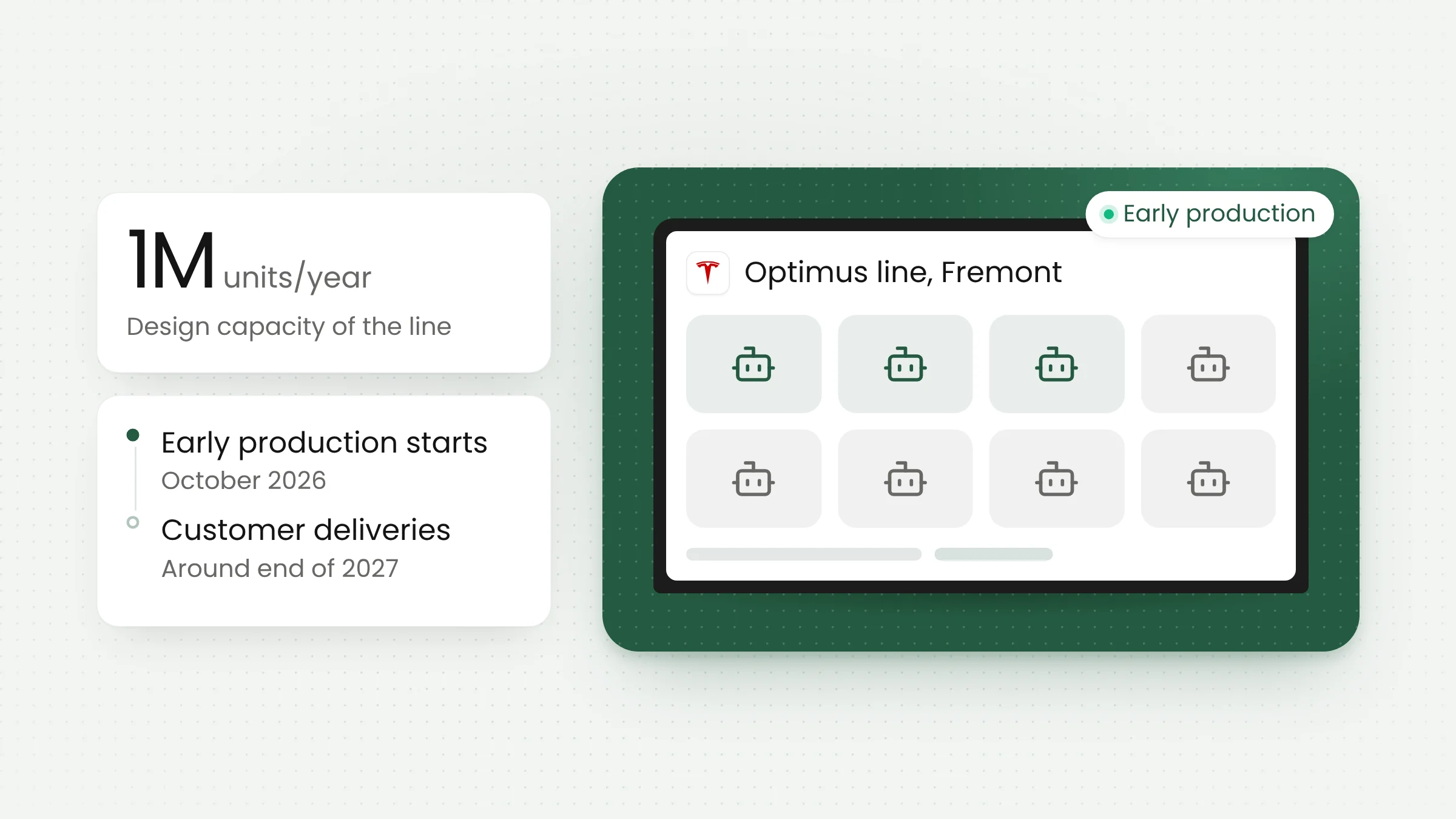
Agility has company. Tesla, for example, has started early production of its Optimus robot in Fremont, with factories as its first target. Agility co-founder Jonathan Hurst told The Robot Report that Digit will likely not get wheels, although wheeled robots are on the roadmap for a broader family of robots. Peggy Johnson also raised the possibility of licensing Agility’s technology to other humanoid developers.
Revenue is small and orders are conditional
The financials show a business at an early stage. According to The Robot Report, Agility’s 2025 revenue was $1.78 million, up from $310,000 in 2024. It posted a net loss of $138.1 million for the year. About 64% of revenue came from related parties, and the company ended 2025 with $103 million in cash.
The Digit 5 order book of more than $300 million is also not revenue yet. Those orders only turn into sales once robots ship against the agreed milestones and specifications. Agility’s own press release lists risks including Digit 5 delivery delays, orders that may not convert, difficulty scaling production, net losses, and the adequacy of its capital.
Investors are betting that Digit can be built at volume and used routinely by many customers. Potential buyers should judge humanoid vendors on after-sales support as well as specifications.
What this means for factories and warehouses in Indonesia
There has been no official announcement about Digit being sold or supported in Indonesia, and Digit 5 is not due for general availability until the end of 2027. Even so, operators of e-commerce warehouses, retail distribution centers, and automotive component plants can use the time to prepare.
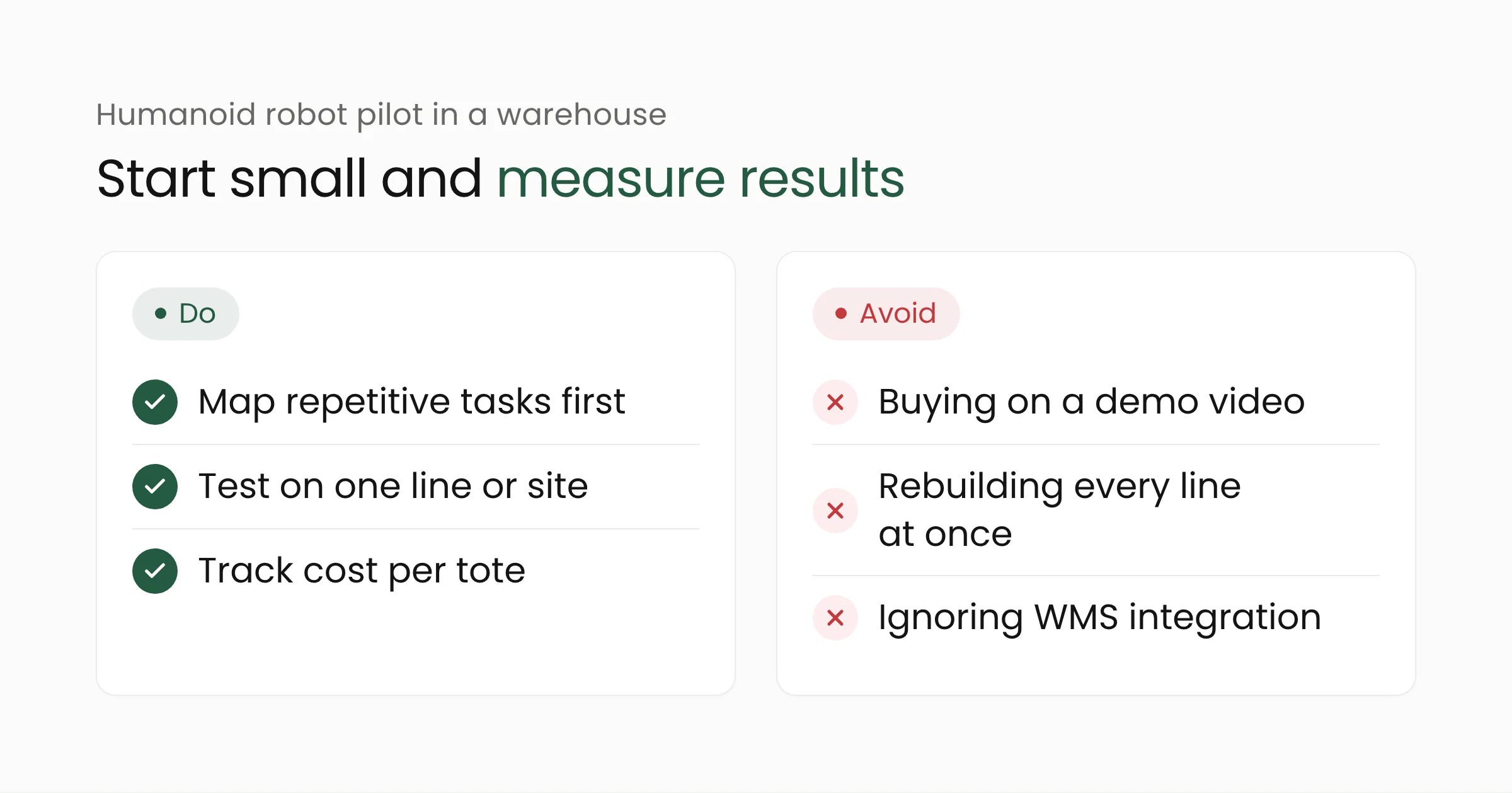
- Start with the task, then pick the robot. List the repetitive jobs that take up the most labor, such as moving totes from racks to conveyors. Measure volume per hour, load weight, and travel paths. That data shows whether a humanoid, an autonomous mobile robot (AMR), a conveyor, or a robot arm makes the most sense.
- Get the facility’s data and connectivity ready. Robots like Digit are managed from a cloud platform and need to exchange data with the warehouse management system (WMS). Reliable wireless coverage, sensors at key points, and real-time monitoring are the groundwork for any robot. An IoT services team can help map those needs early.
- Set safety rules before the pilot. Define shared work zones for robots and people, emergency stop procedures, and operator training. Ask the vendor which safety standards the robot follows.
- Measure the pilot in numbers. Compare cycle time, error rate, downtime, and cost per tote before and after the robot arrives. The GXO and AGCO programs show that even large customers start with a single site.
Ask early about spare parts and local technicians, since a robot that stops mid-shift is as costly as any broken machine.
Frequently asked questions
What is Agility Robotics, and what is Digit?
Agility Robotics is a robotics company based in Salem, Oregon. According to The Robot Report, it was spun out of Oregon State University in 2015. Its product, Digit, is a two-legged humanoid robot currently used to move totes in warehouses and factories.
Can companies in Indonesia use Digit yet?
There has been no official announcement of Digit sales or support in Indonesia. The customers Agility has named do not include any in Indonesia, and Digit 5 is targeted for general availability at the end of 2027.
How is a humanoid different from a regular industrial robot?
An industrial robot is usually a fixed arm inside a work cell, built for one type of motion. A humanoid is designed to move through spaces made for people, such as rack aisles and conveyor areas, so it can be deployed without changing the facility layout. Far fewer humanoids are in use, and their abilities are still being proven on site.
Closing thoughts
Agility Robotics’ Nasdaq listing gives an open view of the humanoid robot business: large customers are testing it and orders are in, but revenue is still small and volume production starts in 2027. For factories and warehouses, now is a good time to prepare data, networks, and safety rules. If you want to start mapping automation needs at your own facility, the Merakit team is ready to talk through our industrial automation solutions.
Sources
- Agility Robotics: Agility Becomes First U.S. Publicly Listed Pure-Play Humanoid Robotics Company, Begins Trading Today on Nasdaq as AGLT (November 5, 2026)
- The Robot Report: Agility Robotics begins trading on Nasdaq (November 5, 2026)
- Manufacturing Dive: Agility Robotics clears shareholder vote, expected to go public this week (November 3, 2026)
- International Federation of Robotics: Five Million Robots now Operate in Factories Globally (September 24, 2026)