Blog Digital Sovereignty
Bali Tech Week 2026: Four Actions on Digital Sovereignty
On this page· 7 sections
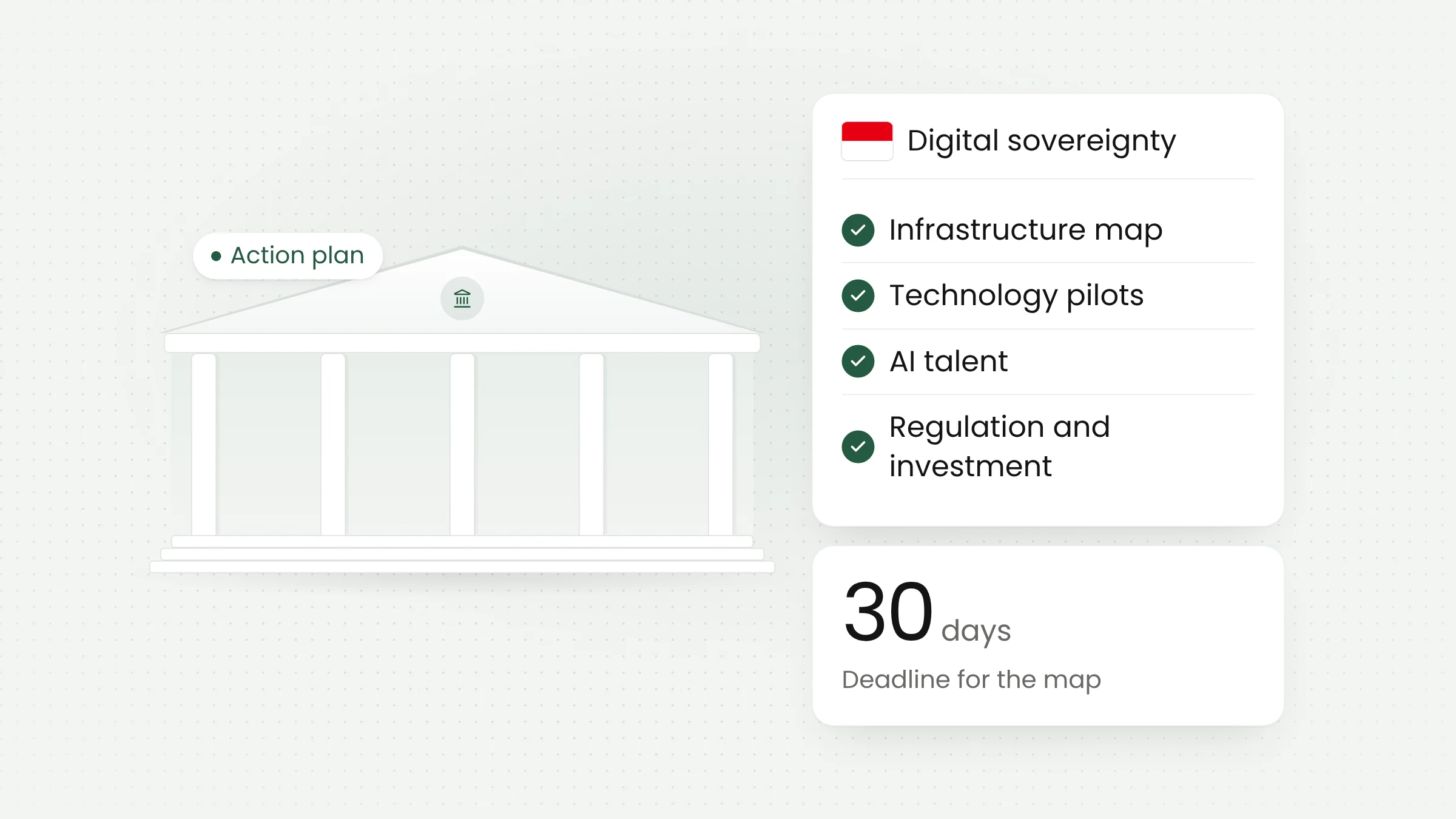
Indonesia’s Deputy Minister of Communication and Digital Affairs, Nezar Patria, announced four follow-up actions for Bali Tech Week 2026 on Thursday, October 22, 2026, in Denpasar. The first is a national digital infrastructure map due within 30 days. The others cover technology pilots, AI talent, and aligning regulation and investment.
The four actions announced in Denpasar
Bali Tech Week 2026 ran from October 19 to 23 at the Bali Beach Convention Center in Sanur. According to ANTARA, the event was organized by the Ministry of Communication and Digital Affairs together with DS Group, with 13 anchor events and a target of more than 4,000 participants, including about 1,000 delegates from more than 30 countries.
The four actions were announced at Sovereign Tech Summit 2026, one of those events. Medcom.id reports that they follow the event’s three pillars: Sovereign Digital Infrastructure, Sovereign Intelligence and Impact, and Sovereign Trust and Risk Alliance. Delivery is described as a collaboration among government, state-owned enterprises, industry, universities, and technology communities.
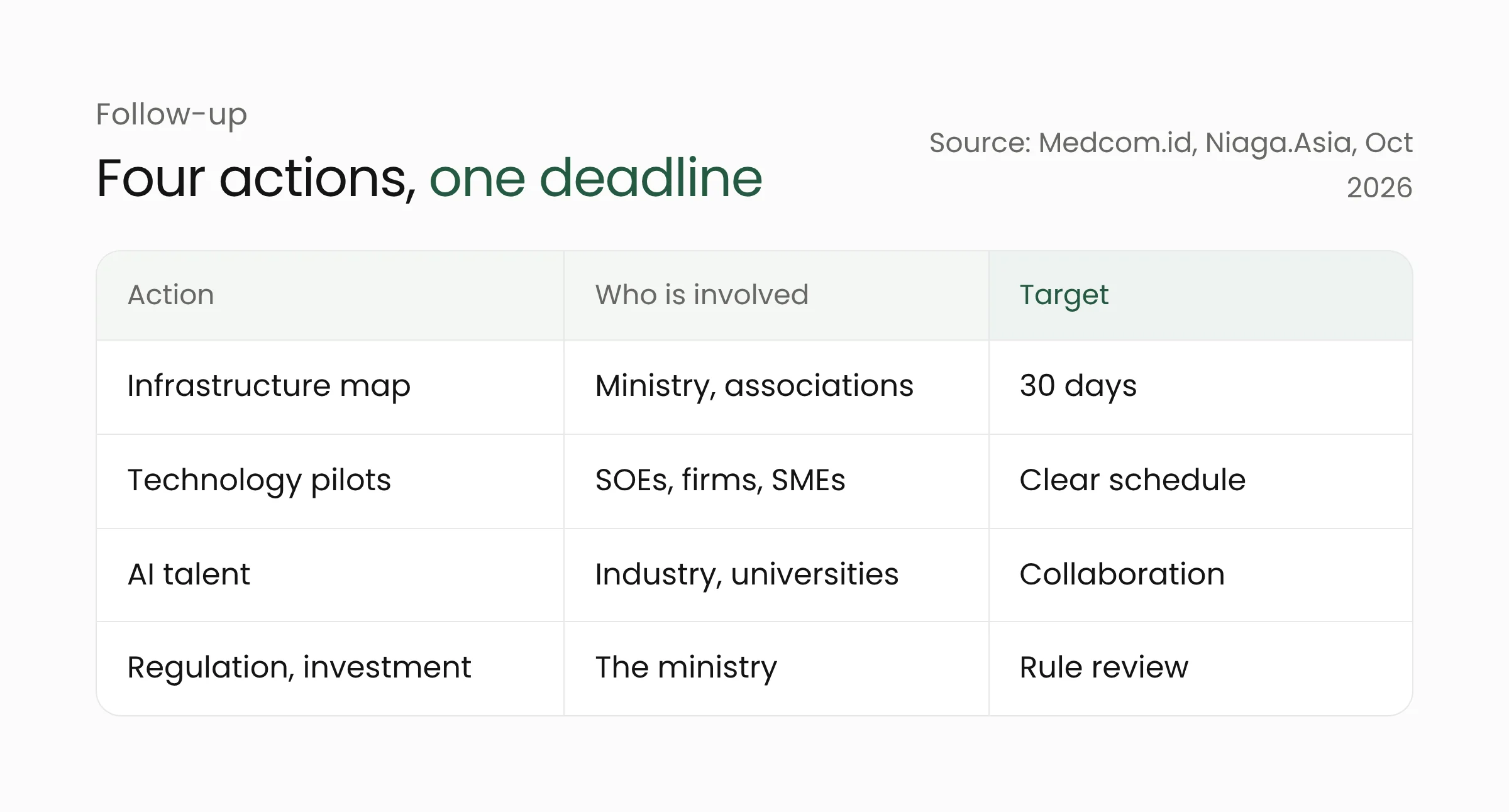
Outlets order the actions slightly differently. ANTARA’s English report lists setting quality standards for digital infrastructure and technology first, while Medcom.id, InvestorTrust, and Niaga.Asia put mapping first. This article follows the latter. We have not found an official ministry document, so technical details may still change.
Three directions from the opening
The four actions build on a framework Meutya Hafid presented at the October 19 opening. ANTARA recorded three directions for digital transformation: connected, growing, and protected.
The connected direction stresses the quality, affordability, and reliability of connectivity. The growing direction focuses on the digital economy. The e-Conomy SEA 2025 report estimated Indonesia’s digital economy gross merchandise value (GMV) at US$99 billion in 2025, up 14 percent. Under the Garuda Spark program, 178 activities have reached more than 15,700 digital talents and mentored 80 startups, with direct investment above Rp429.5 billion.
The protected direction covers public protection, digital service security, and consistent regulation. Efforts include child protection through the PP Tunas regulation, handling of harmful content, digital literacy, stronger personal data protection, and AI governance. Meutya said innovation must ultimately protect the public and companies by providing regulatory certainty. The Denpasar actions can be read as a way to turn those three directions into more concrete work.
A 30-day infrastructure map
The first action is the most measurable because it has a deadline. According to Niaga.Asia, the ministry and industry associations will consolidate the results of all panels into a map of national digital infrastructure and technology. It covers fiber-optic networks, submarine cables, and satellites. The deadline is 30 days from the announcement, or roughly November 2026. The reports we read do not name the associations involved.
Such a map matters because digital service quality depends on the physical links beneath it. At the opening, Communication and Digital Minister Meutya Hafid said about 235 million Indonesians use the internet in 2026, a penetration of 81.72 percent, and that 4G reaches 98.96 percent of the population, according to ANTARA. Those figures show wide coverage but say little about quality and reliability in each region, which is what the mapping is meant to address.
The results have not been published, and it is unclear whether the document will be open to the public. For service operators it is worth watching, since it may become the basis for later action plans. Network operators, data center providers, and local agencies running applications in the regions can compare their own conditions with the mapping findings and use them in budget or partnership proposals.
Pilots, AI talent, and regulatory alignment
The second action is a set of proof-of-concept projects bringing together state-owned enterprises, large corporations, and small businesses. Niaga.Asia says the program needs clear responsibilities, targets, and schedules so that infrastructure investment produces economic value and does not stop at physical facilities. The pilot areas have not been detailed.
The third action strengthens AI talent and innovation through cooperation among industry, university research institutions, and communities. Nezar said workforce readiness matters because infrastructure requires heavy capital spending and long-term planning. In ANTARA’s account, he also said human resource development must keep pace with infrastructure expansion.
The fourth action reviews regulation and investment so that policy stays relevant. The example given is low earth orbit (LEO) satellite service, which Niaga.Asia says can address network gaps in remote, frontier, and outermost regions (known as 3T), maritime areas, and border zones. Nezar said: “Regulasi harus bisa merespons perkembangan teknologi,” which translates as “Regulation must be able to respond to technological developments.” No list of rules to be revised has been given.
What this means for agencies and public service operators
The four actions are policy direction, not new obligations. No rule changed with the October 22 announcement. Even so, agencies designing digital services can use the 30-day window to prepare, especially when a service depends on networks in areas with limited connectivity.
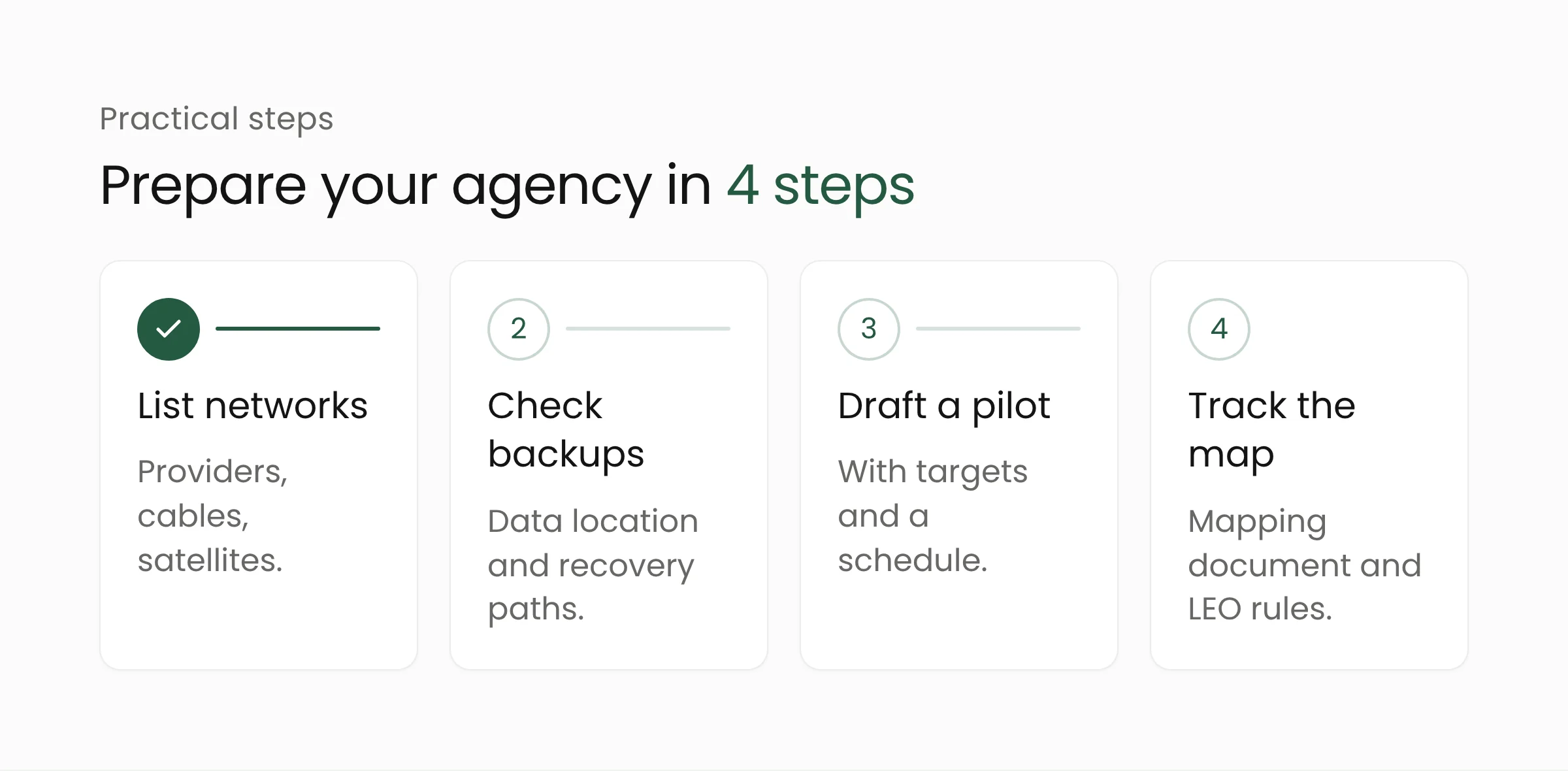
The four steps below are our own practical suggestions, not part of the ministry’s announcement:
- List the network paths your service uses: providers, cables, and satellites where relevant. The list makes it easier to assess your position once the national map appears.
- Check where data and backups sit. System managers often ask whether a service keeps running if one site or one provider fails. Cloud computing services can support that review.
- Prepare a concrete pilot proposal with targets and a schedule, since the second action stresses both. Agencies building public services can refer to our digital government solutions.
- Track the mapping document and any LEO satellite regulation, then adjust network plans if something changes.
For teams building AI features, the talent action signals that training and university partnerships will get attention. The technology choice should still follow service needs, including through suitable artificial intelligence services.
Frequently asked questions
Will the infrastructure map be made public?
That has not been announced. The reports we read say only that the ministry and industry associations will compile the document within 30 days, without stating how it will be published.
Is any new rule in effect now?
No. What was announced is four follow-up actions. Regulation, including for LEO satellites, will be reviewed later, and the rules to be revised have not been named.
What does digital sovereignty mean at this event?
Bali Tech Week 2026 is built on three pillars: Sovereign Digital Infrastructure, Sovereign Intelligence and Impact, and Sovereign Trust and Risk Alliance. According to InvestorTrust, Nezar also said Indonesia remains open to global collaboration, technology, and investment.
Conclusion
The October 22 announcement gives an early picture of what the government will do after the forum, with one clear deadline: an infrastructure map within 30 days. That document will show how concrete the other actions are. If you are preparing a digital service for an agency or company, Merakit is ready to discuss network, cloud, and security design.
Sources
- Medcom.id, 4 Agenda Aksi Bali Tech Week 2026 Perkuat Kedaulatan Digital Indonesia (October 23, 2026)
- Niaga.Asia, Komdigi Siapkan Peta Infrastruktur Digital Nasional dalam 30 Hari (October 24, 2026)
- InvestorTrust, Bali Tech Week 2026 Tetapkan 4 Agenda (October 23, 2026)
- ANTARA, Indonesia outlines four steps to strengthen digital sovereignty (October 22, 2026)
- ANTARA, Menkomdigi bahas 3 arah transformasi digital RI di Bali Tech Week 2026 (October 19, 2026)