Blog Cybersecurity
Drupal Flaw CVE-2026-132165: Patch and Lock Down install.php
On this page· 7 sections
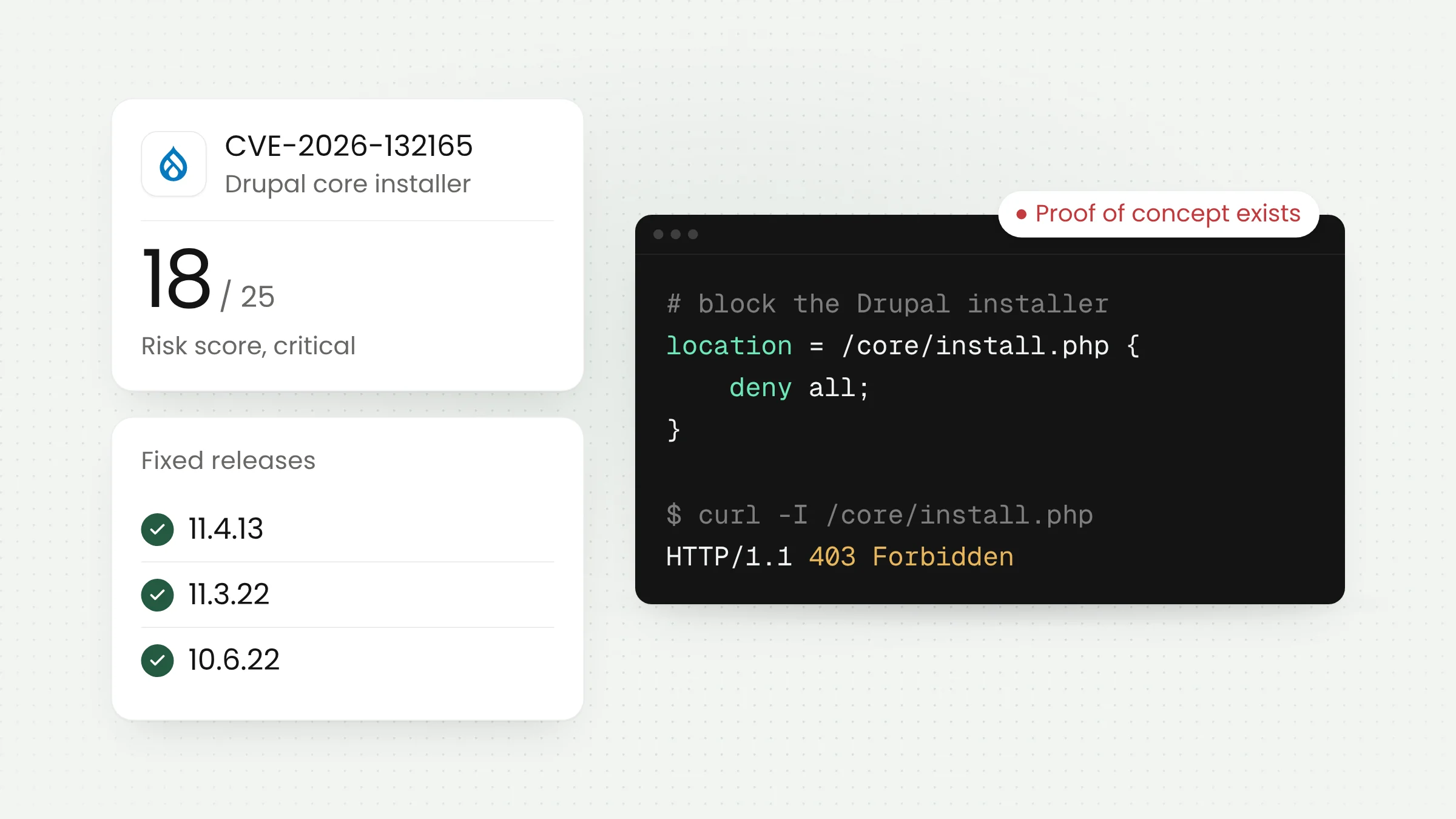
The Drupal Security Team shipped fixes for critical flaw CVE-2026-132165 on November 18, 2026. The bug sits in the install.php installer, and under certain conditions an unauthenticated attacker can use it to try to reinstall Drupal, leading to site takeover or remote code execution. Fixed releases are 11.4.13, 11.3.22, and 10.6.22.
A one-time installer that never leaves
Drupal is a PHP content management system (CMS) widely used for large portals such as government agencies, universities, media outlets, and nonprofits. Every Drupal codebase ships with install.php, the page used once when a site is first set up. After the site goes live, the file stays on the server.
According to advisory SA-CORE-2026-017, under specific conditions an attacker can use that installer to attempt to reinstall Drupal. If the attempt succeeds, the attacker can take over the site or run code on the server. Drupal rates the issue critical, 18 out of 25 on its own risk scale.
The advisory’s risk string adds useful detail. The attack is complex (AC:Complex) and affects uncommon configurations (TD:Uncommon). It also needs no account (A:None), can affect all site data and content (CI:All, II:All), and a proof of concept exists (E:Proof). In its advance notice, PSA-2026-11-16, the security team said at least one of the issues in this release could be exploited by anonymous users.
The advisory notes that some exploit paths are blocked when the web server cannot write to settings.php or change its permissions. That file holds the site’s core configuration, including database connection details. The issue was found by Anthropic’s OSS Scanner and reported by several members of the Drupal community.
The same release closes a second issue, SA-CORE-2026-018, tracked as CVE-2026-132166. It is a gadget chain, a set of existing methods that could be chained into code execution if another flaw on the site passes untrusted data to unserialize(). Drupal rates it moderately critical at 14 out of 25 and says it is not directly exploitable.
Affected Drupal versions and fixed releases
Drupal lists the affected range as every version below 10.6.22, versions 11.0.0 up to but not including 11.3.22, and versions 11.4.0 up to but not including 11.4.13. Fixes are available for the three supported branches:
- Drupal 11.4.x: update to 11.4.13
- Drupal 11.3.x: update to 11.3.22
- Drupal 10.6.x: update to 10.6.22
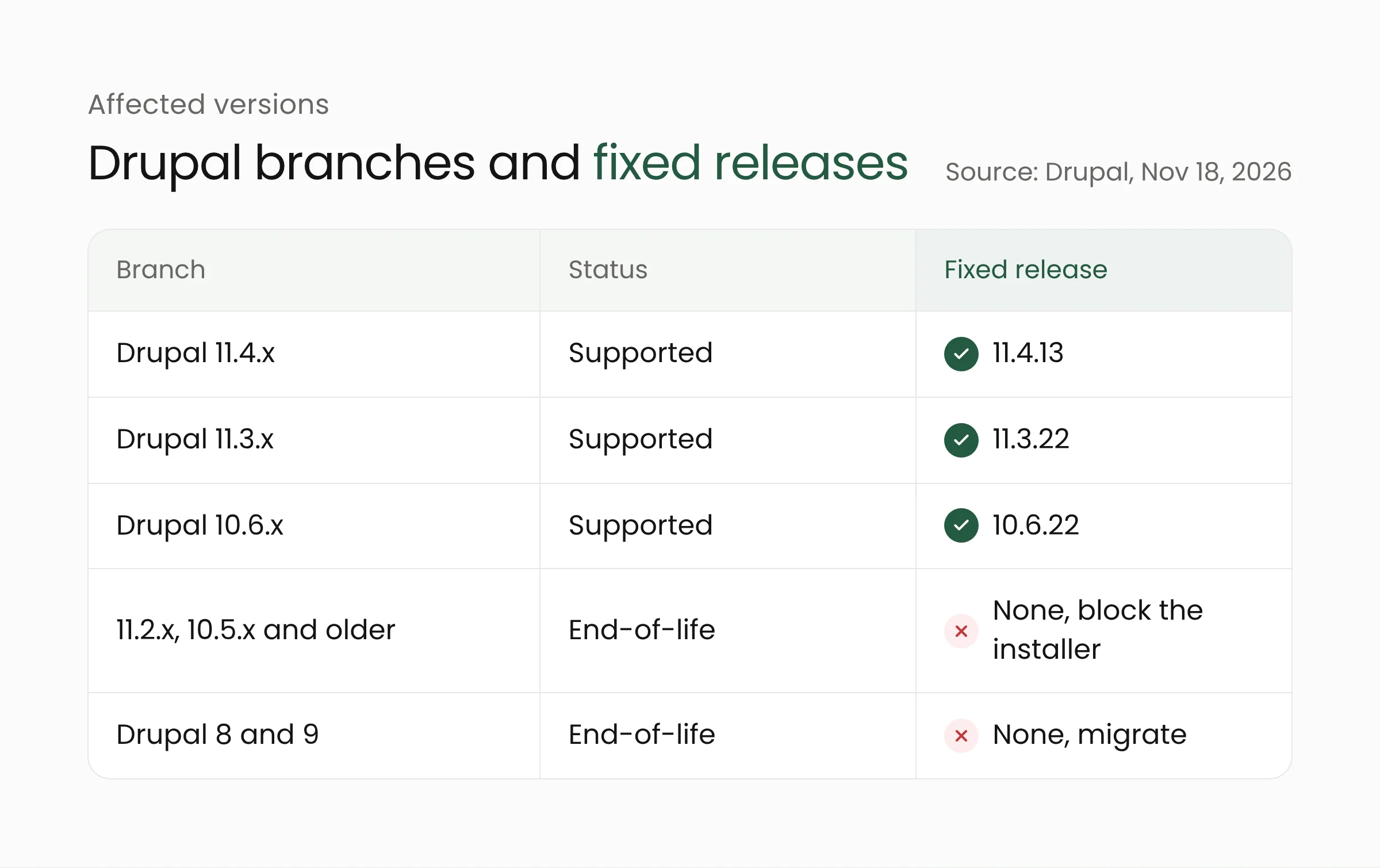
Sites on older branches are in a harder spot. Drupal 11.2.x and below, Drupal 10.5.x and below, and Drupal 8 and 9 are end-of-life and receive no security coverage. For those sites, the advisory points administrators to the guidance on securing the installer as an interim mitigation and urges an upgrade to a supported branch.
Drupal 7 is not mentioned in the advisory. Hosting provider Pantheon offers Drupal 7.109 through long-term support with Tag1 Consulting, and that release removes install.php. The University of Toronto advisory recommends blocking the installer on Drupal 7 sites regardless.
Exploitation status as of November 19
The security team gave two days’ notice. PSA-2026-11-16 announced a release window on November 18, 2026, from 17:00 to 21:00 UTC, and asked administrators to set aside time for updates because exploits could appear within hours or days of the release.
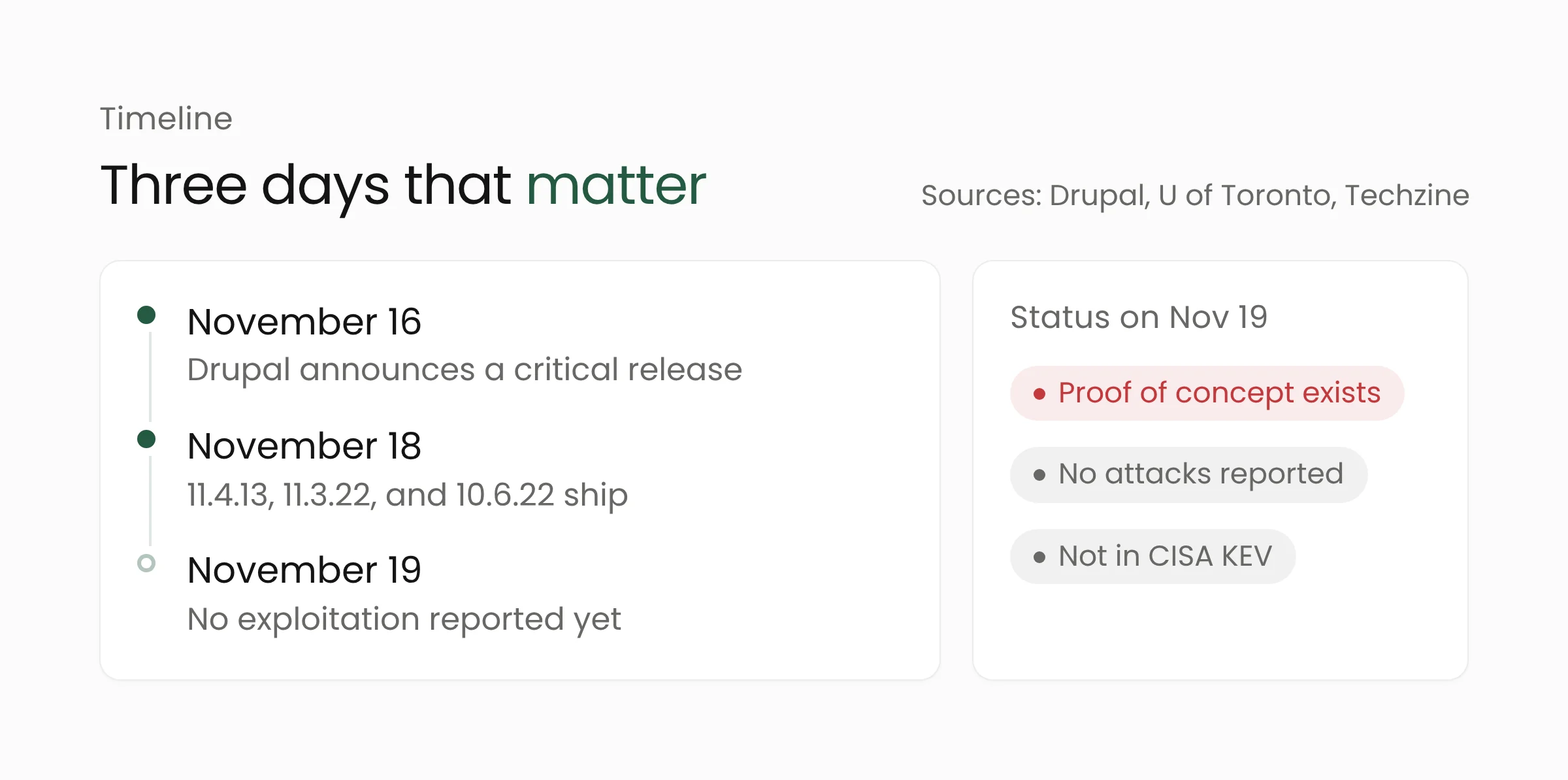
As of November 19, no attacks using the flaw had been reported. Techzine reported this and cited an NCSC assessment that rates the likelihood of exploitation as moderate and the potential damage as significant. The University of Toronto advisory also noted that the flaw was not in CISA’s KEV catalog as of November 19.
That status can change quickly. The University of Toronto pointed out that two other Drupal flaws were exploited earlier this year. In late October, Merakit also covered an exploited Drupal Commerce flaw that targeted online stores. With a proof of concept already in existence, the gap between the fix and the first attacks could be short.
Some hosts moved early. Pantheon said it deployed Drupal Steward protections, a web application firewall service for Drupal sites, to all environments ahead of the release, and that its platform blocks the installer once a site is installed. Drupal stresses that sites protected by Drupal Steward should still update, because new attack paths may be found.
What this means for Drupal site owners
In many organizations, Drupal sites are run by small teams or by agencies whose contracts ended long ago. A provincial agency portal, a faculty website, or a professional association’s site can run for years without core updates. Those sites need checking today, especially if they sit on an end-of-life branch.
Block install.php now
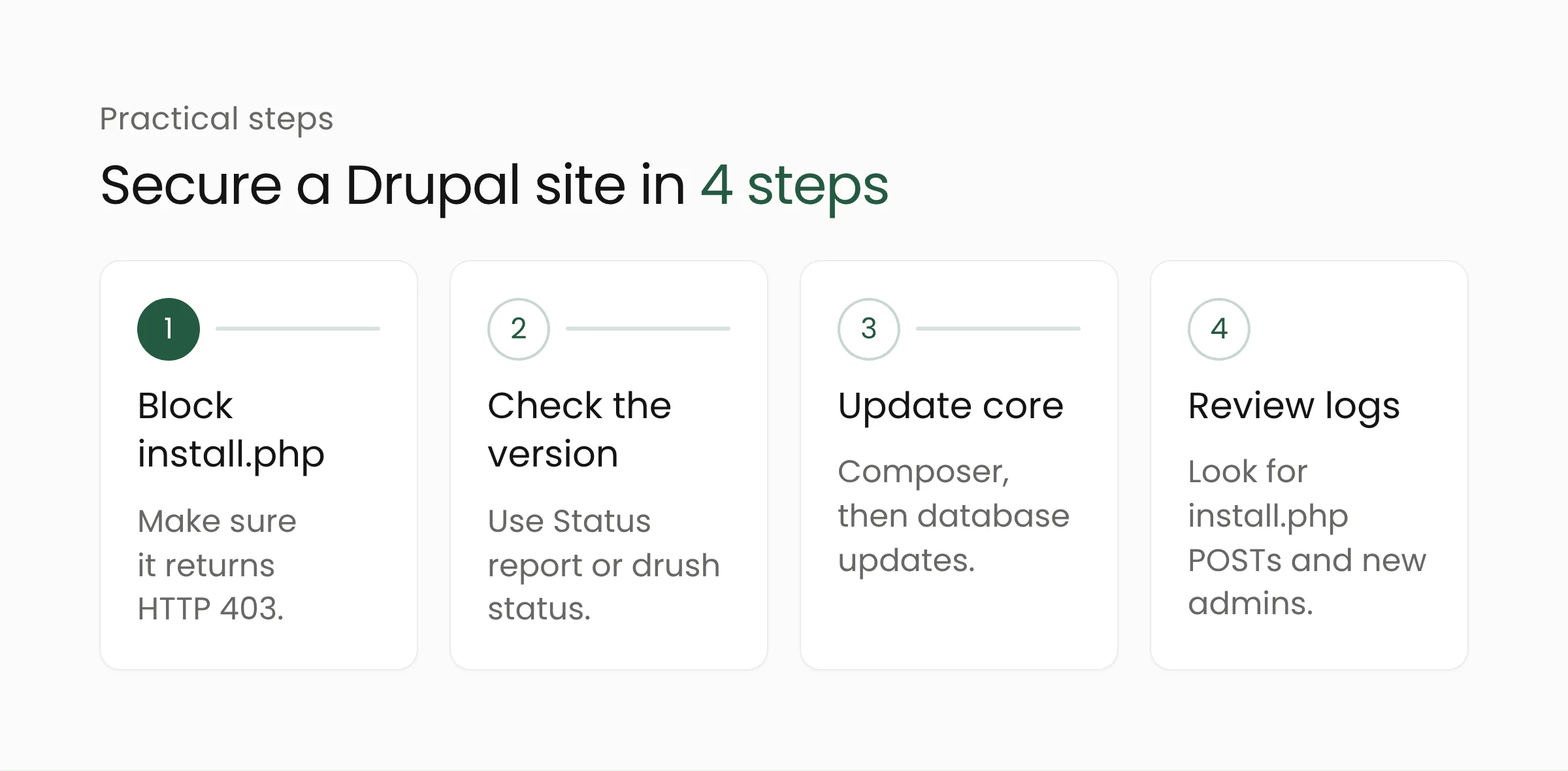
The University of Toronto advisory calls blocking the installer the fastest safe step, and it matches Drupal’s own advice to secure the installer after installation. Do it at the web server level so the rule survives core updates. On nginx, add an exact-match location block:
location = /core/install.php {
    deny all;
}
On Apache, a similar rule can go in the virtual host configuration:
<Location "/core/install.php">
    Require all denied
</Location>
Adjust the path if Drupal lives in a subdirectory. Then confirm that /core/install.php returns HTTP 403, for example with curl -I https://your-site/core/install.php.
Check your Drupal core version
The installed version appears under Reports > Status report (/admin/reports/status) or in the output of drush status. Compare it with the fixed release for your branch, and repeat the check for every site, including old ones nobody visits.
Update to a fixed release
On Drupal 10 and 11, update through Composer, then run database updates and clear caches, for example with drush updatedb and drush cache:rebuild. Test on staging if you have it, but keep that window short. Also make sure the web server cannot write to settings.php or the sites/default directory, since that setting closes some exploit paths.
Look for signs of compromise
Drupal has not published indicators of compromise. The University of Toronto suggests several checks: requests to /core/install.php after go-live in web server logs, especially POST requests; a settings.php modification time later than go-live or unfamiliar database details; new administrator accounts; unknown modules; and unexpected .php files under sites/default/files. If you find anything, isolate the server and preserve logs and the database before restoring anything.
For sites on unsupported branches, blocking the installer only buys time. Plan the move to a supported branch, and if the in-house team is stretched, bring in a web development or cybersecurity team to map the modules and themes that need work.
Frequently asked questions
Is my site safe if nobody ever opens install.php?
Not necessarily. The University of Toronto notes that core/install.php stays in place after installation and Drupal’s default .htaccess rules do not block it, so it is often reachable from the internet. Confirm that it returns a 403.
Is Drupal 7 affected by CVE-2026-132165?
Advisory SA-CORE-2026-017 does not mention Drupal 7. Pantheon offers Drupal 7.109 through long-term support, which removes install.php, and the University of Toronto recommends blocking the installer on Drupal 7 sites anyway.
Has the flaw been exploited yet?
As of November 19, 2026, Techzine and the University of Toronto reported no exploitation. Drupal’s advisory says a proof of concept exists, so updates should not wait.
Conclusion
CVE-2026-132165 shows how a file used once during setup can become an entry point years later. Blocking install.php takes minutes, while a core update takes a little planning. If your organization runs several Drupal sites and needs help setting update priorities, the Merakit team is ready to help.
Sources
- Drupal core, Critical, Remote code execution, SA-CORE-2026-017 (Drupal Security Team, November 18, 2026)
- Drupal core, Moderately critical, Gadget chain, SA-CORE-2026-018 (Drupal Security Team, November 18, 2026)
- Upcoming critical core releases on Nov 18, PSA-2026-11-16 (Drupal Security Team, November 16, 2026)
- Security advisory: Critical remote code execution in the Drupal core installer (University of Toronto, November 19, 2026)
- Drupal core security releases fix a critical remote code execution issue (Pantheon, November 18, 2026)
- Critical Drupal vulnerability allows attackers to take over sites via the installer (Techzine, November 19, 2026)