Blog Cybersecurity
vCenter Flaw CVE-2026-123890 Exploited: Versions to Install
On this page· 7 sections
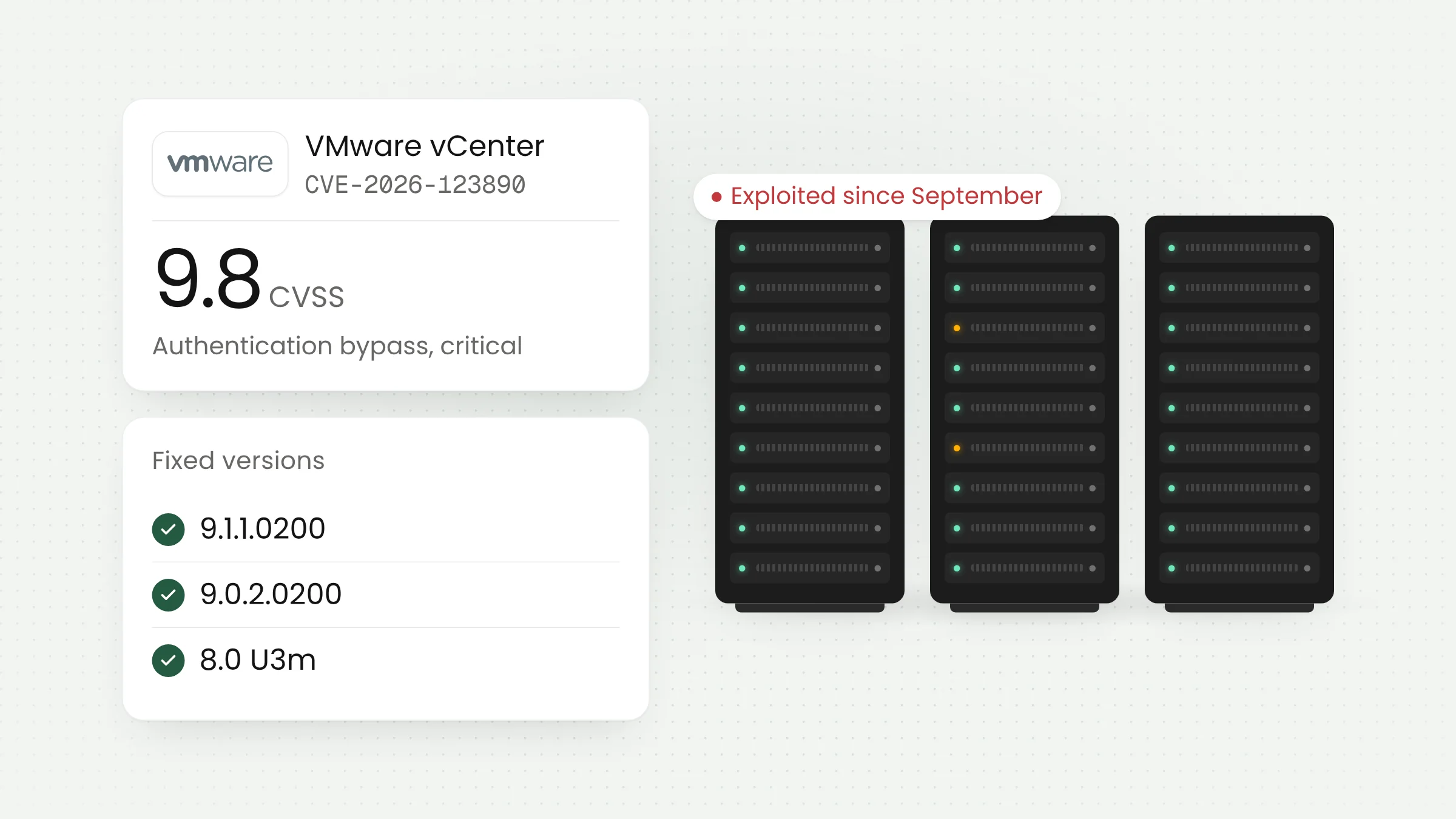
Broadcom released security updates for vCenter flaw CVE-2026-123890 on November 19, 2026. The bug carries a CVSS score of 9.8 and lets an attacker who can reach vCenter over the network get in without a password. Google says it has been used in attacks since early September.
A way into the console that runs every virtual machine
VMware vCenter is the central console for managing an organization’s ESX hosts and virtual machines. In practice, a vCenter administrator account controls every server running underneath it.
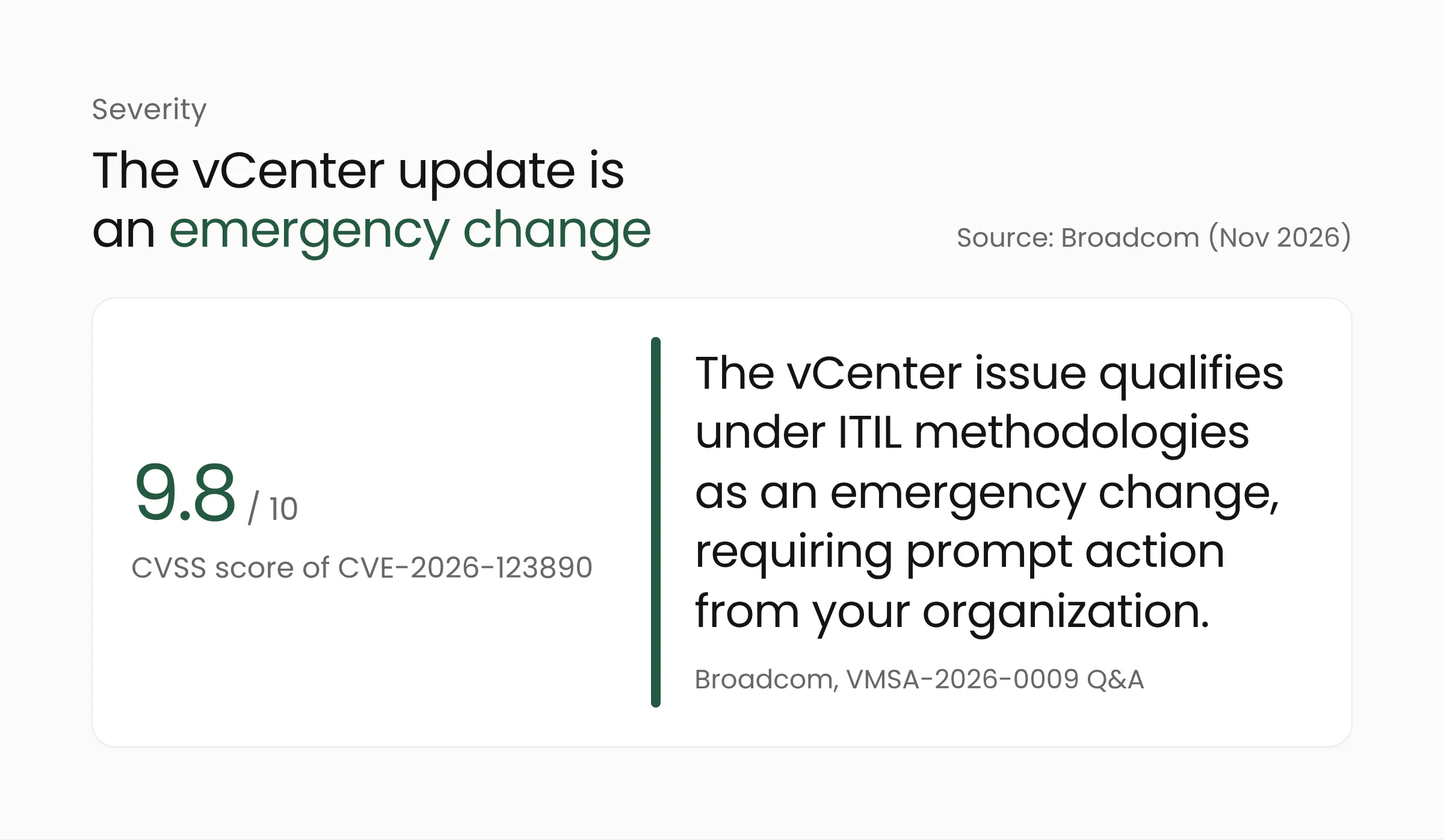
In advisory VMSA-2026-0009, Broadcom describes CVE-2026-123890 as an authentication bypass in the VMware Directory Service, the directory component inside vCenter that holds account and single sign-on data. An attacker with network access to vCenter can skip the login process and gain unauthorized access. Broadcom rates it 9.8 on the CVSS scale, critical severity, and credits Mandiant with the report.
The advisory covers five flaws in total. The other four score between 6.7 and 8.1: three in SDDC Manager (CVE-2026-123891, CVE-2026-123892 and CVE-2026-123893) and one in VMware Tools for Windows (CVE-2026-123894). All four require an attacker who already holds an account or elevated privileges, which is why the vCenter bug gets most of the attention.
Broadcom lists no workaround for any of the five. Its official question-and-answer document states: “The vCenter issue qualifies under ITIL methodologies as an emergency change, requiring prompt action from your organization.” Put plainly, the vCenter update should not wait for the next routine maintenance window.
This is the second critical flaw in the VMware Directory Service in 2026. On July 29, Broadcom patched CVE-2026-59309, another authentication bypass in the same component with the same 9.8 score, as The Hacker News notes.
The attacks Google traced back to September
Broadcom’s advisory says nothing about exploitation. That detail comes from a report by Google Threat Intelligence Group and Mandiant published the same day, November 19, 2026.
According to the report, a group Google tracks as ARMORY CASTLE used the flaw in early September 2026, more than two months before a fix existed. Google assesses the group as a suspected China-nexus espionage actor. The report does not disclose how many organizations were hit, or in which sectors and countries.
The intrusion Mandiant investigated did not start at vCenter. The attackers first entered the victim’s network through a separate flaw in a BeyondTrust Remote Support appliance, then scanned the internal network for ports typical of VMware systems. From an internal Linux appliance that had no endpoint detection tooling, they ran a tool Google calls BONESAW against vCenter.
BONESAW targets the vCenter directory service on port 2012. When it succeeds, the attacker holds a session as [email protected] without ever knowing the password. The vCenter server in this case had already been patched against CVE-2026-59309, which led Mandiant to conclude that the group knew about the new flaw in advance.
With administrator rights in hand, the attackers created a new local admin account, switched on SSH through the vCenter appliance management interface, and switched it off again when they were done. From vCenter they moved to an ESXi host and copied the Active Directory account database straight from virtual machine disks. Google adds that the group forged administrator login tokens with a signing key taken from vCenter, which also bypasses multi-factor authentication.
The two sources differ slightly on scope. Google says BONESAW works against vCenter Server 7.x and 8.x appliances, while Broadcom’s advisory lists vCenter 7.0, 8.0, 9.0 and 9.1 as affected. The vendor advisory is the reference for deciding what to update.
Fixed versions and what to know before updating
Broadcom revised the advisory on November 20, 2026, to VMSA-2026-0009.1, clarifying which VMware Tools versions are affected. The list of fixed vCenter versions did not change.
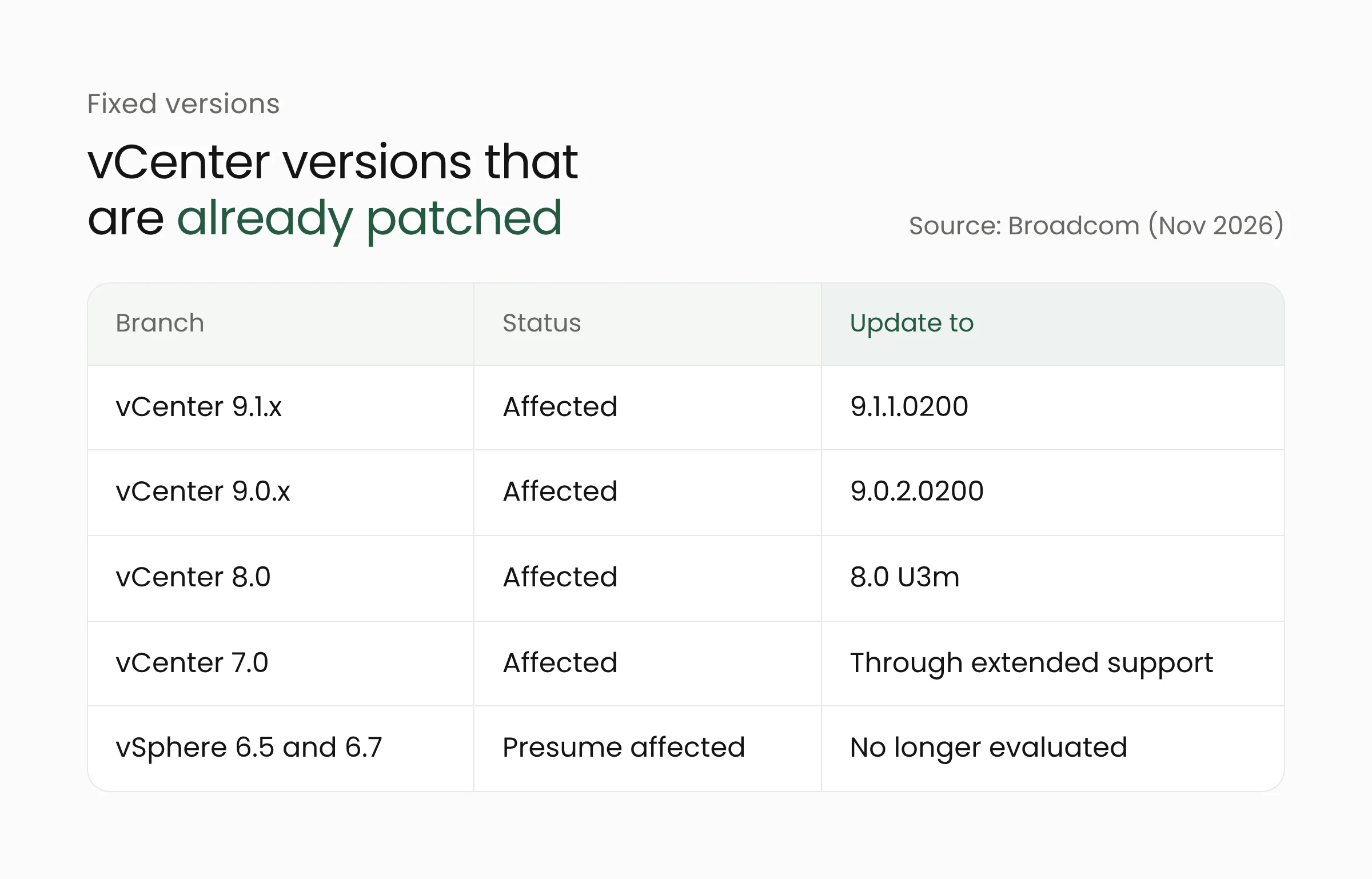
Fixed versions for the vCenter flaw, as listed in the advisory:
- vCenter 9.1.x (VMware Cloud Foundation and vSphere Foundation): update to 9.1.1.0200;
- vCenter 9.0.x: update to 9.0.2.0200;
- vCenter 8.0: update to 8.0 U3m;
- VMware Cloud Foundation 5.x: apply vCenter 8.0 U3m through the asynchronous patching process (KB 88287) and update SDDC Manager to 5.2.5;
- vCenter 7.0: affected, but a patch is available only to customers with an active extended support contract, through Broadcom Support.
For vSphere 6.5 and 6.7, Broadcom tells customers to presume they are affected, because it no longer evaluates products past their end of general support. vSphere 7 itself reached end of general support on October 2, 2025. ESX hosts are not affected by any of the five flaws, and none of them allows code to break out of a virtual machine onto the host.
The other issues in the advisory are closed by SDDC Manager 9.1.1.0200, 9.0.2.0100 or 5.2.5, and by VMware Tools for Windows 13.1.5.0 or 12.5.5.
What happens while the update runs
Broadcom’s Q&A says virtual machines keep running while vCenter is updated. The vSphere Client and other management methods are unavailable for a short time. New encryption and key rotation operations that depend on a Standard Key Provider are also unavailable until vCenter is back, while existing encrypted workloads, vSphere HA and vSAN continue to operate.
The updates cannot be installed with vCenter Quick Patch. They go in through the vCenter appliance management interface (VAMI) or the standard vSphere and VCF update mechanisms. The packages are cumulative and already include the fixes from the previous advisory, VMSA-2026-0008.
A snag for teams upgrading to VCF 9.1.1
vCenter 8.0 U3m and 9.0.2.0200 carry newer build numbers than VCF 9.1.1, so both block an upgrade to VCF 9.1.1. Broadcom calls this a “Back-in-Time” restriction and says compatibility will return in VCF 9.1.2.
Organizations in the middle of an upgrade have two options. They can move vCenter to 9.1.1 first and apply the security update there. Or they can install the security update now and resume the upgrade once VCF 9.1.2 is available. See KB 67077.
What this means for IT teams running VMware
VMware still sits under the server rooms of many local governments, hospitals, universities, banks and factories in Indonesia. In those environments a hospital information system, a regional finance application and an academic server often share one cluster managed by one vCenter. Whoever takes over vCenter takes over all of them at once.
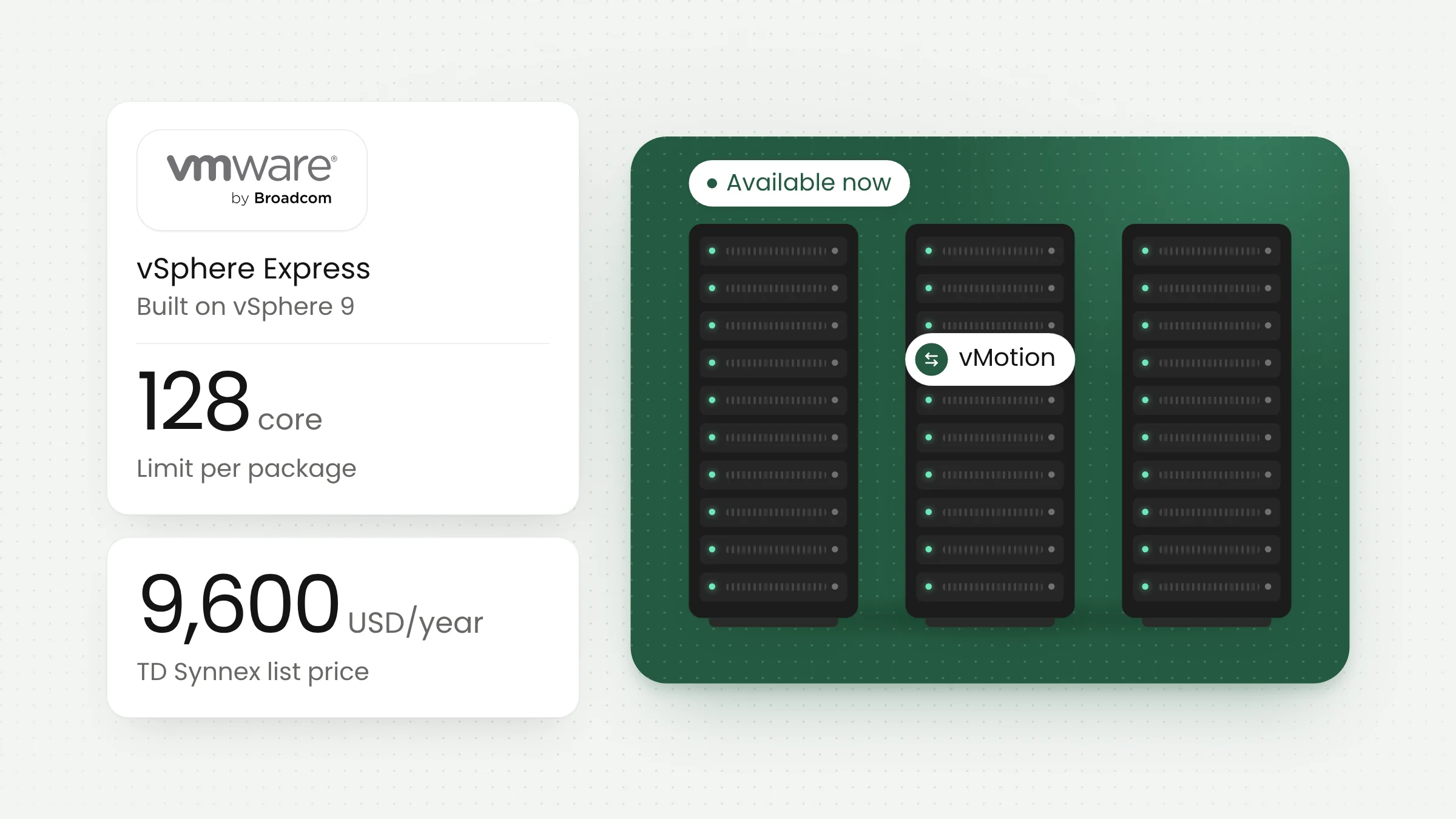
Small teams weighing the new vSphere Express license for servers up to 128 cores depend on vCenter too, so this advisory applies to them as well.
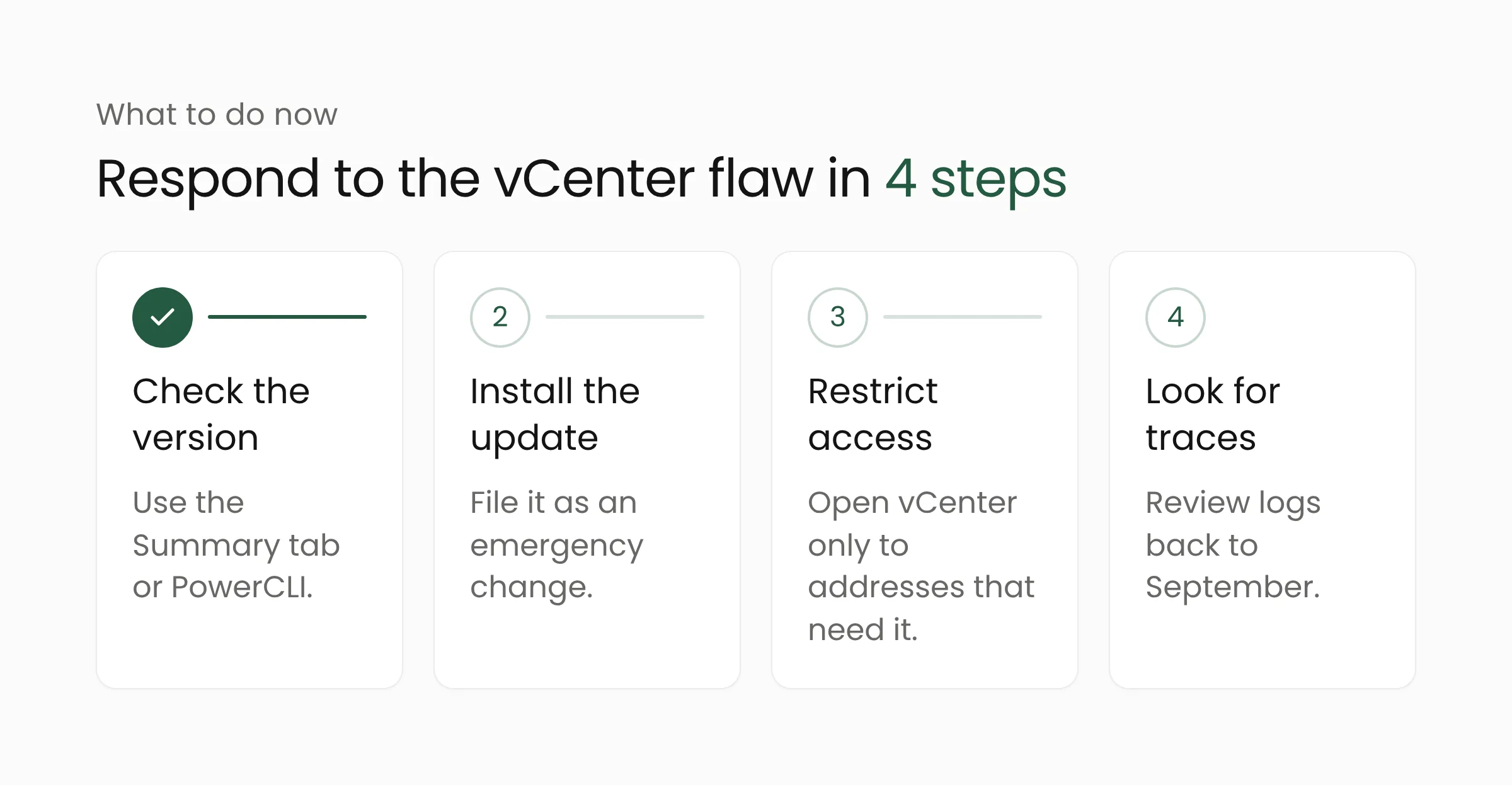
Check the vCenter version and build
The version and build number appear on the Summary tab in the vSphere Client. In PowerCLI, connect with Connect-VIServer, then read $global:DefaultVIServer.Version and $global:DefaultVIServer.Build. Compare the result with the fixed versions above.
Install the update as an emergency change
Request a maintenance window as soon as possible and tell users that only management access will pause briefly, while services inside virtual machines stay up. Customers on third-party engineered systems such as Dell VxRail or HPE SimpliVity are asked to follow their vendor’s guidance.
Restrict network paths to vCenter
Google recommends a default-deny policy for inbound connections to vCenter, covering the web port (443), the directory service, SSH (22) and the appliance management interface (5480). Access should be opened only to the addresses that need it. In the investigated intrusion the attackers reached vCenter from another internal server, so broad trust between servers on the internal network deserves a review. Organizations without network segmentation for management systems can add it to next year’s cybersecurity services plan.
Look for signs of intrusion
The flaw has been in use since September, so patching alone does not answer whether a system was already breached. Google suggests checking for several signs:
- new local administrator accounts in the
vsphere.localdomain that nobody recognizes; - records of SSH being enabled and then disabled through VAMI outside working hours;
- logins by the
vpxuseraccount or root on ESXi hosts that cannot be explained; - changes to root’s
authorized_keysfile on ESXi; - data copied out of ESXi over SCP.
If any of these turn up, treat it as an incident: preserve the logs, rotate credentials and bring in an incident response team before cleaning anything up.
Frequently asked questions
Do ESX hosts need an update for CVE-2026-123890?
No. Broadcom states that ESX is not affected by the flaws in this advisory. The components that need updating are vCenter, SDDC Manager and VMware Tools for Windows.
Is a vCenter server that is not exposed to the internet safe?
Not necessarily. In the attack Google reported, the group was already inside the victim’s internal network and attacked vCenter from another server on that network. A vCenter instance reachable only from the internal network still needs the update.
Is there a workaround that avoids installing the update?
Broadcom lists no workaround. Restricting network access to vCenter can reduce risk, but Broadcom leaves that assessment to each organization, and the measure does not close the flaw.
Closing
CVE-2026-123890 targets the point that controls every virtual server, and Google has documented its use in a real intrusion. Three tasks belong on this week’s list: update vCenter to a fixed version, narrow network access to management systems, and review logs going back to September. If your organization wants a second pair of eyes on its virtualization infrastructure or is weighing cloud computing options, the Merakit team is open to a conversation.
Sources
- VMSA-2026-0009.1: VMware vCenter, Tools, and SDDC Manager updates address multiple vulnerabilities, Broadcom, November 19, 2026, updated November 20, 2026
- VMSA-2026-0009: Questions & Answers, VMware by Broadcom, November 2026
- ARMORY CASTLE Exploits vSphere, Google Threat Intelligence Group and Mandiant, November 19, 2026
- Critical VMware vCenter Zero-Day Flaw Lets Network Attackers Bypass Authentication, The Hacker News, November 19, 2026