Blog Quantum Computing
IBM Nighthawk r3: A 520-Qubit Quantum Chip for Industry
On this page· 7 sections
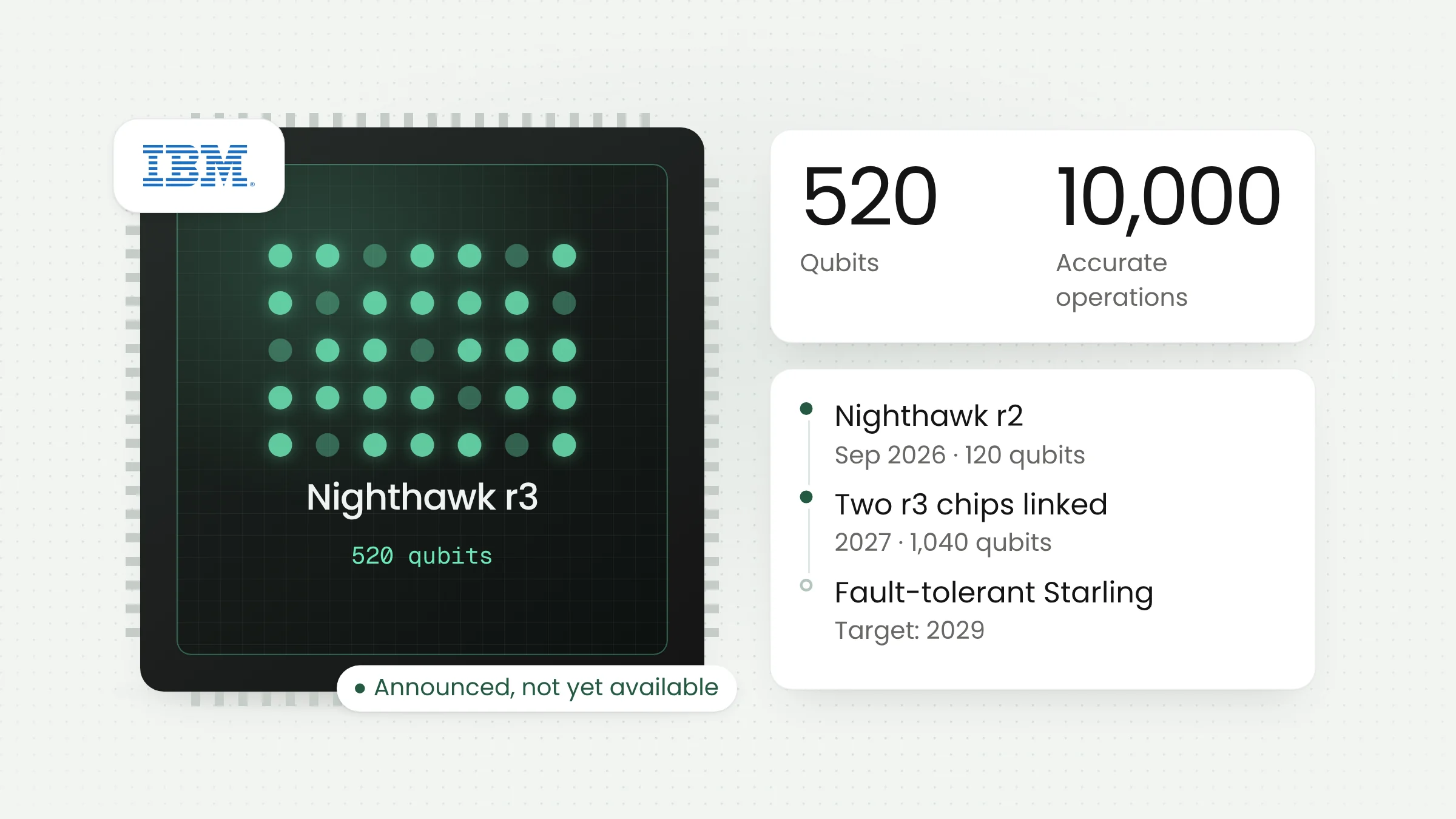
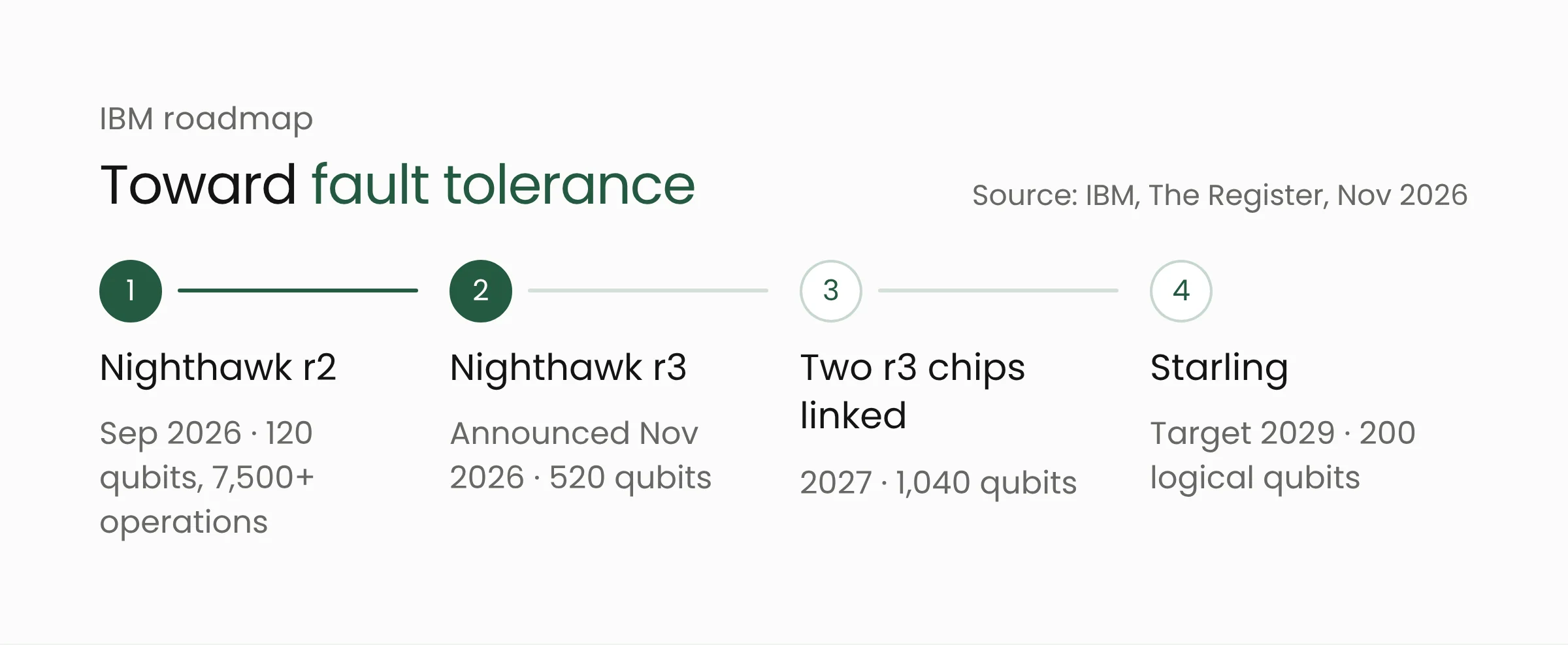
IBM unveiled the IBM Nighthawk r3 quantum processor on November 11, 2026. The chip is designed to accurately execute 10,000 quantum operations across 520 qubits, more than four times the qubit count of the current generation. IBM plans to link two r3 processors into a single 1,040-qubit system in 2027.
The announcement stands out because IBM is leading with accuracy and speed, the two areas that have held quantum computing back. For energy companies, chemical plants, drugmakers and data teams in Indonesia, the news is no reason to buy a quantum computer. What it does change is how the technology is accessed and tested: it is moving closer to the cloud and supercomputing infrastructure organizations already use.
Nighthawk r3 specifications and the 2027 plan
A conventional computer stores data in bits that are either 0 or 1. A quantum computer uses qubits, units of information that can hold a blend of both states at once. That property is expected to let quantum machines handle certain problems, such as simulating molecules or optimizing networks, that are too heavy for classical computers.
According to IBM’s announcement, Nighthawk r3 has 520 programmable qubits and 2,034 total physical qubits. SiliconANGLE notes that the larger figure includes supporting components such as couplers and reset elements. The chip keeps the square-lattice connectivity of its predecessor.
The main addition is a set of 10 chip-to-chip interconnects that IBM calls l-couplers. They are what will allow two r3 processors to be joined into one 1,040-qubit system in 2027. IBM has not given a date for when r3 will reach users, and SiliconANGLE describes it as an upcoming processor.
Nighthawk r2 as the starting point
The current generation, Nighthawk r2, was introduced in September 2026. IBM says it supports more than 7,500 quantum operations on 120 qubits and delivers up to 100,000 samples per second. Fast qubit reset is a large part of that. SiliconANGLE reports that the wait for qubits to return to their ground state drops from about 200 milliseconds to roughly 25 nanoseconds, so the chip spends far less time idle between runs.
IBM clients and partners, including E.ON, Algorithmiq and Q-CTRL, have run 34 billion circuits on r2, and IBM says they have seen speedups of up to 19 times over its earlier processors. The energy company E.ON reported a 15-fold speedup in quantum machine learning for power grid optimization. IBM and Oak Ridge National Laboratory (ORNL) recorded a 12-fold speedup in a simulation of real magnetic materials, with results consistent with neutron scattering experiments.
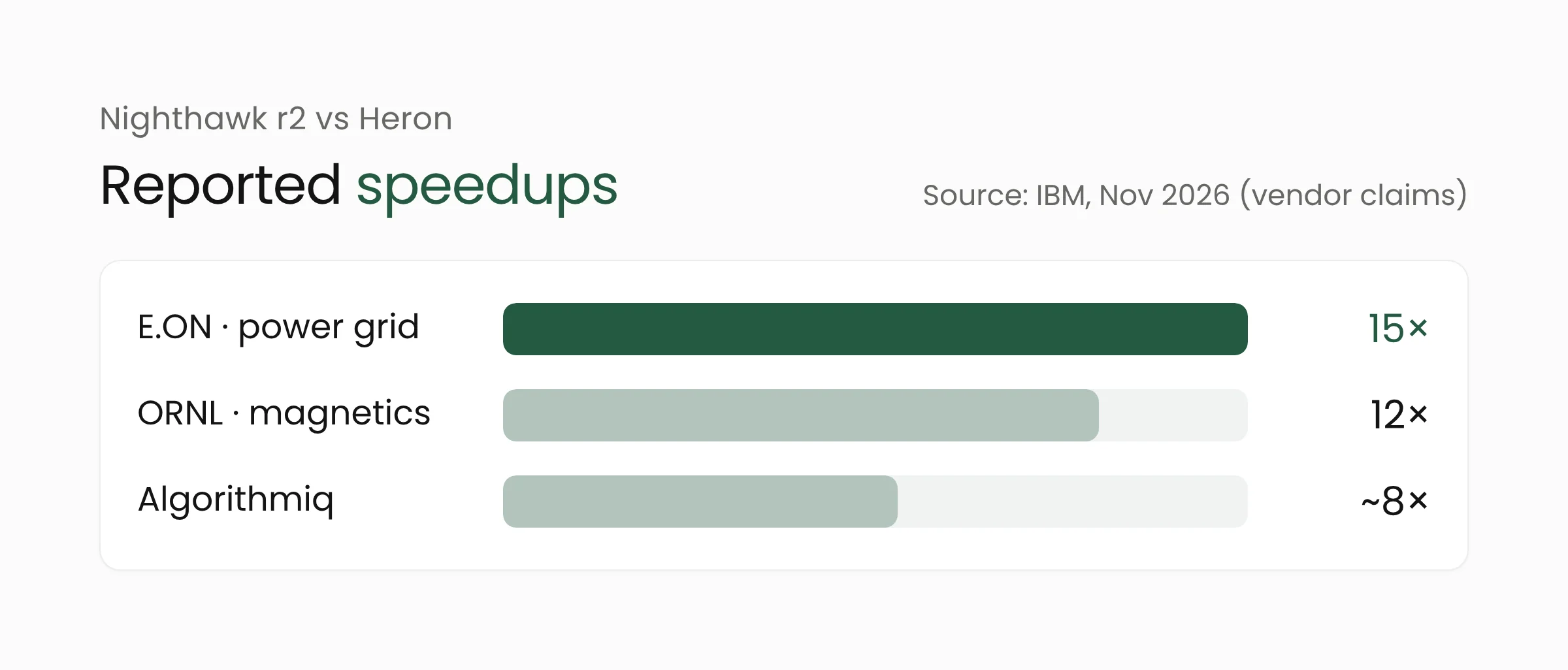
Algorithmiq ran a quantum materials simulation first executed on IBM’s Heron processor, and it now runs about eight times faster on r2. IBM adds that Algorithmiq’s new circuits would need an estimated 240 times more memory for the best classical tensor-network methods to reach comparable accuracy. All of these figures come from IBM and its partners and have not been independently verified.
Quantum and classical computing on one platform
The part of the announcement most relevant to organizations concerns IBM Quantum Platform, IBM’s cloud service for researchers and developers. IBM says the platform now brings high-performance computing (HPC) and quantum computing together in a single managed environment. Users can connect quantum workflows to classical compute anywhere from a laptop to a supercomputer, or use HPC resources that are now available directly on the platform.
IBM’s example comes from RIKEN, the Japanese research institute. A sample-based quantum diagonalization (SQD) workflow developed by RIKEN and IBM ran about five times faster while performing 100 times more computations than in the original study. IBM is also opening pulse-level access, finer control over the timing of operations, so researchers can reset qubits faster and extract more information from each measurement.
A similar pattern is emerging in the United States. On November 5, 2026, IBM, AMD and ORNL launched a research platform that places Nighthawk alongside ORNL’s Umbra HPC system, which runs AMD Instinct MI355X GPUs and fifth-generation AMD EPYC CPUs. The Register points out that RIKEN has also integrated an IBM Quantum System Two with the Fugaku supercomputer.
That direction matters. For the foreseeable future, quantum processors will work as accelerators for specific parts of a calculation, while most of the work continues to run on classical servers and GPUs, whether in an organization’s own data center or in the cloud.
The road to fault-tolerant quantum computers
Qubits are extremely sensitive to interference, so errors pile up as the number of operations grows. That is why 10,000 accurate operations matter as much as the qubit count. IBM’s long-term target, as reported by The Register, is Starling in 2029: a fault-tolerant machine running circuits of 100 million quantum operations on 200 logical qubits.
Several intermediate milestones are already on record. IBM linked two Nighthawk r1 processors with four l-couplers. IBM puts the quantum state transfer fidelity at 99.3%, while SiliconANGLE reports 99.4%; the target is 99.9%. IBM also connected two cryogenic modules into one system for the first time, reaching operating temperature in under five days and cooling to below 15 millikelvin.
Skepticism is still warranted. The Register observes that fault-tolerant quantum technology “always seems to be at least a decade away,” and notes that the l-coupler links have so far been tested only on r1 processors. On quantum advantage, IBM and its partners published experiments in July 2026, and the circuits and results are open for others to test through the community-led Quantum Advantage Tracker.
Jay Gambetta, Director of IBM Research, argues that useful quantum computing depends on delivering results that are both accurate and fast. Those claims can now be checked in public, and the outcome of that testing is what organizations should watch before committing budget.
What this means for industry and data teams
For most organizations in Indonesia, the sensible move today is to prepare at low cost. None of the following requires special hardware.
- Identify suitable problems. The strongest candidates are heavy optimization and simulation workloads, such as power grid scheduling, logistics routing, factory production planning, or materials and drug-molecule simulation. Teams that run industrial automation systems often already hold this kind of data.
- Get the classical data and workflows in order first. IBM’s platform shows that quantum will be used alongside HPC and the cloud. Workflows that are already organized on cloud computing infrastructure, with clean data and baseline results, will be easier to test against a quantum accelerator later.
- Start with small cloud-based trials. Quantum computers are offered as a service, so research teams or partner universities can experiment without buying a machine. Set clear success measures, such as compute time or result quality compared with classical methods.
- Plan for long-term encryption. Progress in quantum hardware is a reason to start inventorying systems that rely on older encryption. Our guide to preparing for post-quantum cryptography is a practical starting point.
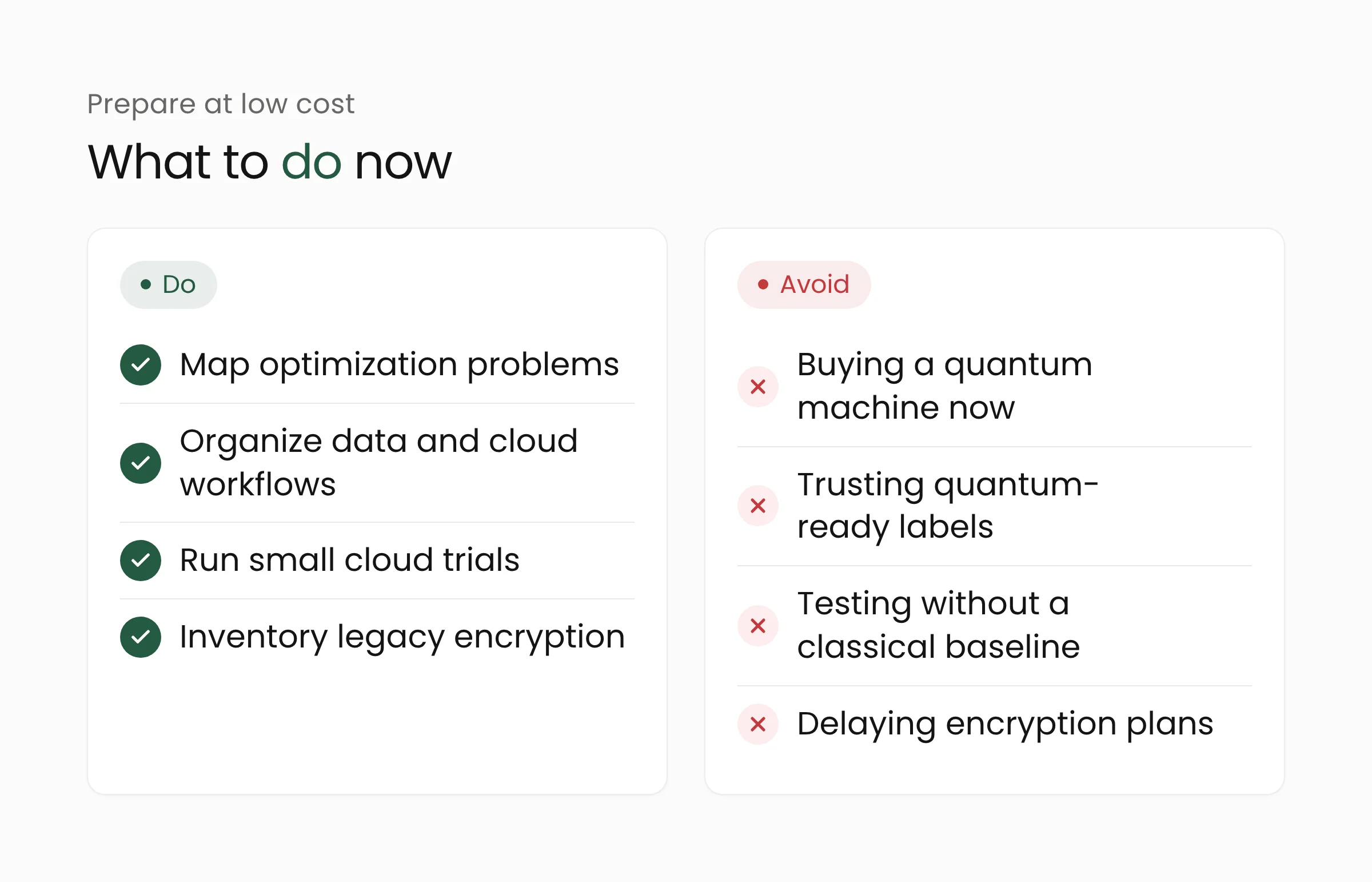
What organizations should avoid is paying for promises. Any offer labeled “quantum-ready” that cannot show a real problem being solved, baseline data and measurable costs deserves hard questions.
Frequently asked questions
When will IBM Nighthawk r3 be available?
IBM has not announced an availability date for r3. The stated plan is to link two r3 processors into a 1,040-qubit system in 2027. IBM Quantum Platform users can currently work with the Nighthawk r2 generation.
Can quantum computers break encryption yet?
There is no evidence of that. The fault-tolerant machine IBM is aiming for is planned for 2029. The Register also cites a University of Auckland professor who said last year that quantum computers had not factored any number greater than 21 without cheating. Even so, moving to post-quantum cryptography takes years, so preparation should start now.
Do organizations need to buy a quantum computer?
Not at this stage. Access is available through cloud services, and IBM itself positions quantum as a complement to HPC. The better investment today is clean data, well-organized cloud workflows, and a team that understands the problems it wants to solve.
Conclusion
Nighthawk r3 shows that the quantum computing race is now measured by accuracy, speed and how easily the hardware works with classical computing. For industry in Indonesia, the most useful preparation starts with data, cloud infrastructure and a clear map of the right problems.
Merakit Indonesia helps organizations build cloud infrastructure, data pipelines and analytics applications that are ready to grow with the next generation of technology. Contact our team if you want to map the computing needs of your organization.
Sources
- IBM Quantum Nighthawk Demonstrates New Levels of Speed and Quality, with Plans to Scale Beyond 1,000 Qubits in 2027, IBM Newsroom, November 11, 2026
- IBM Quantum announces upcoming Nighthawk r3 processor designed to execute 10,000 operations, SiliconANGLE, November 11, 2026
- Quantum leap: IBM plans to scale beyond 1,000 qubits in 2027 with Nighthawk r3 processor, The Register, November 12, 2026