Blog Online Scams
Indonesia Scam Losses Hit Rp104.3 Trillion, Steps for Banks
On this page· 7 sections
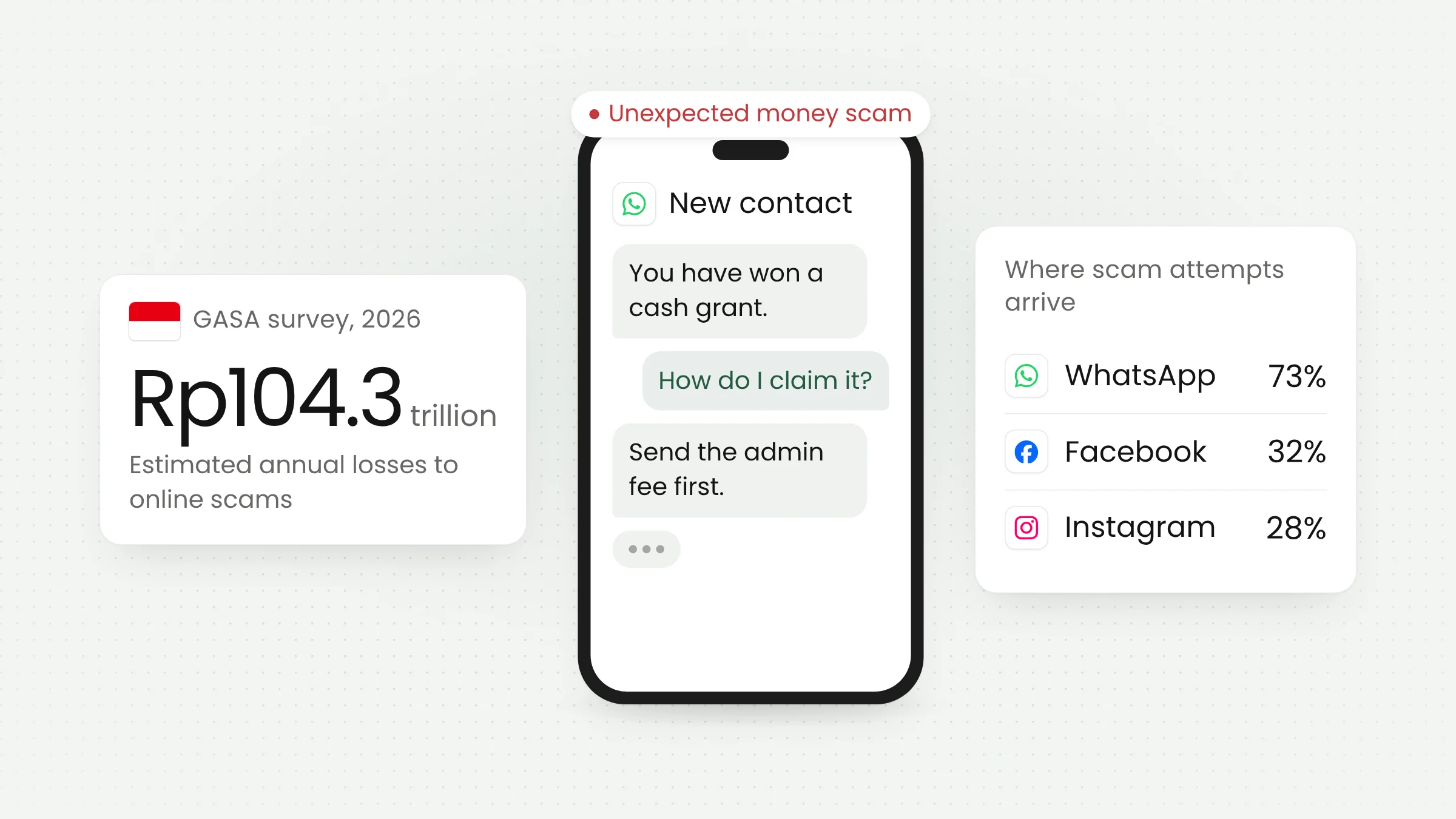
Online scams cost Indonesians an estimated Rp104.3 trillion over the past year, according to the State of Scams in Indonesia 2026 report. The survey by the Global Anti-Scam Alliance (GASA), Mastercard and Indosat Ooredoo Hutchison also found that seven in ten adults faced a scam attempt, most often on WhatsApp.
The report was launched in Jakarta on November 17, 2026. Its loss estimate is more than double the 2025 edition, and the findings touch several groups at once: banks, fintech firms, mobile operators, messaging platforms and law enforcement. Below are the headline numbers, how scammers reach their targets, and the steps financial institutions can take.
Key figures from State of Scams in Indonesia 2026
GASA surveyed 1,160 adults aged 18 and older online between March 16 and April 13, 2026, CNBC Indonesia reported. Liputan6 said the sample was weighted by age, gender and region. The Indonesian survey is part of a global GASA and Mastercard study covering nearly 60,000 respondents in more than 40 countries, according to ANTARA.
Seventy percent of respondents said they had faced a scam attempt in the previous 12 months, up from 66% in the 2025 survey. On average, each person received 63 scam attempts a year. About 35% engaged with a scammer, and 10% lost money or personal data that led to a financial loss.
The average loss per victim was Rp4.89 million, while the median was about Rp1.2 million. The wide gap suggests that a minority of victims lost very large sums. Katadata explained that the Rp104.3 trillion figure comes from multiplying that average by an estimated 21.3 million affected adults.
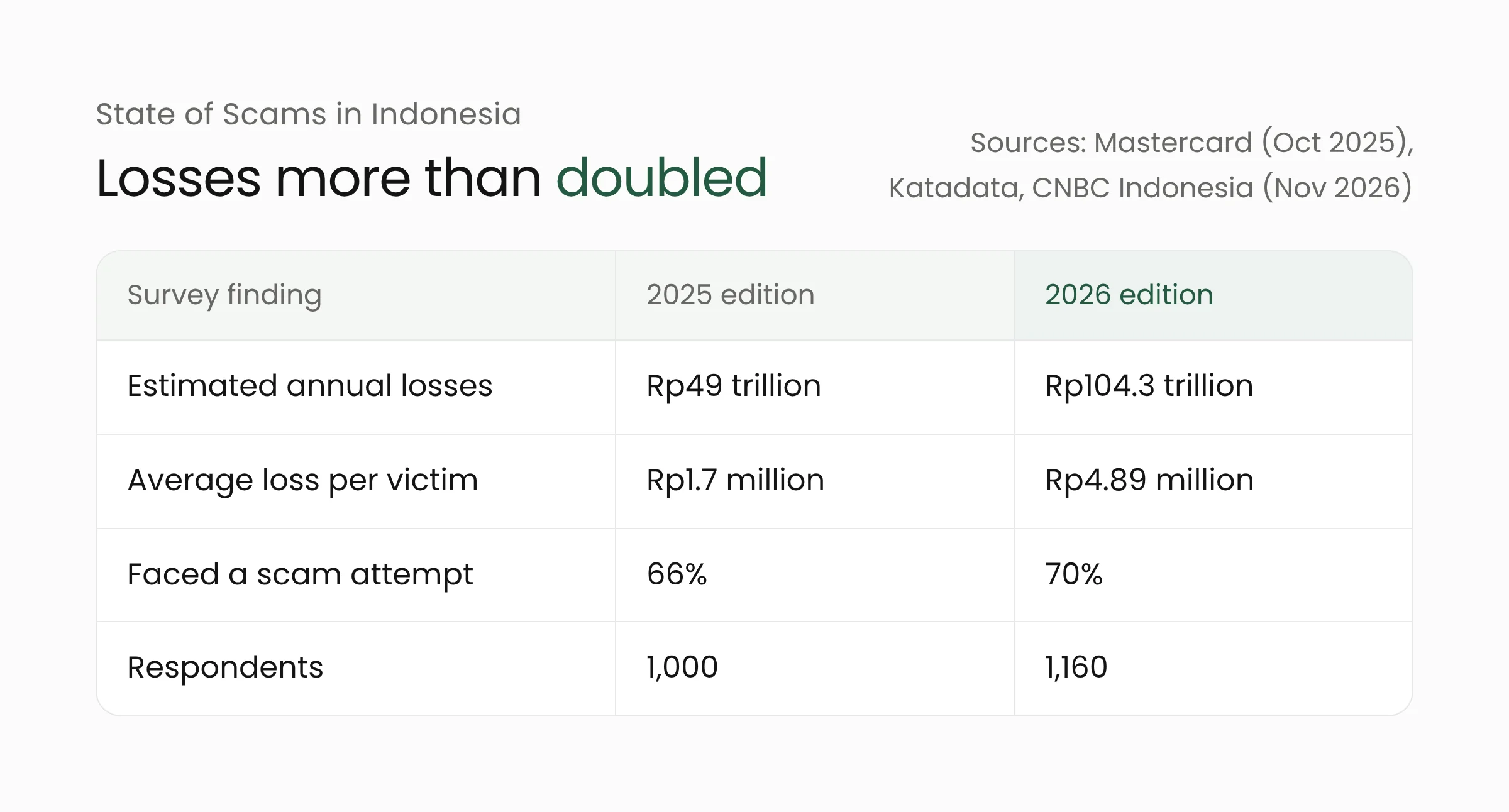
For comparison, the 2025 edition, released by Mastercard on October 31, 2025, estimated losses of about Rp49 trillion from a survey of 1,000 respondents, with an average loss of Rp1.7 million per person. Both figures are survey-based estimates and may differ from losses recorded by police or regulators.
Scams also tend to repeat. Some 47% of victims were scammed more than once in a year, with an average of 1.9 incidents per victim. Around three quarters of victims who lost money reported a moderate or significant effect on their mental wellbeing.
WhatsApp is the main channel for scammers
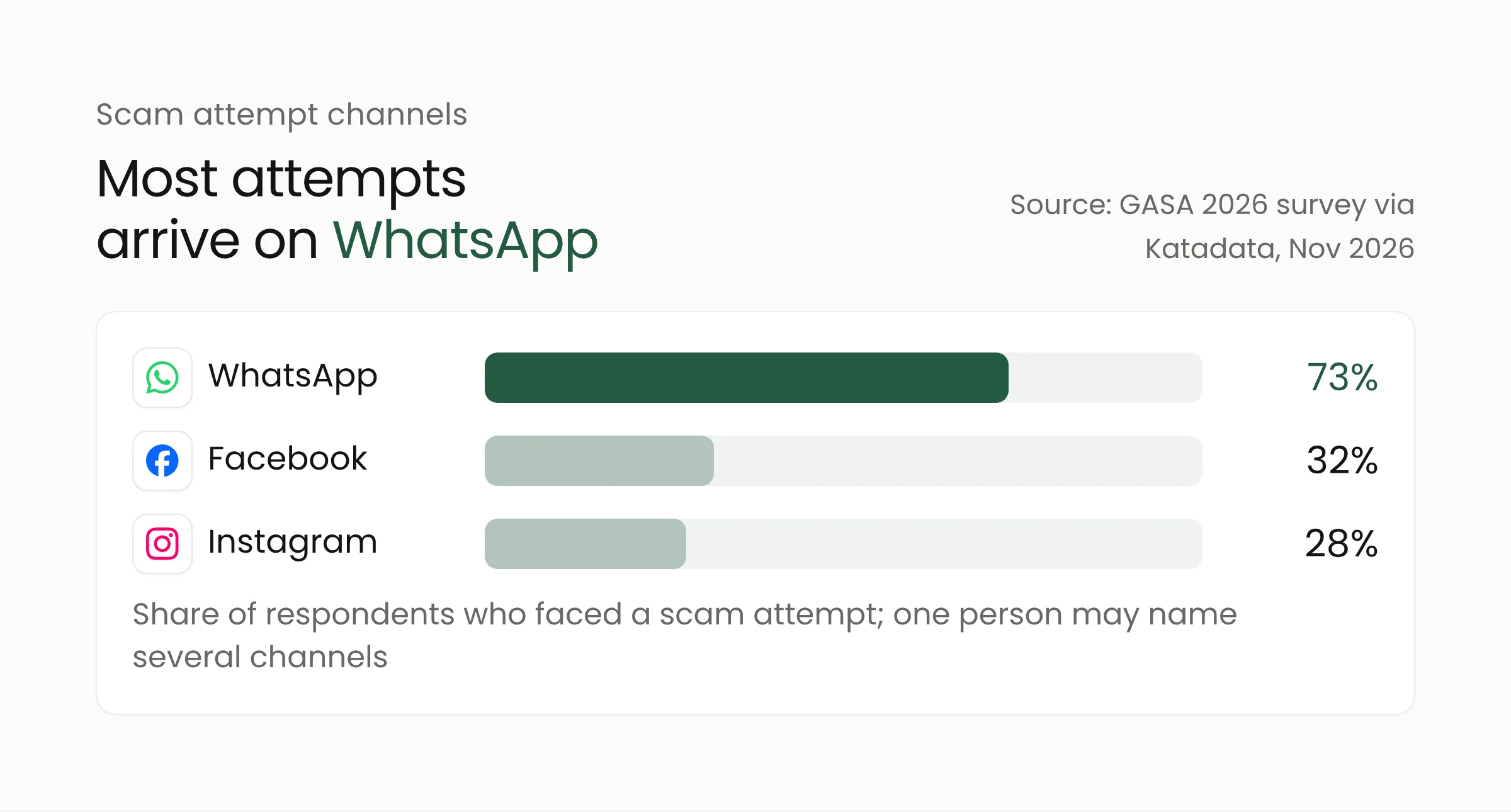
Among respondents who faced a scam attempt, 73% encountered it on WhatsApp. Facebook followed at 32% and Instagram at 28%, according to the breakdown published by Katadata. People use all three apps every day to talk and shop, so scam messages blend in easily with ordinary ones.
The most common schemes were unexpected money offers (36%), shopping scams (35%) and investment scams (32%). Katadata cited the case of a business owner who lost Rp250 million in an investment scheme that began in a WhatsApp group promising a 20% return in one month.
The survey also found a gap between confidence and reality. Kontan reported that 58% of consumers believe they can recognize a scam and 98% say they actively check suspicious offers. Yet three in four adults struggle to spot deepfake videos, which are AI-generated clips that imitate a person’s face and voice.
How victims discover a scam is also changing. Some 49% only realized they had been scammed after someone else told them, down from 62% in 2025. The most common sources were the media (33%) and family or friends (29%). Only 14% of victims heard about it from a bank or payment provider, and 9% from a mobile operator.
Victims report late while money moves fast
Data from the Indonesia Anti-Scam Centre (IASC) shows another side of the problem. The center is run by 23 member institutions of the Task Force for Eradicating Illegal Financial Activities (Satgas PASTI), coordinated by the Financial Services Authority (OJK). According to Kontan, IASC received 741,545 reports between its launch in November 2024 and October 2026. Of the 1,481,176 accounts reported, 748,284 have been blocked.
About US$53.43 million in victims’ funds has been frozen, and about US$11.6 million has been returned. Hudiyanto, head of the Satgas PASTI secretariat at OJK, said 80% of victims only report a scam 12 hours after it happens. Speaking at the report launch in Jakarta, he noted that within half an hour to an hour, stolen funds have already been moved on.
The experience after reporting is also poor. In the GASA survey, only 12% of victims who reported a loss got some or all of their money back. A quarter said their report was received but not followed up, and 20% saw no action at all.
GASA said tackling scams requires cooperation between government, financial institutions, technology and telecom companies, and law enforcement. Its recommendations include sharing information and data, prevention technology that works in real time, and stronger protection for the public.
What this means for banks and fintech firms
The public supports a more active role for service providers. According to Kontan, 78% of respondents back operators and messaging platforms automatically blocking suspicious calls and messages. Some 74% support financial institutions automatically delaying transactions when fraud is suspected, and 60% favor real-time information sharing between banks, telecom operators and law enforcement.
That support matches rules already taking effect in the payment system. Bank Indonesia now allows payment providers to hold transactions flagged for fraud for up to five business days, as we covered in our article on Bank Indonesia’s Payment ID. The GASA results suggest most respondents accept that kind of pause.
For banks, digital banks and e-wallet operators, four steps deserve priority.
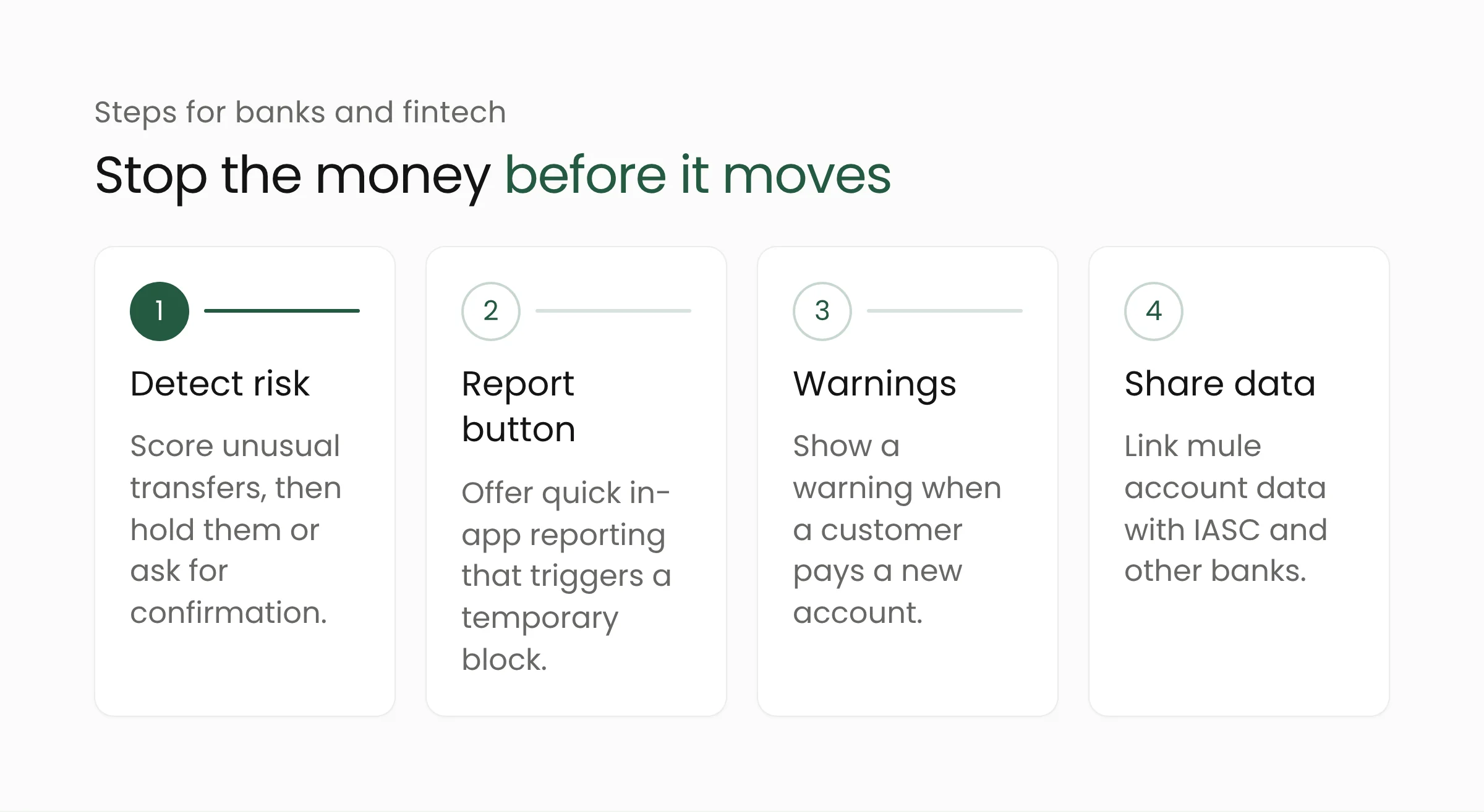
- Detect risky transfers before the money leaves. Transfers made by scam victims often break a customer’s usual pattern, such as a new payee, an unusual amount, or several transfers in quick succession. Machine learning models for anomaly detection can score each transaction and trigger a pause or an extra confirmation.
- Make reporting easy inside the app. Since most victims report more than 12 hours later, a clearly visible report button in the mobile banking app can shorten that delay. A report should immediately trigger a temporary block on the receiving account, in line with applicable procedures.
- Give banks a bigger role in warning customers. Only 14% of victims learned about a scam from a bank or payment provider. A warning that appears when a customer sends money to a new account is more likely to be read than a general notice on social media.
- Share data with other parties. Mule accounts and scammers’ phone numbers are often reused. Connecting to IASC and shared fraud databases shortens the time from report to block.
The GASA report also looked at payment methods. Cards accounted for only 7% of payment channels in Indonesian scam cases, well below the Asian average of 18%. Its recommended safeguards include dynamic tokenization, chip-based security and multi-factor authentication.
Putting these steps in place requires systems that connect transaction data, device behavior and customer reports. Merakit can help financial institutions design such systems through its financial services solutions, from fraud monitoring dashboards to app integration.
Frequently asked questions
Is the Rp104.3 trillion figure official data?
It is a GASA estimate based on a survey of 1,160 adults, calculated by multiplying the average loss per victim by the estimated number of victims. Official records such as IASC data count reports, blocked accounts and returned funds, which cover a different scope.
Where should victims of a transfer scam report it?
Contact the bank or e-wallet provider used for the transaction right away, then file a report with OJK’s Indonesia Anti-Scam Centre (IASC). Satgas PASTI says stolen funds can move within hours, so the sooner a report is made, the better the chance the money can still be frozen.
Why do scammers rely so heavily on WhatsApp?
The survey does not explain the reasons in detail. It does show that 73% of respondents who faced a scam attempt received it on WhatsApp, a messaging app used widely in Indonesia. Common schemes such as unexpected money offers and high-return investments spread easily through private chats and groups.
Conclusion
The State of Scams in Indonesia 2026 report shows that online scams are becoming more frequent and that each victim is losing more. Speed is decisive, because stolen funds move within hours while most reports arrive later. Banks and fintech firms looking to strengthen scam detection and reporting can talk to the Merakit team about steps that fit the systems they already run.
Sources
- Kontan: Kerugian Scam Capai Rp 104,3 Triliun, 74% Warga Dukung Bank Tunda Transaksi (November 17, 2026)
- Kontan: IASC Terima 741.545 Laporan Scam, 80% Korban Lapor Setelah 12 Jam (November 17, 2026)
- Katadata: Kerugian Warga RI Imbas Penipuan Rp 104 Triliun, Rerata Korban Rugi Rp 4,9 Juta (November 17, 2026)
- CNBC Indonesia: Setahun Warga RI Ketipu Rp104,3 Triliun, Ada yang Berulang Kali (November 17, 2026)
- Liputan6: Penipuan Digital Rugikan Masyarakat Indonesia Rp 104,3 Triliun (November 17, 2026)
- ANTARA: GASA sebut 70 persen warga RI terpapar scam, korban alami stres berat (November 17, 2026)
- Mastercard: GASA Launches State of Scams in Indonesia 2025 Report (October 31, 2025)