Blog Fintech
Mastercard Stablecoin Security Scores Risk Before Transfers
On this page· 7 sections
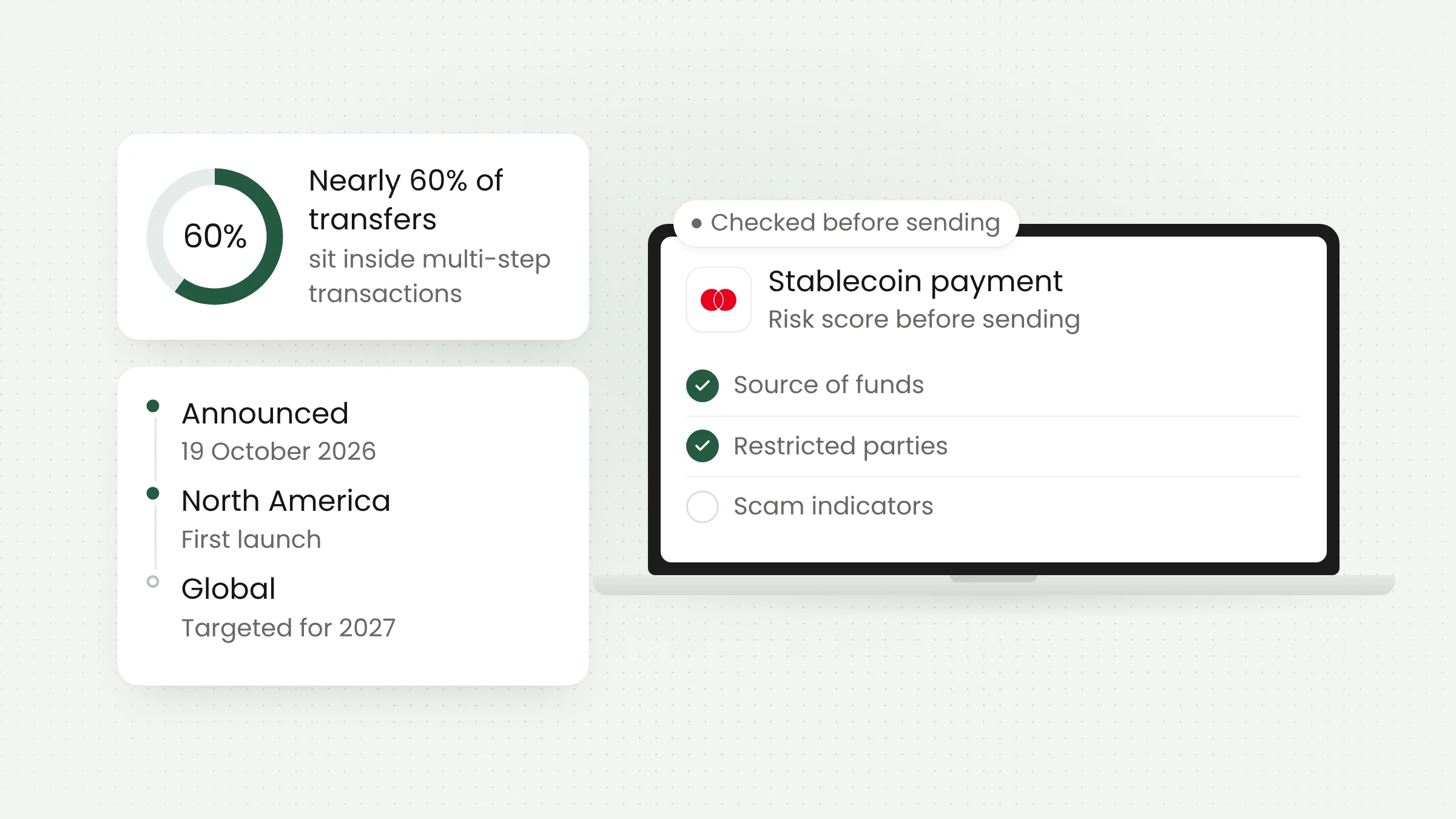
Mastercard introduced Stablecoin Security on 19 October 2026 at Money20/20 USA. The service gives banks and payment providers a risk score for each stablecoin payment, covering fraud, scams and links to sanctioned parties, before any funds move onchain. It launches first in North America, and Mastercard expects worldwide commercial availability in 2027.
How Stablecoin Security works
A stablecoin is a crypto asset pegged to a conventional currency, usually the US dollar. Because its value stays relatively steady, it is increasingly used for cross-border transfers. Blockchain transactions are final, however. Once funds are sent, a bank cannot reverse them the way a disputed card payment can be reversed.
Stablecoin Security is designed to close that gap. According to The Block, the service traces where funds came from and looks for links to fraud, scams, sanctions violations and other financial crime across the stablecoin payment lifecycle. The output is a risk score that arrives before the payment is completed.
CoinMarketCap Academy lists four kinds of signals behind the score: transaction context, source of funds, exposure to restricted parties and scam indicators. Mastercard combines data from its payment network with blockchain analytics to produce the assessment.
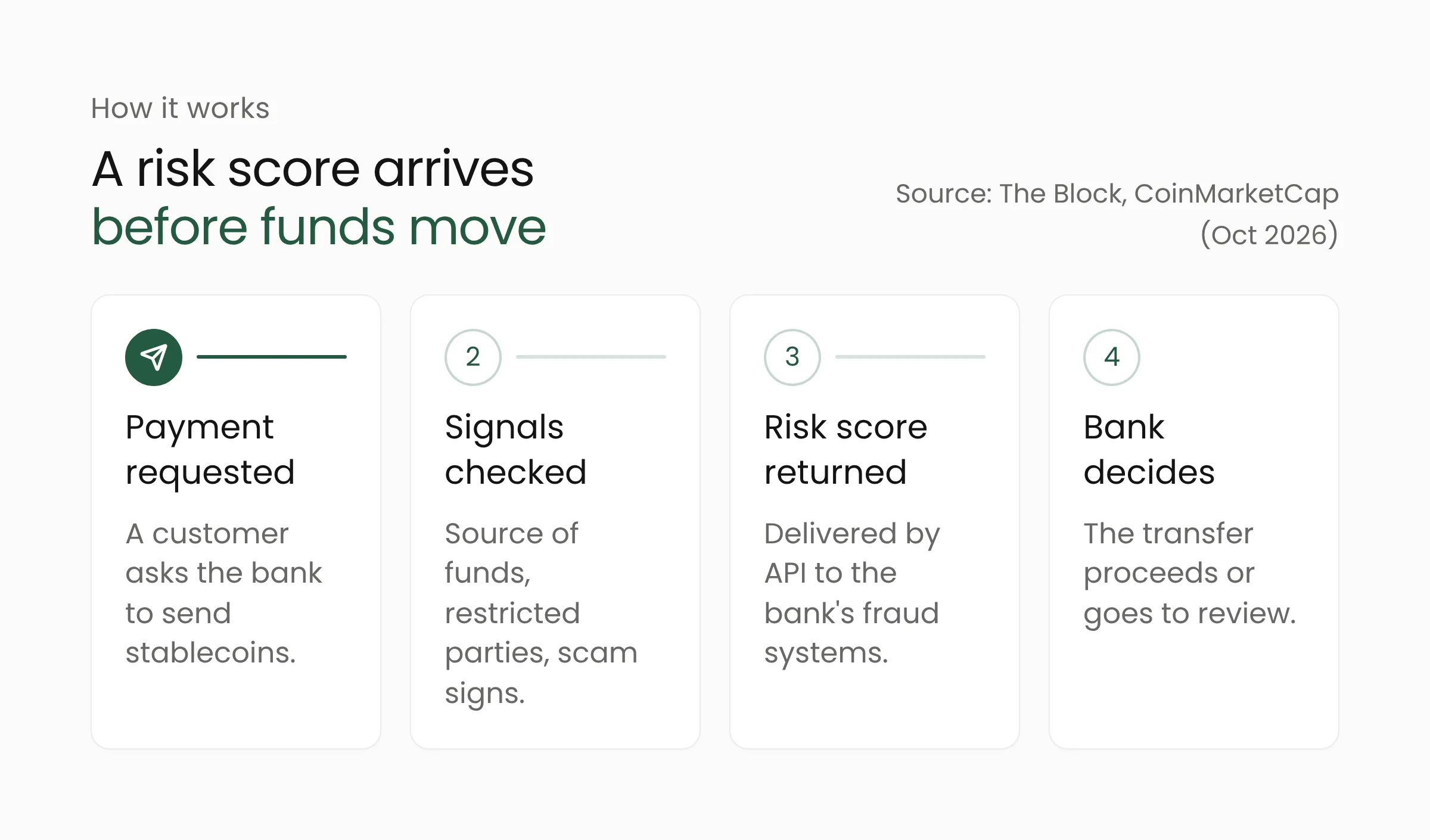
The service is delivered through a platform-agnostic API. Banks can feed the score into the fraud, compliance and case management systems they already run, and staff can use it to decide whether a transfer should go ahead or receive a closer look.
Mastercard’s own example involves a coffee shop in Boston paying a supplier in Brazil through a bank that uses stablecoins. Before the payment is sent, the bank’s service provider runs it through Stablecoin Security to decide whether it can proceed or needs further review.
Ann Johnson, Mastercard’s executive vice president of Security Solutions, framed the reasoning this way: “Stablecoins are creating new possibilities for value exchange, but financial institutions need the right intelligence and controls to participate with confidence.”
Stablecoin transfers are rarely simple payments
Mastercard grounded the product in research from the Bank for International Settlements (BIS). BIS Working Paper No 1359, “The anatomy of stablecoin transactions,” published on 11 June 2026, analysed 593 million event logs from 141 million Ethereum transactions in 2025. The data covered three US dollar stablecoins: USDT, USDC and PYUSD.
The paper found that nearly 60% of stablecoin transfer events take place inside complex transactions. A single transaction can bundle several actions, such as trading, lending, liquidity provision and settlement. The BIS summary adds that roughly one third of stablecoin transactions generate more than one step.
That matters for fraud teams. Treating every transfer as a simple payment from A to B would misread almost six in ten transfer events, and proceeds of fraud are easier to disguise when they pass through a long chain of steps.
Checking only the sender and recipient addresses is therefore not enough. Banks need to understand the path the money has taken before a transfer, which is where blockchain analytics meets conventional payment data.
Launch partners and timeline
Two companies are the first partners. Borderless.xyz connects financial institutions with licensed stablecoin providers in more than 113 countries and 72 currencies. Keyrails focuses on high-value cross-border trade payments, particularly in emerging markets. Both took part in Mastercard’s Start Path programme for blockchain and digital asset startups.
The service will expand through BVNK, the stablecoin infrastructure company Mastercard bought. The Block reported that Mastercard agreed in March 2026 to a deal worth up to $1.8 billion and completed the acquisition in August 2026. A week before the Stablecoin Security announcement, Mastercard and BVNK also launched the Global Money Platform, which combines fiat and stablecoin accounts, conversion and local bank payouts behind a single API.
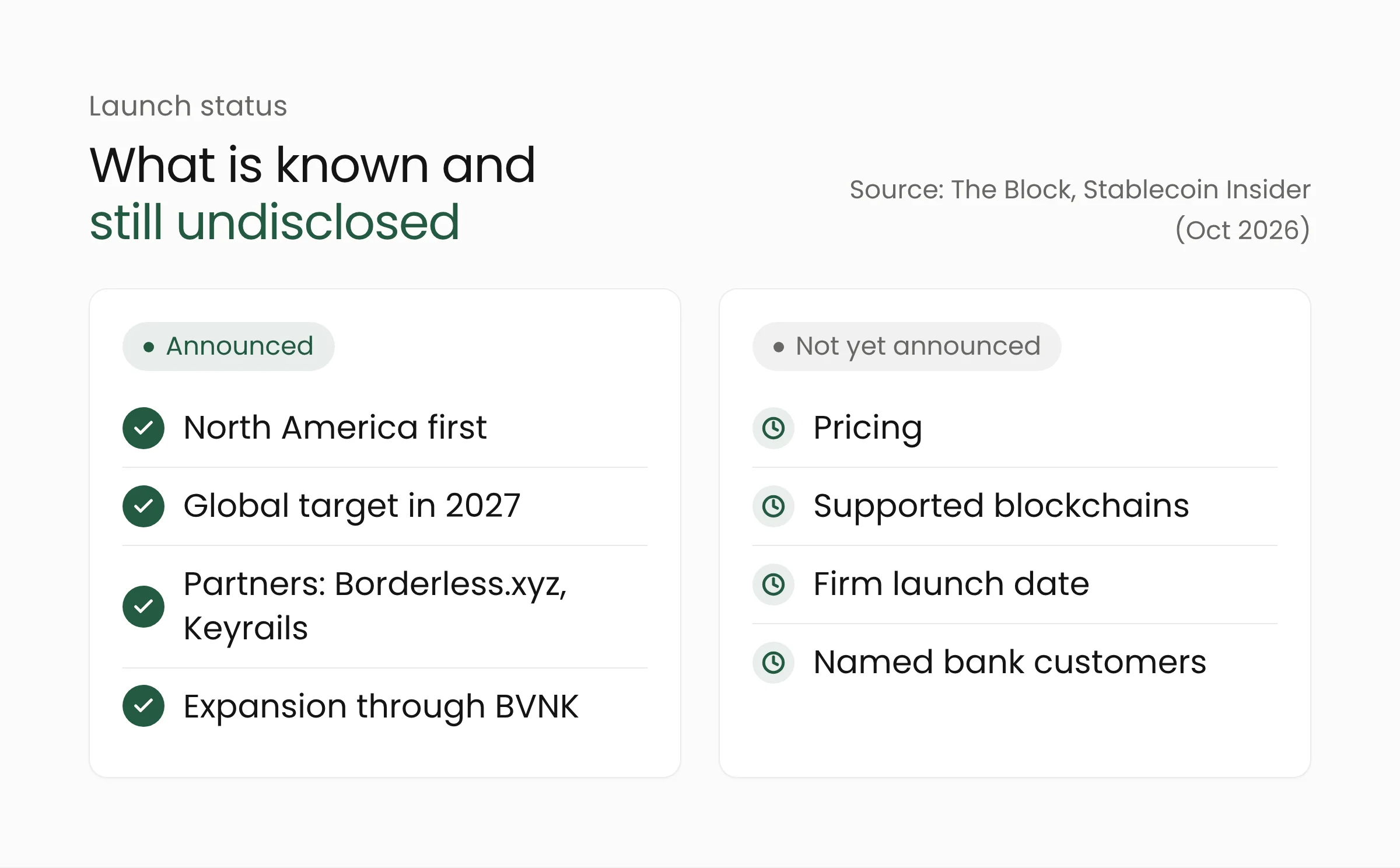
Several important details have not been announced. Stablecoin Insider notes that Mastercard has not disclosed pricing, the blockchains and stablecoins covered, the source of its blockchain analytics data, the scoring method or a firm North American go-live date. No bank customer has been named either.
Mastercard is not alone in this space. On the same day, Cryptopolitan reported that J.P. Morgan brought its JPMD deposit token to Ethereum. Large payment companies are now competing to build the infrastructure that makes stablecoins usable for tightly regulated institutions.
What this means for banks and payment providers
Stablecoin Security is not yet available in Indonesia, and the global rollout is only targeted for 2027. The direction of domestic regulation is starting to take shape, though.
Indonesia is drafting stablecoin rules
Crypto assets in Indonesia are now supervised by the Financial Services Authority (OJK), as mandated by Undang-Undang Nomor 4 Tahun 2023 tentang Pengembangan dan Penguatan Sektor Keuangan (the 2023 Financial Sector Development and Strengthening Law). According to Merdeka.com, OJK is drafting stablecoin-specific rules targeted for completion in early 2027. Adi Budiarso, OJK’s chief executive for supervision of financial sector technology innovation, digital financial assets and crypto assets, said the direction of the rules should be in place around January 2027.
The rules will cover reserves, governance, consumer protection and redemption while protecting the sovereignty of the rupiah and financial stability. Adi also said that anyone who wants to operate in the sector must be licensed by OJK.
Steps to take now
For banks, crypto asset traders and fintech companies, the period before 2027 is a chance to build the foundations of transaction monitoring. Practical steps include:
- Map every flow of funds that touches crypto assets. Record where money enters and leaves, whether from customers, overseas partners or crypto exchanges. That map underpins any risk assessment you adopt later.
- Prepare fraud systems to accept external scores. Services like Stablecoin Security arrive as APIs. Modular compliance systems can be connected to any risk-scoring provider more quickly.
- Set thresholds for manual review. Decide which scores put a transaction on hold and who reviews it. Make that call before transaction volumes grow.
- Follow OJK’s draft rules closely. Requirements on reserves, redemption and licensing will shape product design, especially for providers handling cross-border transfers.
Experience with QR-based cross-border payments is relevant too. We covered the extension of cross-border QRIS to Hong Kong and Timor-Leste, which showed how phased trials and regulatory oversight move together.
For technology teams at financial institutions, the heaviest work is usually data integration: bringing transaction history, customer data and risk signals into a single view that analysts can read. Merakit supports this kind of work through its financial services solutions and blockchain development services, including API design and transaction monitoring dashboards.
Frequently asked questions
What is Mastercard Stablecoin Security?
Stablecoin Security is a Mastercard risk intelligence service that scores stablecoin payments before funds move onchain. The score assesses the risk of fraud, scams and links to sanctioned parties, and it reaches the bank’s systems through an API.
When will Stablecoin Security be available in Indonesia?
That has not been announced. Mastercard is launching first in North America and expects worldwide commercial availability in 2027. The list of countries and pricing have not been disclosed.
Can stablecoins be used for payments in Indonesia?
OJK is still drafting stablecoin-specific rules, with completion targeted for early 2027. OJK has said those rules will protect the sovereignty of the rupiah, so businesses should wait for the official provisions before accepting stablecoins as payment.
Closing thoughts
Stablecoin Security shows payment companies starting to treat stablecoins like any other payment rail that must be checked before money moves. For financial institutions in Indonesia, the wait for OJK’s rules is a good time to tidy up data and transaction monitoring systems. If your team wants to start preparing, Merakit Indonesia is ready to talk.
Sources
- Mastercard unveils Stablecoin Security tool to screen payments for fraud and sanctions risks, The Block, 19 October 2026
- Mastercard Debuts Stablecoin Security to Flag Fraud, Sanctions, CoinMarketCap Academy, October 2026
- Mastercard unveils Stablecoin Security to screen on-chain payments, Cryptopolitan, 20 October 2026
- Mastercard Stablecoin Security: How It Screens Onchain Payments, Stablecoin Insider, 20 October 2026
- The anatomy of stablecoin transactions, BIS Working Paper No 1359, 11 June 2026
- OJK Sebut Stablecoin Bakal Jadi Uang Digital Masa Depan, Merdeka.com, 10 October 2026