Blog Digital Government
Jambi Adds AI to Its 112 Emergency Line on WhatsApp
On this page· 7 sections
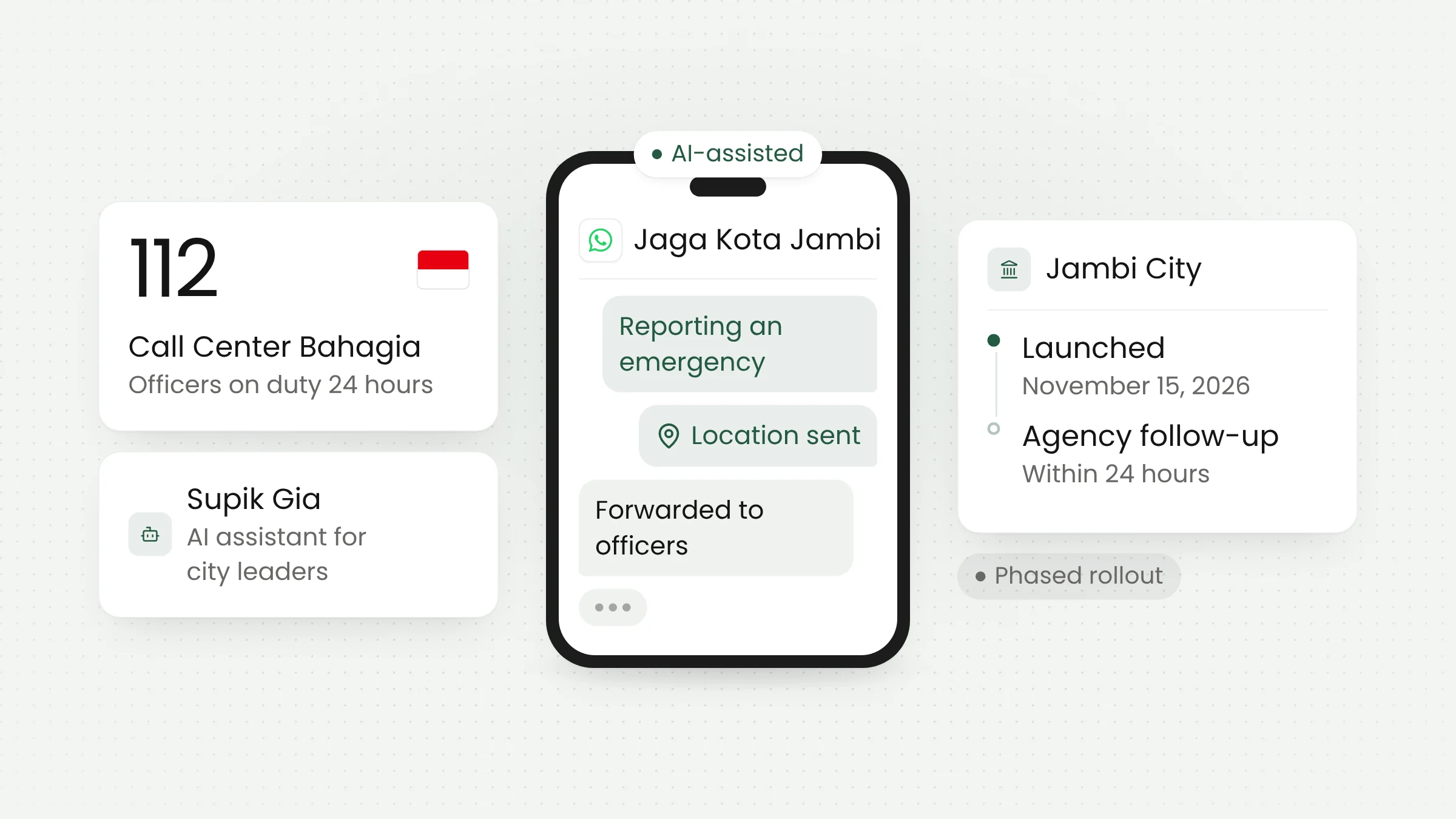
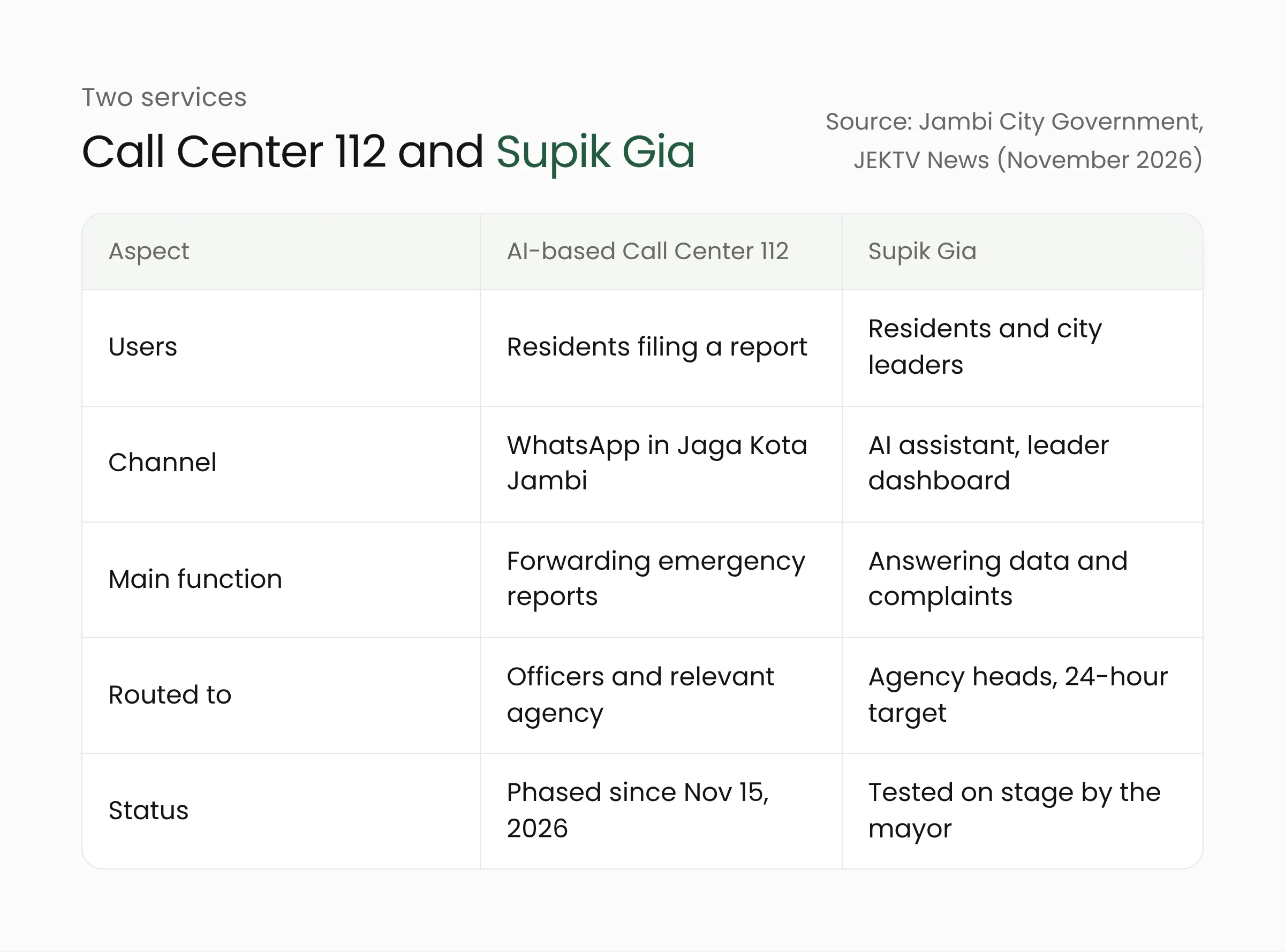
Jambi City, on the Indonesian island of Sumatra, has added AI to its 112 emergency line, which now accepts reports over WhatsApp. The city launched the service on November 15, 2026, together with Supik Gia, an AI assistant for service information and resident complaints. Both are being introduced in stages, and several technical details remain undisclosed.
Two AI services from Jambi Smart City Fest 2026
Mayor Maulana launched both services while opening Jambi Smart City Fest 2026 at Taman Banjuran Budayo on the evening of Sunday, November 15, 2026. According to the Jambi City Government’s official release, the festival ran until November 17 under the theme “Smart City for Better Future” and drew about 438 registrations of participants, teams, entries, and proposals from schools, universities, neighborhood units, and the general public. A national smart city forum followed on November 18–19.
Emergency reports to 112 over WhatsApp
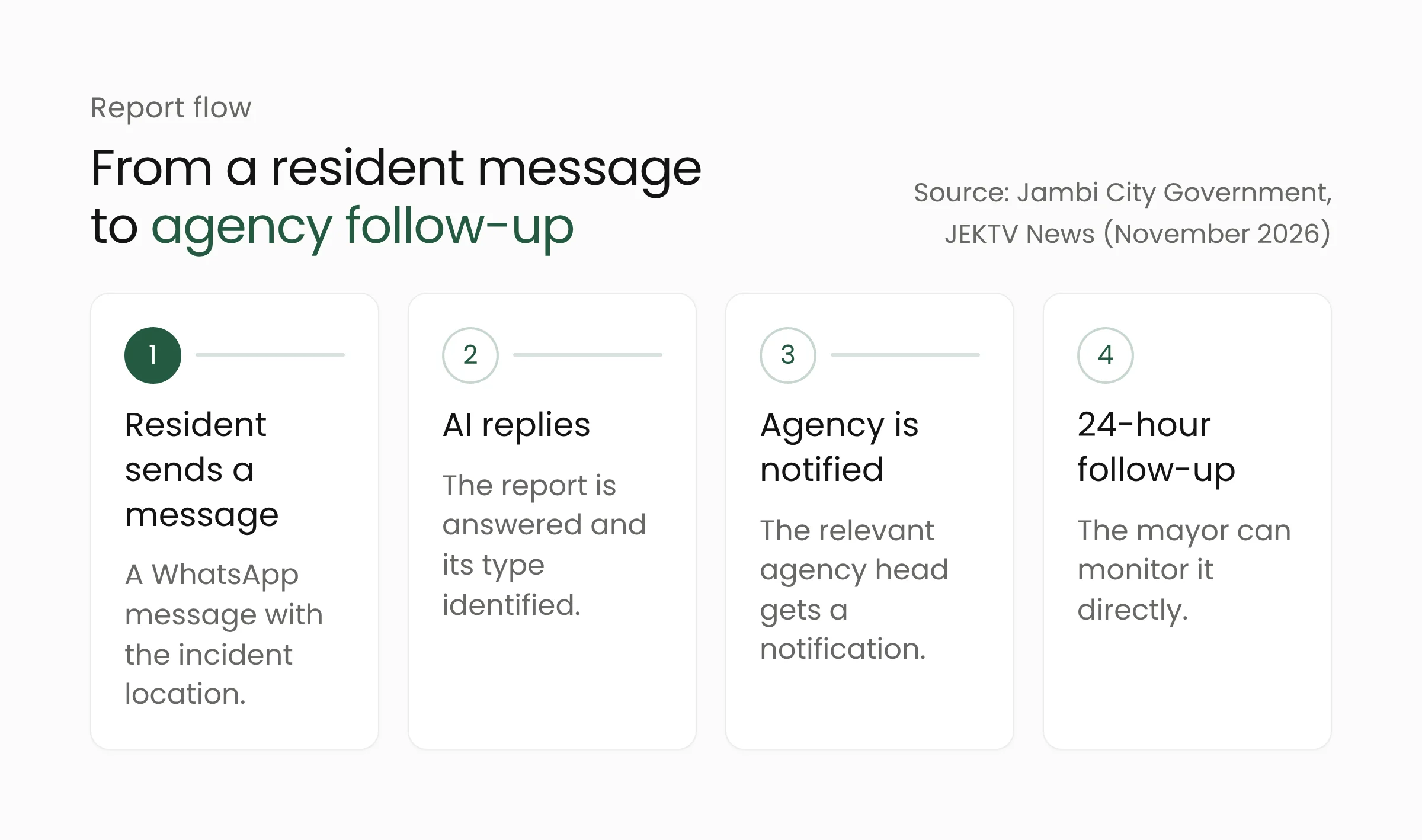
The first service is officially named Call Center 112 Berbasis AI melalui WhatsApp, delivered through the city’s JAGA KOTA JAMBI app. Residents send a message along with the location of the incident, and the report is forwarded to officers or to the relevant regional agency. Indonesian local governments refer to these departments and offices as OPD (organisasi perangkat daerah).
The service builds on Call Center Bahagia 112, which has been staffed by officers around the clock. The city says AI was added so that reports are answered and forwarded faster, and that the change is being made gradually.
Supik Gia, an assistant for residents and city leaders
Supik Gia stands for Sistem Terpadu Pelayanan Informasi dan Keluhan Kota Jambi Bahagia, or integrated information and complaint service system. For residents, the assistant answers questions about public services, permits, regional data collection, government administration, and event schedules.
For city leaders, Supik Gia is a way into government data. Maulana described it as an upgrade to a leadership dashboard that previously showed only figures. He can now ask for data directly when he needs it, including while travelling by car. When data is not yet available, Supik Gia contacts the agency responsible. The same applies to resident complaints that have not been followed up.
How a report travels from resident to agency
JEKTV News reported that Maulana tested Supik Gia by voice on the main stage after the launch. He asked about infrastructure complaints, ranging from a leaking pipe at the municipal water utility to a street light that had gone out.
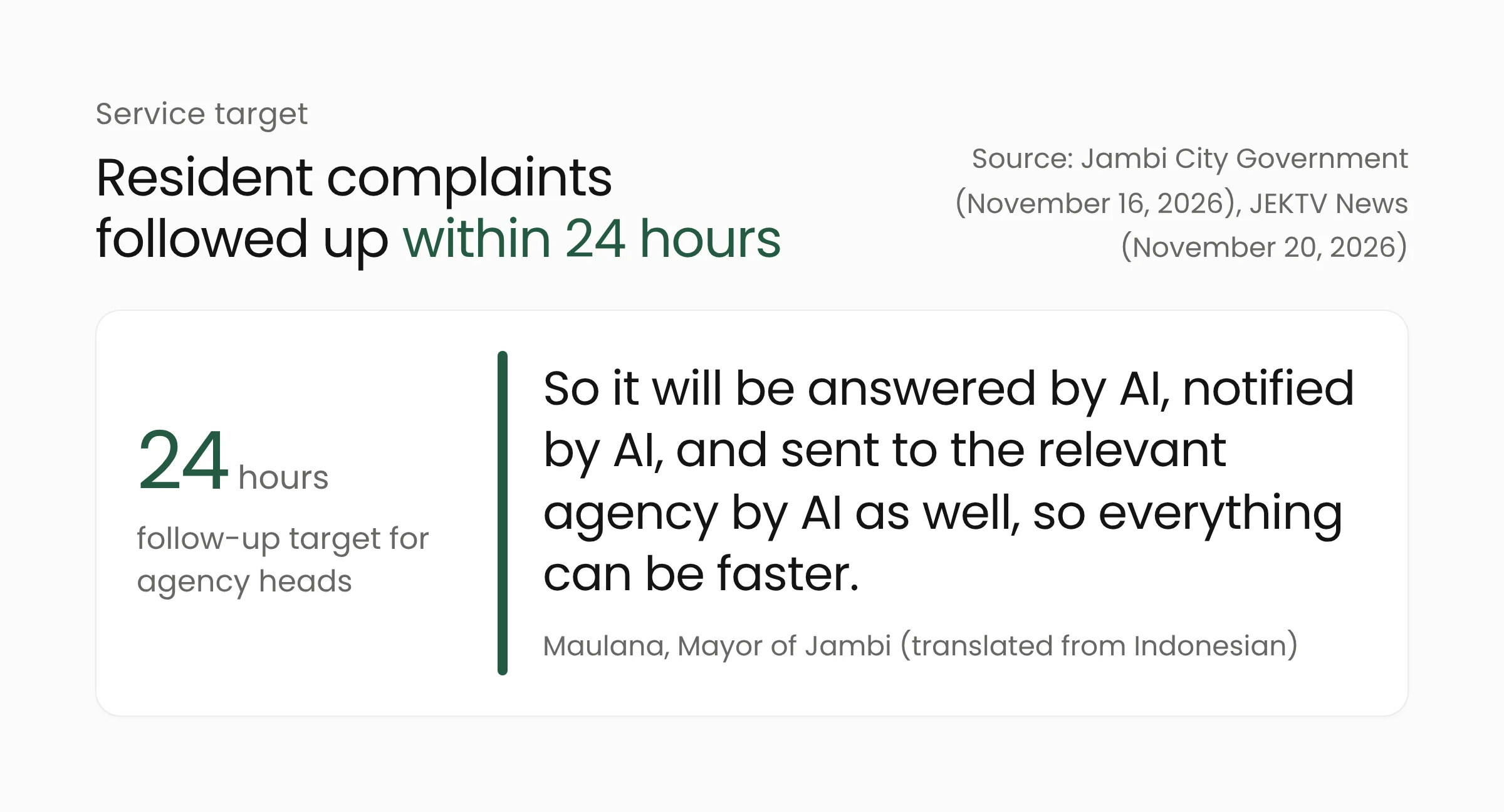
According to the same report, every incoming complaint is detected by AI and sent as a notification to the head of the relevant agency, who is expected to follow up within 24 hours. The mayor can monitor these reports directly.
Maulana summed up the new workflow in remarks carried by the city’s release, translated here from Indonesian: “So it will be answered by AI, notified by AI, and sent to the relevant agency by AI as well, so everything can be faster.”
The accuracy of the assistant depends on the data behind it. Maulana has therefore asked all agency heads and subdistrict heads to update the dashboard data regularly. Without those updates the assistant answers with old information, and decisions based on those answers go wrong with it.
The city uses AI in several other areas. At the festival’s closing on November 17, as reported by JEKTV News, Maulana said garbage trucks carry GPS units and CCTV cameras that are monitored from the leadership dashboard. Community CCTV under the city’s Kampung Bahagia program is also used to watch neighborhood security, traffic density, piles of waste, and flood-prone areas.
National context and open questions
In Indonesia, 112 is allocated to every regency and city as an emergency service number. On September 24, 2026, the Ministry of Home Affairs, the Ministry of Communication and Digital Affairs (Kemkomdigi), and local governments across Bali signed a joint commitment called “Indonesia Siaga 112”. Bali Post reported that Bali was named the pilot for a single emergency number, with the aim of applying the model nationwide within two years.
At that event, a Kemkomdigi official said calls to 112 are free of charge and can be made from mobile and fixed-line phones. A Home Affairs official said the main challenge is making sure every report quickly reaches the authority responsible. Jambi is trying to speed up that hand-off with AI.
Kemkomdigi offered praise along with a caveat. Cahyaning Nuratih Widowati, the minister’s expert staff for legal affairs, attended the festival’s closing and said a smart city should not be judged by the number of apps it owns or the sophistication of its technology. The measure is the benefit that residents feel directly.
Several points are not explained in the sources we read:
- The technology behind it. The city has not named the AI model or the vendor.
- The role of officers in an emergency. There are no details on when a conversation moves from AI to a human, even though Call Center Bahagia has been staffed 24 hours a day.
- Oversight of the 24-hour target. Media reports do not explain how the deadline is monitored or what happens when it is missed.
- Handling of reporter data. Phone numbers, message content, and location are personal data. Retention and access rules have not been presented.
- Usage results. No figures have been published on report volume or response time since the launch.
Local outlets also differ on the assistant’s name. Jambi Prima wrote “Supik Gik”, while the city’s official site uses “Supik Gia”.
What this means for local governments
Jambi’s move is relevant to other administrations that already run a 112 line or a complaint channel and want to add AI. The following considerations can guide a communication and informatics office designing a similar service.
- Fix the routing before adding AI. AI speeds up a flow that is already clear. The list of report types, the agency responsible for each, and the officials to contact should be agreed first, because the AI forwards reports according to that map.
- Define the path to a human for emergencies. Fires, accidents, and medical emergencies need a person as quickly as possible. Set the keywords and conditions that transfer a conversation to an officer immediately, and test that path regularly.
- Assign a data owner in every agency. The mayor’s request to agency and subdistrict heads points to the basic requirement. An AI assistant is only as accurate as the data being updated, so each dataset needs a named owner and an update schedule.
- Measure the follow-up deadline. A 24-hour limit means something only if it is recorded. Store the time a report arrives, the time of notification, and the time of resolution, then show them on a dashboard that can be audited.
- Protect reporter data. Limit who can see a reporter’s number and location, set a retention period, and tell residents when they are being served by AI.
- Keep a fallback channel. An emergency service cannot depend on a single app. Voice calls to 112 must keep working when WhatsApp or the AI service is down.
Regions whose services are spread across many apps usually need to consolidate data and accounts first, as East Java did with its Majadigi portal. That kind of integration falls under digital government solutions, while designing the conversational assistant and its hand-off rules belongs to artificial intelligence services.
Frequently asked questions
How do residents report to Jambi’s Call Center 112 on WhatsApp?
According to the city, residents send a message and the incident location through WhatsApp in the JAGA KOTA JAMBI app. The report is then forwarded to officers or the relevant agency. The sources we read do not list the service’s WhatsApp number, so residents should refer to the city’s official channels.
Is AI replacing the officers at Call Center 112?
The city has not said so. The service is described as a development of Call Center Bahagia 112, which is staffed 24 hours a day, and AI is being introduced in stages. How tasks are divided between AI and officers during an emergency has not been detailed.
What is Supik Gia?
Supik Gia is the Jambi City Government’s AI assistant for public service information and resident complaints. The mayor uses it to ask about government data and to track complaints that have not been handled. The head of the relevant agency receives a notification and is asked to follow up within 24 hours.
Closing
Jambi has placed AI at two points in its complaint service: how fast a report gets a response and whether it is followed up. The benefit will show in data that is not yet available, namely how many reports come in, how long they take to answer, and how many are resolved within 24 hours.
Merakit helps public agencies design complaint services and leadership dashboards connected to agency data. If your region is preparing a similar service, our digital government solutions can be a starting point for discussion.
Sources
- Jambi City Government: Resmikan Jambi Smart City Fest 2026, Maulana Luncurkan Dua Layanan Digital Berbasis AI untuk Percepat Pelayanan Publik (November 16, 2026)
- JEKTV News: Pemkot Jambi Luncurkan SUPIK GIA dan Call Center Bahagia 112 Berbasis AI (November 20, 2026)
- JEKTV News: Kemkomdigi Puji Sinergi Pemkot dan Pemprov Jambi dalam Pengembangan Smart City (November 19, 2026)
- Jambi Prima: Jambi Smart City Fest 2026, Wali Kota Maulana Luncurkan Inovasi Layanan Digital Berbasis AI (November 16, 2026)
- Bali Post: Bali Jadi Pilot Project Nasional Layanan Darurat 112 (September 25, 2026)