Blog Digital Public Services
Majadigi Puts 260 East Java Public Services in One Portal
On this page· 7 sections
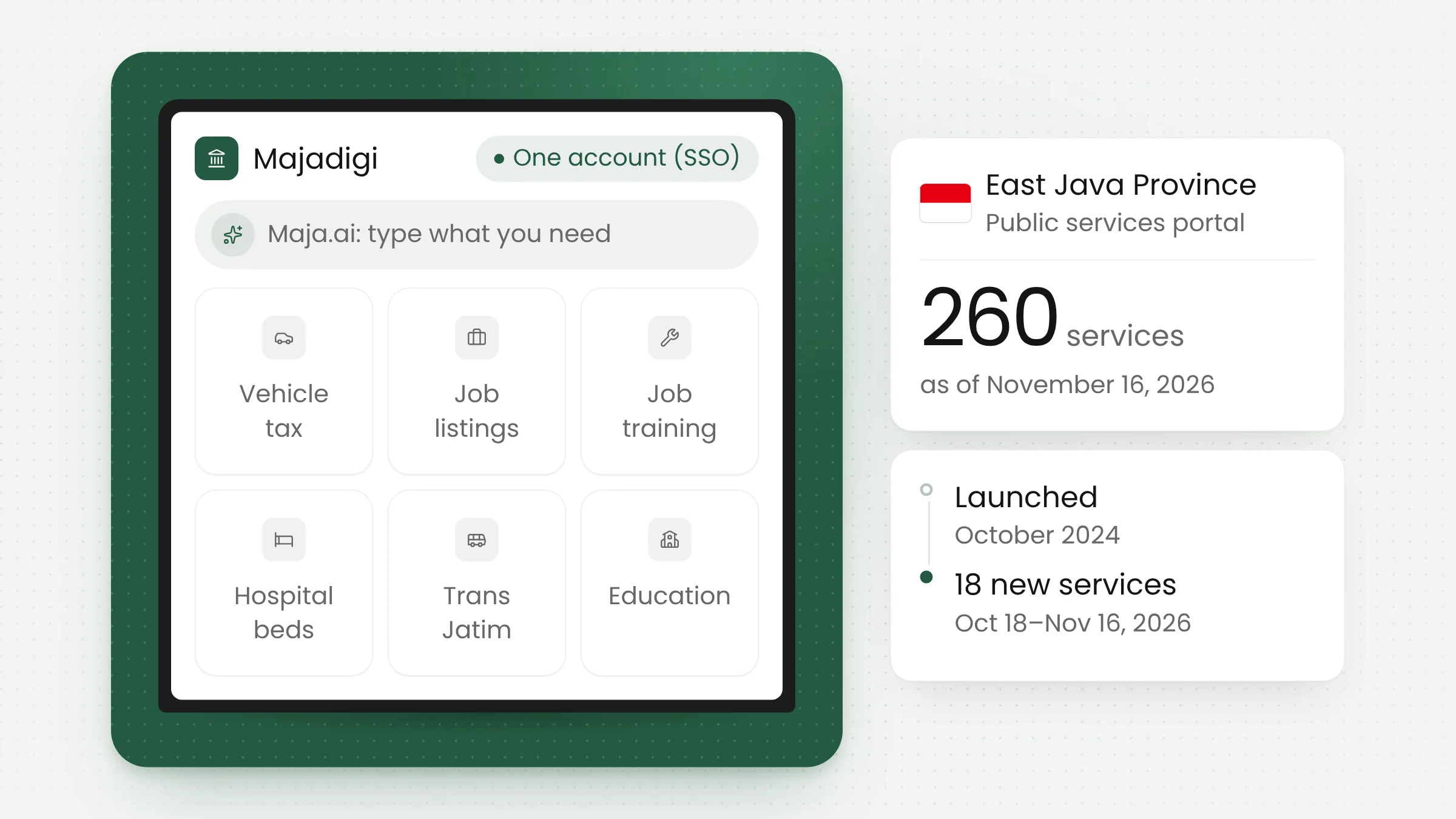
Majadigi, the public services portal run by Indonesia’s East Java provincial government, listed 260 services as of November 16, 2026. Residents can look up vehicle tax, browse job openings and check hospital bed availability from a single entry point. The portal links agencies’ existing apps rather than replacing them.
260 services behind one front door
The 260 figure comes from East Java’s Communications and Informatics Office (Diskominfo Jatim) and was reported by ANTARA Jatim, IDN Times Jatim and TIMES Indonesia on November 18, 2026. Eighteen of those services were added in the month between October 18 and November 16, 2026.
The name is short for Majapahit Digital, after the Javanese kingdom, and the portal lives at majadigi.jatimprov.go.id. Its catalog covers the errands residents deal with most often:
- motor vehicle tax information;
- job listings and registration for training at public vocational centers (Balai Latihan Kerja, or BLK);
- health services, including checking inpatient bed availability at several government hospitals;
- education services;
- routes and fares for the Trans Jatim bus network.
Gugi A. Wicaksono, who heads the informatics applications division at Diskominfo Jatim, said Majadigi was built to strengthen the digitalization of public services. According to Duta.co, the aim is to spare residents from hopping between platforms to handle paperwork.
The reports did not include user numbers. A full list of the 260 services, broken down by agency, has also not been published.
How Majadigi works as a connecting portal
Many Indonesian local governments run dozens of apps, each built separately by a regional agency (known as an OPD). For residents, that means several downloads, several accounts and several passwords. Majadigi tries to tidy up that experience on the resident’s side while leaving the back-end systems in place.
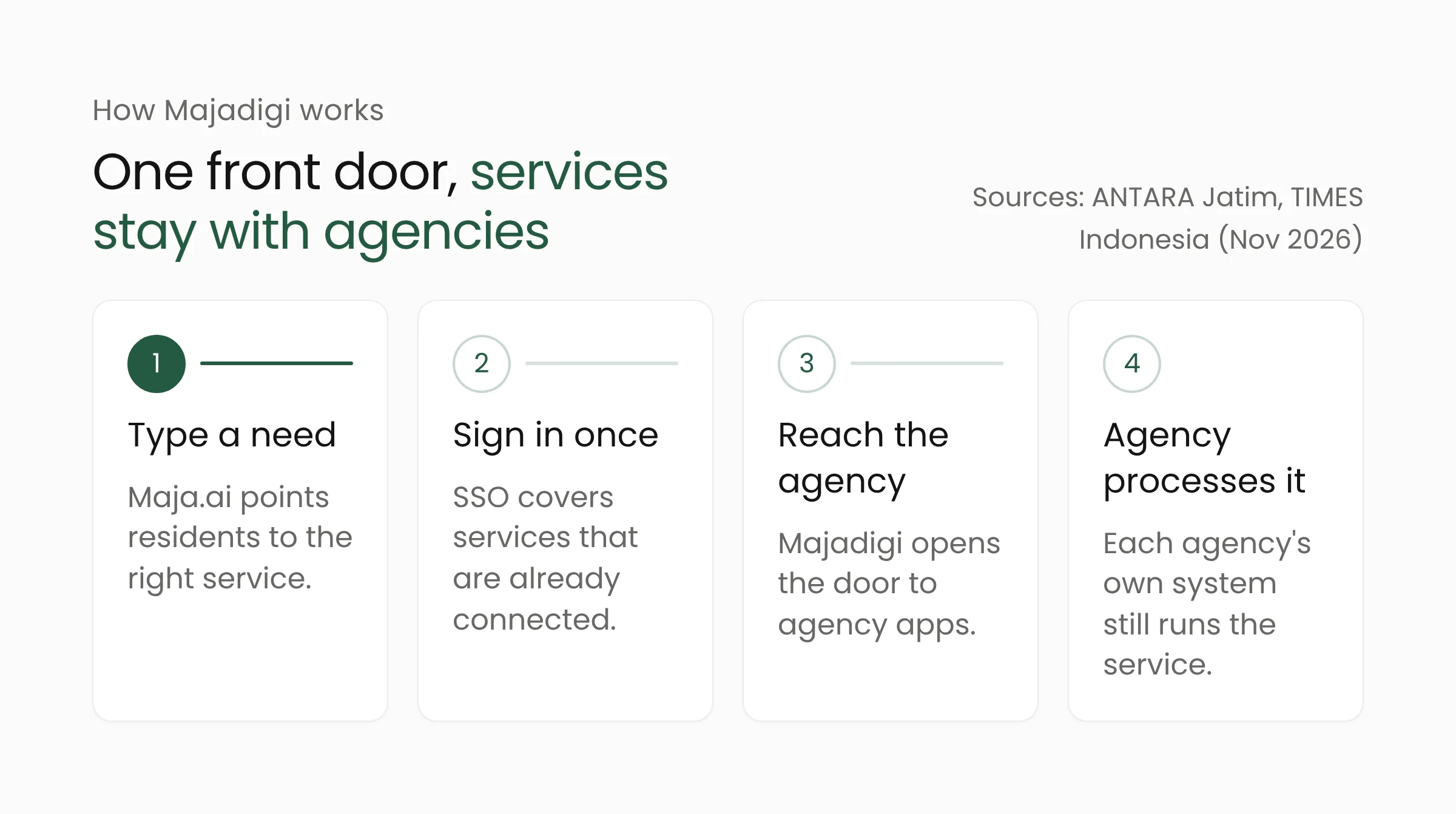
I Wayan Rudy Artha, who leads the applications team in the same division, was explicit about this. “Jadi Majadigi ini tidak untuk menggantikan aplikasi lain yang sudah dimiliki oleh OPD-OPD,” he told TIMES Indonesia, meaning Majadigi is not meant to replace apps the agencies already own. Each service is still run on its agency’s own system, and Majadigi acts as the entry point.
One account through single sign-on
Majadigi uses single sign-on (SSO), which lets a person log in once and reach several applications. After signing in to Majadigi, users can open a number of connected services without typing their username and password again.
SSO covers only the services that have already been connected. Others may still send residents to an agency’s own app or website with a separate account. For residents, the difference shows up in the number of steps. For administrators, SSO means every agency app has to accept user identities from one shared source.
Maja.ai points people to the right service
With hundreds of services, finding the right menu can be hard. Majadigi offers Maja.ai, an AI chatbot that directs users to the relevant service based on what they type.
That is a narrower job than a general-purpose AI assistant. Maja.ai works more like the information desk at a public service office, listening to what a visitor needs and pointing to the correct counter. For that kind of task, the quality of the service catalog matters as much as the quality of the AI model.
The approach resembles the national government’s effort to connect agency apps without merging them, which we covered in our piece on how Komdigi plans to link government apps through SPLP. The difference is that Majadigi operates at the provincial level and faces residents directly.
From three pilot regions to a provincial hub
Majadigi has been in development for several years. According to Suara Surabaya, the portal launched in October 2024, while the program itself began in 2021 and was written into East Java’s 2019–2024 medium-term development plan (RPJMD).
In November 2024, ANTARA Jatim reported that three local governments had already integrated their services: the city of Surabaya and the regencies of Banyuwangi and Tuban. The portal’s development follows a Home Affairs Ministry circular, Surat Edaran Menteri Dalam Negeri Nomor 000.9.3.2/92/SJ. At the time, Diskominfo Jatim also said it planned to connect Majadigi with the national services portal being built by GovTech Indonesia, INA Digital.
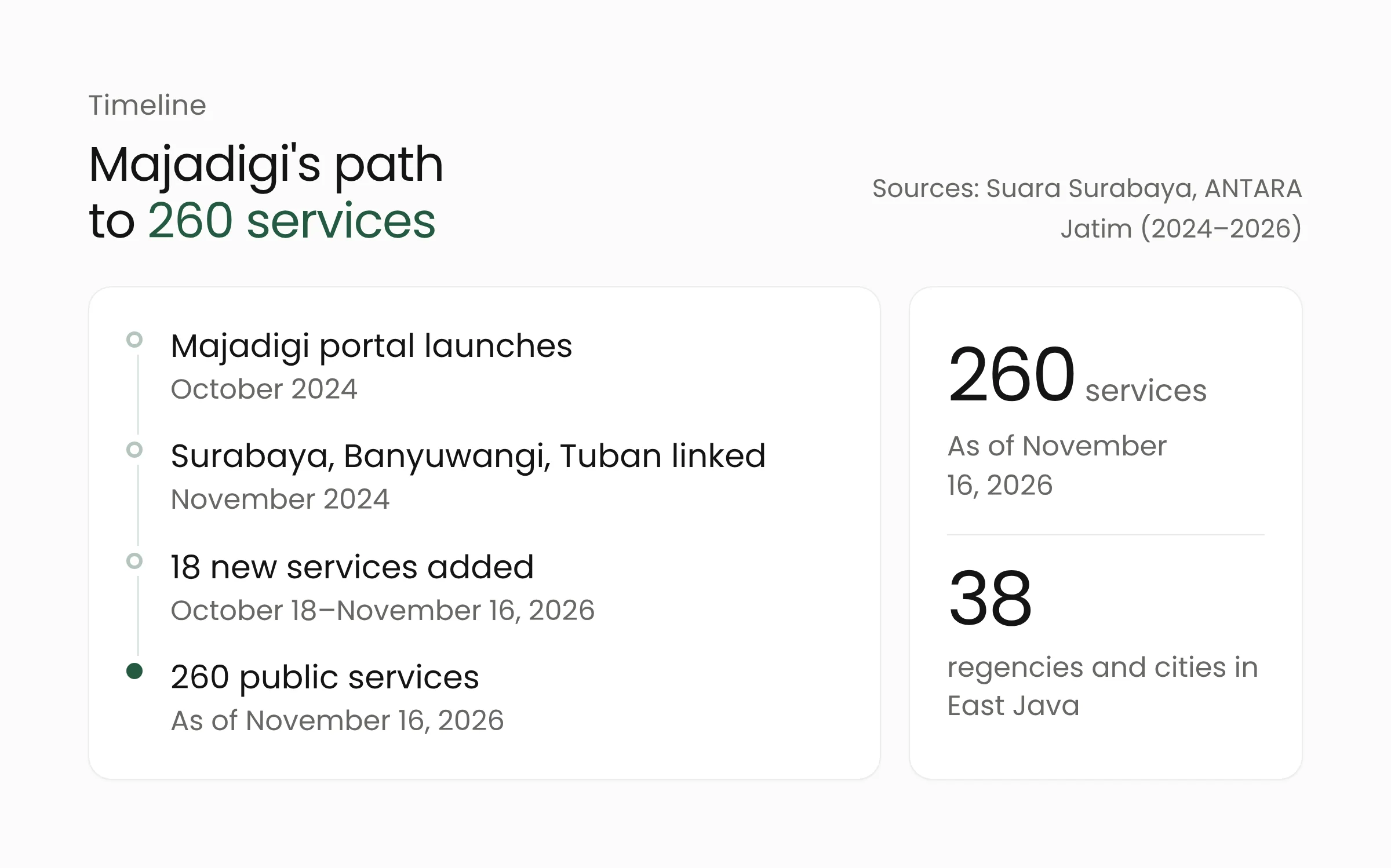
East Java has 38 regencies and cities. Connecting that many governments to one portal requires shared technical agreements, from data formats and how user identities are exchanged to who is responsible when a service breaks. Identity integration will also touch national identity services such as the IKD digital ID issued by the civil registry, Dukcapil.
Support for residents who are new to digital services
A complete portal does not guarantee that everyone will use it. Diskominfo Jatim has run outreach and hands-on digital assistance for village officials, students, older residents and people with disabilities. According to IDN Times, Gugi also said that digitalization without inclusion would widen existing gaps.
Legislators ask for complaint tracking and performance data
Feedback has also come from the provincial legislature. As reported by NU Online Jatim on November 6, 2026, Saifudin Zuhri, a member of the legislature’s Commission A, urged that Majadigi become an integrated complaints hub. He proposed a complaint channel that accepts photos, video and location pins, status tracking through to resolution, and service-level targets such as confirming receipt within one working day.
Saifudin also asked Diskominfo to publish Majadigi’s performance data, including active users, complaints received, resolution rates and average response times. He pointed to West Java’s Sapawarga and Jakarta’s JAKI apps as references. The report did not include a response from Diskominfo.
What this means for local governments
Majadigi’s experience is relevant to other regencies, cities and provinces facing the same problem: too many apps, too many accounts, and residents unsure where to start. Several points are worth weighing before building a similar portal.
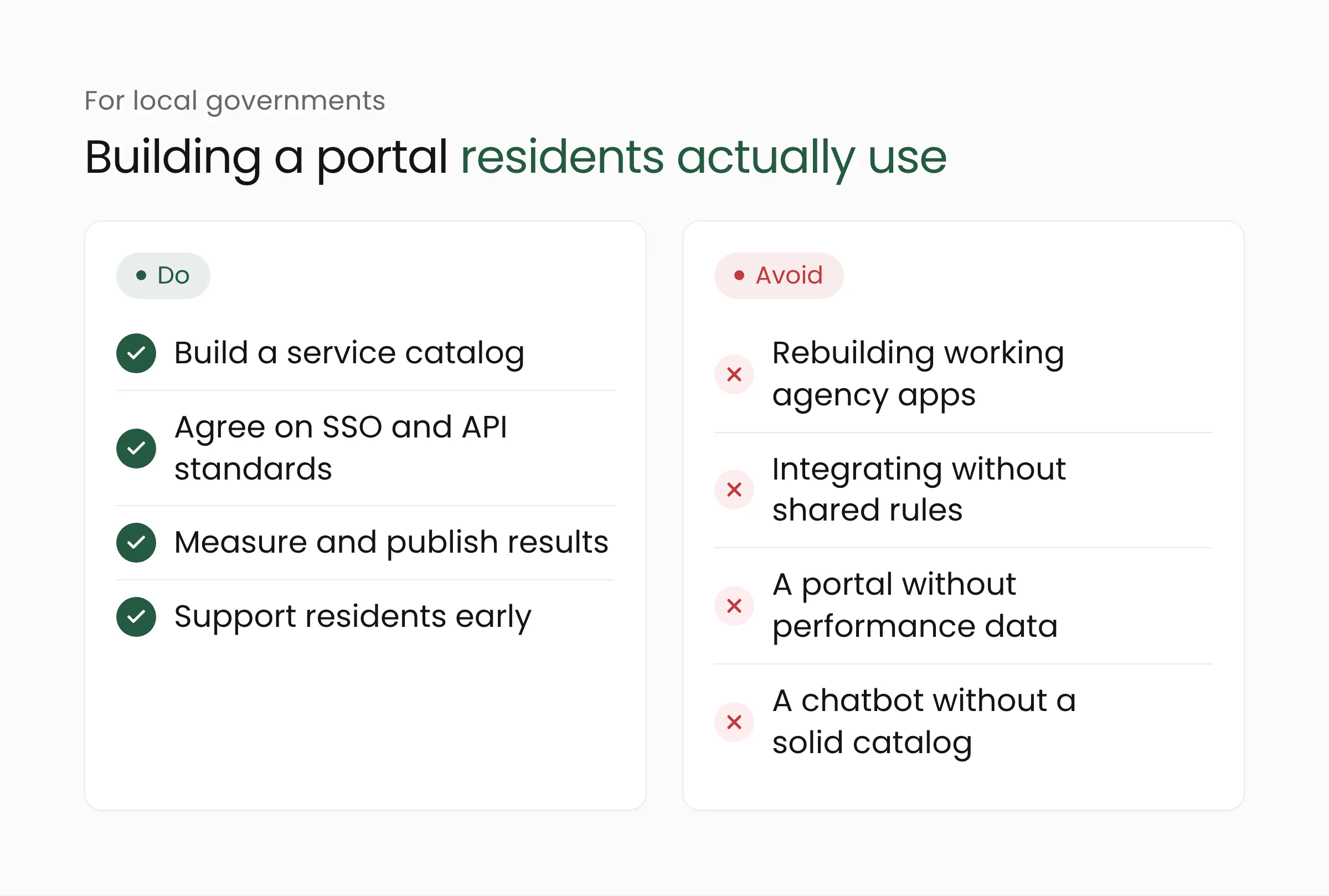
- Build the service catalog first. A clean list of services, with the responsible agency, requirements and official links, is the foundation of the portal. A chatbot like Maja.ai can only route residents correctly if that catalog is accurate.
- Agree on SSO and data interface standards. Every agency needs to accept user identities and exchange data in the same way. Without a standard, each new integration turns into a costly project of its own.
- Keep agency systems running. A connecting portal lets departments keep the apps they already operate. Rebuilding should happen only when an old app cannot be connected securely.
- Measure performance and publish it. The East Java legislature’s proposal offers sensible measures, such as active users, response times and the share of complaints resolved. That data helps decide which services to fix first.
- Plan assistance from day one. Village volunteers, schools and community groups can serve as help points for older residents and people with disabilities.
For agencies planning a similar move, Merakit offers digital government solutions covering app integration, service portals and performance dashboards.
Frequently asked questions
What is Majadigi?
Majadigi (Majapahit Digital) is the public services portal of the East Java provincial government in Indonesia. As of November 16, 2026, it listed 260 services, from vehicle tax information to hospital bed availability, and it is available at majadigi.jatimprov.go.id.
Does Majadigi replace existing agency apps?
No. Diskominfo Jatim says agency apps keep running and remain under each agency’s management. Majadigi serves as the entry point that links them.
Can residents use every Majadigi service with one account?
Not necessarily. Single sign-on applies to the services that have already been connected. Services that are not yet integrated may still require an account on the responsible agency’s own app or website.
Closing thoughts
Majadigi shows how a regional government can tidy up its digital services without tearing down existing systems: one entry point, one account and an AI assistant that points the way. The next tests are extending integration to all 38 regencies and cities and opening up performance data. If your agency is preparing a service portal or app integration, the Merakit team is ready to talk through our web development services.
Sources
- Pemprov Jatim integrasikan 260 layanan publik lewat Majadigi, ANTARA Jatim, November 18, 2026
- Majadig: Bikin 260 Layanan Pemprov Jatim dalam Satu Genggaman, IDN Times Jatim, November 18, 2026
- Tak Perlu Buka Banyak Aplikasi, 260 Layanan Publik Jatim Kini Terintegrasi di Majadigi, TIMES Indonesia, November 18, 2026
- Warga Jatim Tak Perlu Banyak Aplikasi, Majadigi melayani 260 Layanan Publik, Duta.co, November 18, 2026
- DPRD Jatim Dorong Majadigi Jadi Pusat Aduan Terpadu, Diskominfo Diminta Buka Data, NU Online Jatim, November 6, 2026
- Pemprov Jatim terus sosialisasikan aplikasi terintegrasi Majadigi, ANTARA Jatim, November 7, 2024
- Majadigi Jadi Upaya Pemprov Jatim untuk Layanan Publik yang Lebih Cepat dan Efisien, Suara Surabaya, November 9, 2024