Blog Cybersecurity
Lovable Apps Exposed User Data: How Builders Can Fix It
On this page· 7 sections
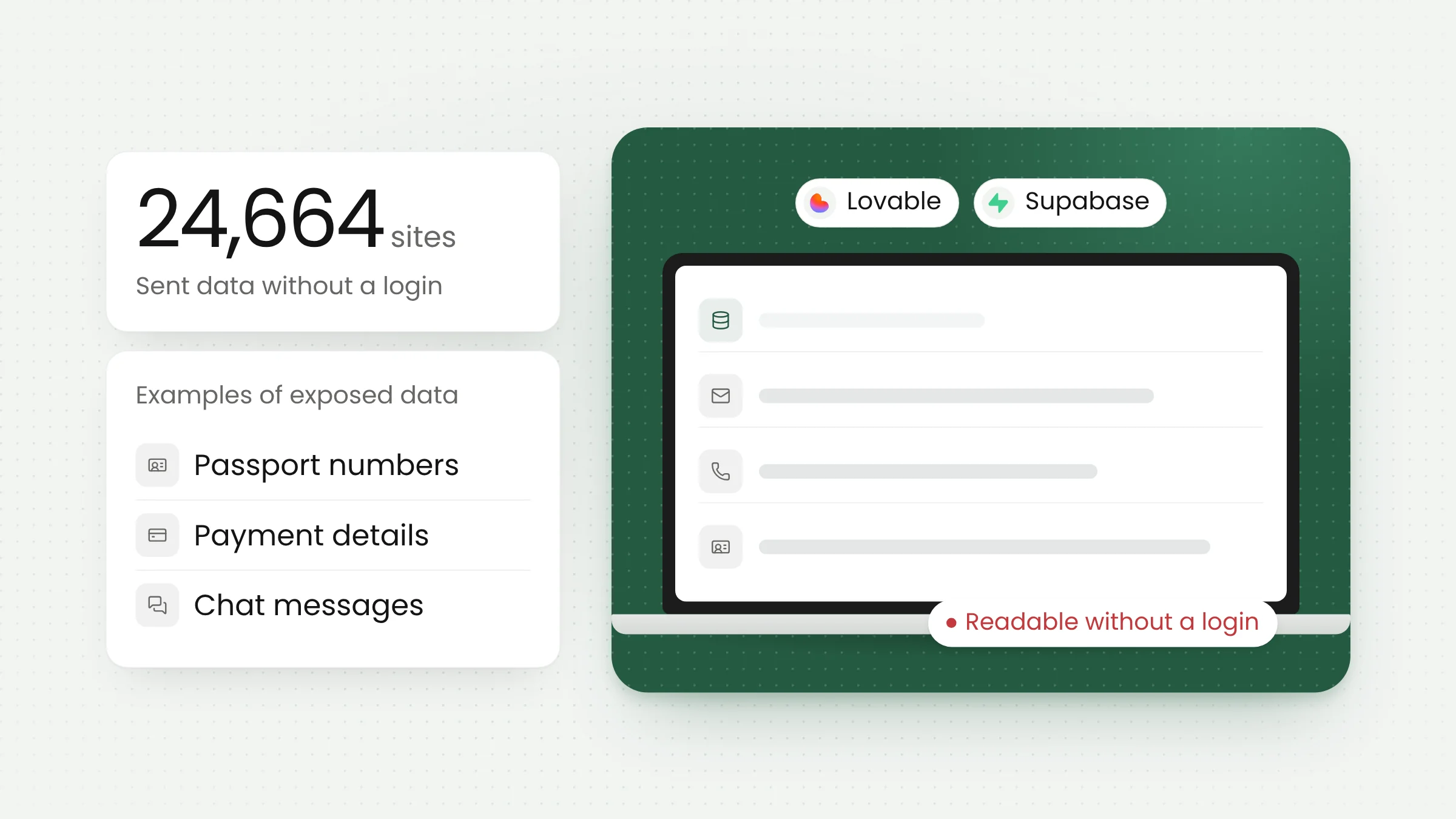
Thousands of apps built with Lovable, the AI app builder, are serving database records to anyone who opens them, without a login, according to research by security firm Crissy Field. Of 24,664 sites that sent such data, 7,403 exposed tables containing email addresses. The main cause is database access rules that are too permissive.
What Crissy Field found
Crissy Field is a cybersecurity firm based in Hamburg, Germany. Its findings were first reported by the German business daily Handelsblatt on November 2, 2026, and later updated in an English-language report on the firm’s website. Outlets including Techzine and PrivacyAffairs have since covered the research and the responses from the companies involved.
Lovable is a Stockholm-based startup founded in 2023. It turns plain-language prompts into web apps, which makes it popular with people who have never written code. Many Lovable apps store their data in Supabase, a widely used database and backend service.
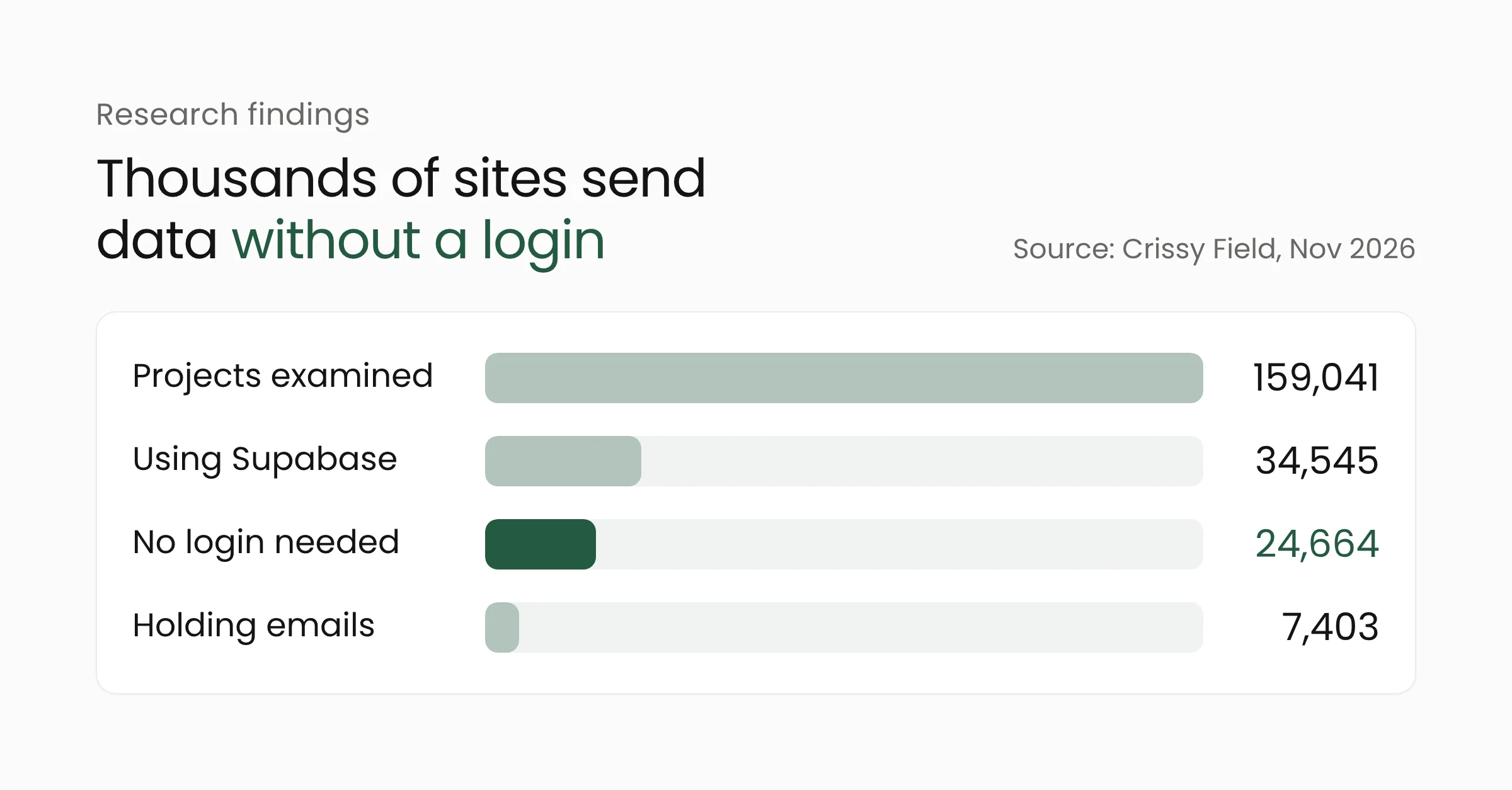
The researchers pulled 159,041 Lovable projects from the open Common Crawl web archive, all published between December 2025 and September 2026. Of those, 34,545 used Supabase. On 24,664 of these sites, Supabase records were sent to the browser as soon as the page loaded, with no login or other interaction required.
Using further read-only requests with the same API key, the team found email addresses in 10,560 tables across 7,403 sites, or about 30% of the sites it examined more closely.
The exposed data covered a wide range. A German lifestyle forum revealed more than 80,000 profiles with names, email addresses, birth dates and gender, along with more than 200,000 chat messages. Several event organizers and restaurants exposed tens of thousands of ticket and food sales records, including phone numbers, postal addresses, payment information and ticket codes.
One service provider exposed more than 1,000 identity records containing passport numbers, expiry dates and nationalities. The researchers also found contracts, invoices, personal photo albums, internal WhatsApp conversations and, in one case, 280,000 emails a company had sent to its customers.
Limits of the research
Crissy Field says the 30% figure is not a confirmed leak rate. Some email addresses may be public contacts or test data, while personal records without an email field were not counted at all. The Common Crawl sample is also not representative of every Lovable app.
The researchers did not name the affected apps and could not determine whether any of the data had been misused. Lovable’s own built-in database features, introduced in late 2025, were outside the scope of the study.
How the data became readable without a login
Apps that use Supabase usually ship a public key inside the code that runs in the browser. That key is meant to be visible. The data itself is protected by rules in the database, chiefly Row Level Security (RLS), which decides which rows each user is allowed to read.
When RLS is switched off or its rules are too broad, anyone holding the public key can read entire tables. They only need to copy the key from the page source and send their own requests to the database. Crissy Field’s report notes that access control mistakes like this can happen in any application, whether it was written by people or generated with AI.
The problem is amplified by how uniform Lovable’s database integrations tend to be. According to the researchers, an attacker who finds one weak app can search for the same misconfiguration across many others with little extra effort.
Lovable is not the only platform affected. Research by UpGuard queried about 300,000 domains showing signs of Supabase use and found 16,326 databases with publicly readable tables. More than half showed signs of holding personal information. UpGuard also pointed out that tables created through the API, which is how AI coding agents work with Supabase, do not have RLS enabled by default.
How Lovable and Supabase responded
Lovable told Handelsblatt that this is a configuration problem known across the industry, according to PrivacyAffairs. Its security documentation says users are responsible for making sure their apps meet the security requirements of their use case. A researcher reported a similar pattern in 2025, which was recorded as CVE-2025-48757, and Lovable disputed it, saying each customer is responsible for protecting their app’s data.
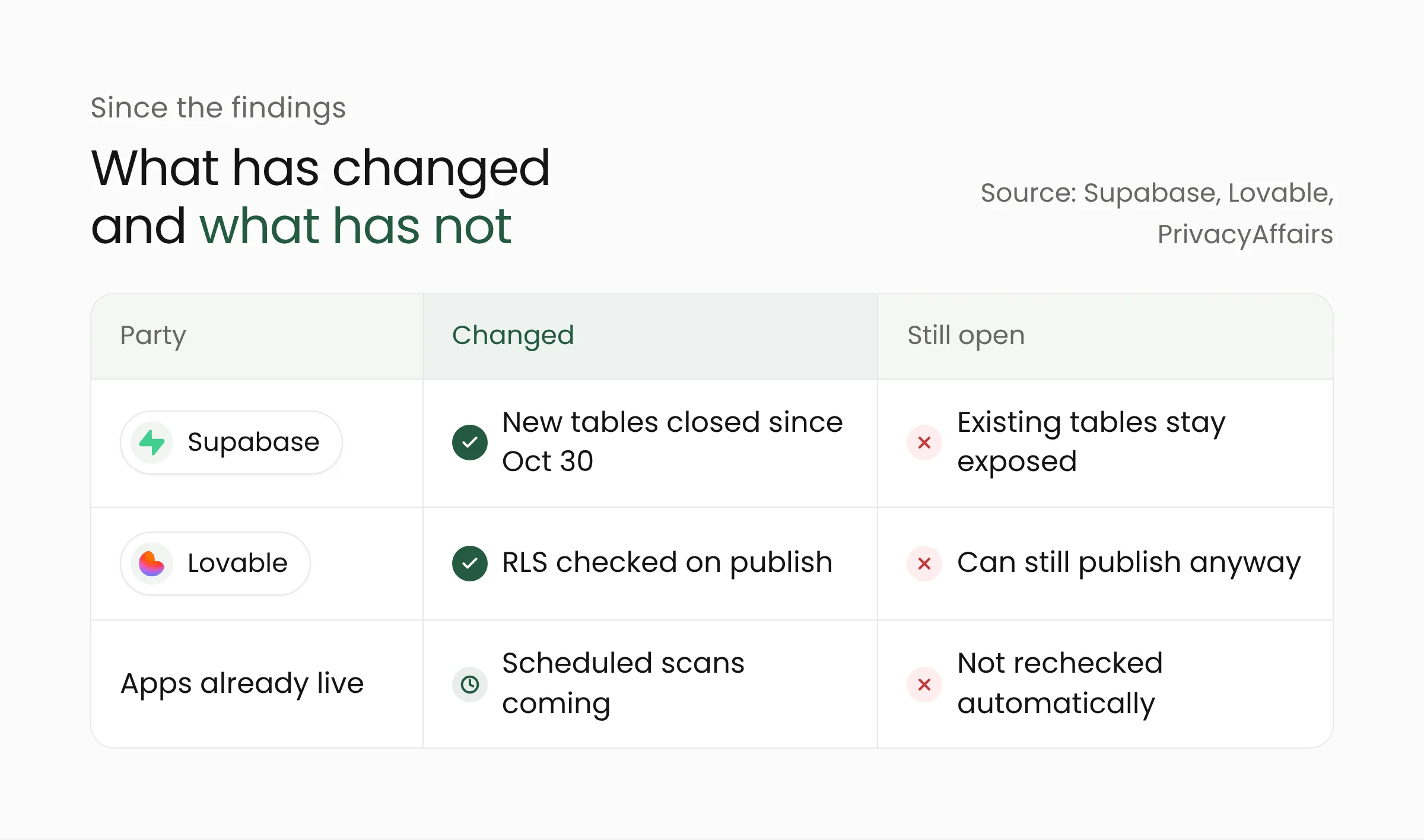
On November 10, 2026, Lovable published a security guide describing the scanning features on its platform. “The most common issue we see in Lovable apps is data access rules that are too open,” wrote Igor, Lovable’s Head of Security. Lovable says every publish now checks code, application logic, database schemas and RLS policies. Users can also run a free Deep scan, turn on automatic fixes, and stop apps with critical findings from going live.
PrivacyAffairs notes that some gaps remain. When publishing an app with critical findings, users can still choose to publish anyway. The quick scan also runs only when the publish window opens, so apps that are already live are not rechecked automatically. Lovable says scheduled scans for all paid plans are due this month.
On the Supabase side, a platform change took effect for all projects on October 30, 2026. New tables in the public schema are no longer exposed to the Data API automatically and need an explicit grant. Existing tables, however, keep their current grants, so data that was already exposed stays exposed until its owner fixes it.
What this means for app owners
In Indonesia, AI app builders appeal to event organizers, restaurant owners, clinics and small businesses that want a registration form or ordering page up quickly. These findings show that an app can work perfectly and still leak data. A form that collects names, phone numbers or photos of ID cards should be treated as a system that stores personal data.
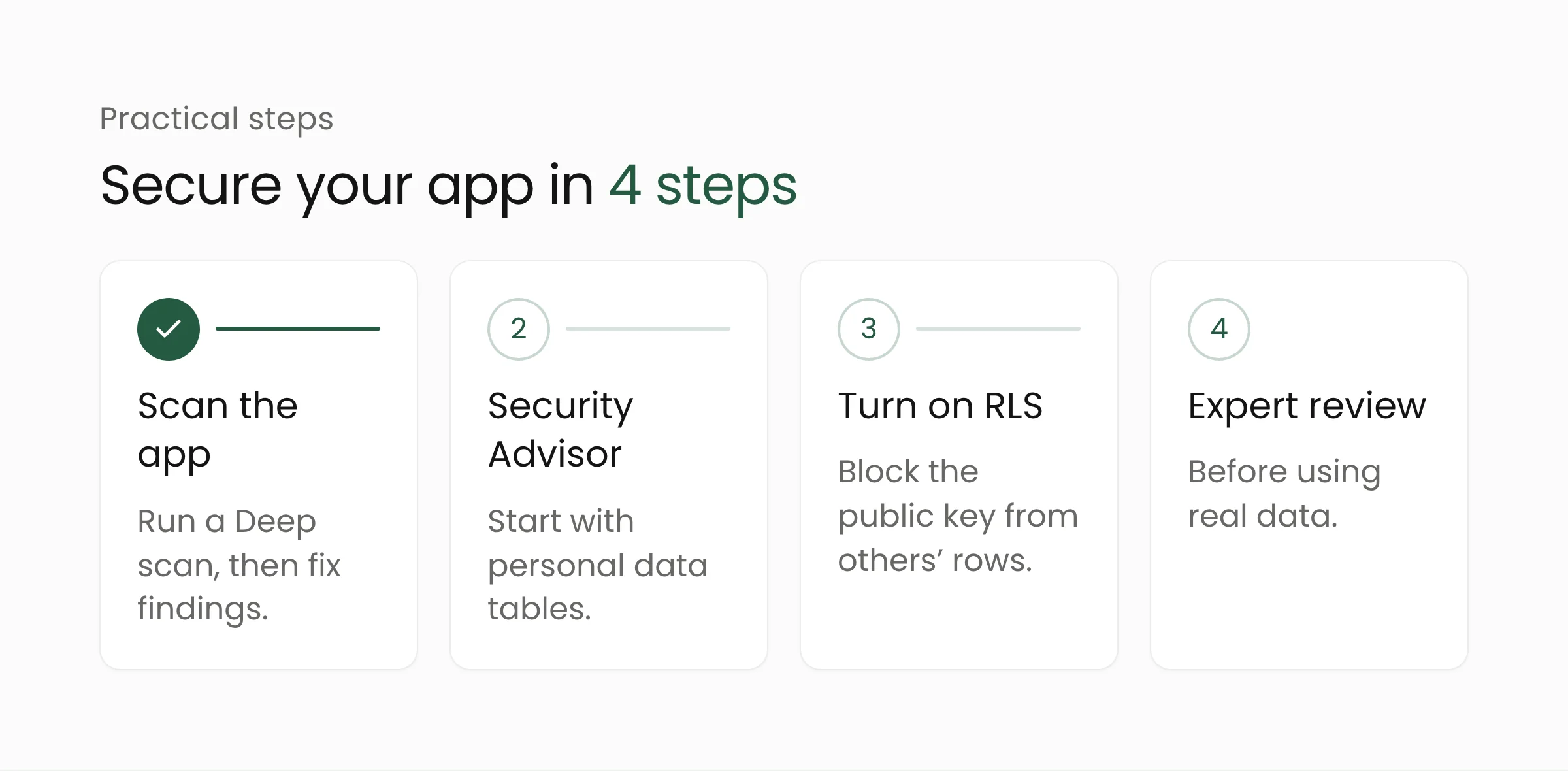
Steps worth taking now, especially for apps that are already live:
- Run a security scan. Lovable users can run a Deep scan from the Security view and fix every finding.
- Check Supabase’s Security Advisor. Start with tables that hold personal data, because existing tables were not closed by the October 30 change.
- Turn on RLS for every table. Make sure no rule lets the public key read other users’ rows, and never put the service role key in code that runs in the browser.
- Get an expert review before using real data. Crissy Field recommends reviewing access rights, interfaces and the separation between user accounts, then repeating the review after major changes.
There is a legal side as well. Article 46 of Indonesia’s Undang-Undang Nomor 27 Tahun 2022 tentang Pelindungan Data Pribadi (Law No. 27 of 2022 on Personal Data Protection) requires data controllers to notify data subjects and the supervisory institution in writing within 3 x 24 hours of a personal data protection failure. The notice must at least state what data was exposed, when and how it happened, and what is being done to handle and recover from it.
For organizations that want to move fast, an AI-built app can still be a sensible starting point. The parts that touch personal data should be reviewed and rebuilt by a team experienced in web application development, including the database setup and user accounts. Regular testing through a cybersecurity service helps find exposed tables before someone else does.
Frequently asked questions
Are all Lovable apps insecure?
No. Crissy Field examined a sample from a web archive, and it does not represent every Lovable app. The issue lies in how database access is configured in specific apps. An app with correct RLS rules does not send personal data to visitors who have not logged in.
Has the exposed data been stolen?
The researchers could not determine whether the data had been misused. Even so, any data that can be read without a login should be treated as at risk, especially passport numbers, payment details and private messages.
How can ordinary users protect themselves?
PrivacyAffairs advises users to be wary of messages that quote their order or identity details, since that information can be used in scams. Verify any payment or login request through the official website rather than through links in messages. Users can also ask service operators what data they hold about them.
Conclusion
Crissy Field’s research shows that the speed of building apps with AI needs to be matched by security checks. The changes at Supabase and Lovable help new apps, but existing tables and live apps remain their owners’ responsibility. A simple review of access rules can keep customer data from being read by strangers.
If your organization already relies on an AI-built app to serve customers, the Merakit Indonesia team can help review its database settings and user access.
Sources
- Lovable: Many Apps Built on the Platform Expose Sensitive Data, Crissy Field, November 2026
- Thousands of Lovable apps are leaking personal data, Techzine Global, November 4, 2026
- Lovable Apps Data Exposure: What’s Fixed and What Isn’t, PrivacyAffairs, November 14, 2026
- Find it, fix it, ship it: building secure apps on Lovable, Lovable, November 10, 2026
- Breaking change: tables not exposed to Data and GraphQL API automatically, Supabase
- Everything Everywhere: Systemic Data Exposure in Supabase Apps, UpGuard
- Article 46 of Law No. 27 of 2022 on Personal Data Protection, Pasal.id