Blog Digital Social Aid
Indonesia Adds Face Verification to Digital Social Aid
On this page· 7 sections
Indonesia is adding face verification to the way it distributes social assistance (bansos) through the Perlinsos portal, and it plans to open recipient data so the public can review it and file feedback. Ministers met on 16 October 2026 to discuss the planned national rollout. For social affairs offices and local governments, digital social aid changes how recipient data is collected and verified.
What was discussed on 16 October 2026
According to detikNews, the coordination meeting took place at the National Economic Council (DEN) office in Jakarta and was chaired by DEN head Luhut Binsar Pandjaitan. Attendees included Social Affairs Minister Saifullah Yusuf, Home Affairs Minister Tito Karnavian, the Minister of Communications and Digital, and Statistics Indonesia (BPS) head Amalia Adininggar Widyasanti. Perlinsos stands for perlindungan sosial, or social protection.
Saifullah Yusuf said digitalization through the Perlinsos portal is meant to improve data accuracy and targeting, through open data, updated biometric identity records, and cooperation between agencies. He described openness as the biggest change: “Dari tertutup menjadi terbuka, itu yang paling istimewa sebenarnya dari proses ini” (from closed to open, the most special part of this process). According to Disway, the openness follows an instruction from President Prabowo Subianto.
Two other changes appear in the same reports. All recipients will be re-registered with stronger identity verification, and face recognition is being added to a process that previously relied on names and addresses. The reports do not give a start date, a recipient count, or a budget.
How face verification and eligibility checks work
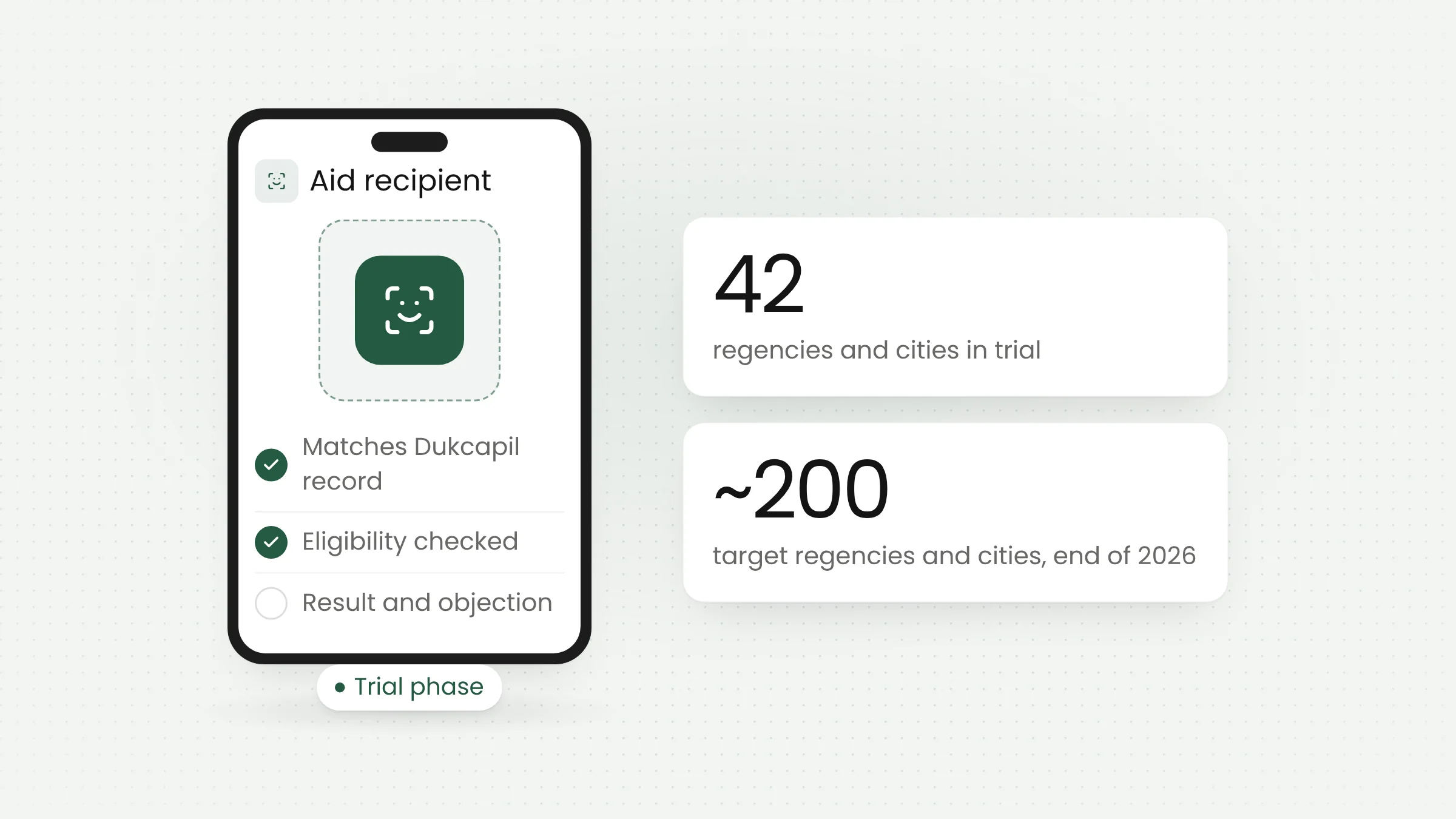
At a media discussion on 18 May 2026, reported by Industry.co.id, Mira Tayyiba, Director General of Digital Government Technology at the Ministry of Communications and Digital, described the foundation. The system uses Digital Public Infrastructure (DPI), a base layer that links digital identity, data exchange between agencies, and digital payments. Recipient verification relies on facial biometrics connected to civil registry (Dukcapil) data.
Once identity matches, eligibility is checked against data held by other agencies. The same report lists vehicle ownership, household electricity, civil servant status, and BPJS Ketenagakerjaan membership. At a ministerial meeting on 30 September 2026, Tito Karnavian said land records from the ATR/BPN ministry and vehicle records from the police are also used, as reported by Investortrust.
People who believe they qualify but are not registered can file an objection. Residents can also check or apply for aid with their national ID number (NIK) through an official government portal.
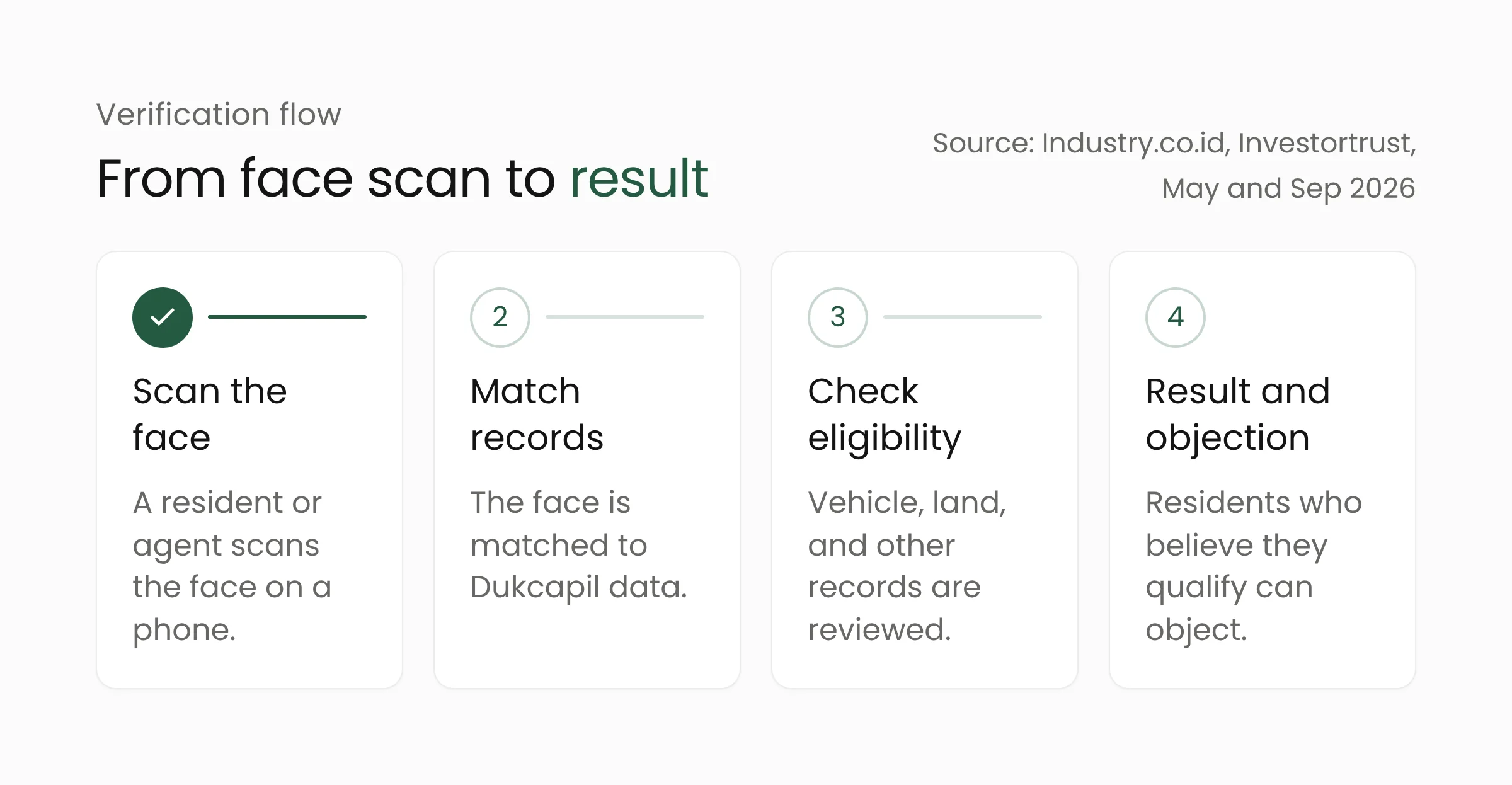
For residents who struggle with technology, the government is setting up Perlinsos agents. The home affairs minister said a face check on a phone takes about five to seven seconds and that trained agents can assist residents. In Bali, for example, community health volunteers act as agents through the banjar neighborhood structure. The timing comes from an official statement and has not been tested independently.
Where trials stand and what is still unclear
Trials began in Banyuwangi Regency. According to Industry.co.id, from June 2026 the scope expanded to 42 regencies and cities covering about 36 million people. Speaking at the FEKDIxIFSE event in Jakarta on 24 September 2026, Tito Karnavian said the target is about 200 regencies and cities by the end of 2026, as reported by Nusaperdana, citing detik Finance. The 30 September meeting also covered an implementation plan for expanding Perlinsos in 2027.
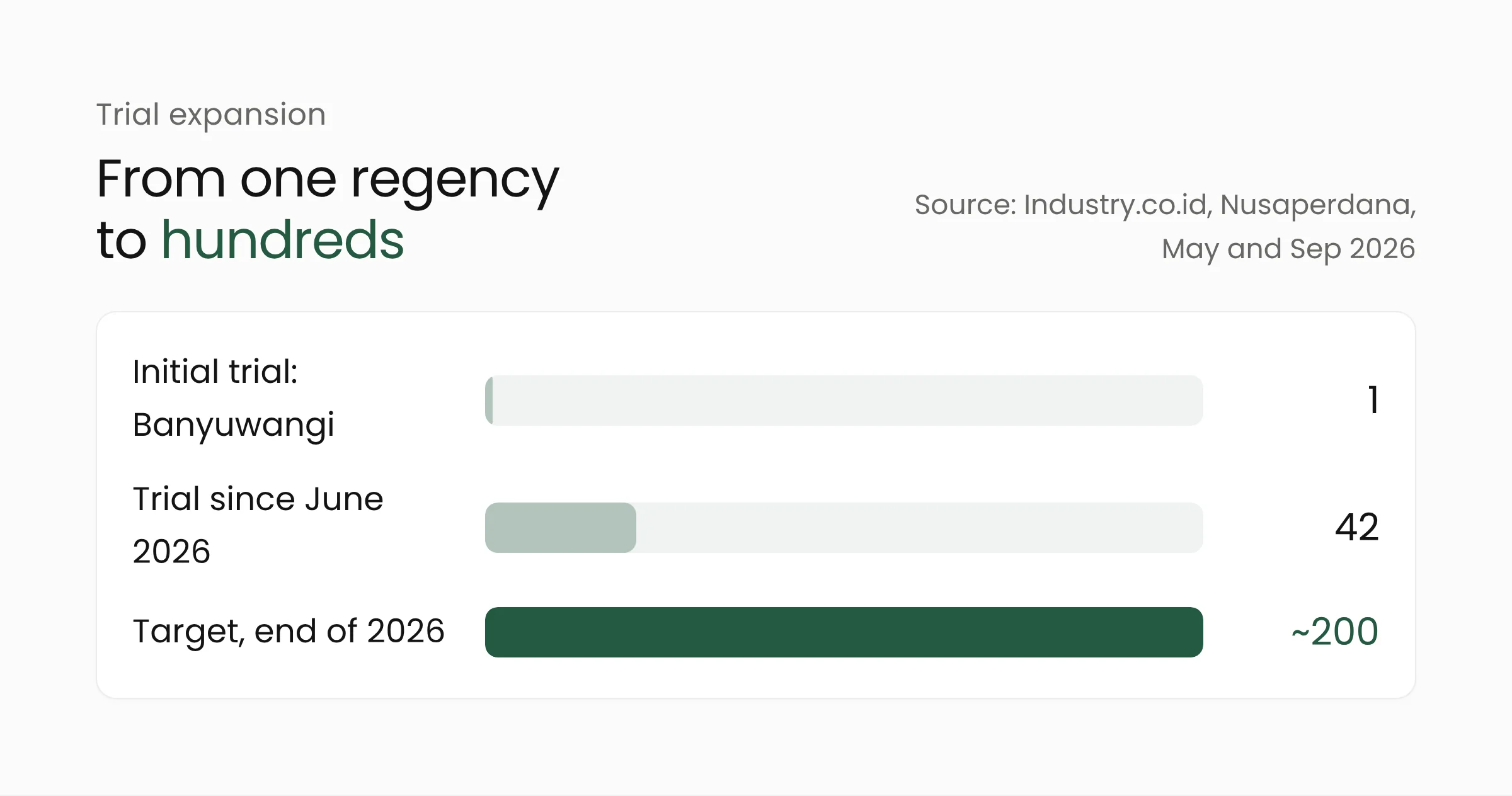
Deployment remains gradual. According to Nusaperdana, the Social Affairs Ministry said current recipients are not yet required to scan their faces, and that no official scanning schedule exists outside trial areas. At the 16 October meeting, the minister added that outreach must continue while the system is strengthened.
The reports we read leave several important questions open. How facial data is stored, secured, and deleted has not been detailed. Nor is it clear how objections are handled or how long resolution takes. Claims about accuracy and transparency come from government officials and a member of the National Economic Council, and trial results, error rates, and independent evaluations have not been published.
This matters because Undang-Undang Nomor 27 Tahun 2022 tentang Pelindungan Data Pribadi (Law No. 27 of 2022 on Personal Data Protection, the PDP Law) classifies biometric data as specific personal data (Article 4). Data of this kind calls for stricter handling than a name or an address.
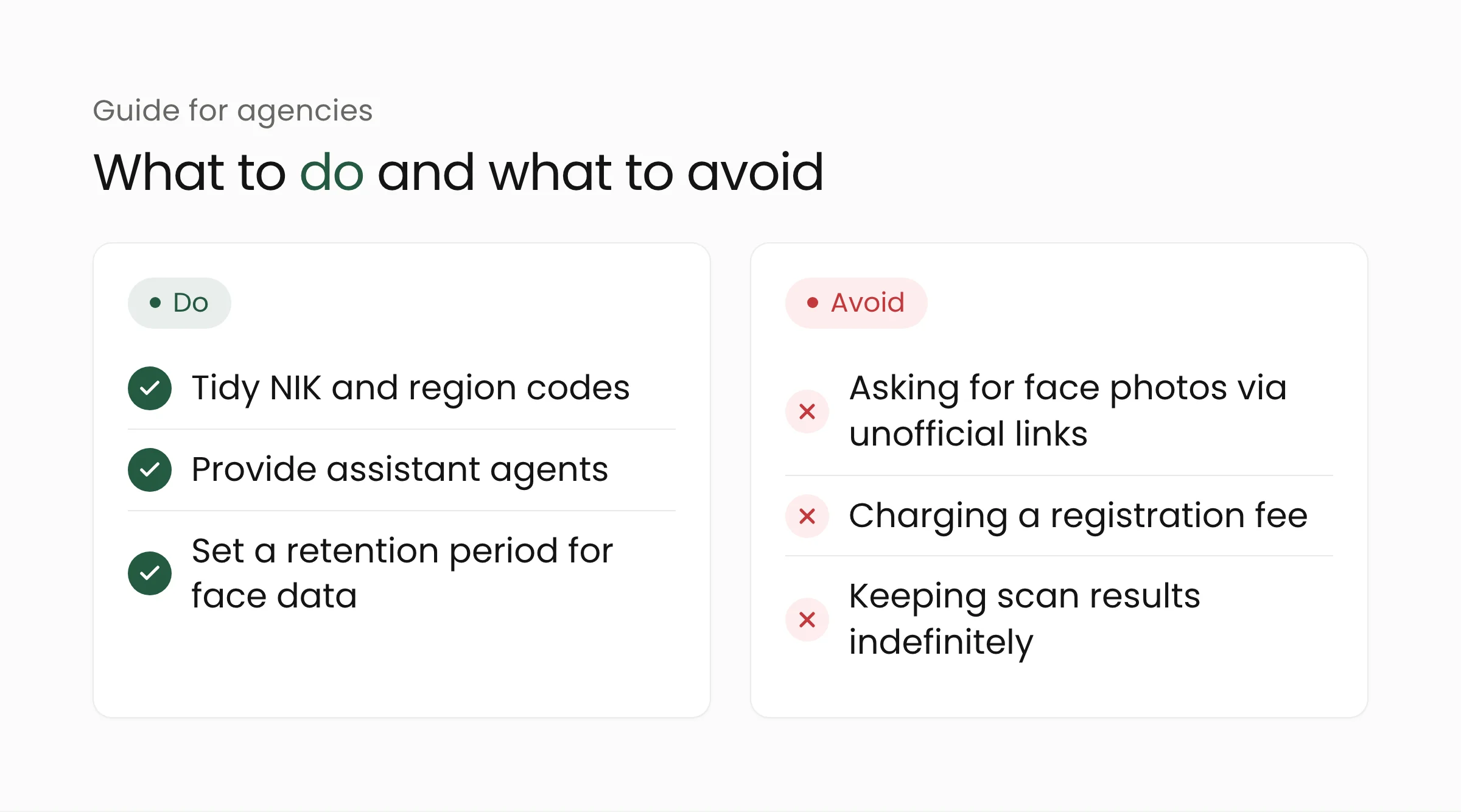
Officials also warn about scams that use “digital bansos” as a pretext. According to Industry.co.id, official services use the go.id domain and do not ask for personal data through unofficial links. Per Nusaperdana, applying for aid is free, so residents should not pay anyone who offers to register them.
What this means for social affairs offices and local governments
Regions entering the expansion phase can start preparing with a few practical steps.
Clean up recipient master data. Older records rely on names and addresses, while the new verification depends on matching the NIK against population data. Inconsistent spellings, region codes, and NIK entries are the easiest source of mismatches to prevent. A data inventory and a simple data dictionary are a low-cost start. Our article on the Satu Data Indonesia law covers this in more depth.
Prepare assistants. Older residents, people with disabilities, and people in areas with weak signal need help with scanning. Perlinsos agents should be trained to operate the app and to explain residents’ right to object.
Set a facial data policy. Record who may access scan results, how long they are kept, and where they are stored. Access logs kept from the start make audits and PDP Law compliance easier, an approach consistent with cybersecurity practice for government systems.
Pilot in one district first. Before expansion, a region can try the scanning flow in a single subdistrict and record how many scans fail, why, and how long each resident takes to serve. Those notes give a clear basis for adding agents or fixing devices, since error rates from the national trials have not been published.
Provide a clear objection channel. Residents need to know where to complain, how long it takes, and how the result is communicated. Tracking objections by district can also reveal where the data is weakest, and this kind of analysis falls under data analytics.
For a broader view of data-driven public services, see our digital government solutions page.
Frequently asked questions
Do aid recipients have to scan their faces now?
According to Nusaperdana, citing the Social Affairs Ministry, current recipients are not yet required to scan their faces, and there is no official schedule outside trial areas. Re-registration of all recipients was mentioned at the 16 October 2026 meeting, but no implementation date has been announced.
What if I qualify but am not registered?
According to Industry.co.id, an objection mechanism exists for residents who believe they qualify but are not registered. Nusaperdana also reports that proposals can be submitted through the village or ward office to be added to the recipient list (DTKS). The process is free.
Is recipients’ facial data safe?
The available reports do not explain how facial data is stored and protected. Biometric data counts as specific personal data under the PDP Law, so those who handle it must meet its protection requirements. For technical details, rely on official explanations from the Social Affairs Ministry, the Home Affairs Ministry, and the Ministry of Communications and Digital.
Accurate aid starts with tidy data
Face verification and open data can make aid reach the right people, provided the underlying data is clean, assistants are available, and biometric protections are clear. Regions that prepare early will be better placed when the expansion arrives.
If your agency or organization wants to discuss data mapping, security, or integration for public services, our team is glad to talk through the contact page, with no obligation.
Sources
- Mensos Gus Ipul Tegaskan Digitalisasi Bansos Tingkatkan Akurasi Data, detikNews, 16 October 2026
- Gus Ipul Tegaskan Digitalisasi Bansos Pakai Face Recognition, Disway, 17 October 2026
- Gunakan Pindai Wajah dan Data Dukcapil, Mendagri Dorong Perluasan Agen Perlinsos, Investortrust, 30 September 2026
- Pemerintah Uji Scan Wajah Penerima Bansos, Diperluas ke 200 Daerah 2026, Nusaperdana, 25 September 2026
- Sistem DPI dan Biometrik Wajah, Cara Baru Pemerintah Benahi Penyaluran Bansos, Industry.co.id, 20 May 2026
- Law No. 27 of 2022 on Personal Data Protection (Undang-Undang Nomor 27 Tahun 2022 tentang Pelindungan Data Pribadi), Wikisource