Blog Cybersecurity
NFS2ROOT Linux Flaw: Fixed Kernels and How to Check
On this page· 7 sections
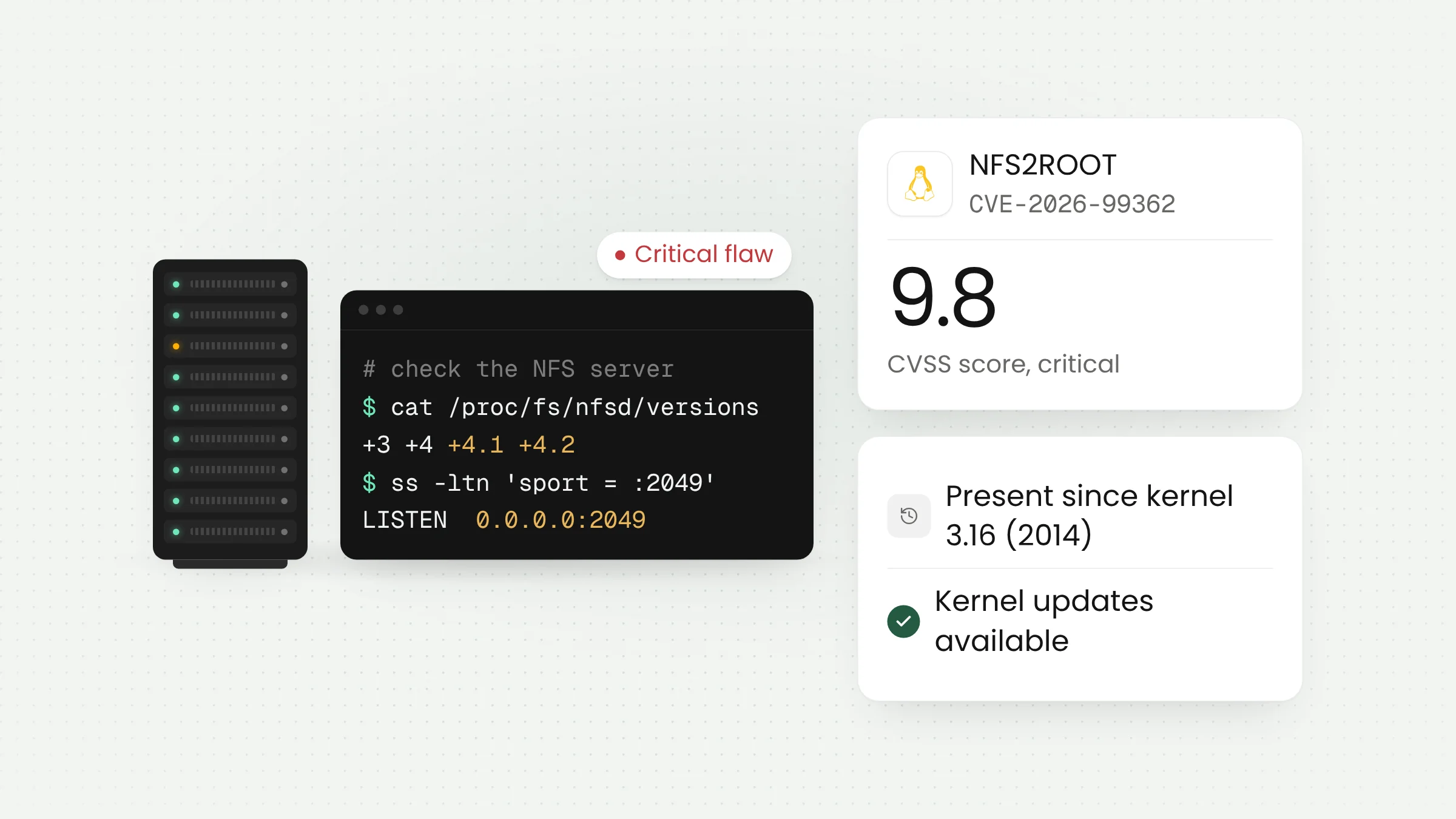
NFS2ROOT (CVE-2026-99362), a flaw in the Linux kernel’s built-in NFS server, lets a remote attacker take over a server without an account by reaching TCP port 2049. Rated CVSS 9.8, it has been present since kernel 3.16 and is fixed upstream. No attacks had been reported as of November 27, 2026.
What CVE-2026-99362 is
NFS (Network File System) is the file sharing protocol most Linux environments rely on. One server exports a directory and other machines mount it as if it were a local disk. The Linux kernel ships its own NFS server, called nfsd, and that component contains the bug.
The Linux kernel team published the CVE-2026-99362 record on November 19, 2026, with a CVSS score of 9.8 out of 10. The bug is a heap overflow: nfsd writes data past the end of a memory buffer while building a reply for an NFS version 4.1 client.
Security firm OpenSec named it NFS2ROOT. BleepingComputer, which covered it on November 27, 2026, reports that Jérémy Jean of ANSSI, the French cybersecurity agency, reported the flaw and submitted a fix in August. OpenSec then handed a full exploit and a patch to the nfsd maintainers in late September.
Severity ratings differ slightly. The CVE record scores it 9.8, while Red Hat scores it 9.4 because it rates the impact on data integrity lower. Both still call it critical, and so does Ubuntu.
How the attack works through port 2049
In NFS 4.1, client and server first agree on a session, including the maximum size of the replies the server keeps in a cache. That cache exists so a reply can be resent after a dropped connection.
According to the CVE record, a client can negotiate that size down to the smallest value allowed. The server then allocates a reply slot with zero bytes of storage. Given a specially built request, it still copies the whole reply into that slot, and the data spills into neighboring kernel memory. In the test case shown in the record, the out-of-bounds write is 80 bytes long, and the client chooses most of its content.
The three messages used in the attack, EXCHANGE_ID, CREATE_SESSION and SEQUENCE, are processed before the server checks whether the client may access any exported directory. An attacker therefore needs no username, no password and no permission to mount anything.
BleepingComputer summarizes OpenSec’s exploit chain this way. The attacker reads part of kernel memory to learn its layout, plants a command in a freed memory region, and closes the NFS connection. When the connection closes, the kernel runs the command as root. The exploit code has not been released.
When a server is exposed
A server is exposed only when three conditions hold together:
- The running kernel is version 3.16 or later and does not include the fix.
- The nfsd service is active and offers NFS version 4.1 or 4.2.
- TCP port 2049 is reachable from an untrusted network.
Machines that only mount NFS shares from another server are not affected. According to a write-up by RFF, user-space NFS servers such as NFS-Ganesha are not affected either, while owners of NAS appliances should check their vendor’s advisory. Red Hat adds that default Red Hat Enterprise Linux configurations do not enable nfsd, so exposure is limited to systems set up to export shares.
nfsd tends to run on file servers, backup targets, virtual machine datastores for Proxmox or VMware, and storage nodes in Kubernetes clusters.
Affected and fixed versions
The CVE record lists every kernel from 3.16 onward as affected until the fixed release in its branch. The fix is titled “nfsd: preflight SEQUENCE replies before accepting a slot” and has landed in eight branches.
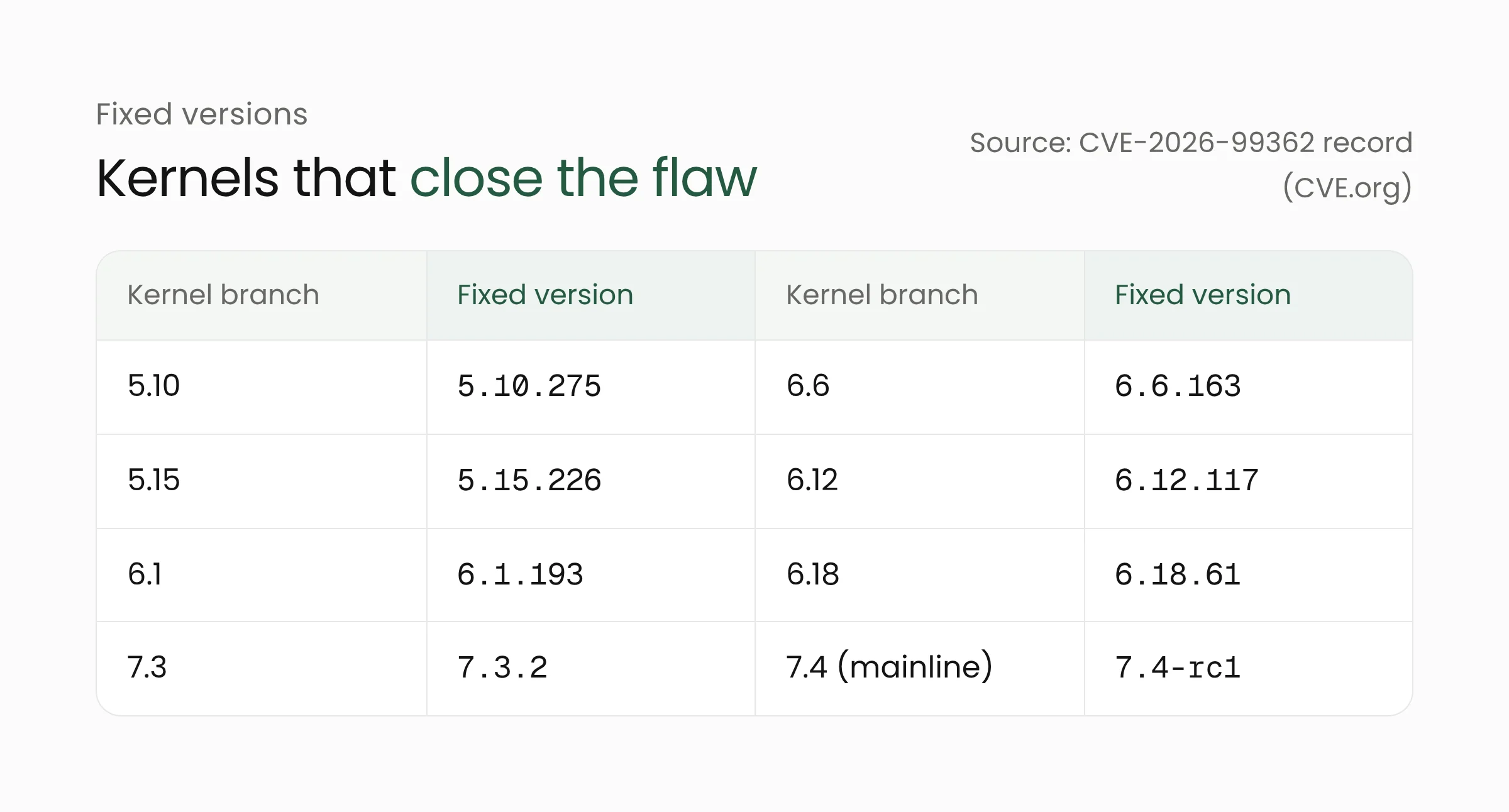
| Kernel branch | Fixed version |
|---|---|
| 5.10 | 5.10.275 |
| 5.15 | 5.15.226 |
| 6.1 | 6.1.193 |
| 6.6 | 6.6.163 |
| 6.12 | 6.12.117 |
| 6.18 | 6.18.61 |
| 7.3 | 7.3.2 |
| Mainline | 7.4-rc1 |
Status across Linux distributions
Most servers run a distribution kernel whose version number differs from upstream. Coverage was uneven when this article was written on November 28, 2026.
- Debian. The Debian security tracker lists a fix for Debian 13 (trixie) in
linux6.12.117-1. For Debian 12 (bookworm), fixes are available from the security repository inlinux6.1.192-3 and inlinux-6.126.12.117-1~deb12u1. - Ubuntu. Ubuntu’s CVE page, last updated on November 25, 2026, still lists the main kernels of Ubuntu 16.04 through 26.10 as vulnerable. Fixes are in progress for 26.04 LTS and 26.10. Ubuntu 14.04 is not affected.
- Red Hat. Red Hat rates the flaw critical and has published mitigation steps. RFF’s write-up, dated November 25, says RHEL 6 through 10 are affected and fixed kernel packages were not yet available.
These statuses change quickly. Check your distribution’s CVE page before deciding what to do.
What this means for Linux server administrators
Many organizations in Indonesia run NFS without thinking of it as a service in its own right. University compute clusters share home directories over NFS, hospitals and government agencies send backups to a file server, and development teams use it as shared storage for containers. The steps below apply to all of them.
Run four checks on every server
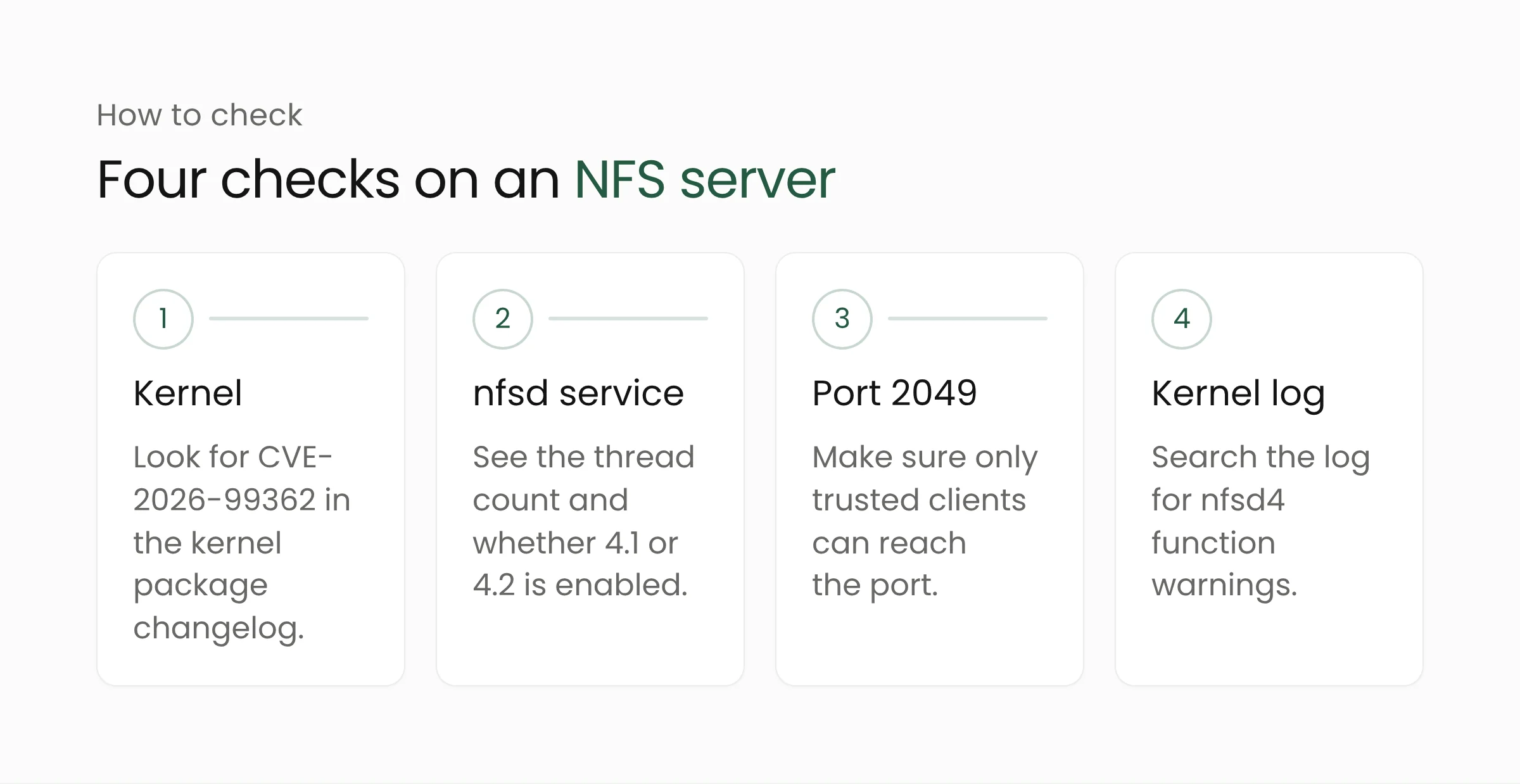
Kernel. The version number alone is not enough, because distributions backport fixes into older versions. RFF suggests searching the kernel package changelog for the CVE number. A count above 0 means the fix is present.
On Debian:
zgrep -cE 'CVE-2026-99362|preflight SEQUENCE replies before accepting a slot' /usr/share/doc/linux-image-$(uname -r)/changelog.Debian.gzOn Ubuntu:
zgrep -cE 'CVE-2026-99362|preflight SEQUENCE replies before accepting a slot' /usr/share/doc/linux-modules-$(uname -r)/changelog.Debian.gzOn RHEL, Rocky Linux and AlmaLinux:
rpm -q --changelog kernel-core-$(uname -r) | grep -cE 'CVE-2026-99362|preflight SEQUENCE replies before accepting a slot'The nfsd service. A thread count above 0 means the server is serving NFS. A +4.1 or +4.2 entry means an affected protocol version is enabled.
sudo cat /proc/fs/nfsd/threads /proc/fs/nfsd/versionsPort 2049. See whether the port listens beyond the loopback address, then compare that with your firewall rules.
ss -ltn 'sport = :2049'Kernel log. OpenSec, as cited by BleepingComputer, lists several signs of an attempted attack: kernel warnings from the nfsd4_check_resp_size function, shells spawned by kernel workers on a file server, and bursts of short NFS 4.1 sessions from a single address. The flaw has no network signatures yet.
sudo journalctl -k | grep -E 'nfsd4_check_resp_size|nfsd4_'Close the hole
Install the fixed kernel from your distribution, then reboot. A patched kernel that is installed but not yet running does not protect the server.
If a fixed package is not available or the reboot has to be scheduled, three stopgaps exist. Red Hat recommends the first two, and the third comes from OpenSec as summarized by RFF.
- Restrict port 2049 at the firewall so that only the clients that need it can connect.
- Stop the service where NFS is not needed:
systemctl stop nfs-server, thensystemctl disable nfs-server. Red Hat warns that this ends active client sessions. - Disable NFS 4.1 and 4.2 by adding the lines below to
/etc/nfs.conf, then restartnfs-server. NFS versions 3 and 4.0 keep working.
[nfsd]
vers4.1=n
vers4.2=n
The third option has side effects. In RFF’s lab test, a client already mounted with version 4.1 received “Stale file handle” errors until the share was unmounted and mounted again. pNFS and server-side copy are also unavailable while those versions are off.
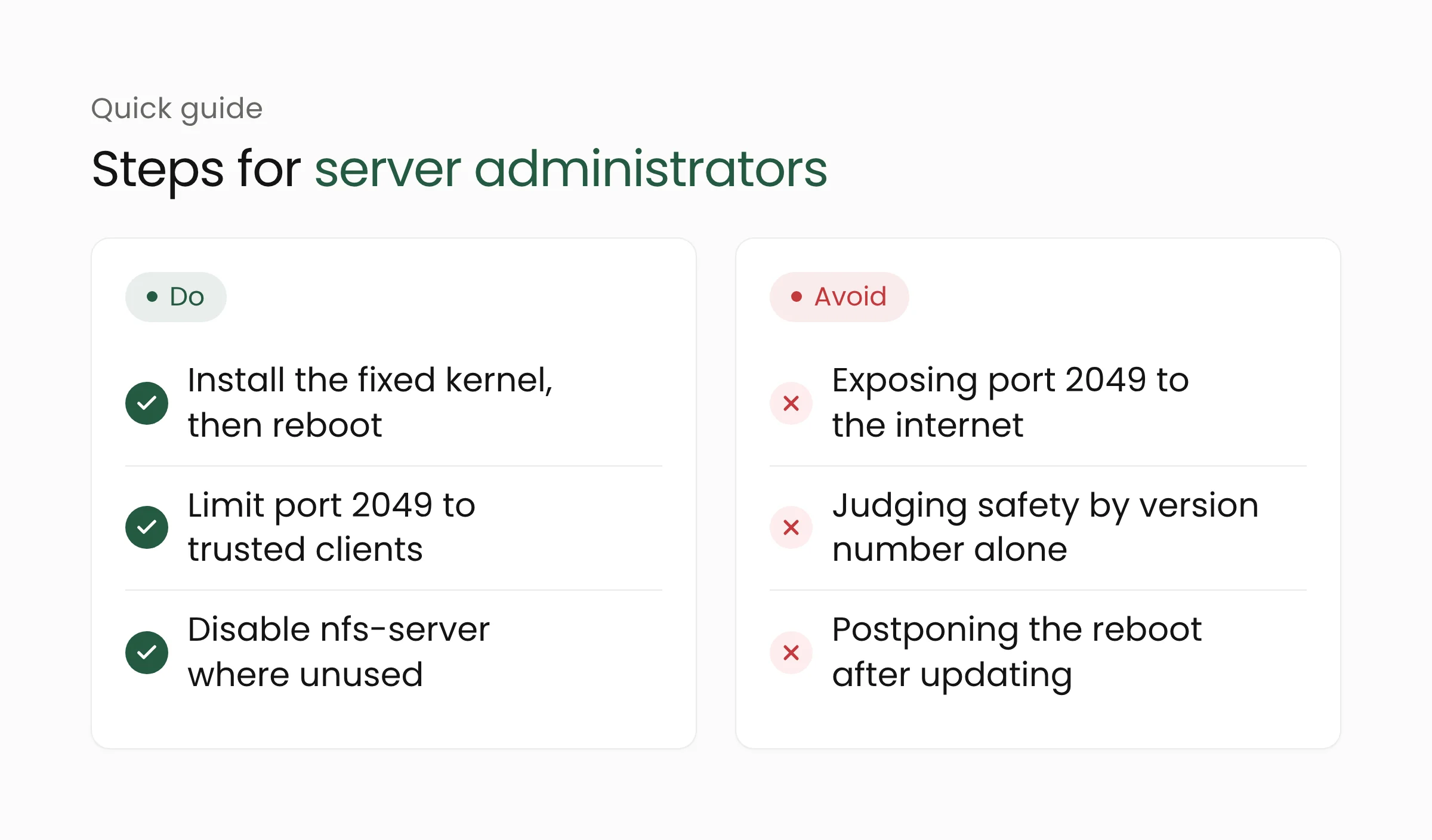
Once the urgent work is done, review where NFS servers sit on the network. The protocol was designed for internal networks, so port 2049 should not be open to the internet or to guest segments. Storage network segmentation and firewall rule audits of this kind are part of our cybersecurity services. Organizations that run shared storage in their own clusters can combine the review with cloud infrastructure management.
NFS2ROOT joins a list of Linux kernel flaws disclosed this year. We covered one of them in our article on Fragnesia, a Linux kernel flaw that was exploited in attacks. A regular kernel update schedule makes the next case easier to handle.
Frequently asked questions
Are machines that only act as NFS clients affected?
No. The flaw is in nfsd, the server side inside the kernel. A machine that only mounts shares from another server does not run the faulty code. The servers that export directories are the ones to check.
Is the flaw being used in attacks?
BleepingComputer wrote on November 27, 2026 that there were no reports of exploitation in the wild. OpenSec has a working exploit and has not released it. That can change, because the technical details are public in the CVE record and in the fix itself.
Is turning off NFS 4.1 and 4.2 enough?
It closes the known attack path, since the bug sits in NFS 4.1 session handling. It is temporary, though, and it removes features. The real fix remains a patched kernel that is running after a reboot.
Closing
NFS2ROOT stayed hidden for 12 years in a service that rarely gets attention. The four checks above take a few minutes per server and show which machines to handle first. If your team needs help mapping NFS servers and planning the updates, the Merakit team is ready to talk.
Sources
- CVE.org: CVE-2026-99362 record (November 19, 2026)
- BleepingComputer: New NFS2ROOT Linux flaw can let attackers gain root privileges (November 27, 2026)
- Red Hat: CVE-2026-99362, statement and mitigation
- Ubuntu: CVE-2026-99362 (updated November 25, 2026)
- Debian Security Tracker: CVE-2026-99362
- RFF: NFS2ROOT (CVE-2026-99362), how to check yours (November 25, 2026)
- Linux kernel: upstream fix “nfsd: preflight SEQUENCE replies before accepting a slot”