Blog Virtualization
VMware vSphere Express: 128-Core Licensing for Small Servers
On this page· 7 sections
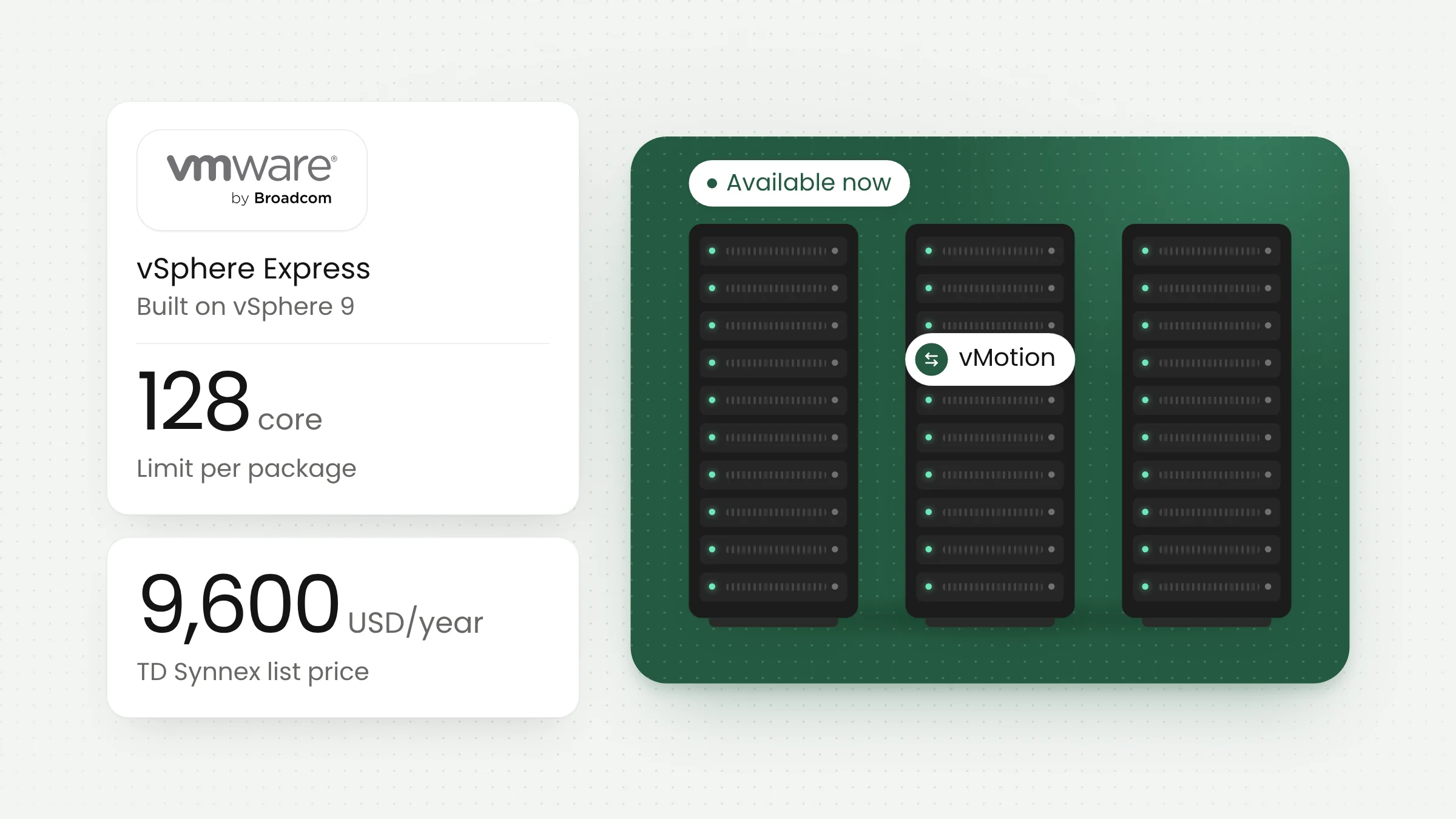
Broadcom launched VMware vSphere Express on November 4, 2026, a server virtualization package for small environments of up to 128 processor cores. It is available immediately in all regions and gives organizations that only need basic virtualization a way to stay on VMware without buying the VMware Cloud Foundation (VCF) private cloud suite.
For many IT teams in Indonesia, the timing matters. Factories with on-site server rooms, regional hospitals, universities, and branch offices that have run vSphere for years now have another option when their subscriptions come up for renewal.
What Broadcom announced
The announcement was written by Prashanth Shenoy, vice president of product marketing in Broadcom’s VCF division, on the VMware Cloud Foundation blog. Broadcom said vSphere Express is built on vSphere 9 and is aimed at customers with smaller environments that need cost-effective core virtualization.
Virtualization lets one physical server run many virtual machines. A single box can host an accounting system, a warehouse application, and a file server at the same time, each with its own share of memory and processor time.
Speaking to The Register, Shenoy was clear about the intended scale: “We do not want a customer to run this on thousands of cores.” Customers with more complex needs are pointed to VMware vSphere Foundation (VVF) or VCF, although vSphere Express will follow the same release cadence as those products.
Included features and limits
According to Broadcom, vSphere Express includes five core capabilities:
- vMotion, which moves running virtual machines to another host without shutting them down.
- High Availability (HA), which automatically restarts virtual machines when their host fails.
- Distributed Switch, which manages virtual networking and monitoring from one place.
- vCenter Quick Patch, which applies updates with minimal disruption.
- TPM 2.0 and vTPM 2.0 support, hardware-based security modules used for encryption and attestation.
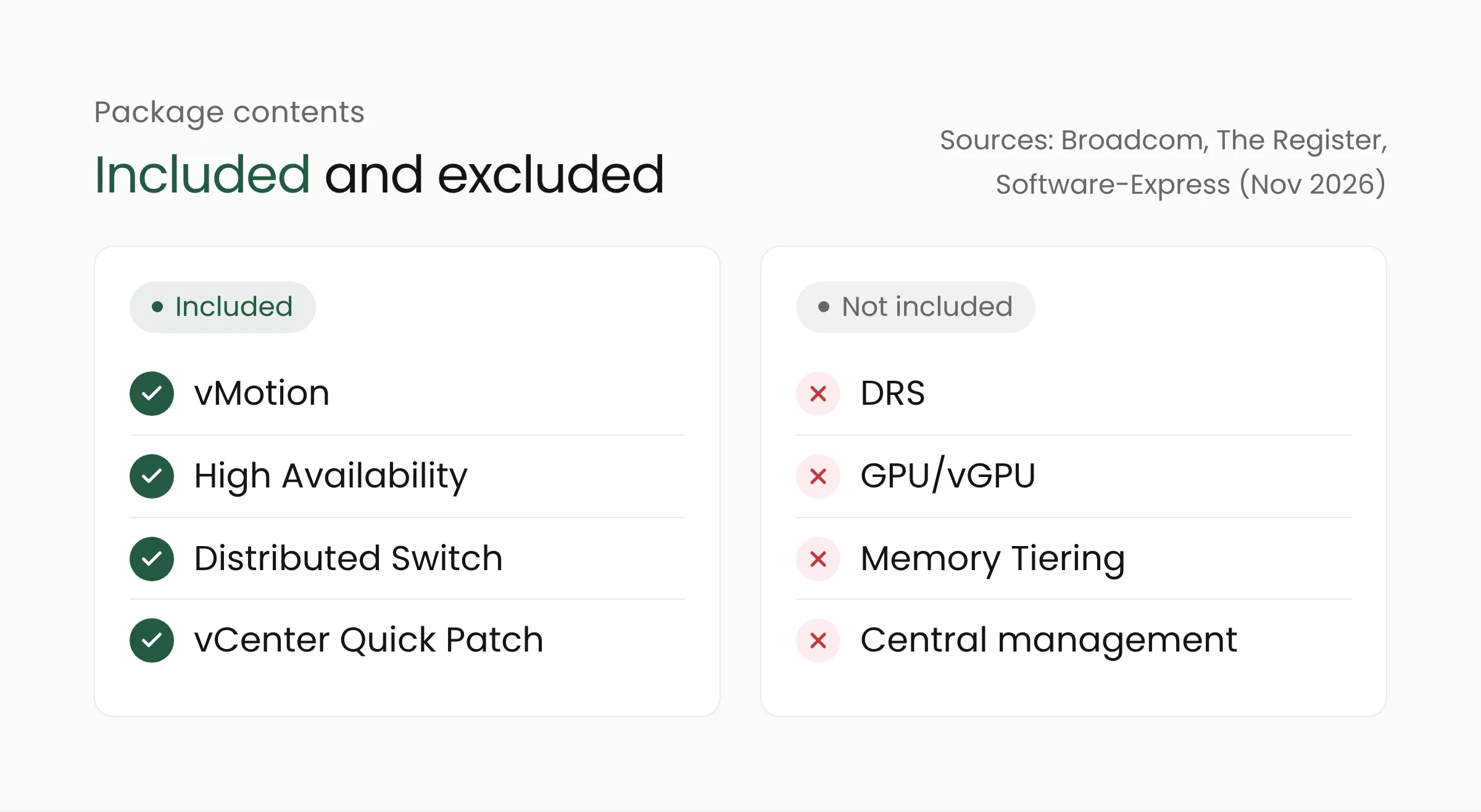
There are limits as well. Shenoy told The Register that each vSphere Express instance is discrete, so multiple instances cannot be managed centrally. Organizations with several branches, each running its own servers, should factor that in.
German distributor Software-Express lists features that are not included, among them DRS (automatic load balancing across hosts), Memory Tiering, SR-IOV, GPU/vGPU, Proactive HA, and Live Patching. That list comes from a distributor and does not appear in Broadcom’s announcement, so it is worth confirming in a formal quote.
No official price yet
Broadcom has not published a price. A VMware spokesperson told The Register only that it will be a per-core subscription priced well below VVF or VCF, and suggested that interested customers contact their local reseller.
Two reports point to the same figure. Ars Technica reported that distributor TD Synnex lists vSphere Express at $9,600 a year for up to 128 cores, and that the price does not drop for fewer cores. TechTarget cited advisory firm C4C Group, which reached a similar number after consulting Broadcom resellers and distributors.
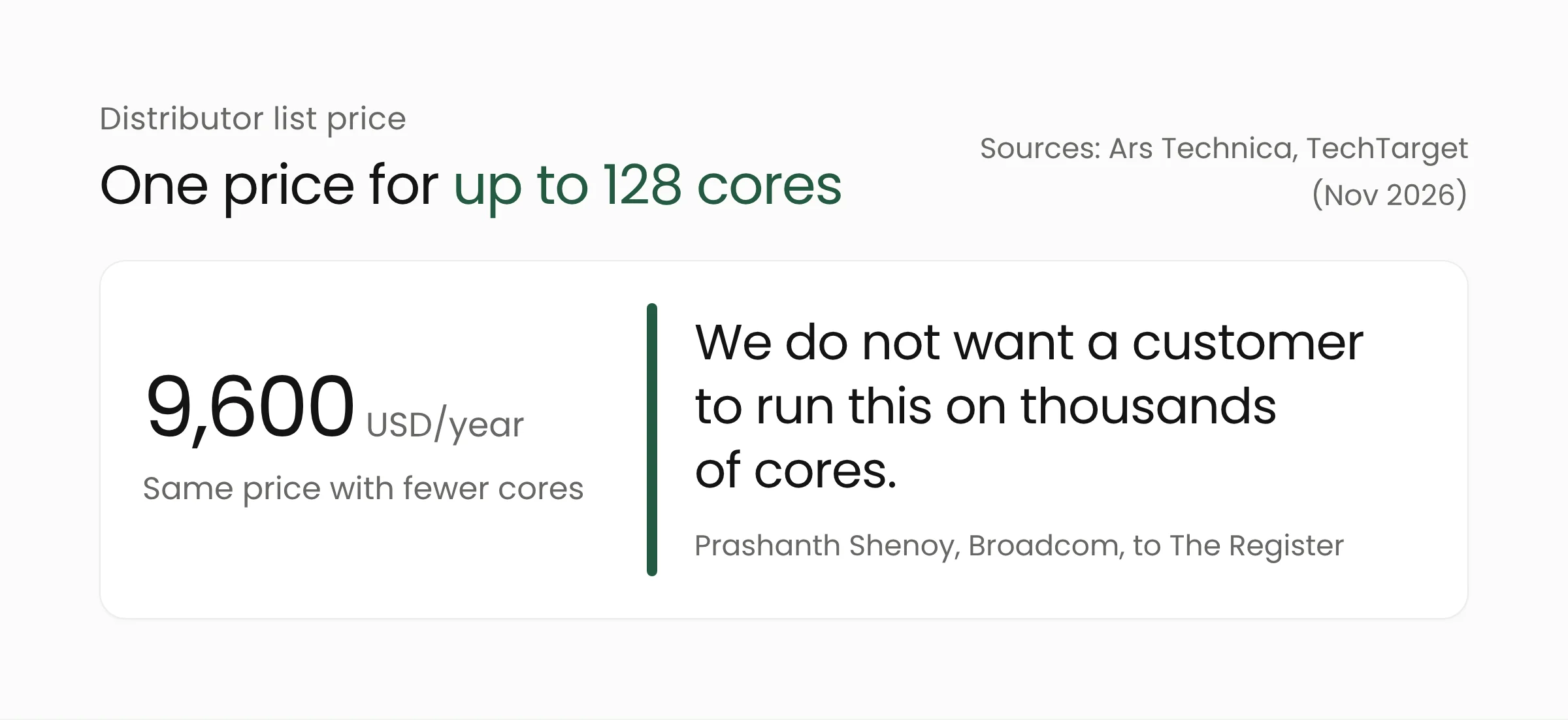
That makes the cost per core highly dependent on size. With all 128 cores in use, it works out to $75 per core per year. A clinic or shop running two servers with 32 cores in total would pay the equivalent of $300 per core. Ars Technica noted that this still poses a challenge for the smallest deployments.
The sales channel has changed too. The Register reported that vSphere Express is sold through distributors’ marketplaces, because Broadcom has sharply reduced the number of resellers in its partner program.
How VMware licensing changed under Broadcom
Broadcom bought VMware for $69 billion in 2023. According to TechTarget, it soon stopped selling standalone perpetual vSphere licenses and steered customers to VCF, which bundles vSphere with vSAN (storage), NSX (networking), and Aria (automation). Some customers bought the full suite just to keep running vSphere, leaving the other components unused.
Those changes pushed some customers to other platforms, and TechTarget said Nutanix and Red Hat took advantage. In September 2026, Paul Turner, chief product officer of the VCF division, acknowledged to The Register that sales incentives had pushed the sales team to focus too heavily on VCF.
Nick Watson of C4C Group said he reads vSphere Express as a response to customers who ran the numbers on VCF and started preparing to leave. Ars Technica also pointed out that thousands of companies have already moved to VMware rivals, and some of them will be hard to win back.
The official announcement adds one regional detail. For customers in the European Economic Area, vSphere Standard 8 and vSphere Enterprise Plus 8 remain on sale until October 31, 2027, with extended support until October 31, 2028 at the latest. The announcement gives no equivalent terms for other regions, including Indonesia, so the status of older products should be confirmed with a reseller.
What this means for your organization
For a factory running production systems, warehouse software, and file servers in its own server room, vSphere Express can be a middle path between paying for VCF and starting a large migration. A sound decision still needs clear numbers. The following steps can help.
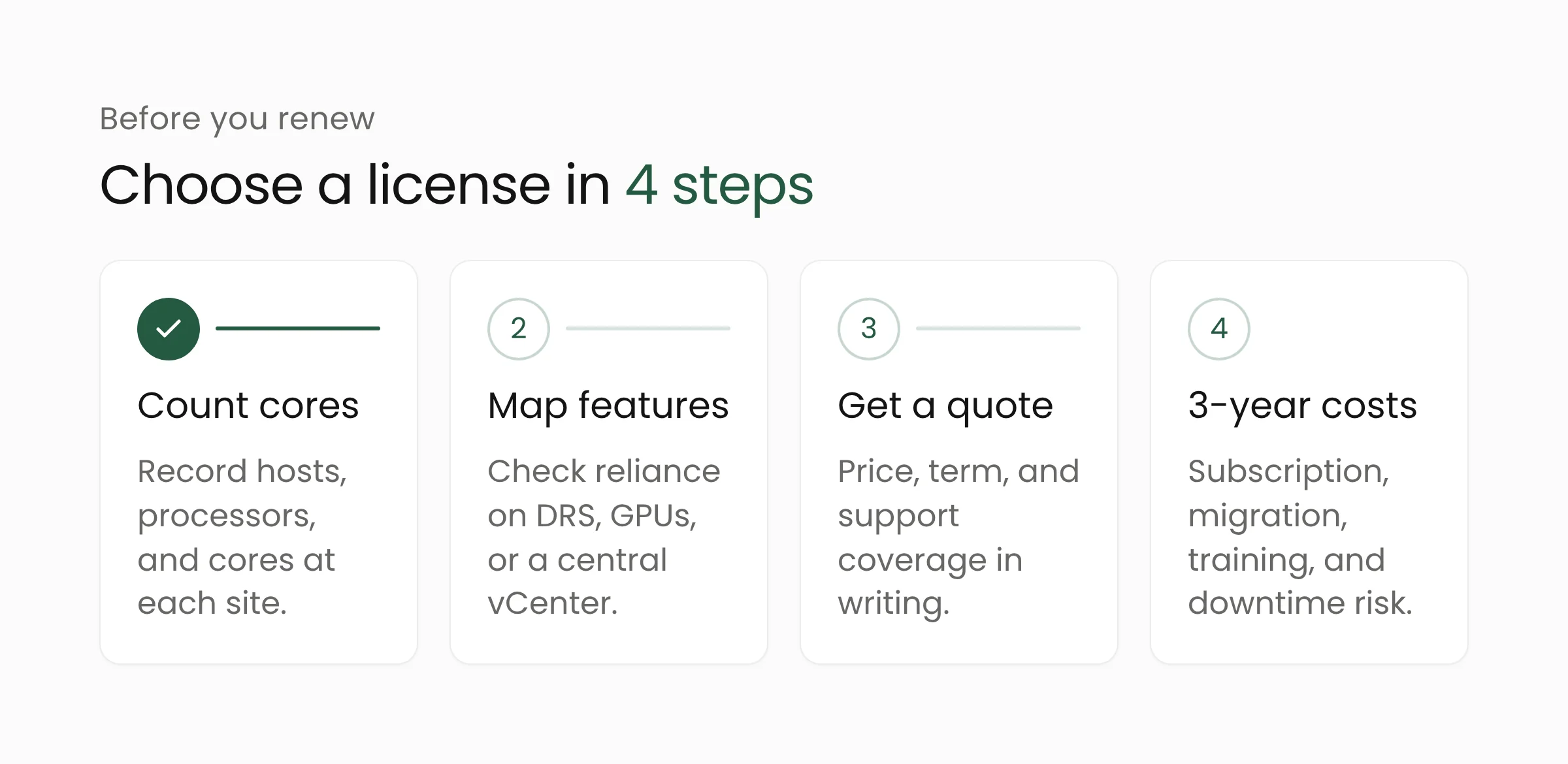
Count the cores you actually use. Record the number of physical hosts, processors, and cores at each site. Three hosts with two 16-core processors each come to 96 cores, which is under the 128-core limit. If your total is far below that, compare the effective per-core cost with other options.
Map the features you rely on. Check whether your cluster depends on DRS, GPUs for AI workloads, or managing several sites from one vCenter console. If it does, vSphere Express is probably not enough, and VVF or another platform deserves a look.
Get a written quote. With no official price, ask your reseller to put the price, subscription term, support coverage, and feature list in writing. Also confirm whether the product you run today can still be renewed in Indonesia.
Compare three-year costs. Set the vSphere Express subscription against the cost of moving to another hypervisor or to public cloud, including migration time, staff training, and the risk of service disruption. Moving off VMware can be costly and slow, so for a small team already busy with other projects, renewing may be the more realistic choice for now.
Review backup and recovery plans. Whatever you choose, make sure virtual machine backups are tested and restorable. Broadcom’s announcement says native disaster recovery is planned for VCF and VVF in the next release and does not mention it for vSphere Express, so a separate backup solution is still needed.
If your on-site servers also run an older operating system, plan virtualization licensing alongside the Windows Server 2016 end of support timeline. Both decisions shape infrastructure costs for the next few years.
The right virtualization choice keeps production lines, warehouse systems, and reports running without licensing costs that keep climbing. Merakit can help map workloads and compare options through its cloud computing services, including for industrial automation environments that combine on-site servers with the cloud.
Frequently asked questions
What is VMware vSphere Express?
vSphere Express is Broadcom’s server virtualization package for environments of up to 128 cores. It is built on vSphere 9 and includes vMotion, High Availability, Distributed Switch, vCenter Quick Patch, and TPM 2.0 and vTPM 2.0 support.
How much does vSphere Express cost?
Broadcom has not published an official price and says only that it is much lower than VVF and VCF. According to Ars Technica, distributor TD Synnex lists it at $9,600 a year for up to 128 cores. Final pricing in Indonesia should be confirmed with a reseller.
Can vSphere Express run on more than 128 cores?
It is designed for small environments of up to 128 cores, and each instance cannot be managed centrally. Broadcom has said it does not want customers running it on thousands of cores, and it points larger environments to VMware vSphere Foundation or VMware Cloud Foundation.
Sources
- VMware Cloud Foundation Blog: Broadcom Updates VMware Portfolio to Protect and Accelerate Private AI Cloud Deployments (November 4, 2026)
- The Register: VMware returns to low-end server virtualization with ‘vSphere Express’ (November 4, 2026)
- Ars Technica: VMware releases vSphere Express for virtualization on up to 128 cores (November 4, 2026)
- TechTarget: Broadcom vSphere Express brings back standalone VMware virtualization (November 4, 2026)
- SDxCentral: Broadcom’s VMware vSphere gains essential tier, VCF set for more updates (November 4, 2026)
- Software-Express: VMware vSphere Express (updated November 3, 2026)