Blog Cybersecurity
Shirudo: Cisco and OpenAI Shield Unpatched Linux Servers
On this page· 7 sections
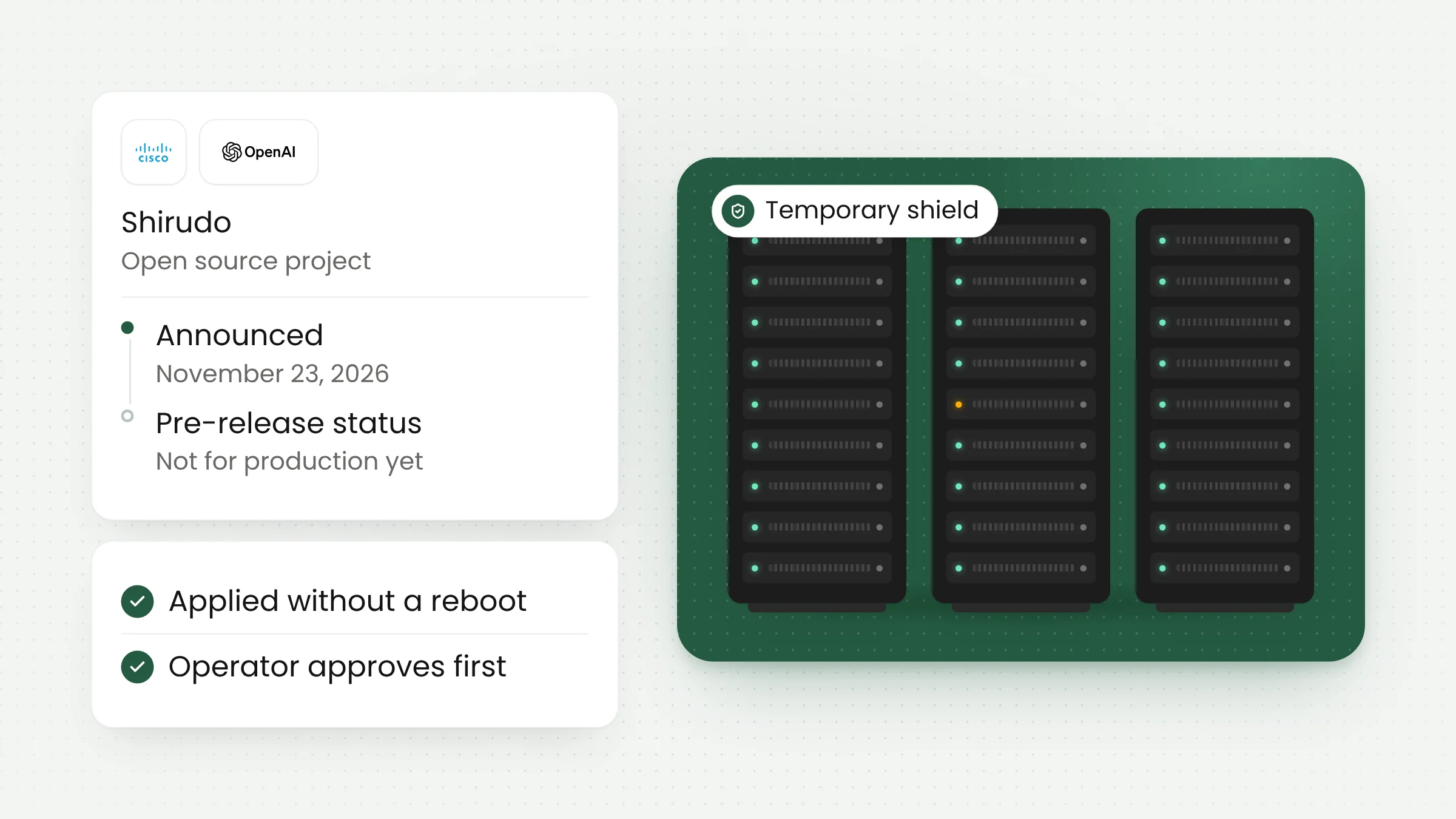
Cisco and OpenAI introduced Shirudo on November 23, 2026. The open source project uses AI agents to build temporary protections for Linux servers that are still waiting for a security patch. The protections load without a reboot, but Shirudo is in pre-release and is not meant for production yet.
The gap between disclosure and deployment
Every disclosed vulnerability starts a race for server administrators. A patch has to be tested so it does not break applications, then scheduled, then rolled out across every machine. OpenAI wrote in its announcement that the process can take days or weeks. Services keep running during that time with a flaw the public already knows about.
The pressure has grown as AI tools speed up vulnerability discovery for researchers and attackers alike. Greg Brockman, OpenAI’s president and co-founder, summed it up in the announcement: “finding a bug today doesn’t mean you can patch every system tomorrow”.
Readers of this blog saw an example last week. The Java4Shell flaw in OpenJDK required Java updates across many application servers at once, and few teams could finish that in a day. Shirudo targets exactly that waiting period.
How Shirudo works
Shirudo is the Japanese word for shield, and the project uses the same word for its output. A shield is a small program that closes the path an attack needs while the service keeps answering legitimate requests.
The underlying technology is eBPF, a Linux feature that runs small programs at specific points in the kernel without changing kernel source code and without restarting the operating system. According to Isovalent’s technical post, a shield can block the path a vulnerability depends on, replace vulnerable code with fixed code, or add visibility to detect attacks. Shields can also work at the application level, for example inside a Java runtime.
Four stages from flaw to shield
TechRepublic describes the workflow in four stages. AI agents identify a vulnerability, either by investigating suspected weaknesses or by starting from a published disclosure. They build a shield, test that it stops the attack without disrupting legitimate workloads, and operators then choose which shields to deploy.
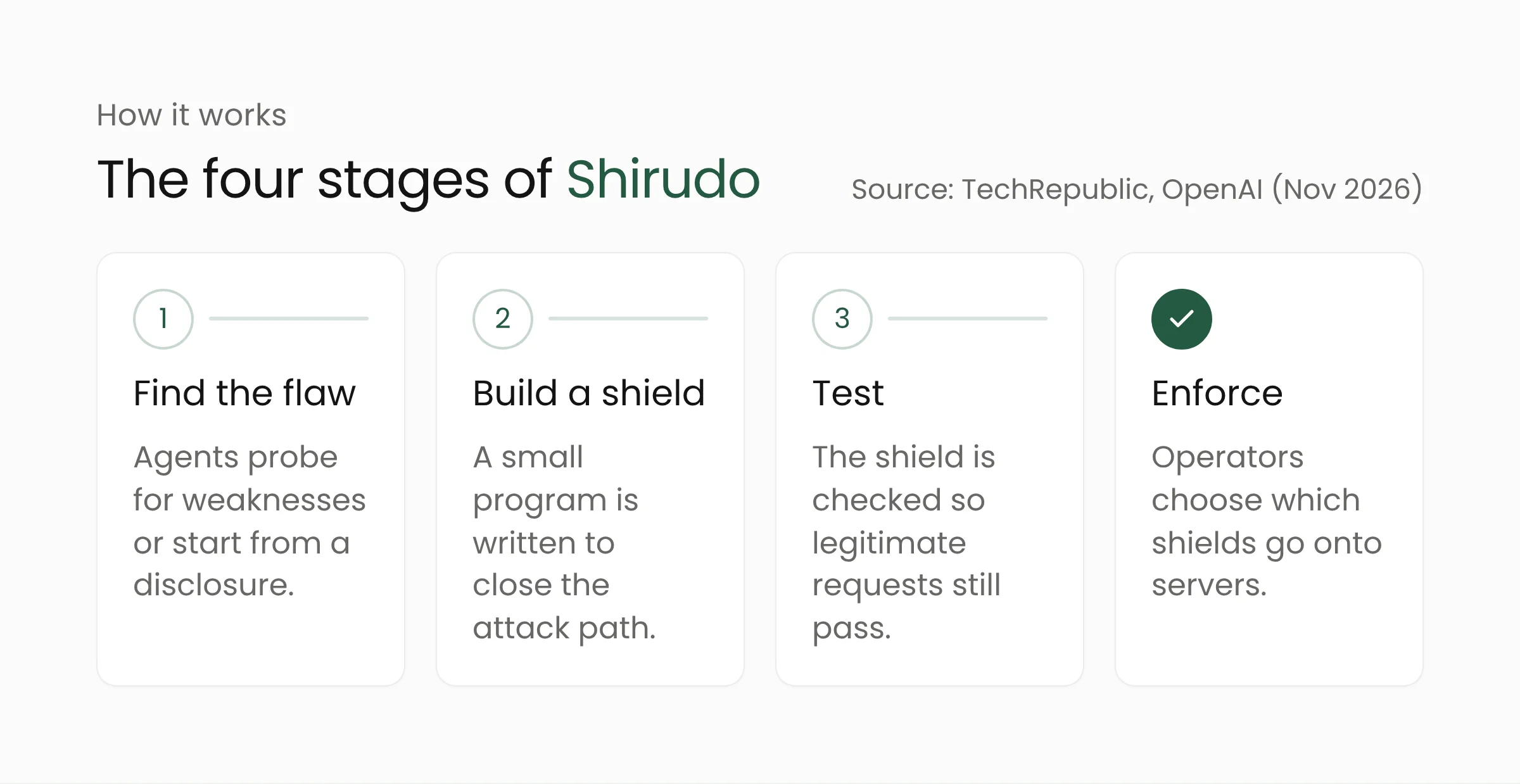
The testing stage addresses the main difficulty with temporary protections. OpenAI explains that an exploit and a legitimate request may rely on the same Linux operation, so blocking that operation outright could take the service offline. Teams can therefore monitor a proposed shield’s effect on applications before enforcing it.
Signatures and the TPM
Loading new code into a running kernel is risky, so Shirudo adds several layers of checks. Each shield is cryptographically signed and verified by the host before it loads. Cisco’s press release says the check holds even if an attacker has gained administrator access.
Shirudo also relies on the Trusted Platform Module (TPM), a security chip on the server’s motherboard, to keep a verifiable record of shields being loaded or removed. Cybersecurity Dive notes that the record supports later forensic analysis.
On the architecture side, Isovalent writes that Shirudo is a one-shot command line tool. No permanently running daemon sits on the protected machines. Shields ship as signed packages through an OCI registry, the same kind of registry used to store container images.
The Java4Shell test
Cisco and OpenAI tested the approach against Java4Shell. In a controlled test described by Isovalent, OpenAI’s Codex agent was given the vulnerability information and produced a shield written as Java bytecode. The shield validates Base64 input to block the memory overwrite the exploit depends on.
The team then ran Elasticsearch 9.5.5, attached the shield to the running process and attempted the exploit. The attack failed and Elasticsearch did not need a restart. Cisco’s press release says Shirudo was also tested against a PHP flaw, without naming it.
These results come from the project’s own authors in a controlled environment. No independent testing has been published so far.
Pre-release status, requirements and criticism
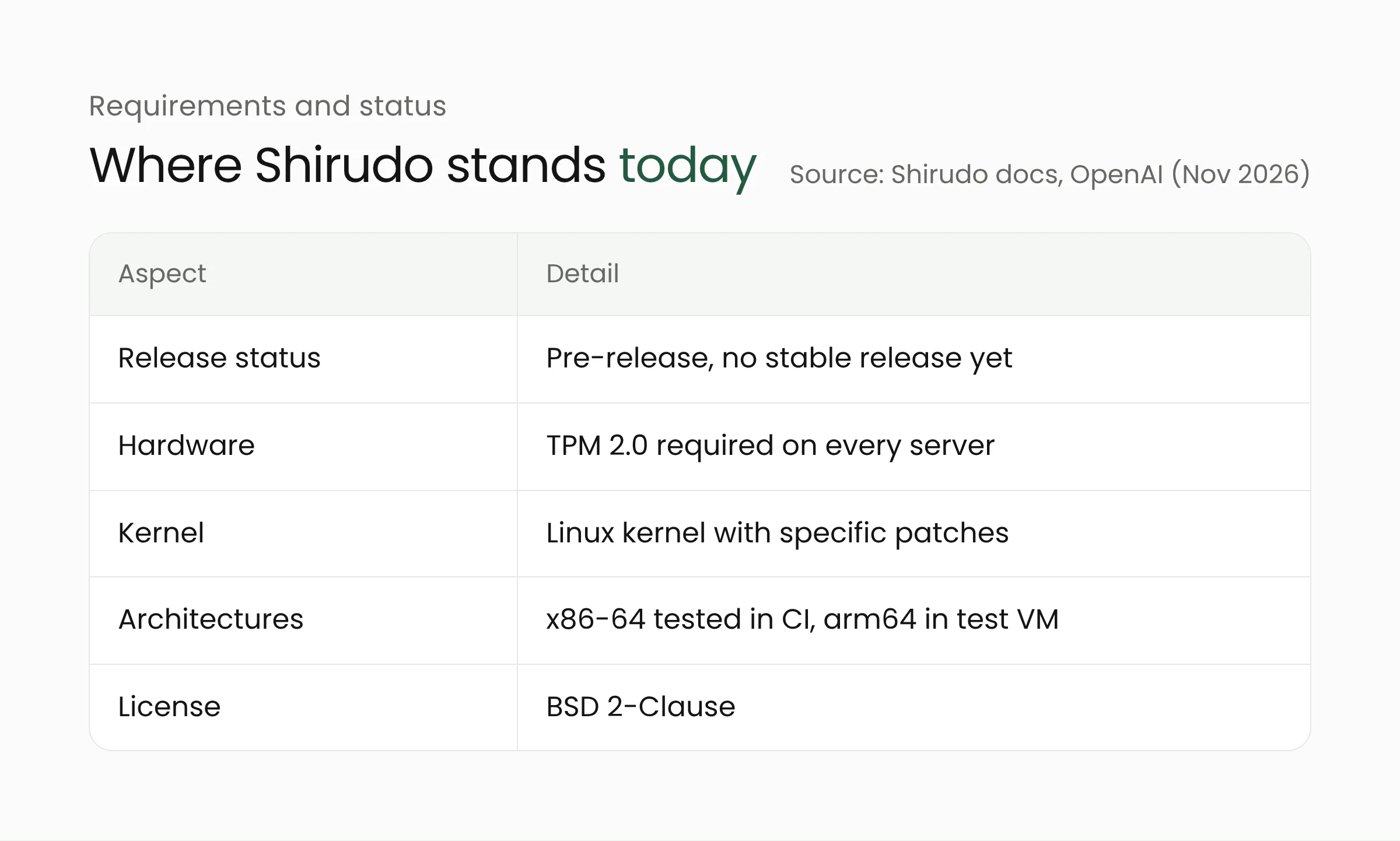
Shirudo is not ready for production servers. The project documentation describes it as pre-release, with no stable releases or supported release branches. Its technical requirements are also demanding for most environments today:
- Every target server needs a TPM 2.0. The documentation states there is no mode without one.
- The Linux kernel must include the signed-loader capability from the bpf-next development branch plus specific patches from the Shirudo project. The project supplies its own kernel build for this.
- x86-64 is tested in CI and the test VM also runs on arm64. No riscv64 target has booted so far.
- Signing uses only ML-DSA-87, a post-quantum algorithm. Existing keys cannot be reused.
Interoperability is another concern. Because Shirudo only admits BPF programs loaded by signed loaders, tools such as Cilium, Falco and bpftrace cannot run as they are on the same host. For teams whose networking depends on Cilium, that is a significant consideration.
The same documentation is candid about the limits of the protection. A root user cannot turn Shirudo off without the signing key, but root with a kernel-level exploit can still bypass every check. Shirudo does not replace kernel updates either. A shield only covers the time until the machine runs a fixed version.
Criticism has come from outside the project. Amiram Shachar, CEO and co-founder of cloud security firm Upwind, told SecurityWeek that writing highly sensitive kernel code on the fly and deploying it straight to runtime is a risky concept. He pointed to the many Linux versions and distributions the tool has to support, and argued it needs to be tested, packaged and automated before anyone trusts it in production.
Project origins and license
Shirudo was not built from scratch. It is a rewrite of Tetragon, the eBPF-based security platform that Isovalent open-sourced in 2022. Cisco acquired Isovalent in 2024, and SecurityWeek reports that Tetragon also underpins the Live Protect mitigation feature in Cisco products.
The main difference lies in who operates it. Isovalent’s engineers write that security tools have long been designed for people to read through consoles, configuration files and policy languages. Shirudo is designed so that AI agents work directly in code, while people set the boundaries and give approval.
Shirudo’s code is released under the BSD 2-Clause license, with its BPF programs dual-licensed under BSD and GPL. According to SecurityWeek, the two companies hope shields can eventually be distributed alongside vulnerability disclosures, giving organizations temporary protection until permanent patches are installed. Isovalent has scheduled a technical deep dive for December 15, 2026.
What this means for IT teams
For server administrators at government agencies, hospitals, universities, banks or startups, Shirudo is something to study for now and not something to install. A few sensible steps:
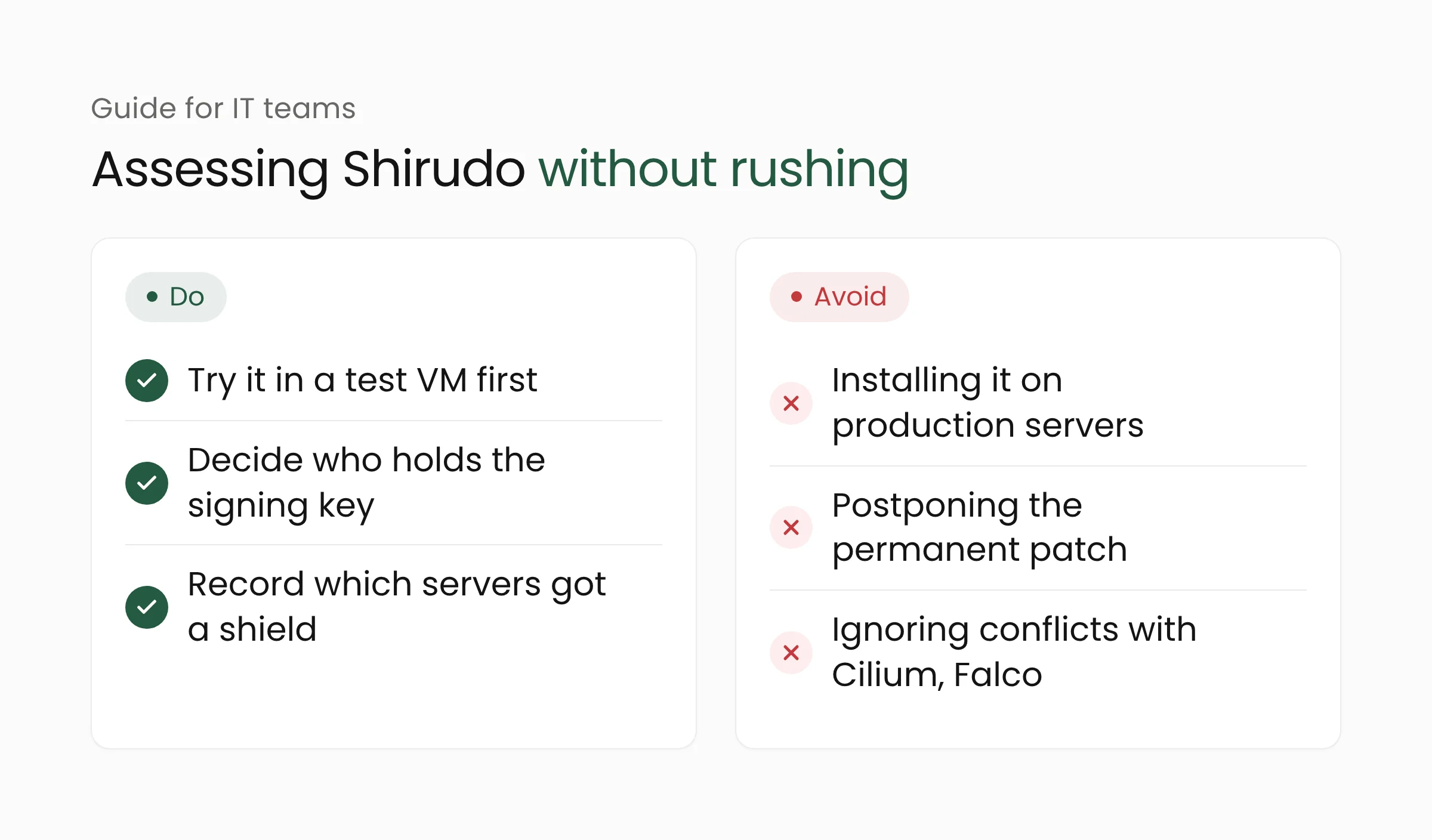
- Try it in an isolated environment. The project provides a test VM and a self-guided lab. Teams can learn the workflow without touching servers that carry user traffic.
- Check hardware readiness. List which servers have a TPM 2.0. Rented servers and virtual machines may not expose one, and the inventory is useful for other security work as well.
- Design governance before the tool matures. TechRepublic advises organizations to assign who reviews shield behavior, who holds the signing key and who approves deployment. That division of roles applies to any temporary mitigation.
- Measure the effect on normal traffic. When a shield is eventually tested, measure latency and error rates under representative load, look for legitimate requests that get blocked, and confirm that removing the shield restores normal service.
- Record and remove. Every temporary mitigation should be logged: which servers received it, who owns the permanent patch, and when the mitigation comes off.
Basic discipline remains the primary defense: an accurate software inventory, a regular patch schedule and working monitoring. Organizations that lack these can start with a trusted cybersecurity services team or cloud infrastructure operator before considering tools that are still experimental.
Frequently asked questions
Is Shirudo ready for production servers?
No. The project documentation describes it as pre-release with no stable release. It also requires a kernel with specific patches and a TPM 2.0 on every server.
Do Shirudo shields replace security patches?
No. A shield is a temporary protection while a patch is tested and deployed. The documentation states that it only covers the time until the server runs a fixed version.
Do AI agents deploy shields without human approval?
Not in the design that was announced. Agents build and test shields, while security teams control which ones are deployed. Each shield must also be signed with the organization’s own key before a server will load it.
Closing
Shirudo points to a new direction in server defense, with AI agents preparing temporary protections far faster than a normal patch cycle and people giving the approval. The idea is promising, but the technical requirements and expert criticism show that the road to production is still long. If your organization wants to review how it handles patching and temporary mitigations on Linux servers, the Merakit team is open to a conversation.
Sources
- Cisco and OpenAI Launch Shirudo, A New Project to Safeguard Agentic AI, Cisco Newsroom, November 23, 2026
- Introducing Shirudo, OpenAI, November 23, 2026
- Cisco and OpenAI Introduce Shirudo, Isovalent, November 23, 2026
- Shirudo FAQ, Shirudo documentation, accessed November 25, 2026
- OpenAI, Cisco Unveil Open Source Tool to Shield Unpatched Linux Systems, SecurityWeek, November 24, 2026
- OpenAI, Cisco debut tool that lets AI agents safely block vulnerability exploitation, Cybersecurity Dive, November 24, 2026
- Cisco and OpenAI Launch Shirudo for Linux Runtime Security, TechRepublic, November 25, 2026