Blog PHP
PHP 8.6 Released: New Features and an Upgrade Plan for Teams
On this page· 7 sections
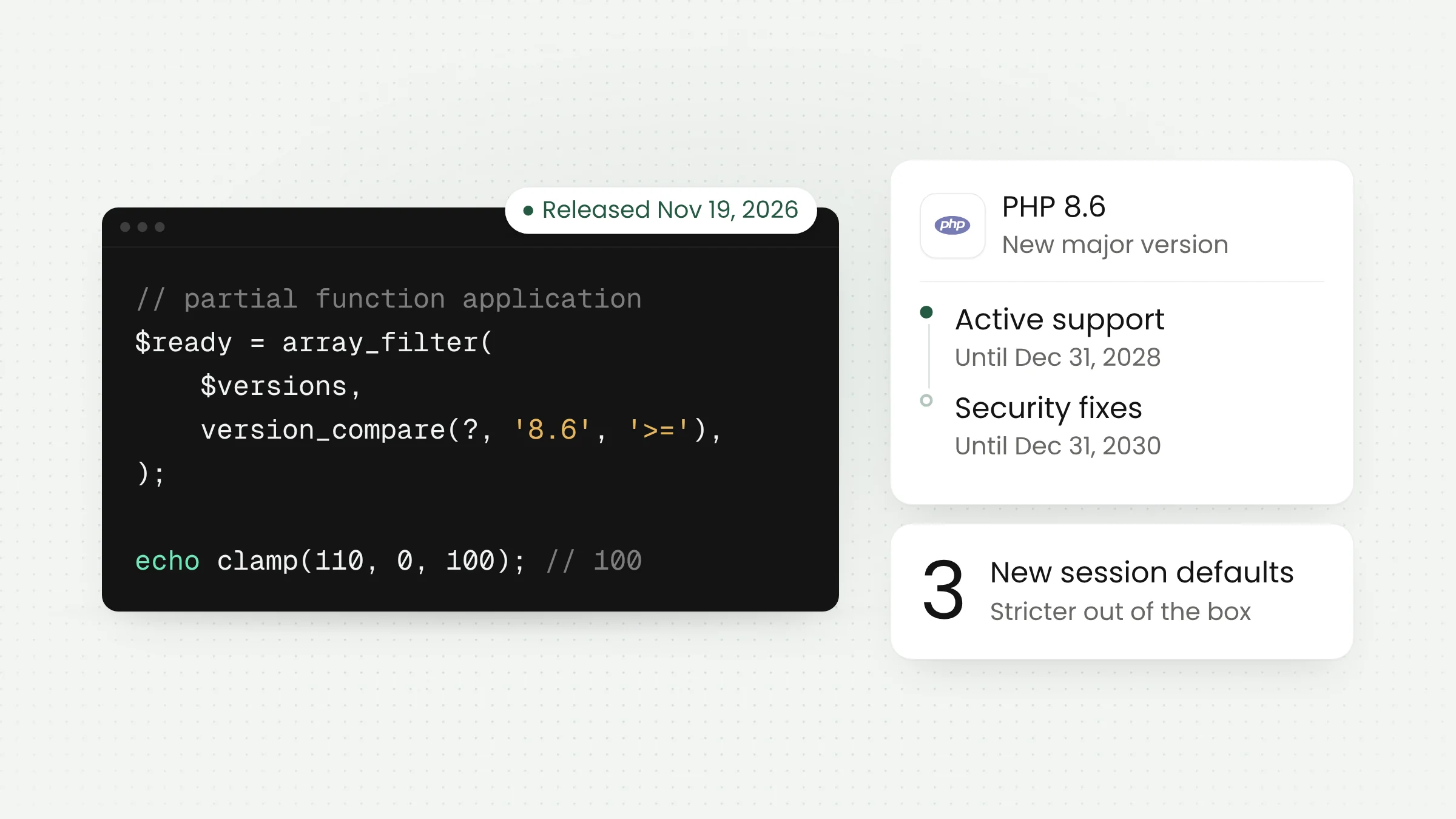
PHP 8.6 was released on November 19, 2026. It adds partial function application, a Duration class, a clamp() function, and a Polling API. Web teams should also look at three session defaults that are now stricter and a long list of deprecations before they raise the version on production servers.
What ships in PHP 8.6
The PHP team calls the version a major update of the language in its release announcement. It lands exactly a year after PHP 8.5, in line with the project’s annual November schedule.
According to the supported versions page on php.net, the 8.6 branch receives active support until December 31, 2028 and security fixes until December 31, 2030. Each branch gets two years of full support, then two years of critical security fixes.
Matthew Weier O’Phinney of Zend describes the release as focused on additive features and developer experience. In his review, he writes that it is not on the scale of PHP 8.0 or 8.1.
Partial function application
The most discussed addition is partial function application. A developer can supply some of a function’s arguments in advance and mark the rest with ? or .... The result is a Closure, and the original function runs only once the remaining arguments are passed in.
The official example filters a list of versions:
$supportsPfa = array_filter(
    $versions,
    version_compare(?, '8.6', '>='),
);
Zend expects the feature to encourage use of the pipe operator (|>) that arrived in PHP 8.5.
The Duration class and clamp()
The \Time\Duration class represents elapsed time as a stopwatch would measure it. It is independent of any date or time zone, has nanosecond precision, and can cover a range of more than 250 years. That suits timeouts and retry delays, often written today as bare numbers.
The clamp() function keeps a value inside a given range. If the value falls outside it, the function returns the nearest boundary. clamp(110, 0, 100) returns 100, and the function works with Duration objects as well.
Polling API and stream errors
The Polling API (Io\Poll) watches many connections at once using the best mechanism on each operating system: epoll, kqueue, event ports, or WSAPoll. The PHP team notes that stream_select() typically cannot handle more than 1,024 connections. It is meant as a foundation for event loop libraries such as ReactPHP and AMPHP.
Stream operations can now be configured to throw a StreamException. Previously, a failed read only raised a warning.
Other additions
- Readonly property defaults. A
readonlyproperty may now declare a default value. Laravel News points out that this used to be a compile-time error. - The
SortDirectionenum. It offersAscendingandDescendingas a standard way to express sort order. Kinsta notes that PHP’s built-in sort functions do not accept it yet. mysqli::quote_string(). It escapes a string and wraps it in quotes, matchingPDO::quote().- Post-quantum cryptography in Sodium. The extension adds X-Wing and ML-KEM-768 key encapsulation.
Changes that can affect existing applications
Zend counts 26 deprecations in this release. Code that uses them still runs, but PHP emits a notice and some of the features will be removed in PHP 9.0. A handful of other changes alter behavior right away.
Three stricter session defaults
The PHP 8.6 migration guide lists three php.ini settings whose default values changed:
session.use_strict_modeis now1(was0). PHP rejects session IDs it never created, which makes session fixation harder.session.cookie_httponlyis now1(was0). JavaScript can no longer read the session cookie throughdocument.cookie.session.cookie_samesiteis nowLax(was unset). The session cookie is not sent on cross-site requests, except for top-level navigations that use safe HTTP methods.
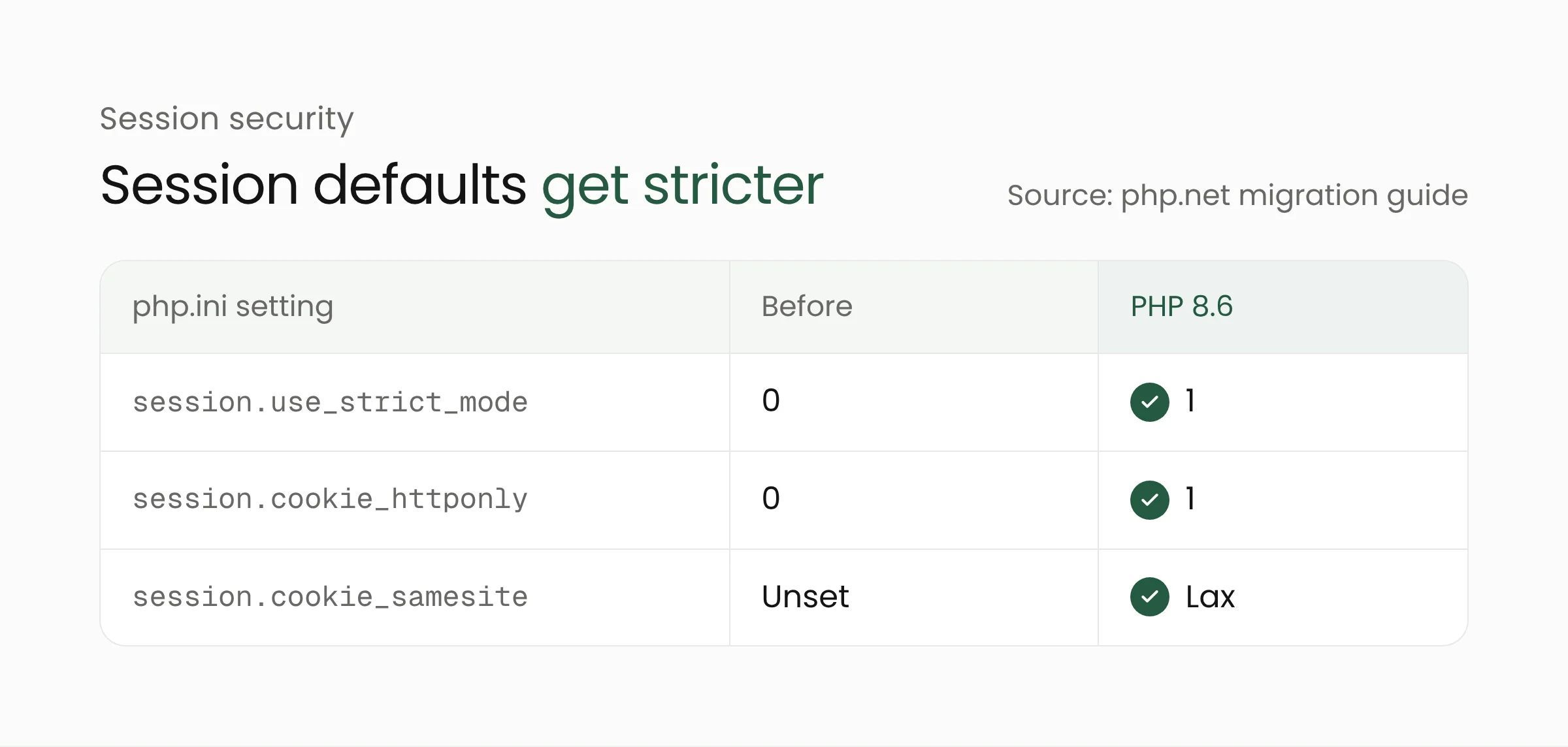
All three improve security, but they can interrupt flows that work today, such as a checkout page that receives a POST from a payment provider’s site and relies on the session cookie. For those cases, the migration guide says to set session.cookie_samesite to None together with session.cookie_secure set to 1. Applications with a custom session handler need to implement create_sid() and validateId().
Functions that behave differently
trim(),ltrim(), andrtrim()now strip the form feed character (\f) as well.fclose(),file_put_contents(), andcopy()returnfalsewhen flushing or closing the stream fails. That failure used to be ignored.- Many functions throw a
ValueErrorfor out-of-range values, invalid flags, or strings that contain NUL bytes. Examples includenumber_format(),sleep(),getenv(), andfile_exists().
Deprecated functions
- All mbstring regex functions, such as
mb_ereg()andmb_split(), because the Oniguruma library is no longer maintained. The replacement is the PCRE functions with theumodifier. - The aliases
is_double(),is_long(),is_integer(), anddoubleval(). Useis_float(),is_int(), andfloatval(). returninside afinallyblock, and return values from__construct()and__destruct().php://filterURLs with more than 16 filters when thefilter.max_filter_countoption is not set. Zend explains that the cap is meant to blunt attacks built on filter chains.
Performance and framework support
The release tagline includes the word “Faster”, but the announcement page carries no benchmark figures. The improvements it names are narrow, such as quicker printf() calls, cached stateless closures, and faster JSON encoding.
A Tideways benchmark published on November 16, 2026 shows what that means for real applications. Benjamin Eberlei, the founder of Tideways, tested PHP 8.6.0 RC 5 without JIT on a Hetzner server, with 15 concurrent users for 60 seconds.
- Laravel 13.17.0 served 792.33 requests per second on PHP 8.6, compared with 792.70 on PHP 8.5 and 778.50 on PHP 8.4.
- Symfony 8.1.9 gained about 2.5 percent, from 458.14 to 469.36.
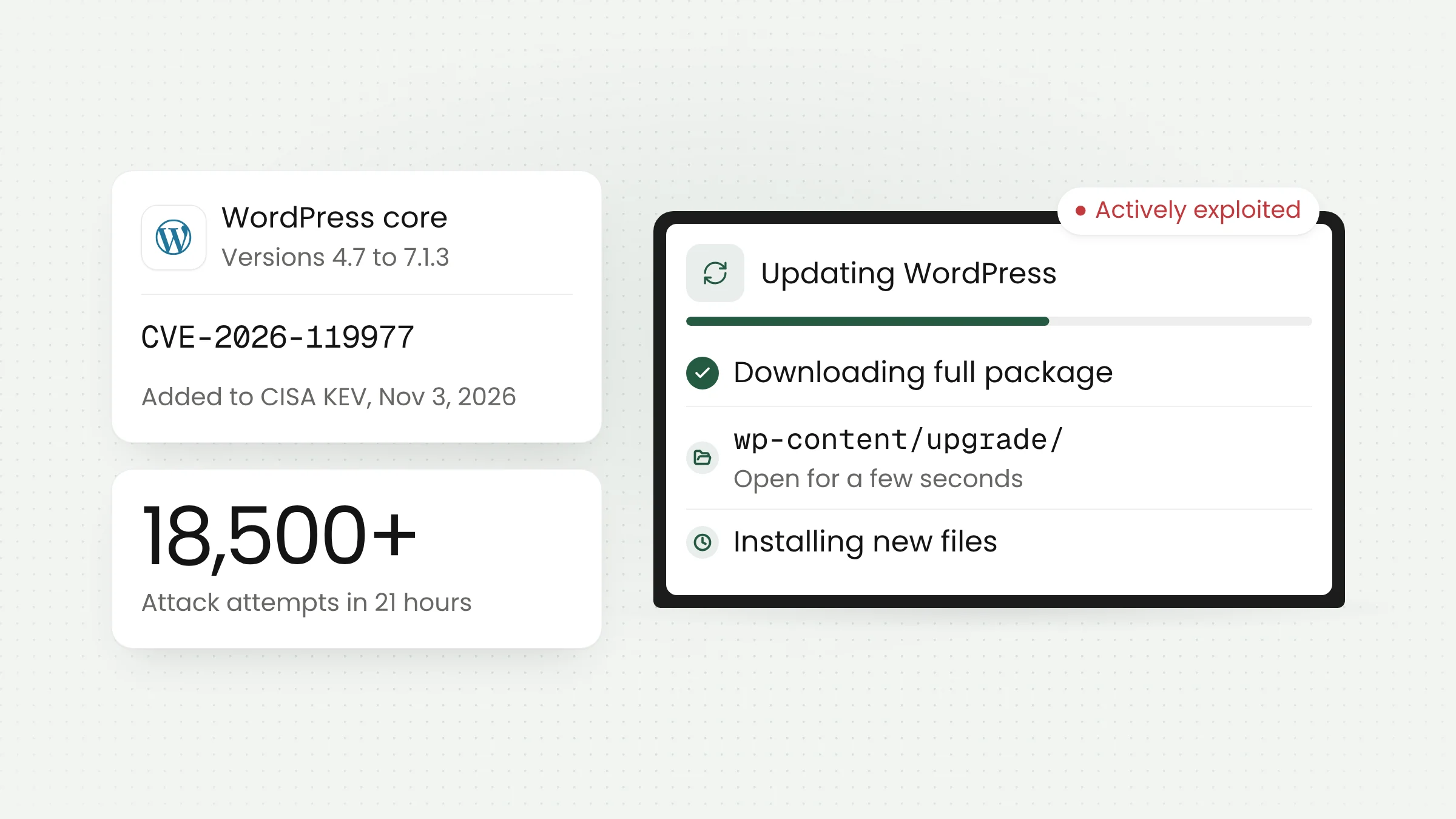
- WordPress 7.1.3 recorded 159.60, against 158.23 on PHP 8.5 and 160.30 on PHP 8.4.
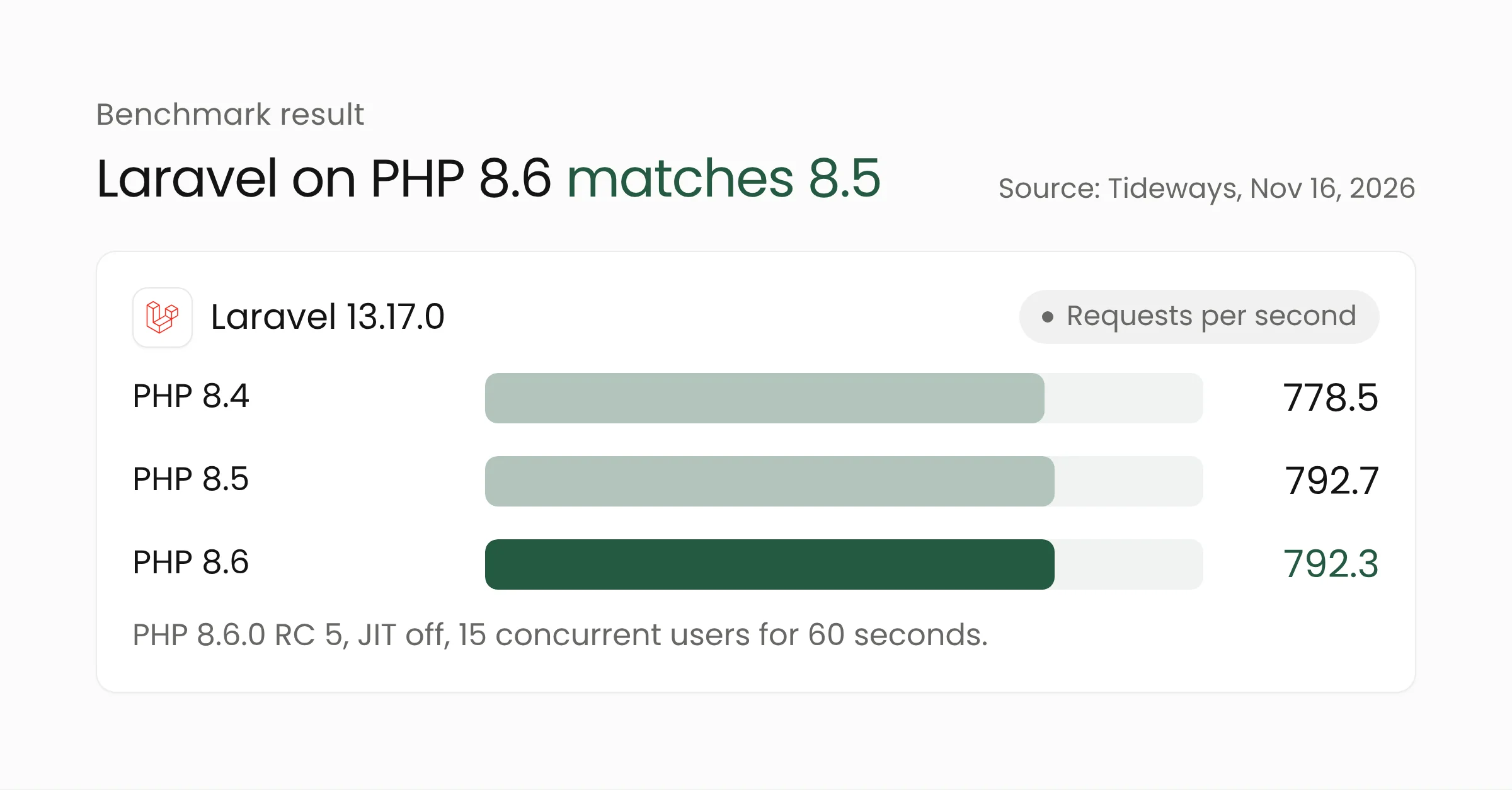
Eberlei concludes that PHP 8.6 has “no major engine improvements that makes it broadly faster than previous versions.” In his view, application architecture and code matter far more. The test used demo applications, so your results may differ.
Official framework support is still catching up. The Laravel 13 release notes list PHP 8.3 through 8.5 as supported versions. The WordPress compatibility table, last updated on November 4, 2026, goes up to PHP 8.5.
What this means for web teams and application owners
PHP runs a large share of sites in Indonesia, from local government portals and campus systems to small online stores built on WordPress or Laravel. Nobody has to move this week. The pressing task is to know where each application stands.
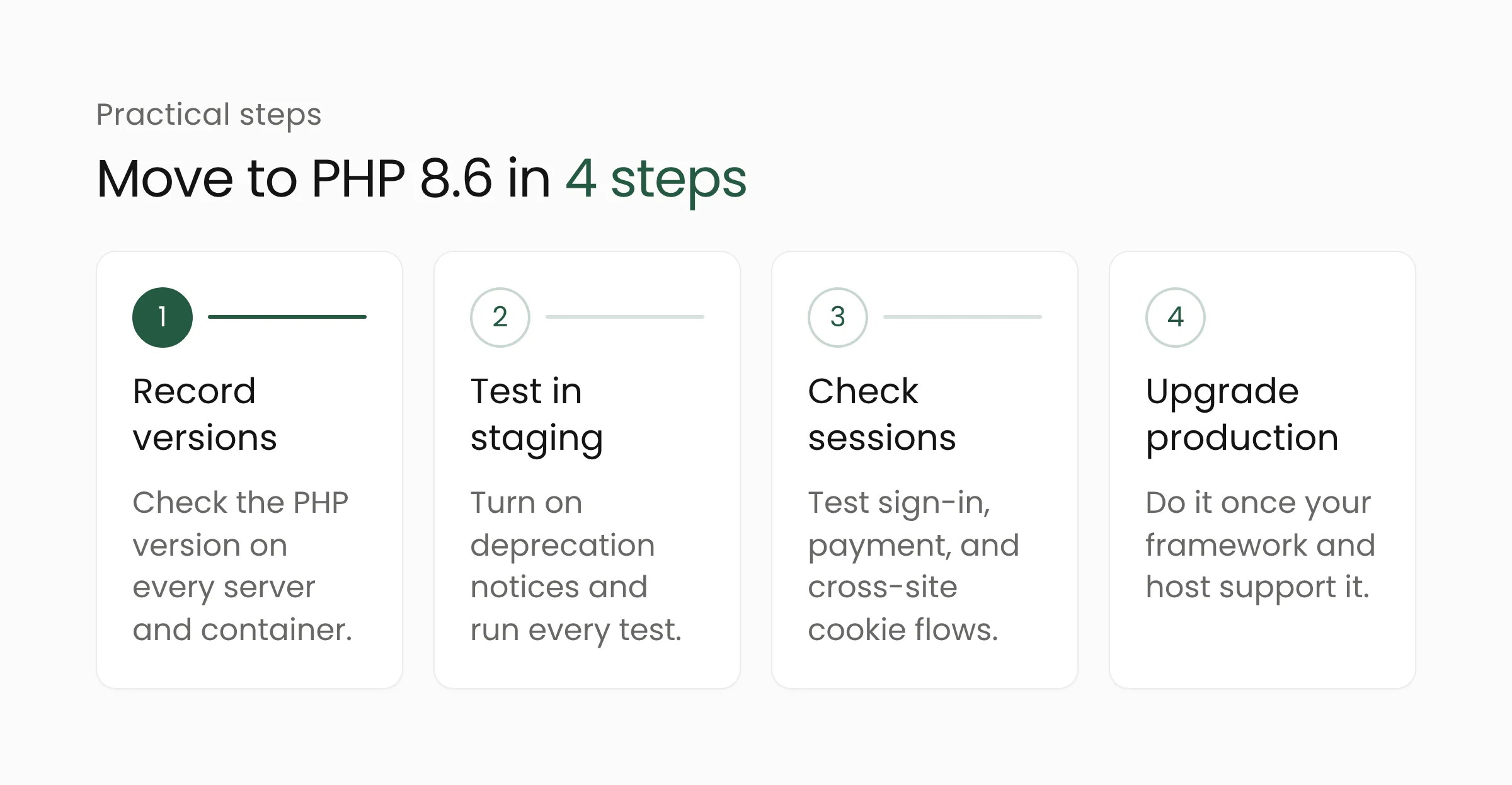
- Record the PHP version on every server. Run
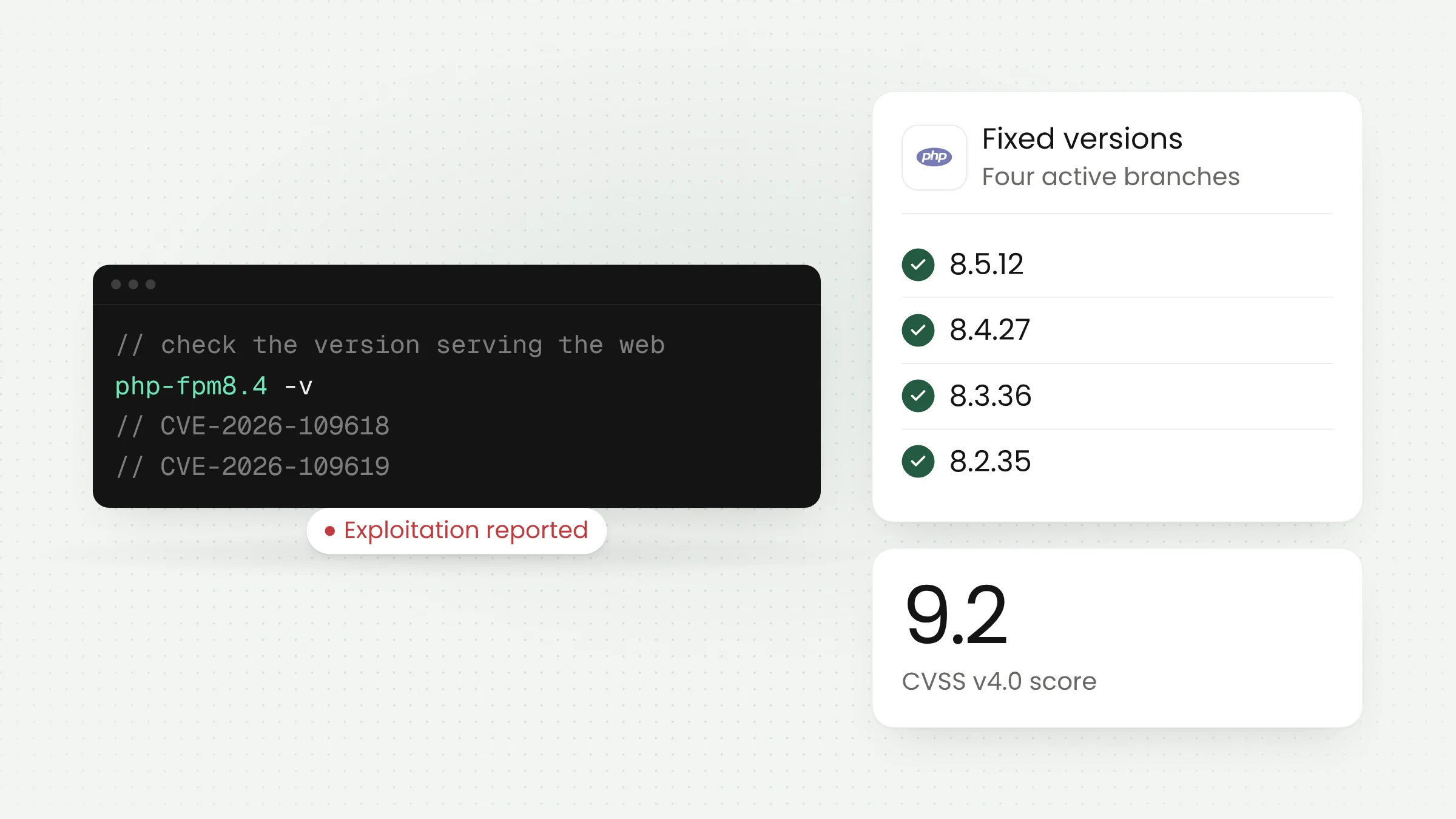
php -v, then check the version used by PHP-FPM and by container images. Security fixes for PHP 8.2 end on December 31, 2026, and active support for PHP 8.4 ends on the same date. Applications on PHP 8.2 should move first, and the target can be 8.4 or 8.5, which frameworks already support. - Install PHP 8.6 in a test environment. Kinsta recommends trying any new PHP release in staging before it reaches a live site. Turn on
E_DEPRECATEDreporting, run the full test suite, and collect the notices. - Test sign-in and payment flows. Look for uses of
document.cookie, cross-site POST requests, and custom session handlers. Where a flow depends on the old behavior, set the value explicitly inphp.ini. - Wait for official support before production. For Laravel and WordPress applications, the switch is safer once PHP 8.6 appears as a supported version.
Zend’s annual survey shows how often migrations slip. About one in three teams did not complete a PHP migration in the past year, and one in five had none planned at the time of the survey. Indonesia shows a similar pattern, as covered in our article on Komdigi’s alert to agencies that still run outdated PHP.
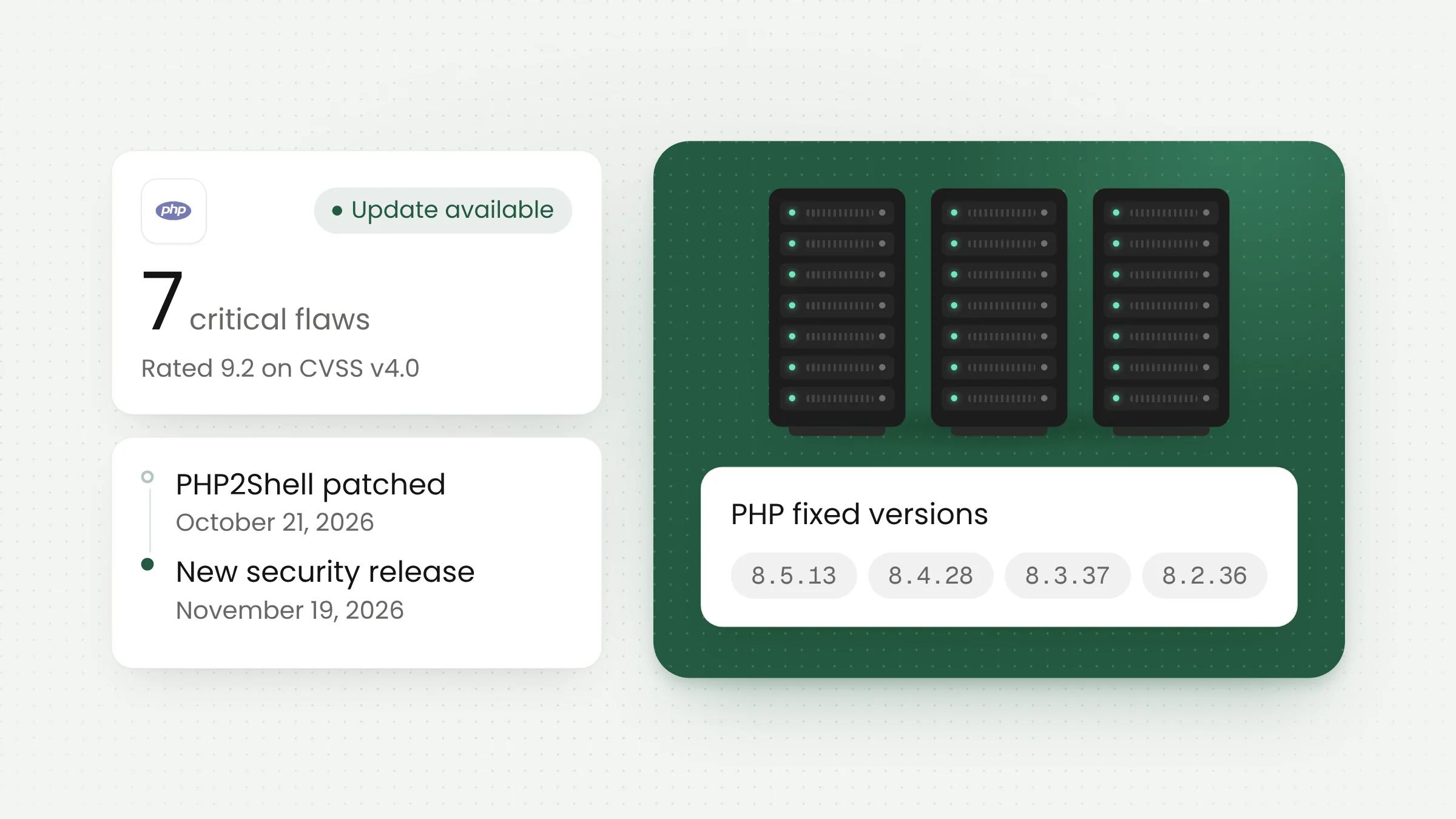
Teams that stay on an older branch should not delay security updates. On the same day as the 8.6 release, the PHP team shipped fixes for seven critical flaws in branches 8.2 through 8.5. Tracking PHP versions across applications is part of the web application development we do with clients.
Frequently asked questions
Is PHP 8.6 faster than PHP 8.5?
For real applications, the difference is small. The Tideways benchmark found Laravel 13 running at the same speed on both versions, Symfony about 2.5 percent ahead, and WordPress nearly level.
How long will PHP 8.6 be supported?
Active support runs until December 31, 2028. After that, the 8.6 branch receives critical security fixes only, until December 31, 2030.
Should a Laravel or WordPress application move to PHP 8.6 now?
Not yet. The Laravel 13 release notes list PHP 8.3 through 8.5, and the WordPress compatibility table does not include PHP 8.6. Test in staging first, then move production once your framework, plugins, and host state their support.
Closing
PHP 8.6 adds tools that make code shorter and tightens several defaults. The cost of the upgrade sits in session testing and libraries that are not ready. If you would like to map the PHP versions across your organization’s applications and plan the migration, the Merakit team is glad to talk.
Sources
- PHP 8.6 Release Announcement, php.net, November 19, 2026
- Supported Versions, php.net, accessed November 23, 2026
- Backward incompatible changes, PHP 8.6 migration guide, php.net, accessed November 23, 2026
- PHP Benchmarks: 8.6 vs 8.5, 8.4, and 7.4, Tideways, November 16, 2026
- What’s New in PHP 8.6: Features, Changes, and Deprecations, Zend, updated after the November 19, 2026 release
- Kinsta’s overview of PHP 8.6, Kinsta, November 20, 2026
- PHP 8.6 is released, Laravel News, November 19, 2026
- Laravel 13.x Release Notes, Laravel, accessed November 23, 2026
- PHP Compatibility and WordPress Versions, WordPress Core Handbook, updated November 4, 2026