Blog Smart Glasses
Ray-Ban Meta Launches in Indonesia as Exam Rooms Take Note
On this page· 7 sections
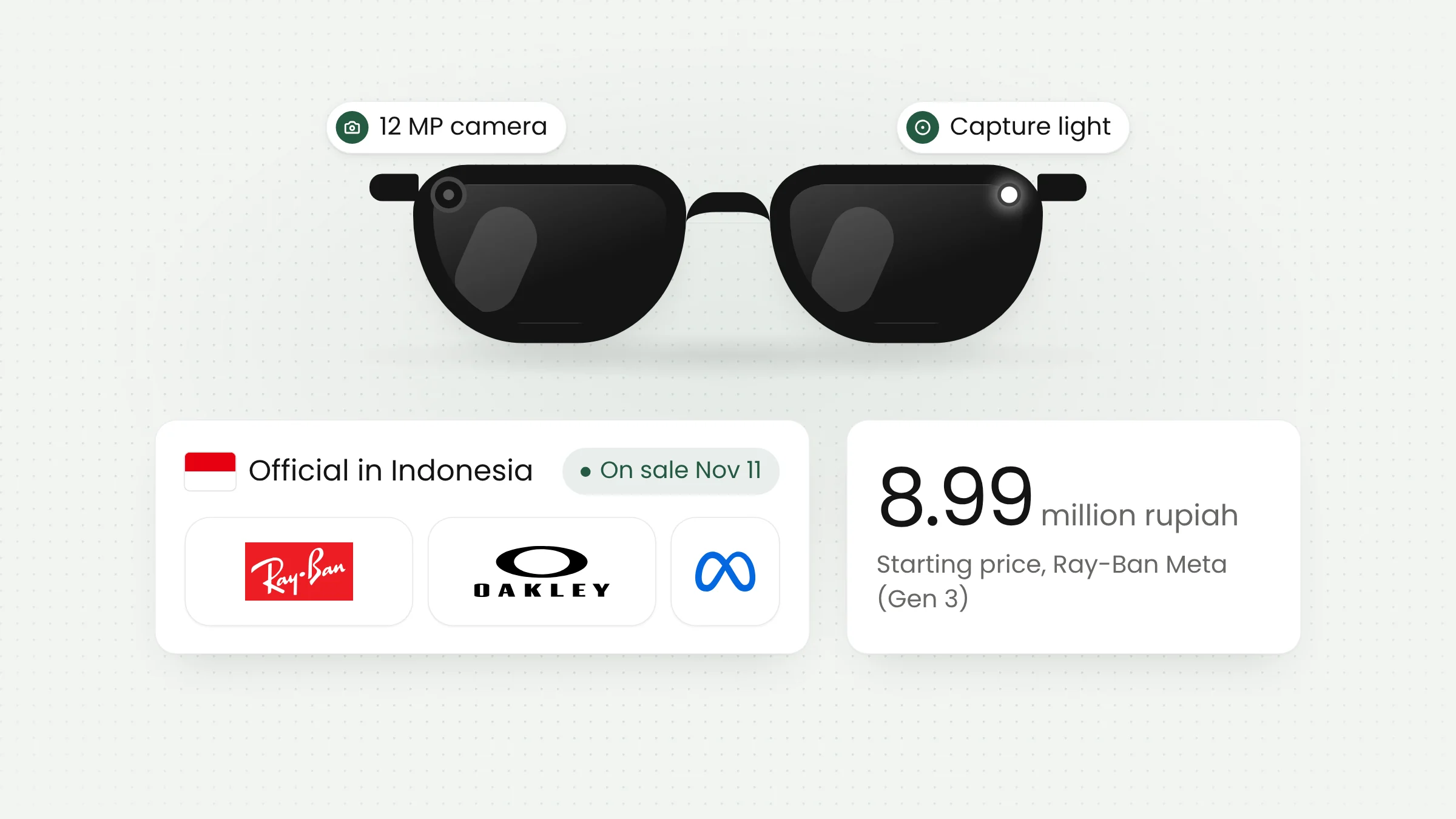
EssilorLuxottica and Meta launched Ray-Ban Meta and Oakley Meta smart glasses in Indonesia at an event in Jakarta on November 3, 2026. Sales begin on November 11, with prices starting at about Rp8.8 million. Each frame carries a camera, microphones, open-ear speakers, and the Meta AI assistant.
The launch puts camera-equipped glasses on the shelves of ordinary optical stores, next to regular frames. For consumers, that means a new way to take photos and ask an AI questions without reaching for a phone. For schools, universities, certification bodies, and recruitment test committees, it means exam room rules are due for a review.
Four models on sale from November 11
According to Liputan6 and Investortrust, four main models are coming to Indonesia. The Oakley Meta HSTN is the cheapest, starting at Rp8,799,000. The Ray-Ban Meta (Gen 3) starts at Rp8,999,000, the Ray-Ban Meta Optics (Gen 2) at Rp9,399,000, and the Oakley Meta Vanguard at Rp10,999,000.
The sources disagree on one figure. Republika lists the Oakley Meta HSTN at Rp10,999,000, the same as the Vanguard. Buyers should confirm final prices at authorized stores when sales open.
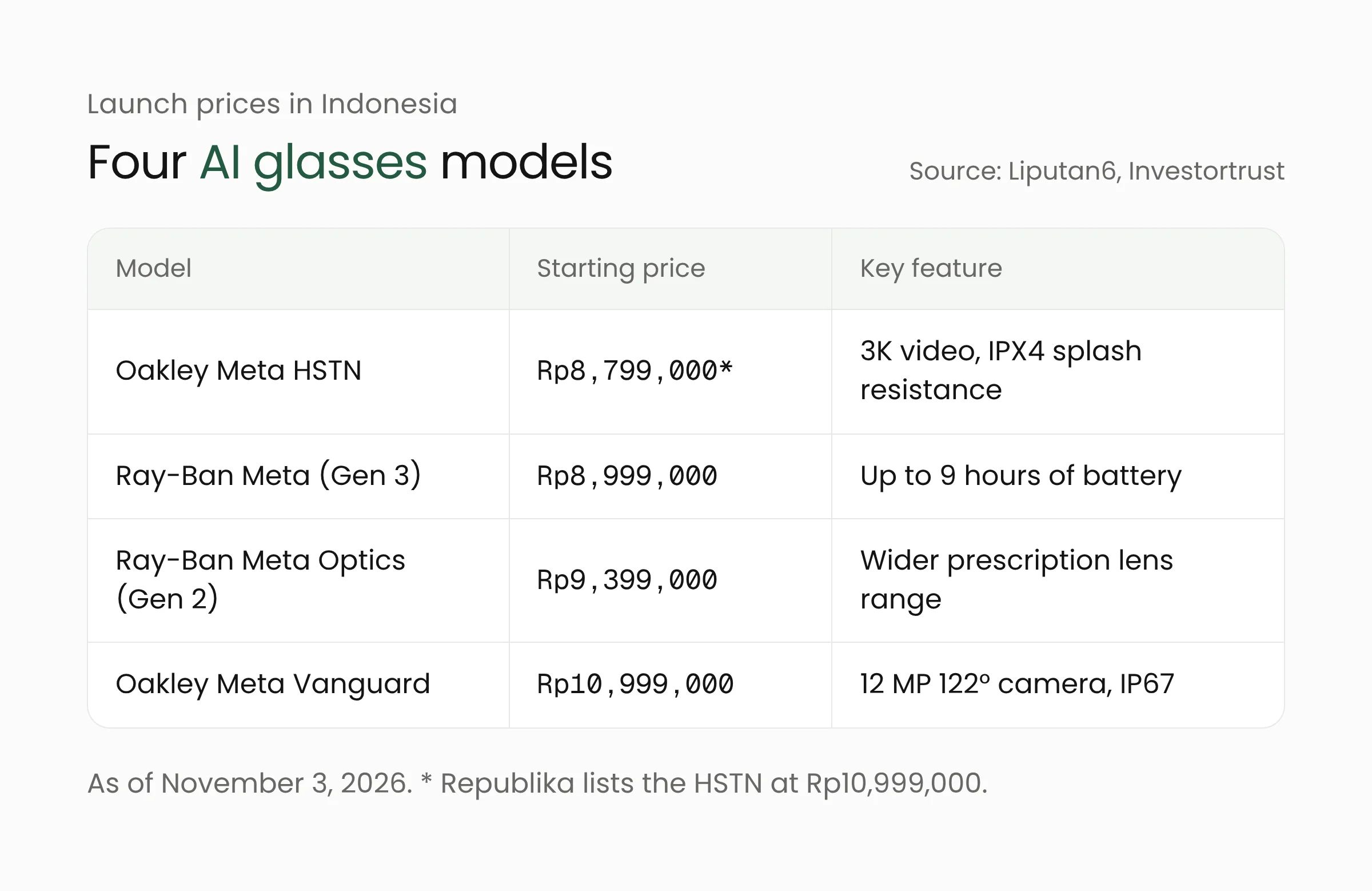
The Ray-Ban Meta (Gen 3) comes in Wayfarer, Aviator, and Zena styles. The Optics (Gen 2) line targets people who wear prescription glasses and offers a wider choice of lenses, including Transitions lenses that adjust to changing light. The Oakley Meta HSTN is pitched at daily wear and light exercise, while the Vanguard is built for athletes and connects to Garmin and Strava.
Ray-Ban Meta glasses will be sold at official Ray-Ban stores and EssilorLuxottica retail partners, including 75 selected Optik Seis outlets across Indonesia. Oakley Meta will be available at official Oakley stores and dealers. “Kacamata AI kami dirancang untuk digunakan setiap hari,” said Dailami Aziz, president director of EssilorLuxottica Indonesia, as quoted by Liputan6. The line translates as “Our AI glasses are designed to be used every day.”
The arrival was flagged at Meta Connect on September 23, 2026. In its official announcement, Meta listed Indonesia alongside Thailand, Malaysia, the Philippines, and several other countries as markets getting its AI glasses later this year.
How the camera and Meta AI work inside the frame
Meta says the Ray-Ban Meta (Gen 3) uses a 12 MP camera that records 3K Ultra HD video. Battery life is rated at up to nine hours, one hour more than the previous generation. Six microphones in the frame are claimed to cut more than 90% of background noise, and a customizable action button calls up Meta AI. These are Meta’s figures and have not been independently tested in Indonesia.
The camera and microphones are what set these frames apart from regular glasses. Wearers can ask Meta AI about an object in front of them, translate a conversation in real time, have incoming messages read aloud, set reminders, or get suggestions for nearby places. Answers play through open-ear speakers in the arms, so the ears stay uncovered.
All of this works together with a phone. The glasses capture images and sound, and the companion app on the phone connects them to Meta’s AI services. That makes the AI features dependent on an internet connection and on which features Meta enables for Indonesia.
The capture light and photo storage
A small white light on the front of the frame blinks when the glasses take a photo and stays on while they record video. In a Q&A page, Meta says the light has no off switch. Since the second generation, the camera shuts off automatically if the light is covered.
Meta also says photos and videos captured for the gallery are stored on the glasses, and the wearer decides when to import them to a phone. Sharing images with Meta AI is optional.
The capture light lets people nearby know they are being recorded. Even so, a small light is easy to miss in a bright or crowded room. We looked at consent for people caught on recordings in an earlier piece on Amazon’s Bee AI recorders.
Smart glasses are entering exam rules
Camera glasses raise a new problem for exam organizers. They look like ordinary eyewear, yet they can photograph a question and pass it to an AI assistant. Phones and smartwatches have long been collected before a test, but glasses are something candidates need in order to see.
Some testing bodies abroad have already acted. Inside Higher Ed reported that the College Board, which runs the SAT in the United States, banned candidates from wearing smart glasses during the test from March 2026. The ban also covers prescription smart glasses. Students who cannot sit the test without them are asked to return on another day with regular glasses.
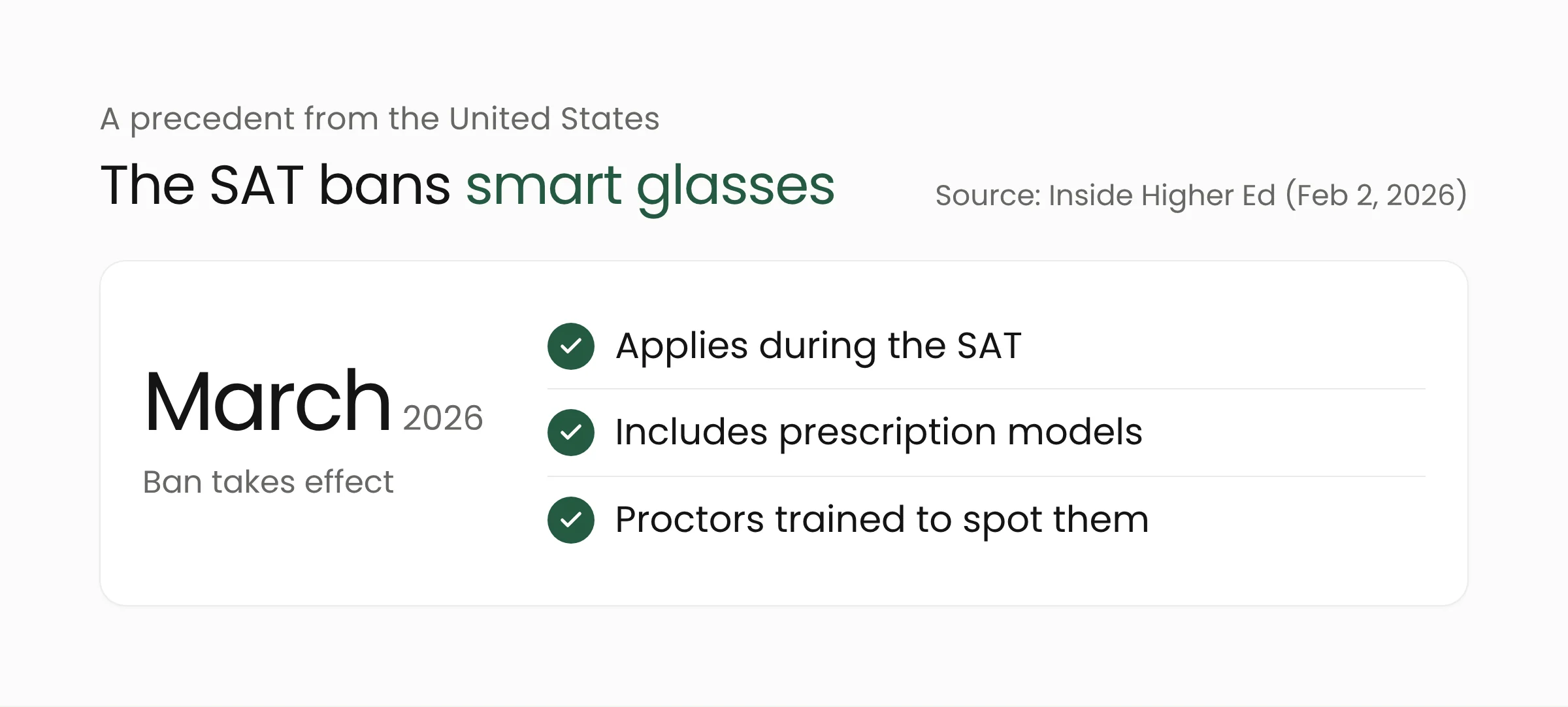
Priscilla Rodriguez, the College Board’s senior vice president of college readiness assessments, said the organization knew of no SAT cheating cases involving smart glasses. The ban was a preventive step. Proctors are trained to spot thick frames and the camera light that turns on when the device is in use.
In Indonesia, national exam organizers have not issued any official guidance on smart glasses. With prices close to an upper mid-range phone and sales running through optical stores, though, the devices are likely to show up in exam rooms sooner or later.
What this means for exam organizers
Organizers do not need to wait for a first incident to update their rules. The steps below apply to schools, faculties, training centers, and civil service or corporate recruitment panels.
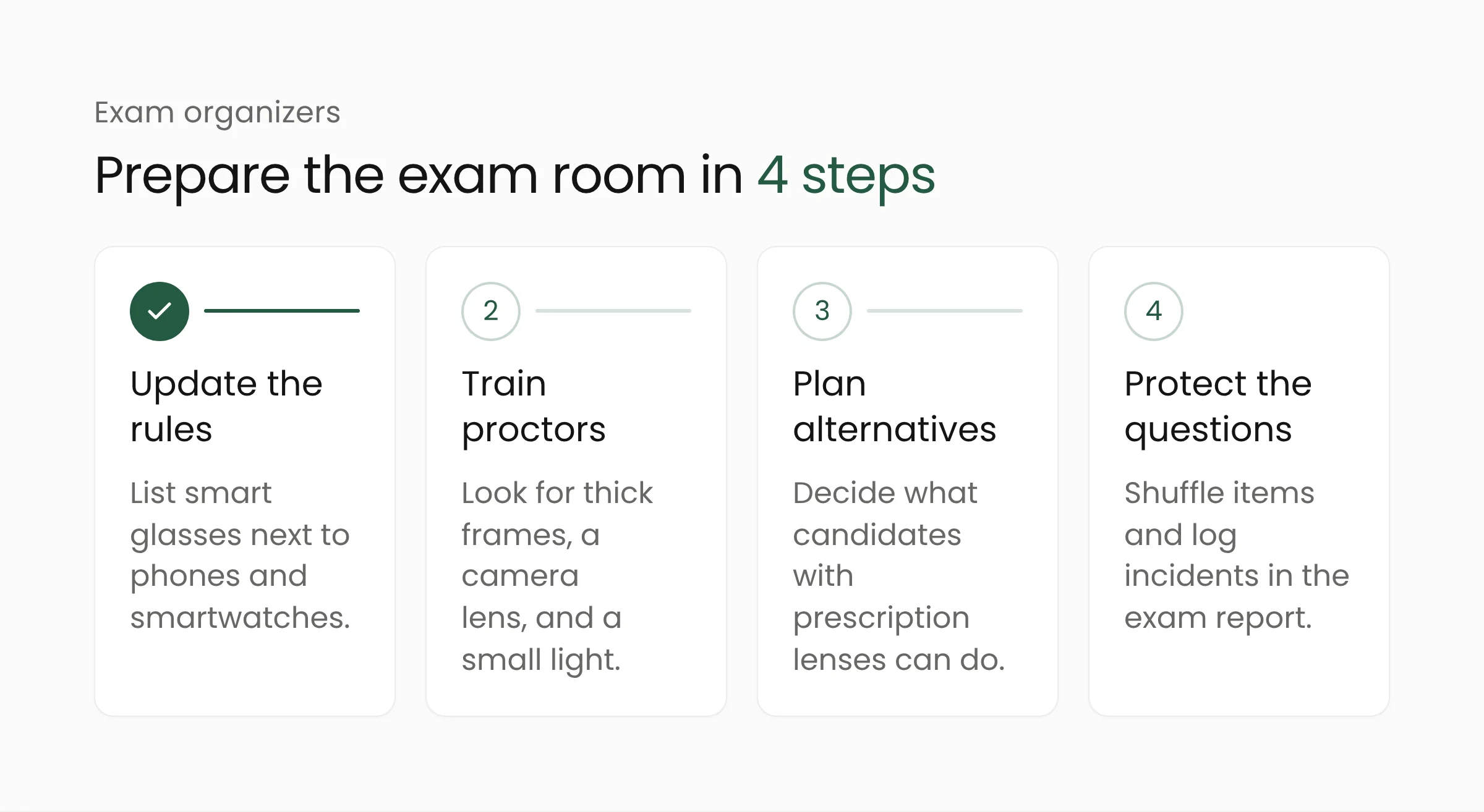
- Update the rules. Name smart glasses explicitly on the list of banned devices, next to phones, smartwatches, and earbuds. A rule that only mentions “communication devices” is easy to dispute.
- Train proctors. Proctors should know the common signs of AI glasses: thicker frames, a small camera lens at one corner, and a white light on the other side. Physical examples can now be seen at optical stores.
- Plan for prescription wearers. Some candidates may own only prescription smart glasses. Decide in advance what is fair, such as bringing regular glasses or sitting a later session, so nobody has to improvise on exam day.
- Reduce the value of a photographed question. Shuffle item order, draw from a large enough question bank, and log every incident in the exam report. For computer-based tests, a system such as Merakit Exam helps committees prepare candidates and questions, monitor the session, and compile results and exam documents.
The same steps apply to other places that hold sensitive information, such as boardrooms, server rooms, or examination rooms at health facilities. Organizations that handle personal data remain bound by Indonesia’s Undang-Undang Nomor 27 Tahun 2022 tentang Pelindungan Data Pribadi (Personal Data Protection Law), including when that data is captured by a device a visitor is wearing.
For schools and universities reworking their digital processes, device rules in exam rooms belong in the same policy as account management, student data, and exam systems. Merakit’s education technology solutions page covers that wider picture.
Frequently asked questions
When do Ray-Ban Meta and Oakley Meta go on sale in Indonesia?
Official sales begin on November 11, 2026, at authorized Ray-Ban and Oakley stores and dealers. Ray-Ban Meta is also available at 75 selected Optik Seis outlets. Liputan6 and Investortrust list the Oakley Meta HSTN from Rp8,799,000, while Republika gives Rp10,999,000 for the same model.
Can people nearby tell when the glasses are recording?
Meta says a white light on the frame blinks for photos and stays on during video, with no way to switch it off. The camera turns off automatically if the light is covered. The light is still small, so written notices in sensitive areas remain useful.
Are smart glasses banned in Indonesian exams?
National exam organizers in Indonesia have not made an official announcement. In the United States, the College Board has banned smart glasses during the SAT since March 2026. Organizers in Indonesia can add them to their own exam rules.
Closing
The arrival of Ray-Ban Meta and Oakley Meta in Indonesia puts a camera and an AI assistant into something people wear all day. Features such as live translation and hands-free help will be useful to many wearers, but exam rooms and other sensitive spaces need clear rules from the start. If your team is rethinking how it runs computer-based exams, we are happy to help map out what you need.
Sources
- EssilorLuxottica dan Meta Resmi Luncurkan Kacamata AI di Pasar Indonesia (Investortrust, November 3, 2026)
- Ray-Ban Meta Luncurkan Kacamata Canggih Berbasis AI di Pasar Indonesia 11 November 2026 (Investortrust, November 3, 2026)
- Daftar Harga Ray-Ban dan Oakley Meta AI Glasses di Indonesia (Liputan6, November 3, 2026)
- EssilorLuxottica dan Meta Bawa Kacamata AI ke Pasar Indonesia (Republika, November 3, 2026)
- Introducing Ray-Ban Meta Audio and Our Deepest Lineup of AI Glasses Yet (Meta, September 23, 2026)
- Meta’s AI Glasses: Your Questions Answered (Meta, July 2026)
- College Board Prohibits Wearing Smart Glasses During SAT (Inside Higher Ed, February 2, 2026)