Blog Digital Regulation
SALAM T3: Indonesia Tightens Rules for Internet Resellers
On this page· 7 sections
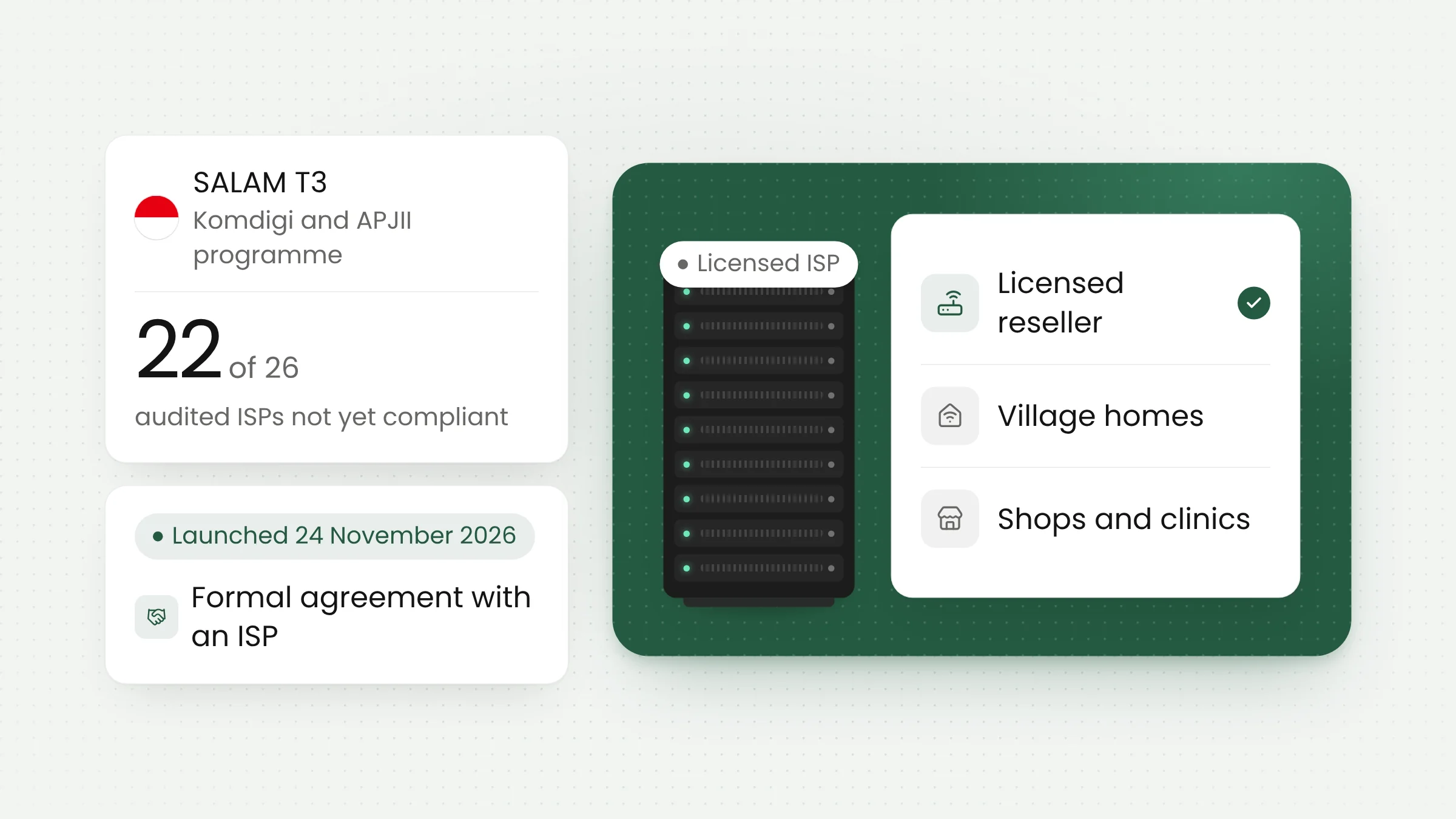
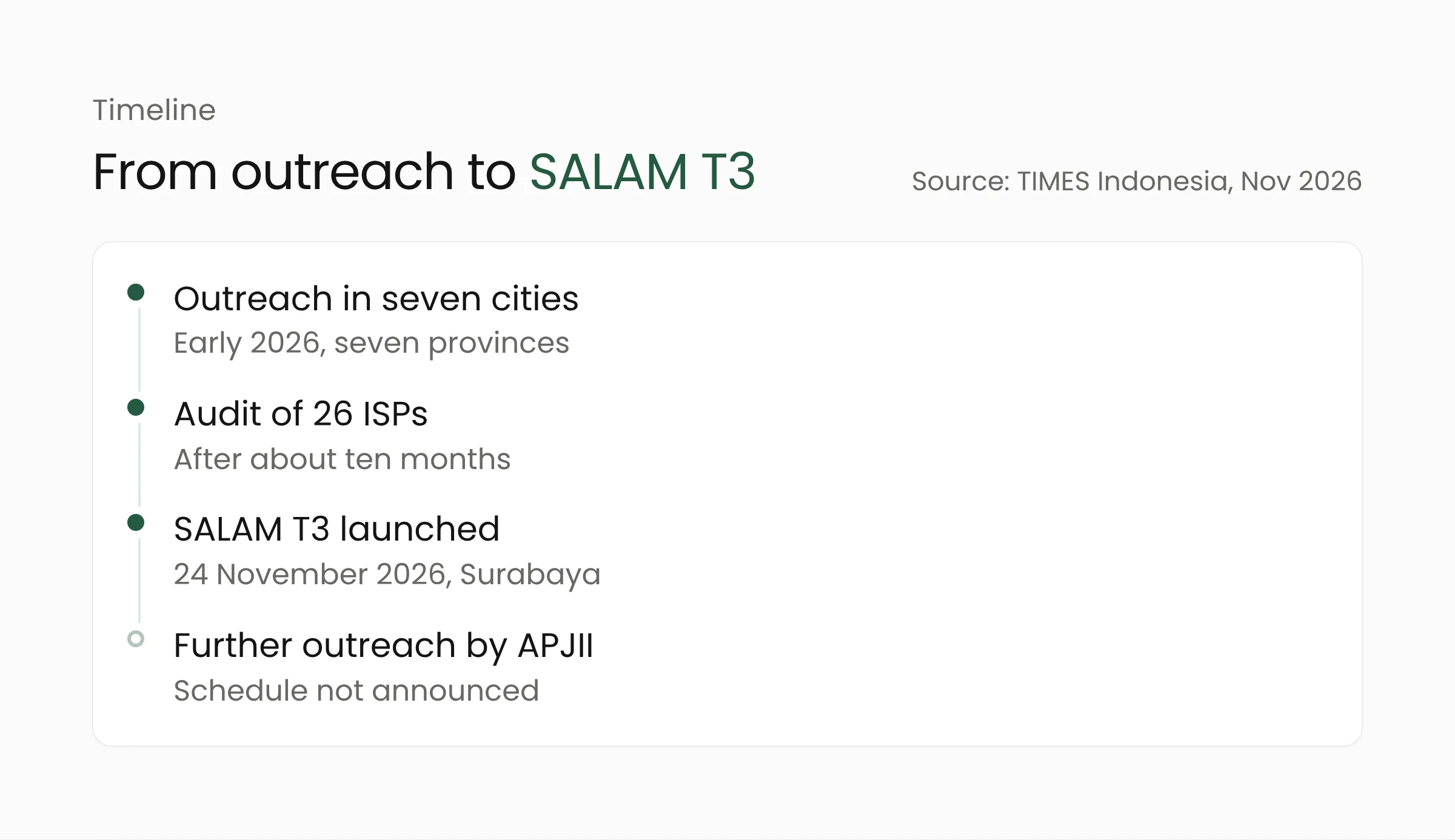
Indonesia’s Ministry of Communication and Digital Affairs (Komdigi) launched a programme called SALAM T3 in Surabaya on 24 November 2026 to bring order to the internet reseller business. At the same event the ministry disclosed audit results showing that 22 of 26 internet service providers it examined did not meet the rules on reselling.
An internet reseller buys connectivity from a licensed internet service provider (ISP) and sells it on to customers nearby. In many Indonesian neighbourhoods these small operators are known as RT/RW Net. The government credits them with carrying internet access into villages, and it now wants them to operate under formal agreements, on compliant networks, with reported data.
The SALAM T3 programme and its three goals
SALAM T3 is an Indonesian acronym that stands for a business that is healthy, accountable and safe, so that it can advance, grow, stay connected and stay protected. ANTARA reported that the programme is meant to make reselling more orderly and compliant while protecting service quality. VIVA Jatim wrote the name as “SALAM 3T” in its headline, while other outlets use “SALAM T3”.
The launch took place at the JW Marriott hotel in Surabaya. Duta.co reported that Komdigi’s Directorate General of Digital Ecosystem initiated it with the national board and East Java chapter of APJII, the Indonesian internet service providers association. TIMES Indonesia counted about 100 representatives from 150 ISPs in East Java and other cities, including reseller partners. Duta.co wrote of hundreds of business representatives.
Edwin Hidayat Abdullah, Komdigi’s Director General of Digital Ecosystem, said resellers play an important part in extending internet coverage, particularly to rural areas that ISPs do not fully reach.
Dany Suwardany, the ministry’s Director of Digital Ecosystem Control, set out three goals, according to TIMES Indonesia:
- Educating ISPs and their reseller partners on the reseller rules so both sides share the same understanding.
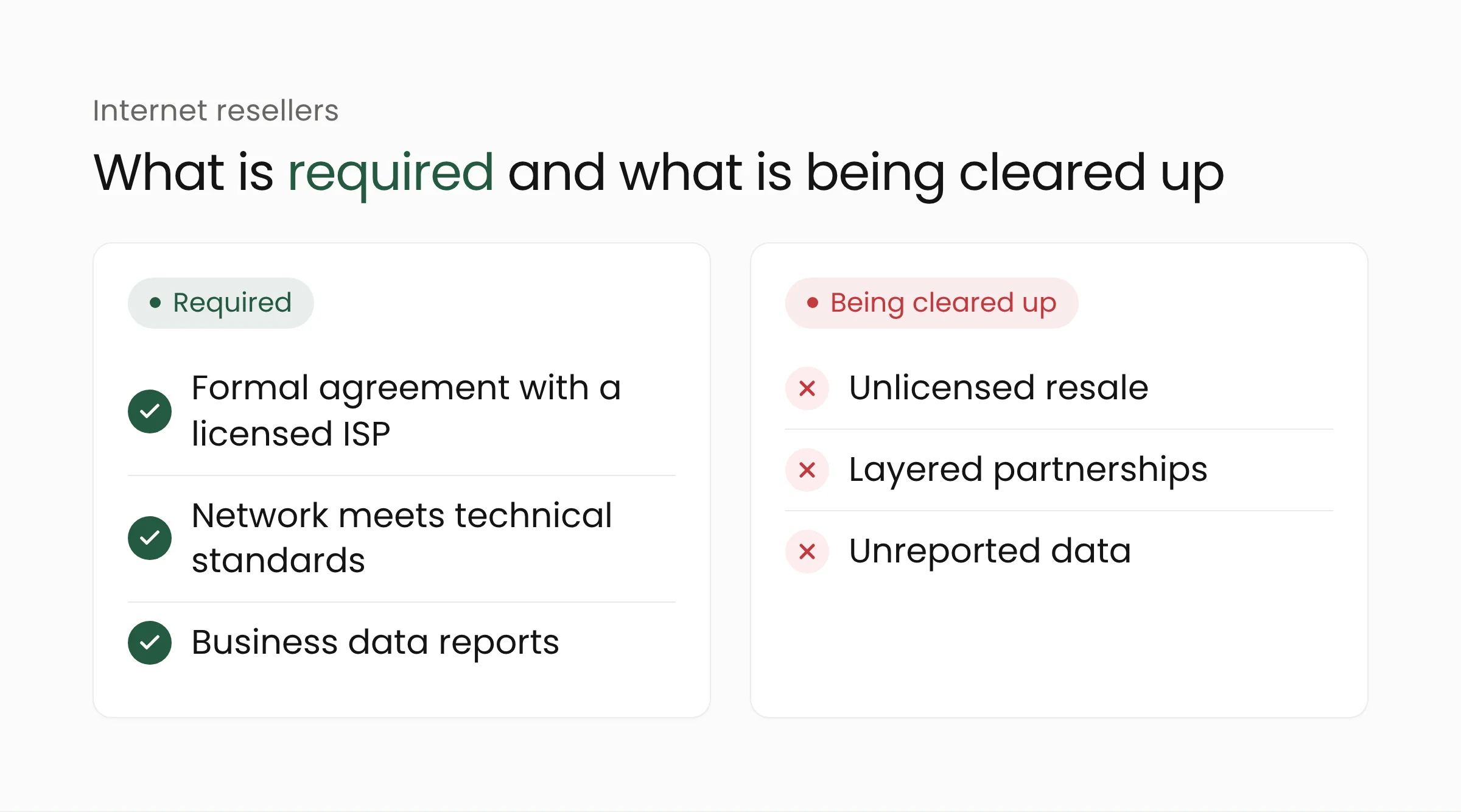
- Organising resale through single-tier partnerships, as the regulations require.
- Preventing illegal reselling by identifying operations that do not meet the regulations.
What resellers and ISPs are required to do
Edwin listed four obligations for resellers: a formal agreement with a licensed ISP, maintained network quality and customer service, compliance with government technical standards for infrastructure, and reporting of business data.
He gave the fourth point particular weight. As quoted by VIVA Jatim, Edwin said reporting matters because the data the ministry receives forms the basis for policy decisions. He added that reporting should not be seen as an administrative burden.
Single-tier partnerships
Neither TIMES Indonesia nor Duta.co spells out a definition of the single-tier partnership. Read literally, the term means one layer of partner between the ISP and the customer.
ISPs carry obligations as well. TIMES Indonesia reported that they are asked to run a fraud monitoring system, which watches for misuse of the service, and to cut off customers found to be reselling without a licence.
Rules that were already in force
Based on the reporting so far, SALAM T3 does not introduce new rules. It promotes and enforces existing ones. In September 2024, trade publication Selular.ID summarised those provisions from the ministry’s official page, citing Article 22 of Peraturan Menteri Komunikasi dan Informatika Nomor 13 Tahun 2019 (a 2019 ministerial regulation) and Article 34 of Peraturan Menteri Komunikasi dan Informatika Nomor 1 Tahun 2021:
- A reseller may operate only after obtaining a standard certificate for the resale of telecommunications services, under business classification code KBLI 61994, through oss.go.id.
- A reseller may use the ISP’s brand and add its own. Customer bills must show the ISP’s brand.
- All revenue from resale counts as the ISP’s revenue and is recorded in the ISP’s books.
- For internet protocol services, the reseller must use public IP addresses and the autonomous system number (ASN) belonging to the ISP.
- The ISP may end the partnership if the reseller fails to record and report all sales revenue.
Audit of 26 ISPs and the direction of enforcement
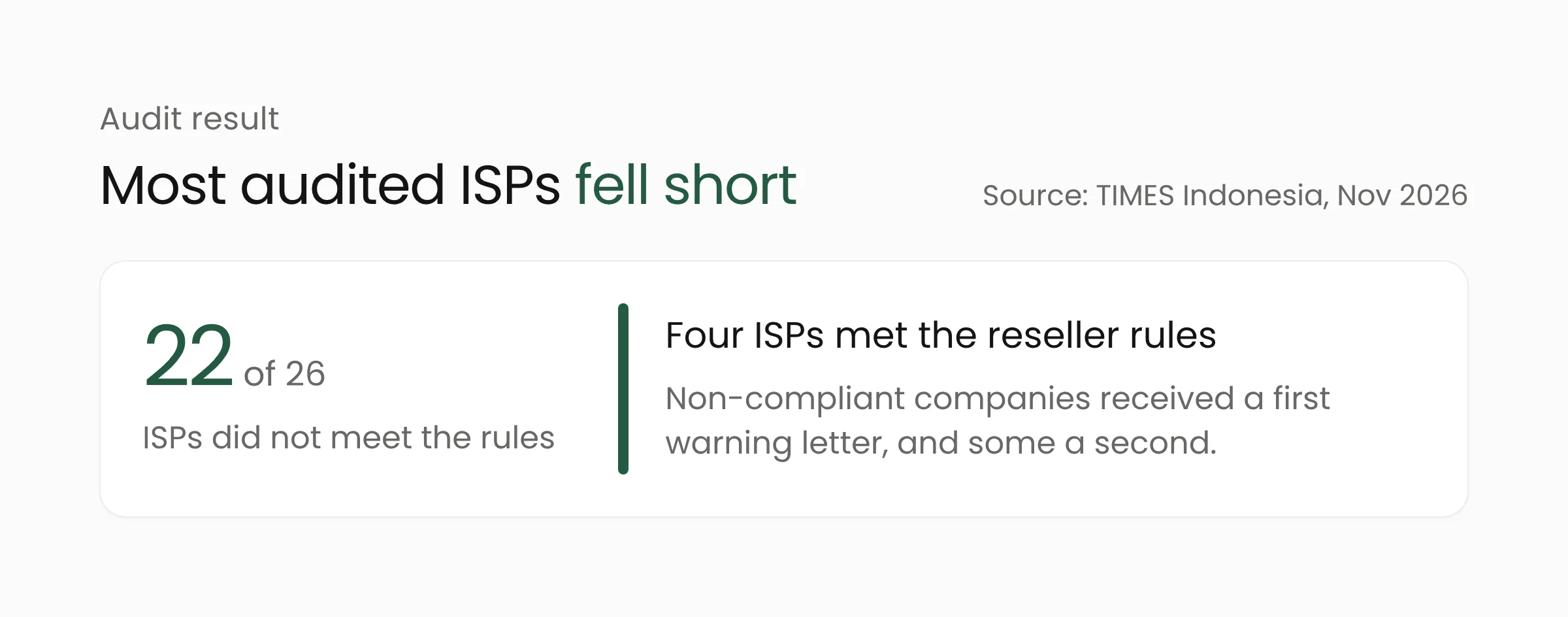
According to TIMES Indonesia, Dany said Komdigi began outreach in seven cities across seven provinces early this year. After roughly ten months, compliance testing of 26 ISP companies found that 22 did not meet the reseller rules. The remaining four did.
Komdigi issued first warning letters to the non-compliant companies, and some have already received a second. Duta.co reported the same outcome without figures. The companies were not named.
On unlicensed reselling, Komdigi works with the police and has already carried out enforcement at several locations. Dany also mentioned administrative fines under Indonesia’s Job Creation Law, which apply before any criminal process and, he said, still need review.
Why the ministry is stepping in
According to Duta.co, he said the information and communication technology industry now contributes more to gross domestic product than finance and banking. TIMES Indonesia put the figures at about 8% against no more than 5%.
The ministry says it will intervene with policy only where there are signs of market failure. TIMES Indonesia recorded four indicators that Edwin named: a market that is too concentrated, abundant supply where demand is still weak, strong demand that is not being served, and harm to surrounding communities such as cables and poles piling up in residential areas. He said about 1,600 companies hold licences while only about 10 large ones earn significant profits.
TIMES Indonesia reported Edwin as saying that utilisation of the national fibre network stands at only about 28%, even as cables accumulate in Jakarta, Yogyakarta and Bali. We covered the demand side in an earlier article on Indonesia’s 100 Mbps home internet target.
Regulations under review
On the same day, Komdigi held a focus group discussion with the East Java regional police, the telecommunications operators association ATSI, APJII and reseller representatives. Duta.co reported that the discussion evaluated Undang-Undang Nomor 36 Tahun 1999 tentang Telekomunikasi (the 1999 Telecommunications Law) and its implementing rules. Dany noted that the law is almost 27 years old. TIMES Indonesia added that the 2019 ministerial regulation and a 2022 director general regulation, Peraturan Direktur Jenderal Nomor 1 Tahun 2022, are also being evaluated.
ATSI executive director Marwan O. Baasir backed the ministry and called for a thorough review of regulations. APJII’s Firdhyan Adhi Lesmana said the association would take the outreach to other regions.
Still unreported are deadlines for the companies that received warnings, the number of resellers on record, and a schedule for outreach beyond East Java.
What this means for customers and internet businesses
For resellers. Make sure there is a written partnership agreement with a licensed ISP and a KBLI 61994 standard certificate. Check that customer bills show the ISP’s brand and that the IP addresses and ASN in use belong to the partner ISP. Keep separate records of customers and revenue, because that is the data the reporting obligation asks for.
For ISPs. The audit shows that ISPs are held responsible for the partners beneath them. Three tasks can start now, namely listing every partner along with its agreement documents, checking whether any partner sells on to a further party, and setting up usage monitoring that flags household subscribers whose traffic resembles a resale point. Monitoring of this kind is essentially data analytics work on traffic logs and subscriber records.
For organisations that subscribe. Shops, clinics, schools and village offices in areas served only by resellers should know which ISP stands behind their connection. If the provider cannot show that, the service risks being cut off when an ISP or the authorities act against unlicensed resale. The risk is greater for organisations whose daily work depends on point-of-sale, medical record or exam applications that run on cloud computing. A backup connection from a different provider, such as a mobile data plan, is worth preparing for services that cannot stop.
Frequently asked questions
Are RT/RW Net businesses banned?
No. Komdigi says resellers help extend internet coverage to rural areas. Enforcement targets resale without a formal agreement with a licensed ISP and without a business licence.
What penalties apply to ISPs or resellers that break the rules?
Komdigi has issued first and second warning letters to non-compliant ISPs. Unlicensed resale is handled together with the police. Administrative fines are provided for in the Job Creation Law, though the reports do not give amounts.
How can a customer tell whether a provider is legitimate?
Bills from a legitimate reseller must show the brand of its partner ISP. Customers can also ask for the name of that ISP and confirm the partnership with the ISP directly.
Closing
SALAM T3 keeps the push for village internet access and ties it to legal standing, network quality and verifiable data. The audit of 26 ISPs points to partner records and reporting as the largest gap. If your organisation needs to put subscriber data, network monitoring or a fallback plan for cloud applications in order, the Merakit team is ready to talk.
Sources
- Komdigi tata bisnis “reseller” internet lewat program SALAM T3, ANTARA, 24 November 2026
- Luncurkan Salam T3, Komdigi Tertibkan dan Perkuat Tata Kelola ISP, TIMES Indonesia, November 2026
- Komdigi Perkenalkan Program SALAM T3 di Surabaya, Perketat Pengawasan Reseller Internet, dan Benahi Tata Kelola ISP, Duta.co, 25 November 2026
- Program SALAM 3T, Cara Komdigi Tata Bisnis Reseller Internet, VIVA Jatim, 25 November 2026
- Program SALAM T3, Komdigi Menata Bisnis Reseller Internet, Harian Bhirawa, 25 November 2026
- Komdigi Luncurkan SALAM T3 untuk Awasi Reseller Internet, MCI News, 24 November 2026
- Tergiur RT/RW Net, Jangan Lupakan Aturan Berikut Ini, Selular.ID, 30 September 2024