Blog Connectivity
Indonesia Targets 100 Mbps Home Internet for Rp140,000
On this page· 7 sections
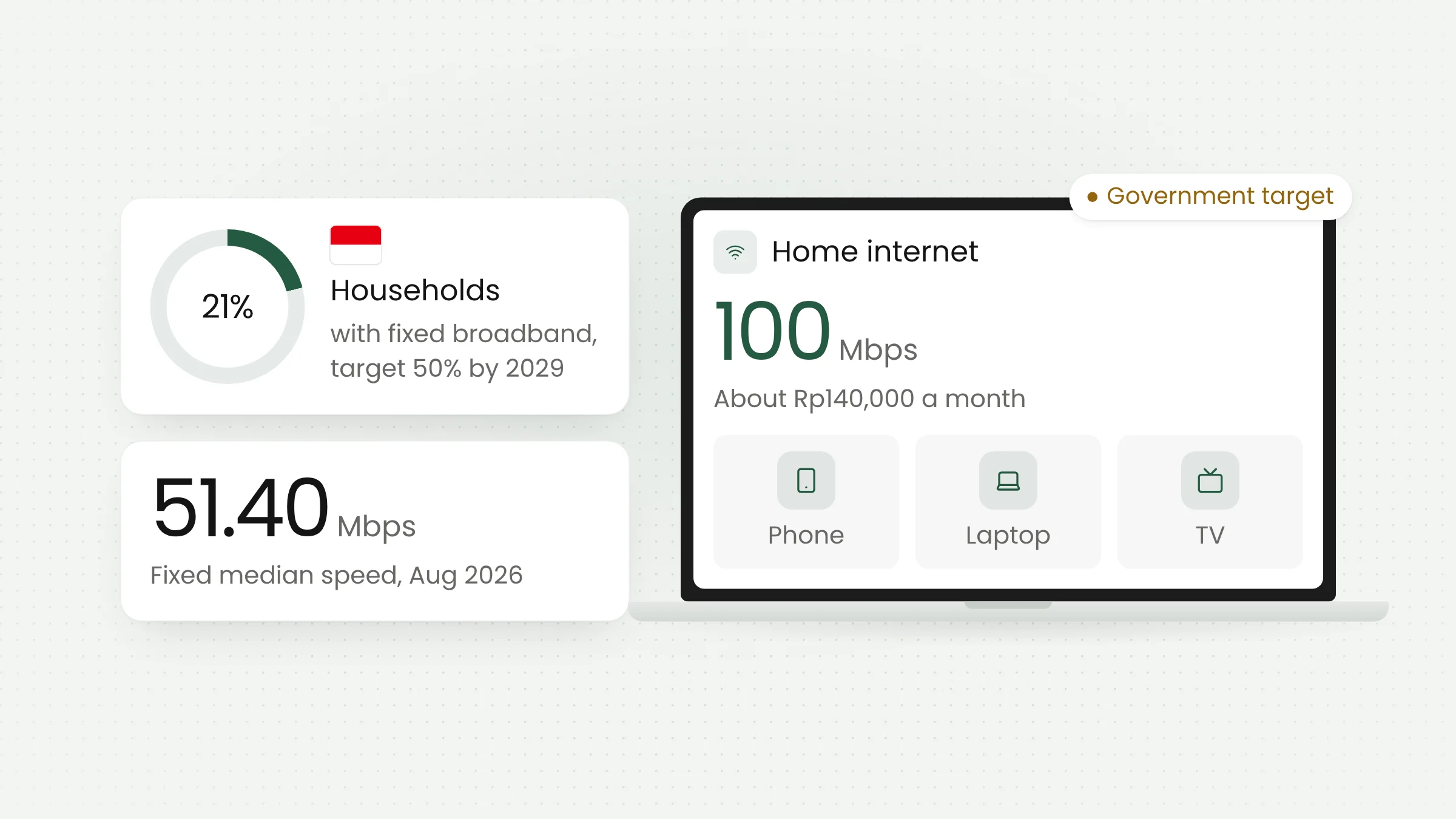
Indonesia’s Ministry of Communication and Digital Affairs (Komdigi) wants 100 Mbps home internet to cost about Rp140,000 a month, and in any case under Rp200,000. Deputy Minister Nezar Patria set out the target in late October 2026, tying it to extending fiber-optic networks into residential areas. No timeline or operators have been named yet.
For families whose children study at home, the appeal is that one household connection can serve everyone under the same roof. For schools and online learning providers, the target is a good moment to check how well their platforms cope with the very uneven connections students actually have today.
The 100 Mbps target and the Rp140,000 price
According to JawaPos, which reported the remarks on October 31, 2026, Nezar spoke at the Komdigi office in Central Jakarta. He argued that internet costs can come down by expanding fixed broadband, meaning connections installed at a home or office rather than mobile data plans on a phone.
“Dengan kecepatan 100 Mbps, masyarakat bisa membayar sekitar Rp140 ribu atau di bawah Rp200 ribu,” Nezar said, as quoted by Katadata. In English: with 100 Mbps speeds, people could pay about Rp140,000, or under Rp200,000.
The government wants fiber to reach residential neighborhoods instead of stopping at business districts and city centers. Its reasoning is that a home connection is shared across schoolwork, jobs, small businesses, and access to public services.
At the same briefing, Nezar said 5G adoption in Indonesia is still below 10 percent. The government aims to lift that to roughly 30 to 40 percent within three to five years, starting with stronger infrastructure.
Part of a plan running to 2029
The price target sits on top of goals already set in the National Medium-Term Development Plan (Rencana Pembangunan Jangka Menengah Nasional, RPJMN) for 2025 to 2029. In October 2025, Communication and Digital Affairs Minister Meutya Hafid said only 21 percent of households had fixed broadband. The 2029 goals are 50 percent household fixed broadband penetration, fiber reaching 90 percent of sub-districts, and 100 Mbps service speeds, Bisnis.com reported.
A Komdigi funding matrix cited by Bisnis.com in January 2026 sets the average fixed broadband speed target at 45 Mbps for 2026, up from 37 Mbps in 2025, rising to 100 Mbps by 2029.
Where Indonesia’s fixed broadband stands today
Ookla’s Speedtest Global Index for August 2026 put Indonesia’s median fixed broadband download speed at 51.40 Mbps, with uploads at 36.23 Mbps. That placed the country 113th globally and ninth of ten in Southeast Asia, according to a Bisnis.com summary.
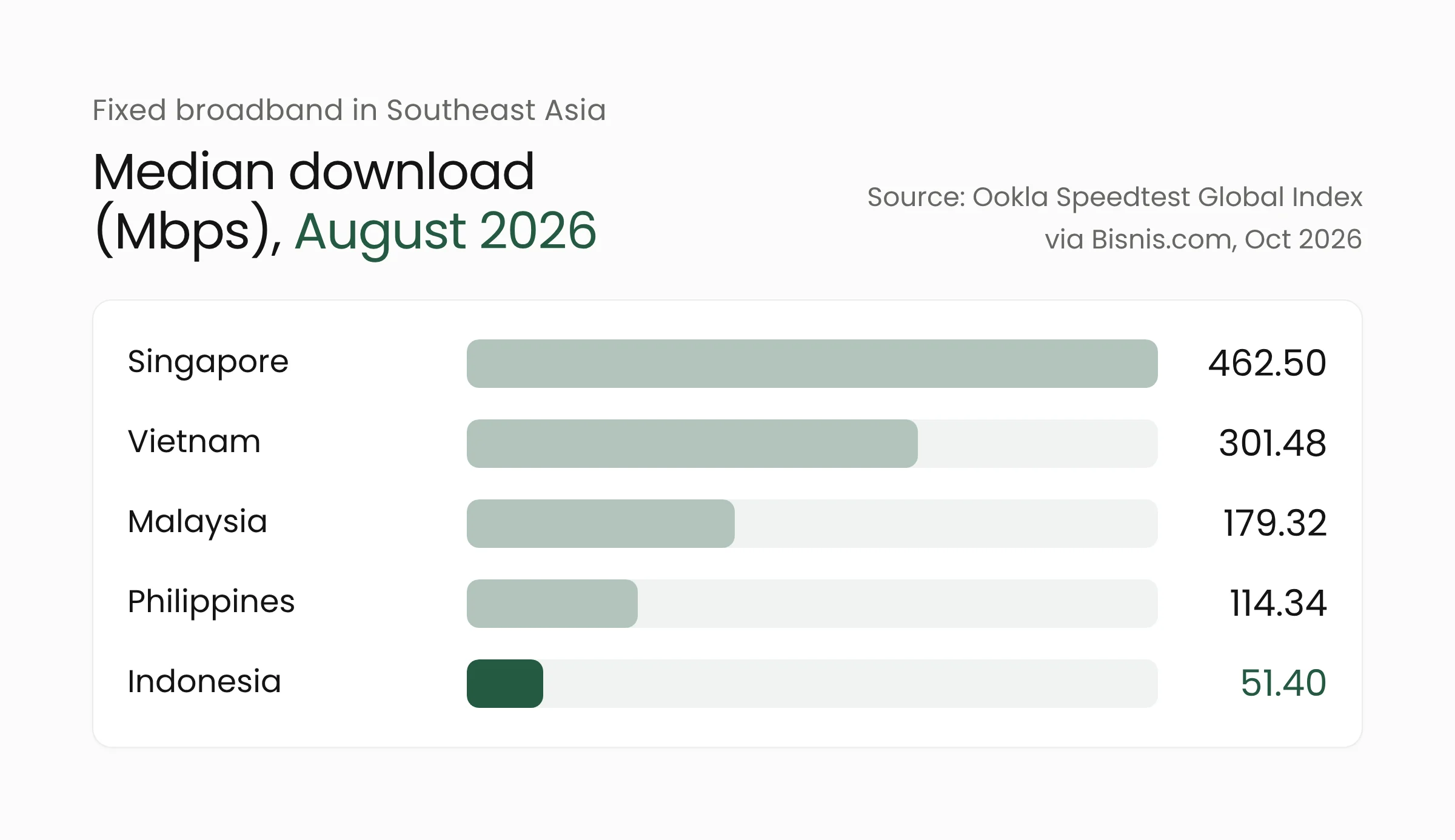
Mobile internet was faster in the same month, with a median download of 66.34 Mbps and a global rank of 70. The fixed broadband median is also roughly half the 100 Mbps goal for 2029.
On overall access, the 2026 survey by the Indonesian Internet Service Providers Association (APJII) counted 235.26 million internet users, or 81.7 percent of the population, Investortrust reported. Regional gaps remain. Penetration reached 85.95 percent on Java, against 69.74 percent in Maluku and Papua.
Fixed broadband figures also vary with the method. Komdigi measures households (about 21 percent), while APJII’s 2025 survey found 28.43 percent of people use fixed internet at home, as cited by detikInet. Both numbers point the same way: most Indonesians still rely on mobile data.
Two routes to affordable home internet
The government is pursuing two tracks at once. The first is fiber to the home, which underpins the Rp140,000 target. The second is Internet Rakyat (People’s Internet), a wireless fixed broadband service that is already running.
According to a Katadata infographic published on October 14, 2026, Internet Rakyat uses 5G Fixed Wireless Access (FWA) on the 1.4 GHz band. Customers install a router that receives a radio signal, so no cable has to be run to the house. The service offers up to 100 Mbps for Rp100,000 a month.
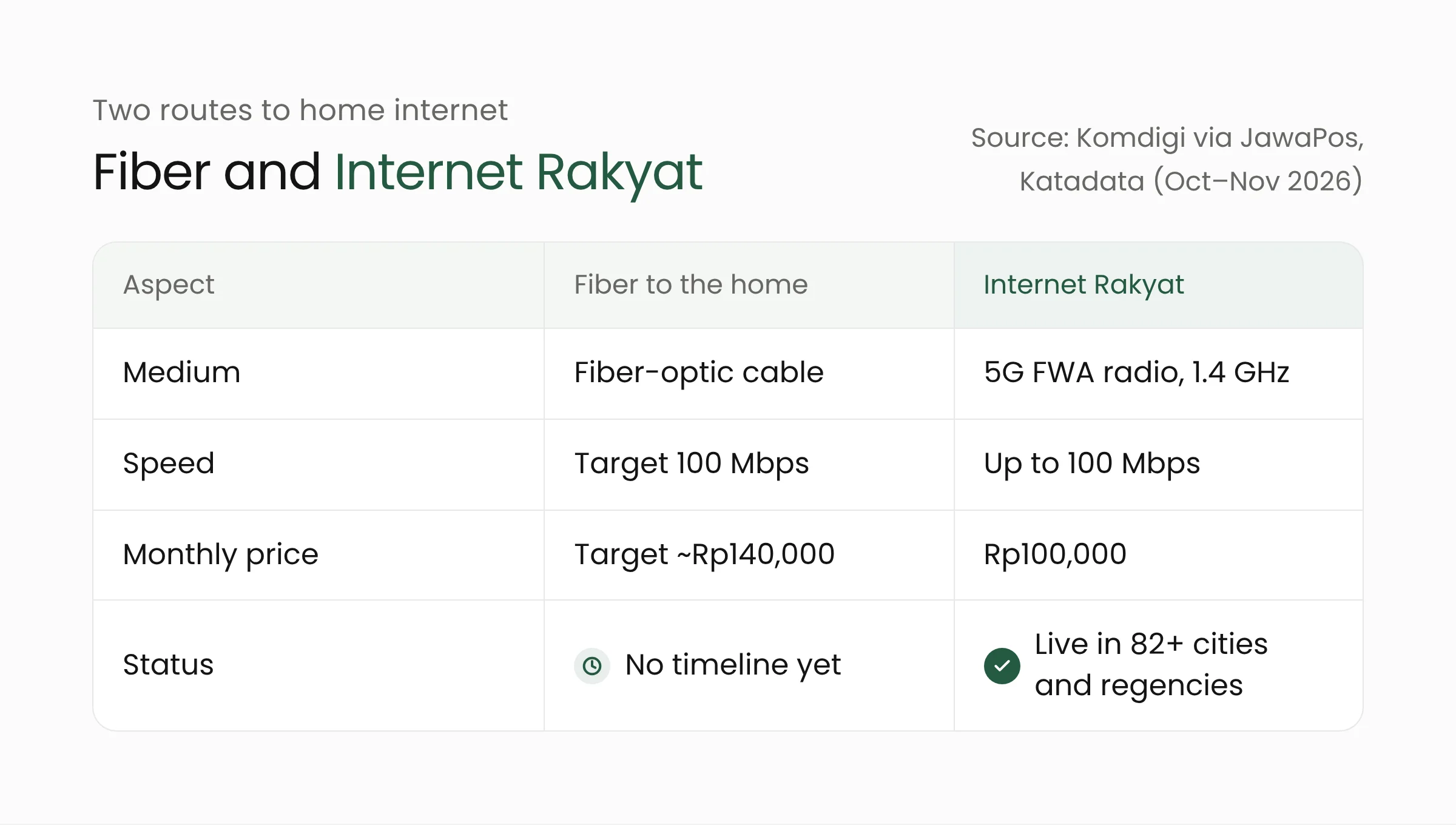
As of May 26, 2026, Internet Rakyat ran on more than 550 active sites and 3,189 radio units across more than 82 cities and regencies in Java, Maluku, and Papua. Komdigi is also preparing a 1.4 GHz spectrum policy for fixed internet services. The government aims to cut the ratio of internet prices to per capita income from about 4.8 percent in 2026 to 1.4 percent by 2029.
Each route has trade-offs. Fiber is generally more stable for heavy use, but it takes time and money to lay. Radio networks such as FWA are quicker to deploy, though quality depends on the distance to the transmitter and how many users share an area.
Details still to be announced
The Rp140,000 figure is not yet a product anyone can buy. CNA Indonesia noted that the government has not said when the price will be reached, which operators will offer it, or how prices will be set. Funding for the fiber expansion and incentives for operators have not been detailed either.
Decisions that depend on this price, such as a school’s connectivity budget or a student internet subsidy, are better made once the implementing rules are published.
What this means for schools and online learning providers
If the target is met, more homes will have enough bandwidth for video lessons, live classes, and computer-based exams. For the next few years, though, students in the same class will keep working on very different connections. Some will have fixed broadband, some will depend on mobile data, and some will still lack reliable access at home.
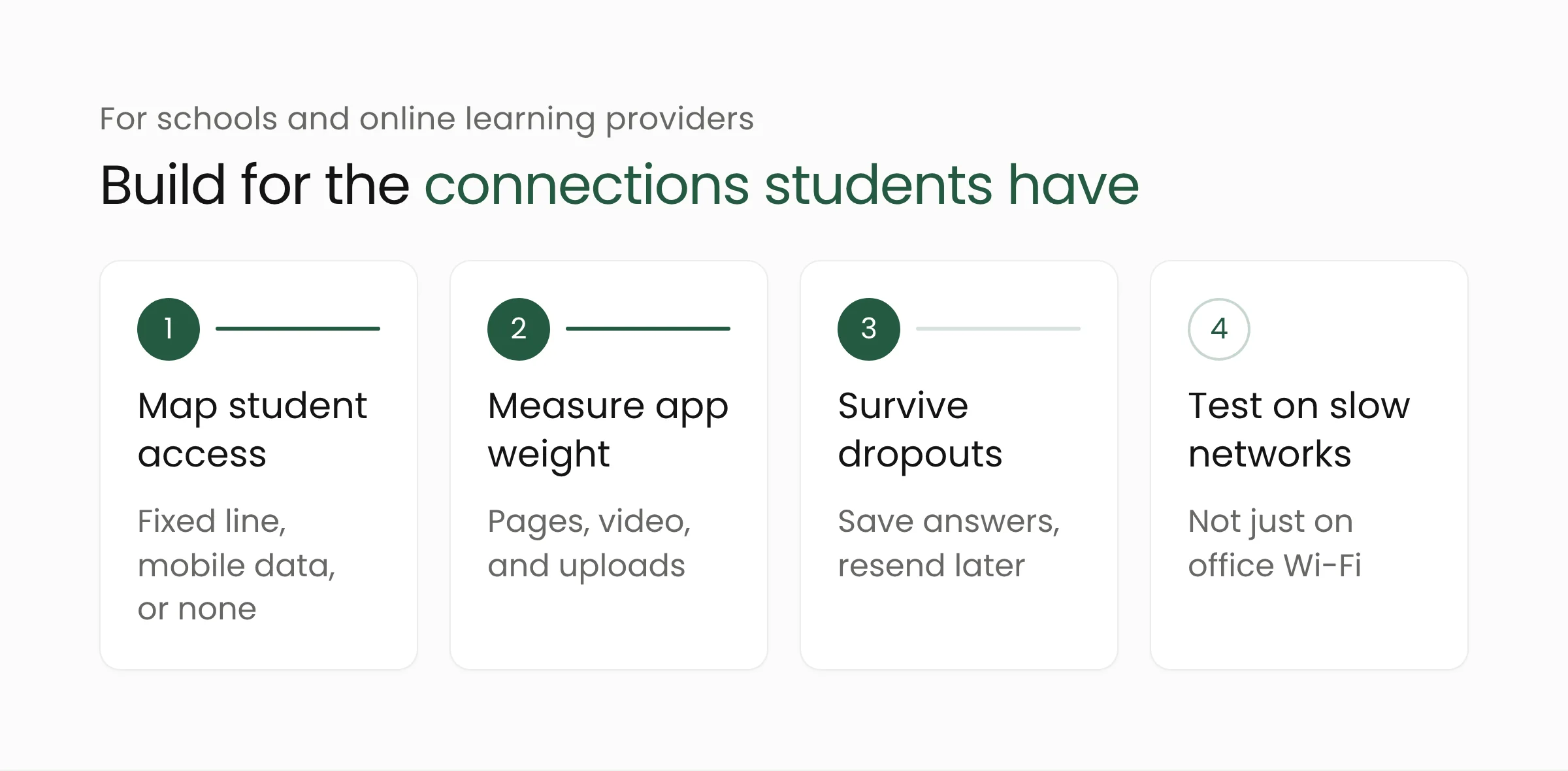
There are practical steps to take now.
- Map student access. A short survey can show whether students use fixed broadband, mobile data, or have no home access. That helps schools decide which assignments are reasonable to set as homework.
- Measure app weight. Work out how much data one learning session uses, including video and assignment uploads. Offer lower video quality options and materials that can be downloaded in advance.
- Design for dropped connections. In computer-based exams, answers should be saved on the device and resent once the connection returns. This matters for online exam platforms such as Merakit Exam.
- Test on slow networks. Try the app at speeds close to what students actually get, rather than only on a fast office network.
For providers, schools, or education offices building learning platforms, the experience on slow networks should be treated as a core requirement from the design stage. This is also a focus of Merakit’s education technology solutions.
Classroom hardware needs attention too. Schools receiving interactive digital boards, for example, need a stable school connection to use online content during lessons.
Frequently asked questions
Is 100 Mbps home internet for Rp140,000 available now?
Not as an official program. Rp140,000 is a government target, and its timeline and operators have not been announced. The cheapest service already running is Internet Rakyat, which offers up to 100 Mbps for Rp100,000 a month in areas it covers.
How does Internet Rakyat differ from regular fixed broadband?
Fixed broadband usually runs over a cable, such as fiber, laid into the home. Internet Rakyat also counts as fixed broadband, but the signal travels by 5G radio on the 1.4 GHz band to a router in the house, so no cable is needed.
How fast is fixed broadband in Indonesia today?
According to Ookla’s Speedtest Global Index, Indonesia’s median fixed broadband download speed in August 2026 was 51.40 Mbps. The government’s average speed target for fixed broadband is 45 Mbps in 2026 and 100 Mbps by 2029.
Conclusion
The 100 Mbps for about Rp140,000 target gives home internet development a clear direction, even though the details are still pending. While the implementing rules are prepared, schools and online learning providers can start making their services work well on the networks students have today. If your team is building a learning or exam platform that needs to hold up on unstable connections, the Merakit team would be glad to talk it through.
Sources
- JawaPos: Komdigi Akan Hadirkan Internet 100 Mbps di Bawah Rp200 Ribu untuk Warga (October 31, 2026)
- Katadata: Komdigi Target Kecepatan Internet 100 Mbps Seharga Rp 140 Ribu per Bulan (November 2, 2026)
- CNA Indonesia: Internet Rumah 100 Mbps Rp140 Ribu, Ini Rencana Komdigi (November 2, 2026)
- Bisnis.com: Komdigi Targetkan Penetrasi Fixed Broadband Naik dari 21% menjadi 50% pada 2029 (October 1, 2025)
- Bisnis.com: Target Komdigi 2026, Rerata Kecepatan Seluler 60 Mbps, Fixed Broadband 45 Mbps (January 5, 2026)
- Bisnis.com: Peringkat Kecepatan Internet RI Merangkak di Global Agustus 2026 (October 14, 2026)
- Katadata: Internet Rakyat, Akses Digital untuk Belajar, Bekerja, dan Berusaha (October 14, 2026)
- Investortrust: APJII, Pengguna Internet Indonesia Tembus 235 Juta (May 22, 2026)
- detikInet: Pasar Fixed Broadband Baru 21%, Industri Kebut Jaringan Fiber Nasional (November 7, 2025)