Blog Higher Education
SAPA Diktisaintek Puts 48 Higher Education Services Online
On this page· 7 sections
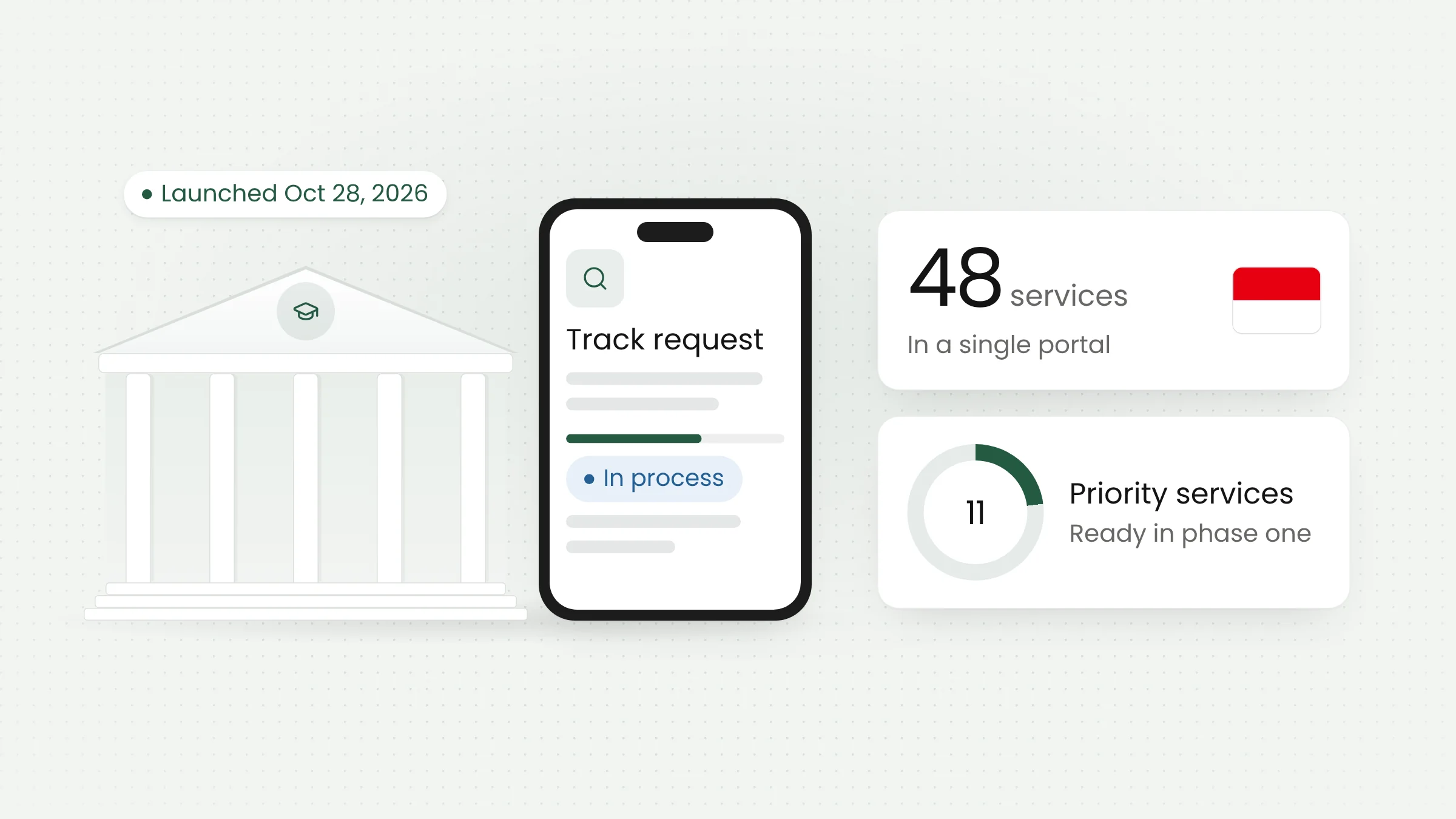
Indonesia’s Ministry of Higher Education, Science and Technology (Kemdiktisaintek) launched SAPA Diktisaintek on October 28, 2026. The portal gathers 48 ministry services behind a single entry point. Eleven priority services are available in the first phase, and every request can be tracked online.
The launch and the 48 services
Minister Brian Yuliarto launched the portal online on Wednesday, October 28, 2026, according to the ministry’s official release. Universitas Nusa Cendana (Undana) reported that the event ran on Zoom and was streamed on the ministry’s official YouTube channel under the slogan “Melayani Lebih Mudah, Berdampak Lebih Nyata” (roughly, “easier service, more tangible impact”).
SAPA stands for Sistem Akses Pelayanan yang Adaptif, or Adaptive Service Access System. The ministry and the national news agency ANTARA use that name, while Undana drops the word “yang”. Undana also gives the portal’s address as sapa.kemdiktisaintek.go.id.
The portal covers 48 services grouped into six segments. Secretary General Badri Munir Sukoco said the services were mapped together with the ministry’s Bureau of Organization and Human Resources and its Center for Data and Information Technology. Of the 48, 11 priority services are ready in the first phase. The ministry has not announced when the remaining services will be added.
Undana sorted the priority services into three groups. For universities, they include Siera for Recognition of Prior Learning (RPL), permits for degree-granting academic partnerships, management of master accounts for PDDikti (the national higher education database), and requests for PDDikti data. For lecturers and education staff, they include lecturer certification (Serdos), the academic rank competency assessment (JAD), talent pool management, and study leave permits (E-Tubel). For the general public, the portal offers foreign diploma equivalency (PILN).
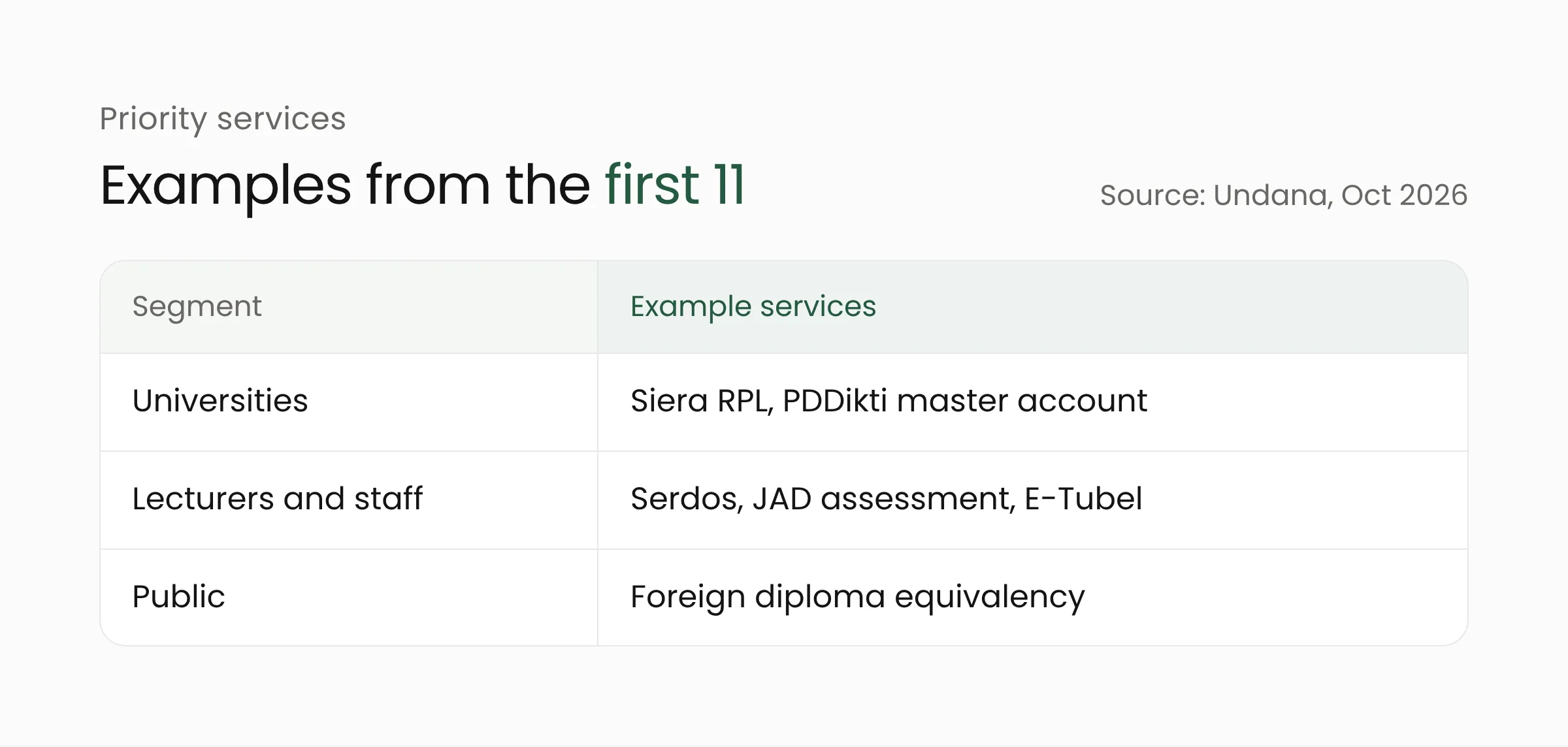
Several of these services cover paperwork that has long taken time. RPL lets universities recognize earlier study or work experience as equivalent to formal learning outcomes. PILN matters for graduates of foreign universities who need their degrees recognized in Indonesia to apply for jobs or continue their studies. Serdos and JAD affect a lecturer’s career path directly.
A catalog, time standards and request tracking
According to the ministry, users can see the service standard, requirements, process stages and responsible unit before they submit a request. That matters because applicants often do not know which office handles their case or which documents to prepare.
During a demonstration at the launch, Deddy Novrandianto of the ministry’s data and information team showed an interactive service catalog, filters by user group, service descriptions and processing time standards, Undana reported. Each submitted request receives a request number, which users can enter to see where their paperwork stands.
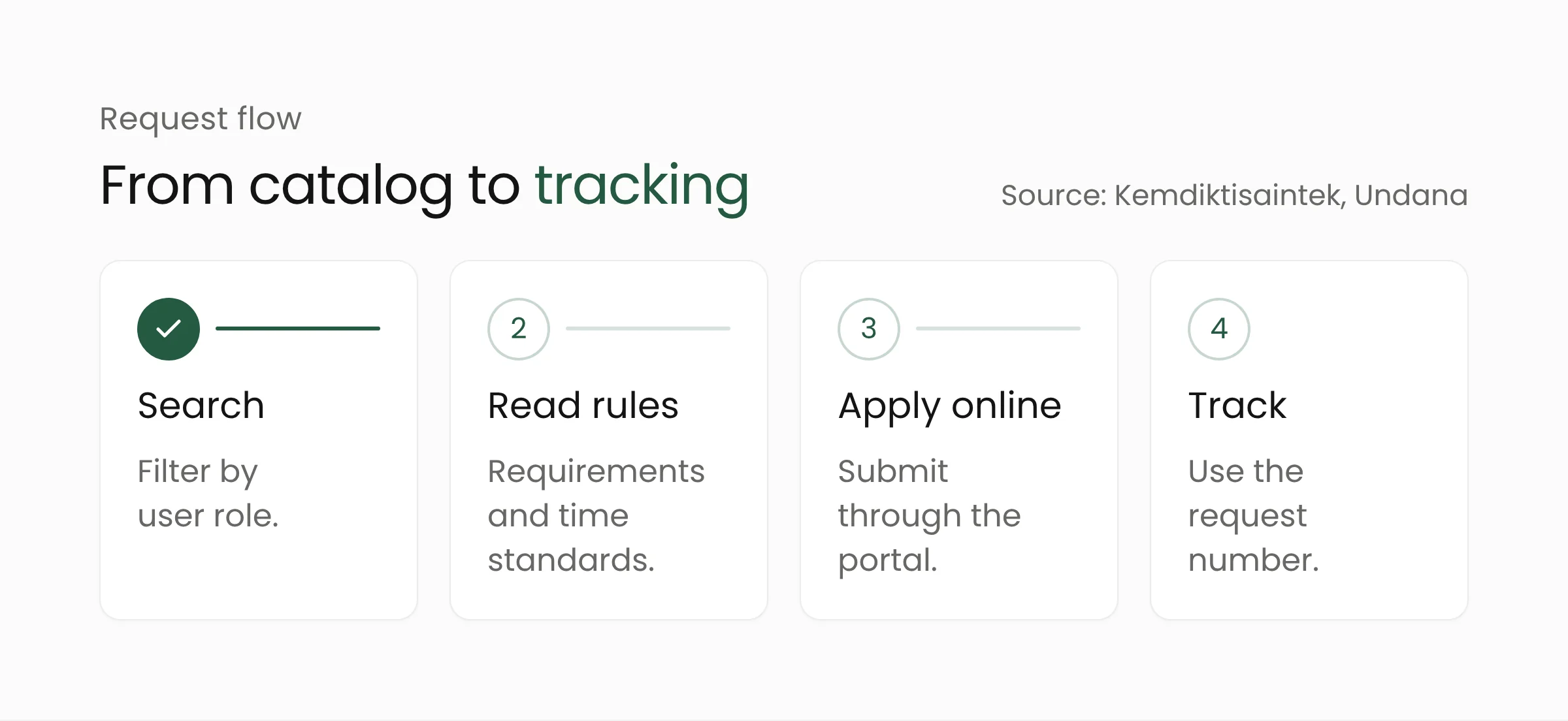
The approach is familiar from parcel tracking or online business licensing. Applicants no longer need to call or visit an office simply to ask about a file. For staff, requests logged under unique numbers make workloads and delays easier to monitor.
The launch materials did not list a time standard for each service. The ministry said the portal will be developed in stages, including clearer procedure information, firmer service timelines, help and complaint channels, and stronger security and personal data protection.
PDDikti data and online-first service
Brian Yuliarto set out three goals: simpler access, more transparent processes, and service that is more responsive and trustworthy. He also pointed to lecturers who still have to visit service offices in person.
“Kalau masih ada dosen kita, tenaga pendidik kita yang mengurus sesuatu harus datang ke lokasi, berarti layanan kita belum baik,” Brian said in the ministry’s release. In English, the remark means that if lecturers and educators still have to show up in person to get something done, the ministry’s service is not yet good enough.
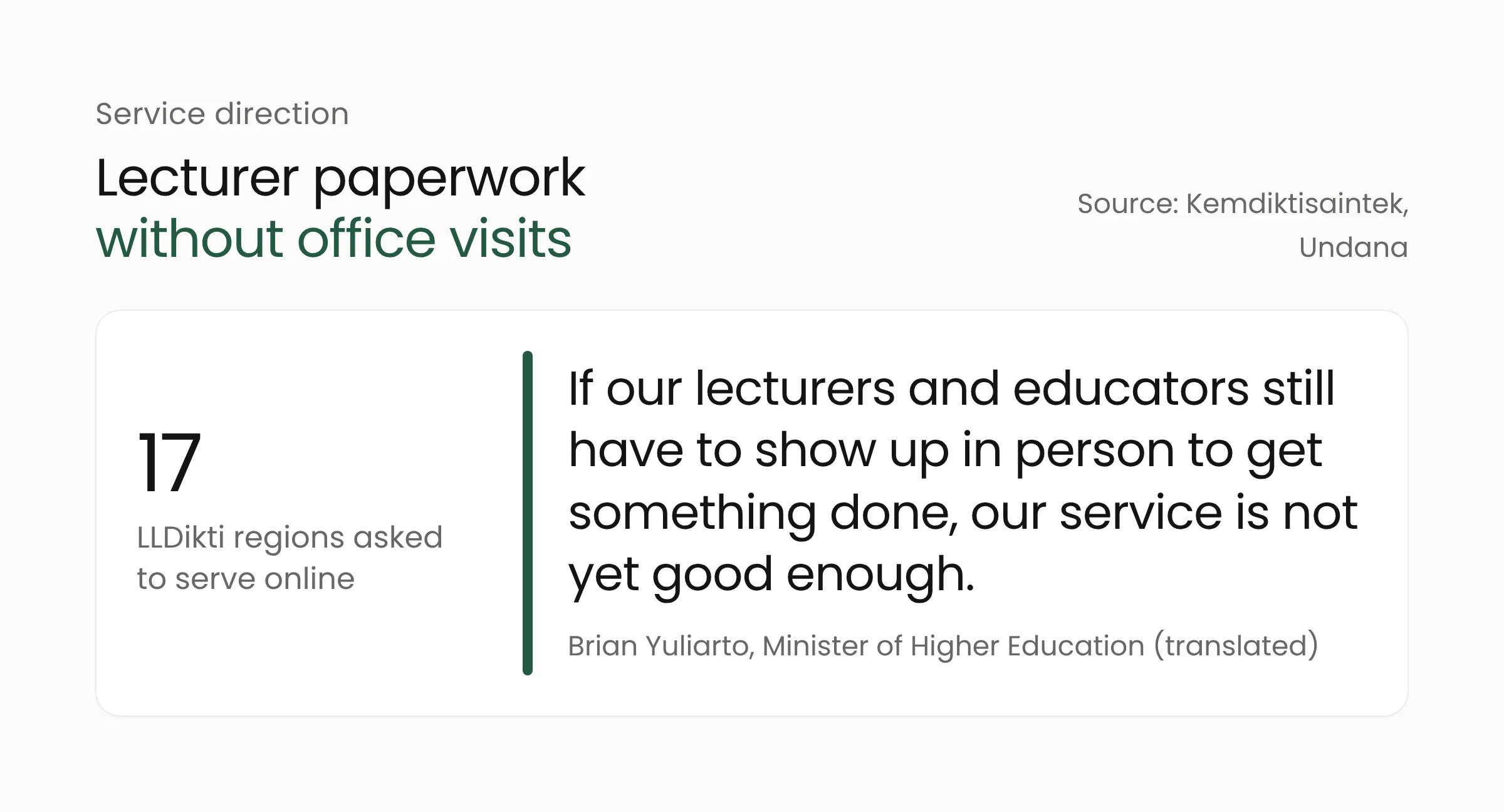
Reports differ in how strongly they describe the instruction to the regional higher education service offices (LLDikti). The ministry’s release says the minister encouraged LLDikti to improve online services. Undana wrote that the minister instructed the ministry and LLDikti Regions I through XVII to move fully online, and that requiring people to appear at service offices is now prohibited.
The most consequential technical change is data integration. The ministry said users should no longer have to resubmit documents whose data already sits in government systems, including PDDikti. That integration, it added, must follow existing rules and protect security and personal data. Brian also stressed that simpler service does not mean lower requirements.
The idea fits a wider government push. Indonesia’s communications ministry is reorganizing thousands of agency apps so they can exchange data without asking citizens for the same details again, as we covered in our report on government apps connected through SPLP. SAPA Diktisaintek applies a similar principle to higher education, with PDDikti as its main data source.
As a result, the quality of PDDikti records matters more than before. If data on lecturers, study programs or students is out of date, processes that rely on it may stall or require extra checks. Universities with clean records will see the benefits of integration sooner.
What this means for universities and lecturers
A single portal moves part of the work from service counters into software. Universities and lecturers can take several steps now.
- Check PDDikti records. Because the ministry wants fewer repeat uploads, existing records will be used more often. Make sure lecturer data, academic ranks and study program details match the latest documents.
- Assign a PDDikti master account owner. Master account management is one of the priority services. Name a clear owner, document handovers when staff change, and limit access to authorized people.
- Keep documents in clean digital form. Diplomas, appointment letters, certificates and assignment letters should be stored as legible scans with consistent file names, ready to upload when needed.
- Log request numbers and time standards. Staffing offices can keep a simple register of service type, submission date, request number and status. It helps follow up on files that run past their time standard.
- Send feedback through official channels. The ministry has asked users to submit feedback and complaints to guide improvements. Specific reports, such as an unclear process stage, are easier to act on.
For academic and staffing offices, the launch is also a useful model for internal services. Students and lecturers file many requests at the campus level, from enrollment letters and academic leave to promotion applications. The same pattern applies: a service catalog listing requirements and time standards, online forms, and request numbers that can be tracked. Systems like this can be built through web application development connected to a university’s academic data.
Merakit supports education institutions through its education technology solutions, including service portal design and data integration. For higher education, we are also preparing Merakit Campus, a product for managing academics, finance and student administration.
Frequently asked questions
Who can use SAPA Diktisaintek?
According to the ministry, the portal serves the public and the academic community, including universities, lecturers and education staff. Members of the public can use services such as foreign diploma equivalency.
Are all 48 services available yet?
No. Only the 11 priority services are available in the first phase. The ministry said the portal will be developed in stages, but it has not announced a schedule for adding the rest.
How can I check the status of a request?
Each request receives a request number. Users can enter that number in the tracking feature to see where their file is in the process.
Closing thoughts
SAPA Diktisaintek gives lecturers, universities and the public one place to check requirements, submit requests and follow their progress. Its value will depend on how quickly the remaining services arrive and how well PDDikti data is connected. If your university wants to bring the same approach to its internal services, the Merakit team is ready to talk.
Sources
- Kemdiktisaintek: Integrasikan Layanan, Kemdiktisaintek Hadirkan Sapa Diktisaintek (October 28, 2026)
- Universitas Nusa Cendana: Pangkas Birokrasi, Kemdiktisaintek Resmi Luncurkan Portal SAPA Diktisaintek (October 28, 2026)
- BatamToday: SAPA Diktisaintek Diluncurkan, 48 Layanan Pendidikan Tinggi Terintegrasi (October 29, 2026)
- ANTARA: Integrasi layanan, Kemdiktisaintek resmikan layanan SAPA Diktisaintek (October 30, 2026)