Blog Digital Government
Komdigi to Connect Thousands of Government Apps via SPLP
On this page· 8 sections
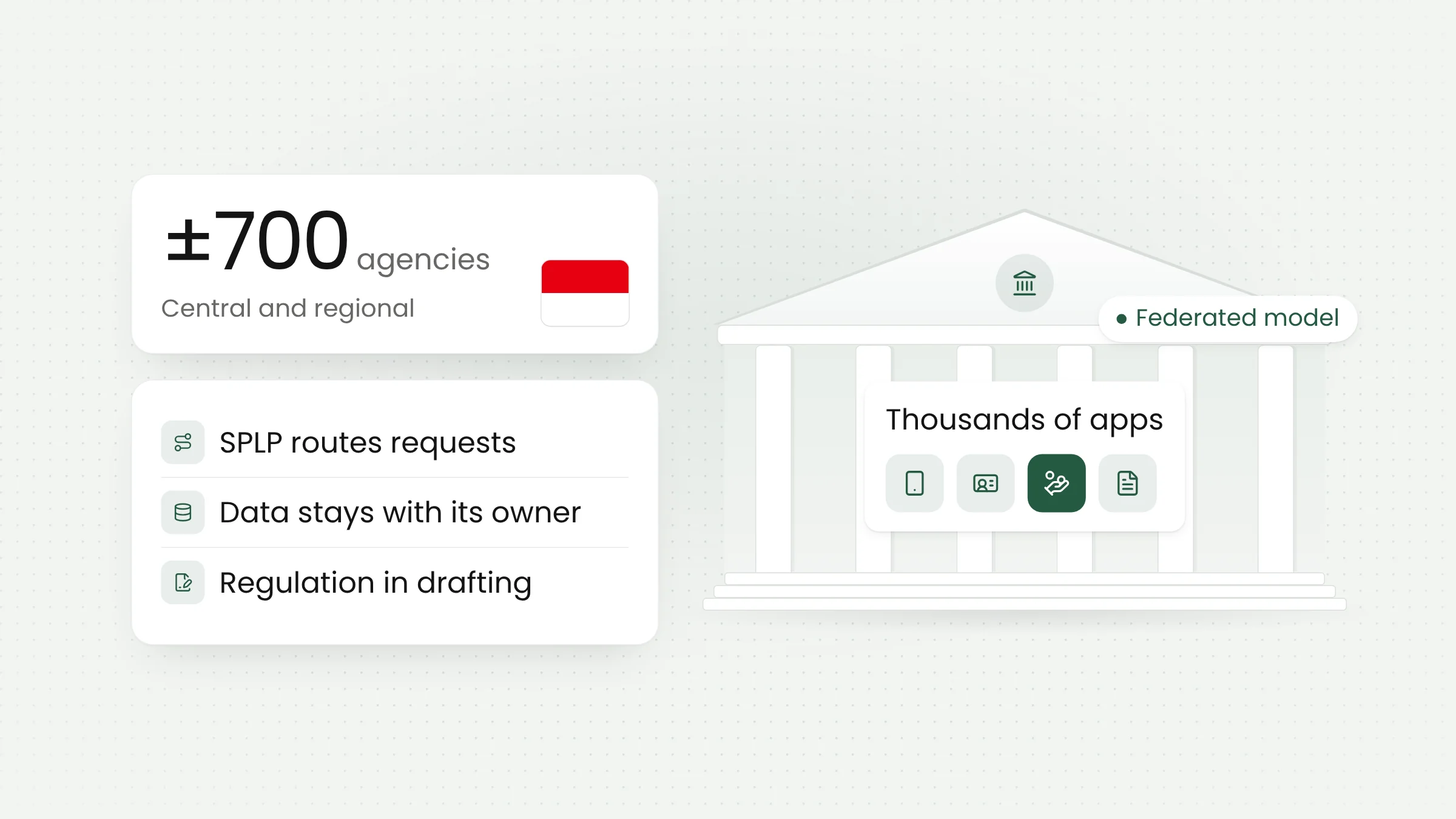
Indonesia’s Ministry of Communication and Digital Affairs (Komdigi) is reorganizing thousands of public service apps run by about 700 central and regional government agencies. The apps will not be merged into one. Komdigi has chosen a federated model: each agency keeps running its own services, while data moves between agencies through the Government Service Connection System (Sistem Penghubung Layanan Pemerintah, SPLP).
The plan announced on October 29, 2026
The plan was outlined by Yessi Arnaz Ferari, Komdigi’s Director of Digital Government Applications, at a “Ngopi Bareng Komdigi” media event in Jakarta on Thursday, October 29, 2026. According to Liputan6, she said there are around 700 government agencies with different infrastructure, budgets, and staffing, and that their apps number in the thousands. Investortrust put the number of agencies at more than 700.
In Yessi’s view, the problem with government digitization lies in systems built sector by sector. Many agencies build their own apps because data sharing between institutions has not worked well. As a result, citizens have to enter the same population data again and again each time they use a different service.
The reorganization relies on several instruments. Investortrust reported that Komdigi is preparing a national Digital Government Architecture as a reference for ministries, agencies, and regional governments, while a Presidential Regulation on Digital Government is still being drafted. The effort is also aligned with the One Indonesia Data policy and with digital public infrastructure (DPI), with SPLP serving as the data exchange layer.
The federated model and the role of SPLP
Under the federated model, each agency remains the owner of its business processes and the custodian of its service data. The Ministry of Social Affairs keeps running social assistance programs, the civil registry (Dukcapil) keeps managing population records, and regional governments keep operating their own services. The change is in how data travels from one agency to another.
Komdigi describes SPLP as a toll road for data. An agency that needs information sends a request through SPLP, which forwards it to the agency that holds the authority over that data. According to Warta Ekonomi, SPLP does not store any data. The data stays with each ministry or agency, which can grant access to others when it is needed for verification.
“SPLP tidak mengambil alih seluruh data milik kementerian dan lembaga,” Yessi said, as quoted by Liputan6. In English: SPLP does not take over all the data owned by ministries and agencies.
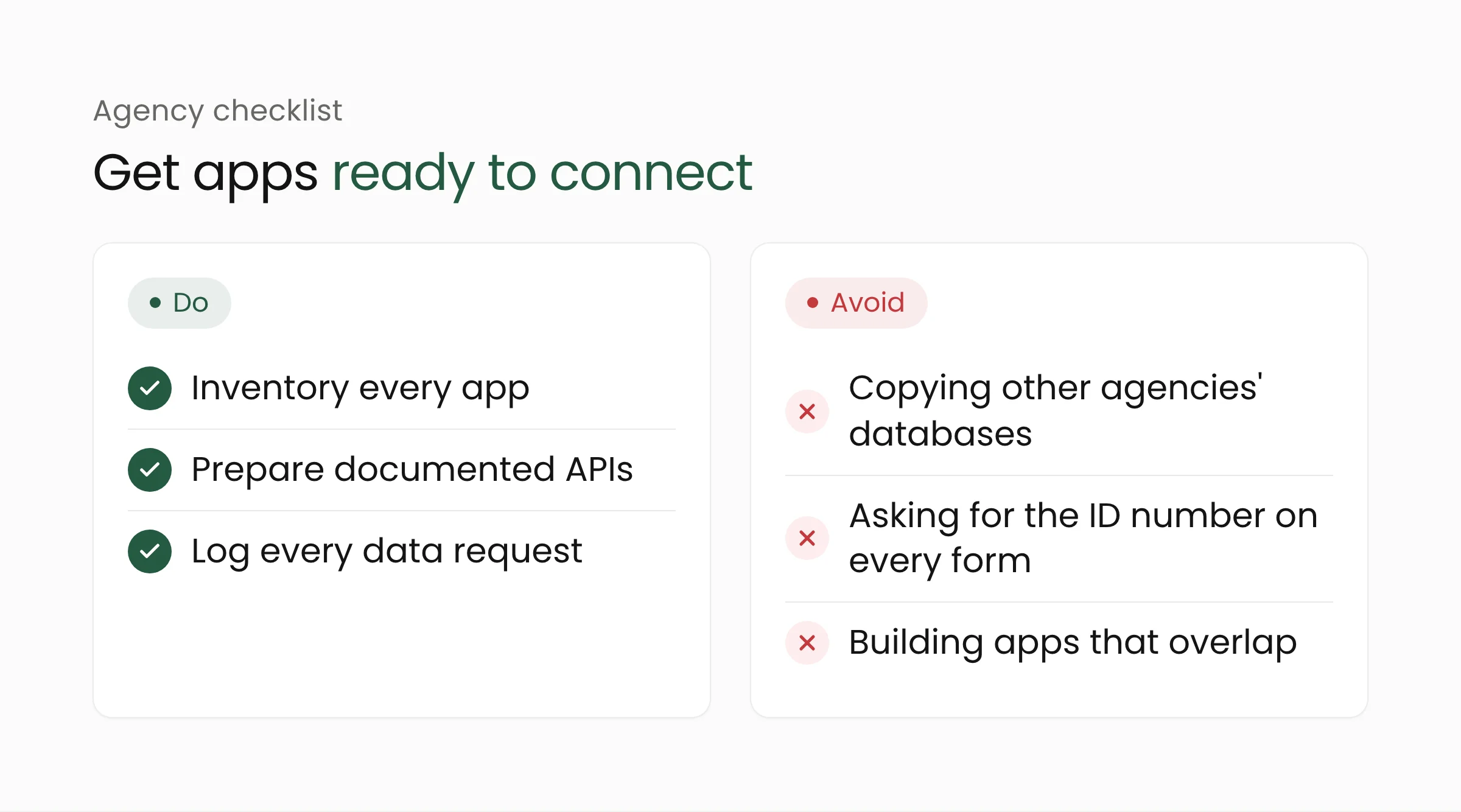
For software teams, the model resembles an API-based architecture. Each system stands on its own but exposes a documented interface so that other systems can request data securely. The benefit is that an agency no longer needs to copy another agency’s database just to check a single piece of information.
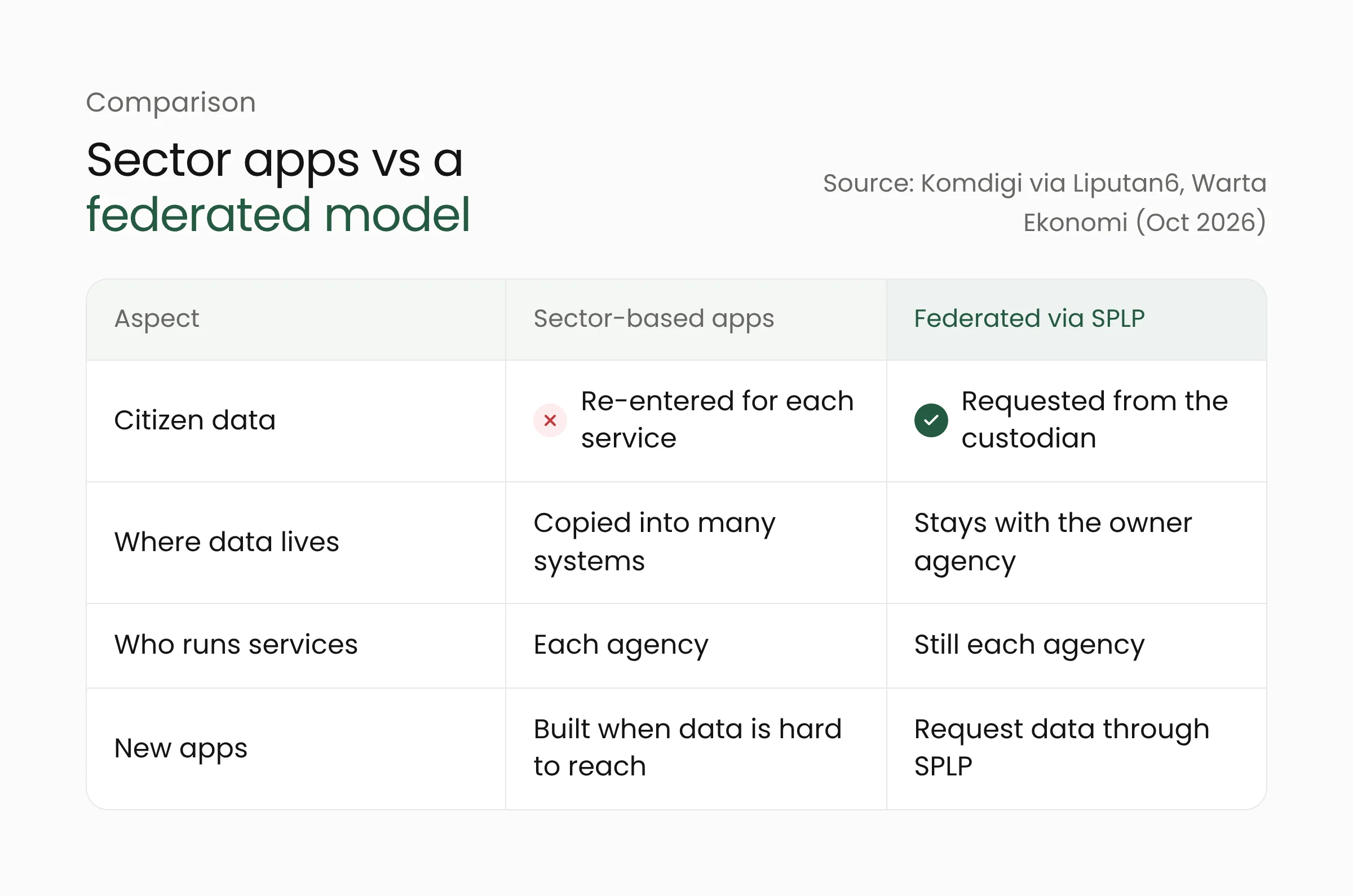
Komdigi has promoted this idea since the One Indonesia Data bill was under discussion. In a Komdigi press release in June 2026, Deputy Minister Nezar Patria explained the “once only” principle: data that citizens have already given to the state should be reusable by other agencies through a secure mechanism. He also named three supporting pieces of infrastructure: SPLP for data exchange, the National Data Center (PDN) for storage, and the Government Intranet (JIP) as a dedicated network for agencies.
A working example from social assistance registration
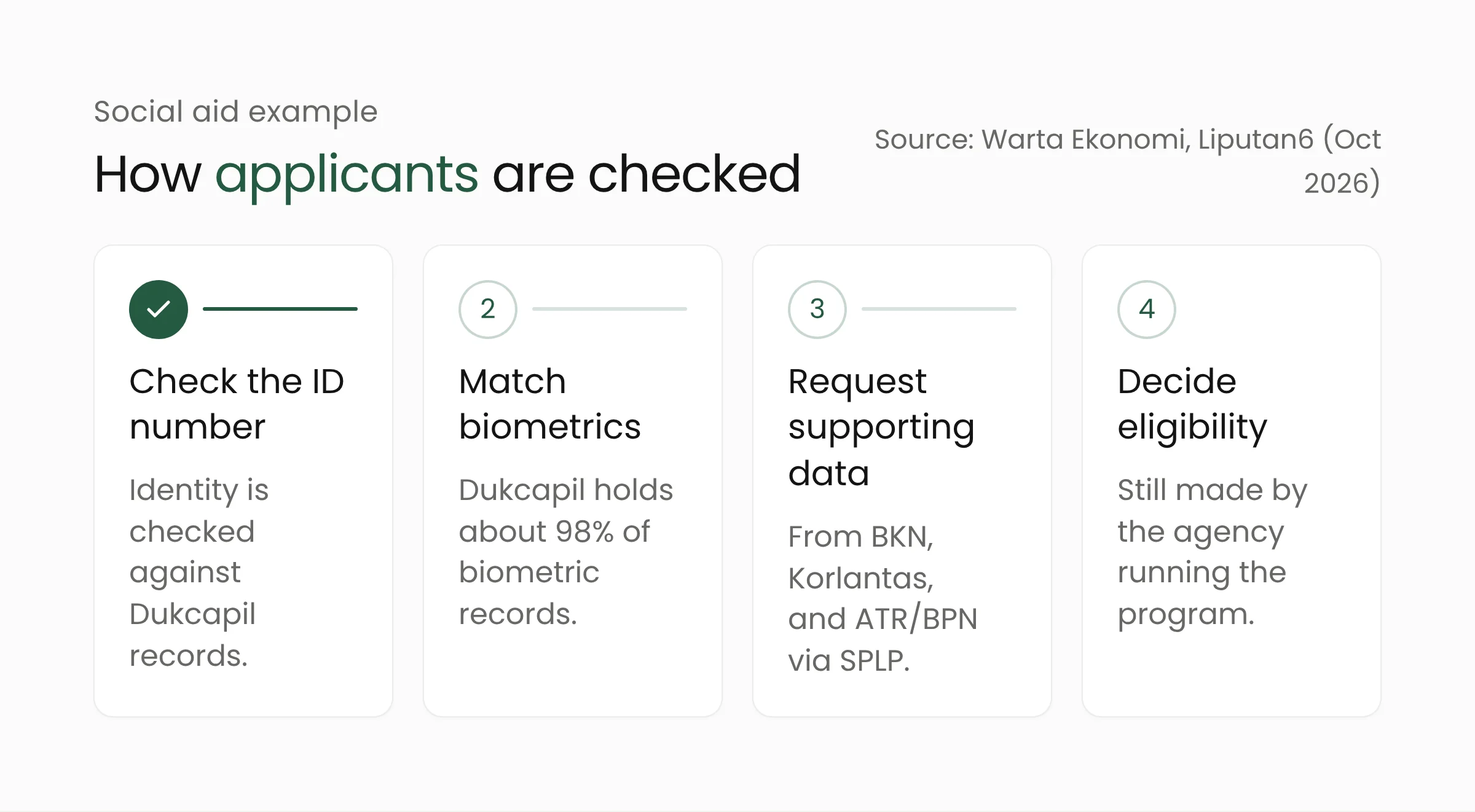
The digital social protection program (Perlinsos Digital) is the example Komdigi cites most often. According to Warta Ekonomi, applicants are first checked against their national identity number (NIK) and then matched through biometric verification. Yessi said Dukcapil already holds biometric records for roughly 98 percent of Indonesian citizens.
Once identity is confirmed, the system requests supporting data from other agencies to assess eligibility. These include the National Civil Service Agency (BKN), the National Police Traffic Corps (Korlantas Polri), and the Ministry of Agrarian Affairs and Spatial Planning/National Land Agency (ATR/BPN). Liputan6 noted that the decision on whether someone qualifies for assistance stays with the agency that runs the program.
The pilot is already running at scale. Bisnis.com reported on September 30, 2026, that SPLP had processed more than 19.8 million transactions in the Perlinsos Digital pilot, covering about 5.4 million households, based on data as of September 28, 2026. Communication and Digital Affairs Minister Meutya Hafid said SPLP capacity would be expanded ahead of the wider rollout. Synchronous and asynchronous exchange mechanisms will also be aligned so that data can be shared in near real time, including bulk transfers to many agencies at once.
We covered the face verification step of this program in our article on digital social aid and face verification. The app reorganization announced this week extends the same pattern to other public services.
How it connects to the One Indonesia Data Law
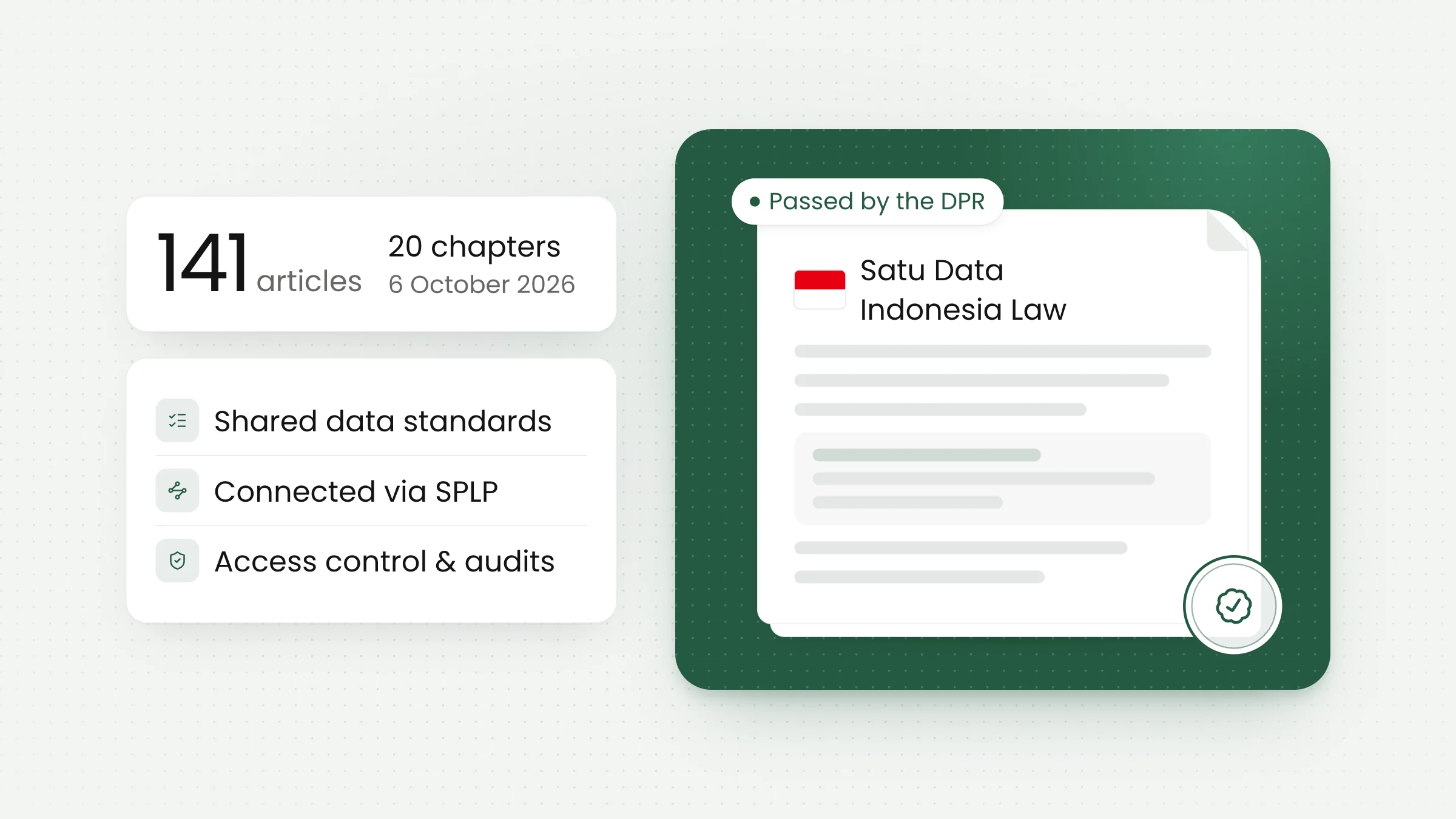
Indonesia’s House of Representatives (DPR) passed the Undang-Undang Satu Data Indonesia (One Indonesia Data Law) at a plenary session on October 6, 2026, as reported by CNN Indonesia. The law covers national basic data, data governance, and the security and protection of government data. We summarized its main points in our piece on the One Indonesia Data Law and what it means for agencies.
Komdigi’s app reorganization can be read as the technical side of that law. The law provides the legal basis for data governance, while SPLP and the Digital Government Architecture supply the exchange layer and the technical reference. The details agencies care about most, such as interface standards, adjustment deadlines, and what happens to overlapping apps, will likely become clear only after the Presidential Regulation on Digital Government is issued. At the time of writing, no date for that regulation had been announced.
What this means for local agencies and government software vendors
The federated model lets agencies keep the systems they already run. Those systems, however, need work before they can connect. Five things can be prepared now.
- Take inventory of your apps. List every app the agency runs, what data each one stores, who uses it, and whether another app already does the same job. This list becomes the starting point when agencies are asked to align with the national architecture.
- Define the data you are responsible for. In a federated model, each agency is the custodian of certain data. Make sure that data is clean, kept up to date, and has a clear owner, because other agencies will depend on it.
- Prepare data interfaces (APIs). An app that can only be reached through its web screens will be hard to connect. Plan documented APIs with authentication and a log of every data request.
- Cut repeated form filling. Review service forms that ask for an identity number, address, or other population data. If that data can be requested from the custodian agency, the form can be shortened.
- Strengthen security and audit trails. Exchanging data across agencies raises the impact of a breach in any single system. Apply access controls, encryption, and logs that can be audited.
For vendors, this direction changes how government software projects should be designed. New apps should be built on the assumption that they will connect to SPLP, for example by separating the data layer from the user interface and using consistent data formats. Our web development services and digital government solutions help agencies prepare for this kind of integration, from mapping existing apps to designing APIs.
Frequently asked questions
Will all government apps be replaced by a single app?
No. Komdigi says the reorganization follows a federated approach. Each agency keeps managing its own services and processes, while data exchange runs through SPLP. Apps with overlapping functions may still be reviewed, but no details have been announced.
Does SPLP collect citizens’ data in one place?
According to Komdigi, SPLP does not store data. It only forwards data requests from the agency that needs the information to the agency that owns it, and the data stays with its custodian.
When will the technical rules take effect?
The Presidential Regulation on Digital Government is still being drafted, and no release date has been announced. Agencies can start with an app inventory and API preparation while they wait.
Closing thoughts
Connecting thousands of government apps through SPLP promises simpler public services, mainly because citizens would no longer have to enter the same data repeatedly. The outcome depends on how ready each agency is: clean data, clear interfaces, and solid security. If your agency is mapping its apps or planning data integration, the Merakit team is happy to talk.
Sources
- Liputan6: Bukan Satukan Semua Aplikasi, Komdigi Siapkan “Jalan Tol” Data Pemerintah (October 29, 2026)
- Investortrust: Kemenkomdigi Tata Ribuan Aplikasi Pelayanan Publik (October 29, 2026)
- Warta Ekonomi: Komdigi Siapkan SPLP untuk Integrasikan Ribuan Aplikasi Pemerintah (October 29, 2026)
- Bisnis.com: SPLP Komdigi Proses 19,8 Juta Transaksi Perlinsos Digital (September 30, 2026)
- CNN Indonesia: Paripurna DPR Sahkan UU Satu Data Indonesia (October 6, 2026)
- InfoPublik (Komdigi press release): Wamen Nezar Patria, Warga Tak Boleh Lagi Jadi Kurir Data Antar Instansi (June 9, 2026)