Blog AI Agents
Self-Hosted Claude Managed Agents: What It Means for Banks
On this page· 7 sections
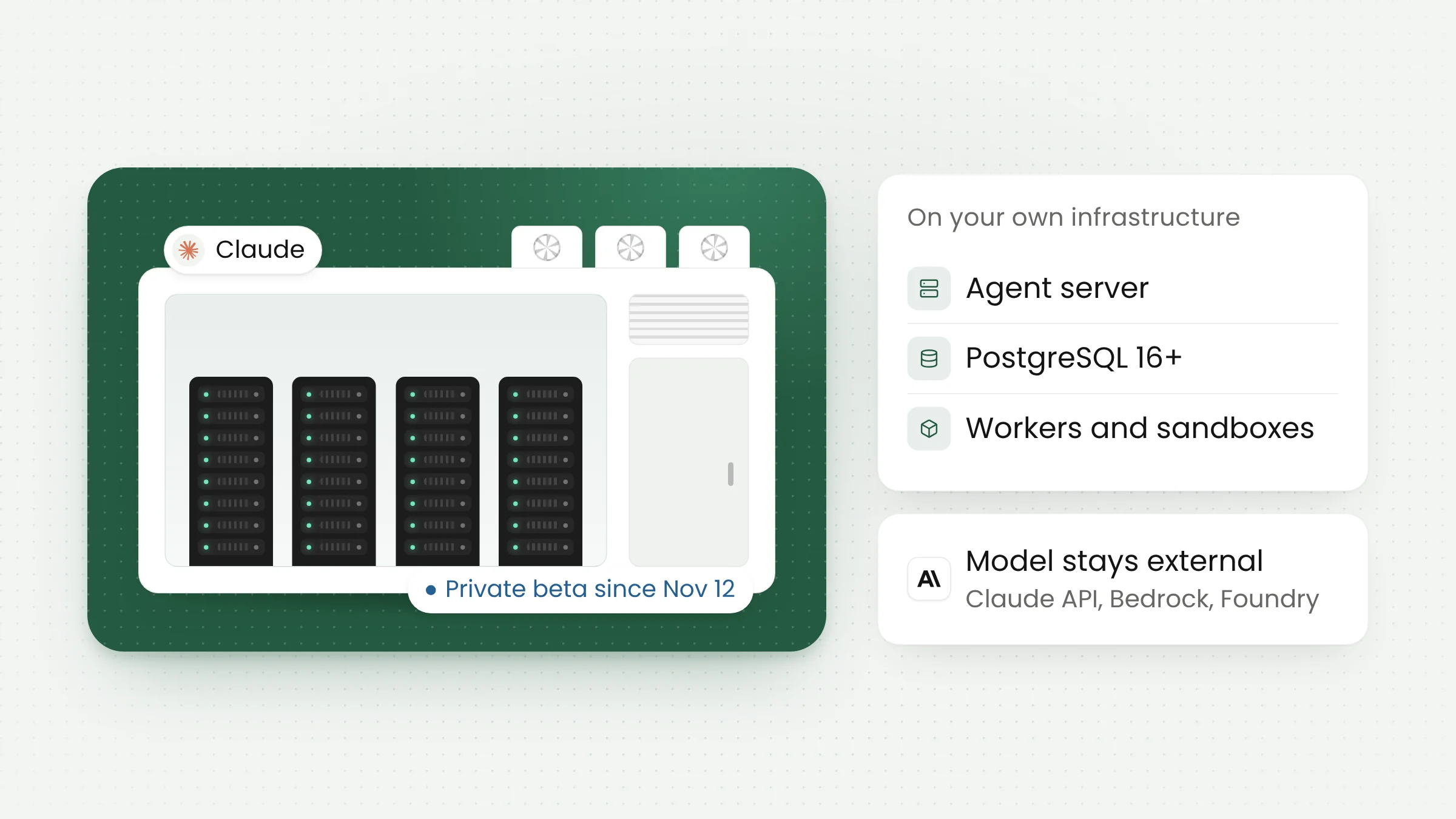
Anthropic released self-hosted Claude Managed Agents as a private beta on November 12, 2026. Companies can now run Claude’s agent service in their own cloud account or data center, including the agent server, database, credentials and session history. The model itself is still called from outside the company network.
What Anthropic released
Claude Managed Agents is Anthropic’s service for running Claude as an autonomous agent. Developers define an agent, start a session, and the agent works with the tools it is given, such as running terminal commands, editing files or calling other systems. Until now, Anthropic operated that service.
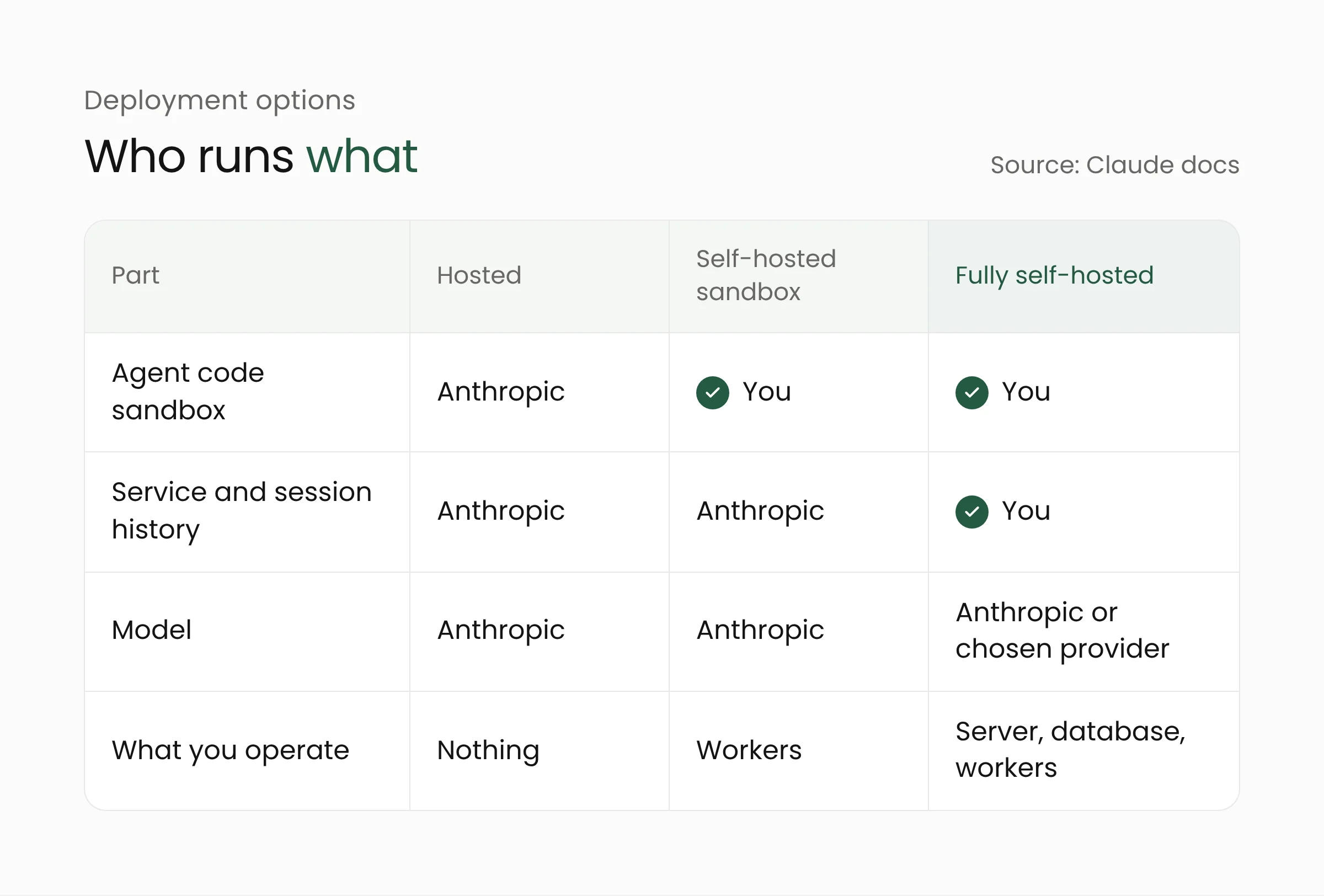
According to Anthropic’s announcement, there are now three ways to deploy it. In the first, Anthropic runs everything. In the second, the customer hosts only the sandbox, the isolated workspace where the agent’s code runs. The new third option moves the entire service onto customer infrastructure.
Access to the third option is limited. Companies must request it through their Anthropic account team, and pricing has not been announced. Help Net Security noted that the release targets agents that work unattended inside corporate systems, fixing broken builds, testing releases, triaging alerts and working through bug backlogs.
What runs on your own infrastructure
The self-hosted Managed Agents documentation lists three main components. A server called cma-server serves the API, runs the agent loop and stores agents and session history. The database is PostgreSQL 16 or later. Without a database, the server keeps its data in memory, and a restart erases it.
The third component is the worker, a program that takes jobs from the server and runs the agent’s shell and file tools inside a sandbox. The server never runs an agent’s commands itself. Anthropic also ships a web console at the server’s address, where staff sign in through the company’s identity provider to create agents and run sessions.
The server exposes the same API as Anthropic’s hosted service, so the Claude SDK and the ant CLI work with it. Nothing carries over from the hosted service, however. Agents, skills, credentials and memory stores have to be created again, and old session history is not copied.
The model is still called from outside
Self-hosting does not put the model on company servers. Each time the agent needs the model, the server sends the conversation so far, including tool inputs and results, to the chosen inference provider. The options are Anthropic’s Claude API (the default), Amazon Bedrock, Google Cloud, Microsoft Foundry or a company-run model gateway.
Organizations with a zero data retention (ZDR) agreement with Anthropic get the same treatment for these requests to Claude. Two things therefore need to be kept apart: agent storage, which can now sit inside the company, and conversation content, which still leaves every time the model is called.
Four security principles and the limits
Anthropic describes four principles that apply to all three options. First, the part that calls Claude is separated from the sandbox where code runs, and a sandbox starts only when a tool needs it. Second, credentials stay out of the sandbox. For MCP tools and supported API calls, a proxy outside the sandbox attaches the credential to the request. “Vaults are designed to keep credentials out of the sandbox,” Anthropic wrote in its announcement.
Third, network access for each environment can be limited to an allowlist of hosts, and requests to any other host are blocked. Fourth, every agent step, including tool calls and their results, is logged and can be exported through OpenTelemetry to existing monitoring tools.
The self-hosted version has gaps. According to the page on differences from the hosted service, the server sends no webhooks, scheduled deployments are unavailable, and the prebuilt docx, pdf, pptx and xlsx skills cannot be used. Web search and web fetch stay off until enabled in the server settings, and MCP servers and Git hosts must be added to an allowlist first.
Operational duties shift as well. The documentation says customers must secure the server, host memory stores, detect unusual usage and install every release themselves. The agent’s bash tool is a real shell with the worker process’s permissions, so Anthropic advises running workers in disposable containers or VMs.
Why this matters for Indonesian banks
Banks in Indonesia are bound by OJK Regulation No. 11/POJK.03/2022, Penyelenggaraan Teknologi Informasi oleh Bank Umum (on IT management by commercial banks). Article 35 requires banks to place electronic systems in a data center and disaster recovery center within Indonesia. Placement abroad is possible for certain criteria with approval from the Financial Services Authority (OJK).
An agent service hosted entirely by an outside provider keeps session history, logs and credentials on that provider’s infrastructure. For a bank IT team, session history can contain fragments of operational data, such as incident tickets or command output from internal servers. The self-hosted option lets all of that stay in the bank’s data center or in a cloud account the bank chooses.
Model calls still send conversation content to the inference provider. Banks need to work out with their compliance teams which data may appear in agent conversations and in which region the provider processes it. Self-hosting reduces what leaves the network, but that assessment is still required.
Our earlier piece on ChatGPT Wallet and AI agents that pay looked at agents that deal with customers. Anthropic’s release sits closer to internal work: agents that support IT, risk or operations teams inside the bank’s own network.
What this means for banks and fintechs
For banks and fintech companies starting to test AI agents, the release adds a new architecture option. These are the points IT, security and compliance teams can settle before requesting access.
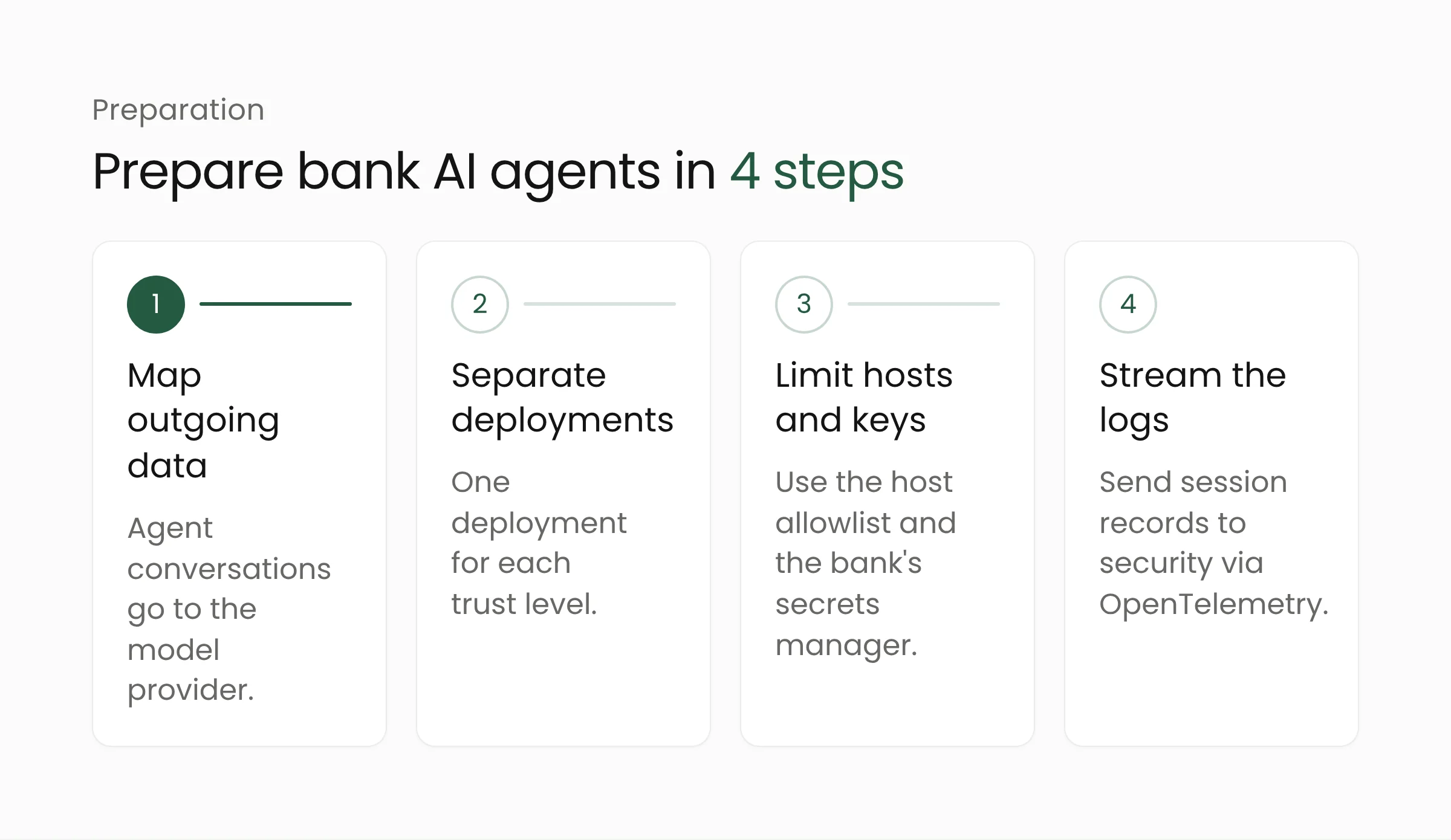
- Map the data that leaves. Decide what information may enter an agent conversation, since that content goes to the model provider. Customer data is best masked or left out entirely in early trials.
- Separate deployments by trust level. Anthropic’s documentation says each trust level needs its own deployment. Agents for developers and agents that touch production should not share a server, database or keys.
- Limit hosts and credentials. Use the host allowlist and the bank’s own secrets manager. An agent that fixes builds only needs the code repository and the package registry.
- Send logs to the security team. Export session records through OpenTelemetry into the monitoring stack already in use, so every agent action can be audited.
Running costs matter too. Teams have to operate the server, PostgreSQL and workers and apply every release. For organizations without a platform team, starting with a self-hosted sandbox can be a middle step. Merakit helps design this kind of architecture through its artificial intelligence services and financial services solutions, including workload placement on cloud computing.
Frequently asked questions
Does the Claude model run on company servers?
No. Self-hosted Managed Agents moves the agent service, database, workers and credentials onto customer infrastructure. The model is still called through the Claude API or another chosen provider, such as Amazon Bedrock, Google Cloud, Microsoft Foundry or a company gateway.
How do companies get access?
The option is in private beta. Companies need to contact their Anthropic account team to request access and the software download. Anthropic has not announced pricing for the self-hosted version.
Can agents and session history move over from the hosted service?
Not automatically. Anthropic’s documentation states that nothing is copied from the hosted service, session history included. Agents, skills, credentials and memory stores must be recreated on the company’s own server.
Conclusion
Self-hosted Claude Managed Agents gives companies more control over where AI agents keep their data and credentials. For Indonesian banks, the option fits the requirement to place electronic systems in the country, as long as the data flowing to the model provider is mapped carefully. If your team is weighing an AI agent architecture that meets regulatory requirements, Merakit Indonesia is ready to talk.
Sources
- Operate Claude Managed Agents inside your security perimeter, Anthropic, November 12, 2026
- Self-hosted Claude Managed Agents, Claude Platform Docs, accessed November 15, 2026
- Differences from the hosted service, Claude Platform Docs, accessed November 15, 2026
- Self-hosted Claude Managed Agents keeps agent credentials in your environment, Help Net Security, November 12, 2026
- Self-Hosted Claude Managed Agents Enter Private Beta, VKTR, November 12, 2026
- OJK Regulation No. 11/POJK.03/2022, Article 35, Pasal.id, accessed November 15, 2026