Blog Cybersecurity
Java4Shell CVE-2026-114938: Which Java Versions Are Safe
On this page· 7 sections
Java4Shell (CVE-2026-114938) is a flaw in the OpenJDK Base64 decoder that lets an unauthenticated attacker corrupt memory on a Java server and potentially run code remotely. Oracle and OpenJDK shipped fixes on November 17, 2026. Java 17, 21, 25, and 27 need updating, especially on x86-64 servers with AVX-512.
A bug in HotSpot’s Base64 fast path
Base64 turns binary data into text so it can travel over networks. It shows up everywhere: authentication tokens, file uploads, and messages between services. Nearly every Java application calls the built-in Base64 decoder, often without its developers noticing.
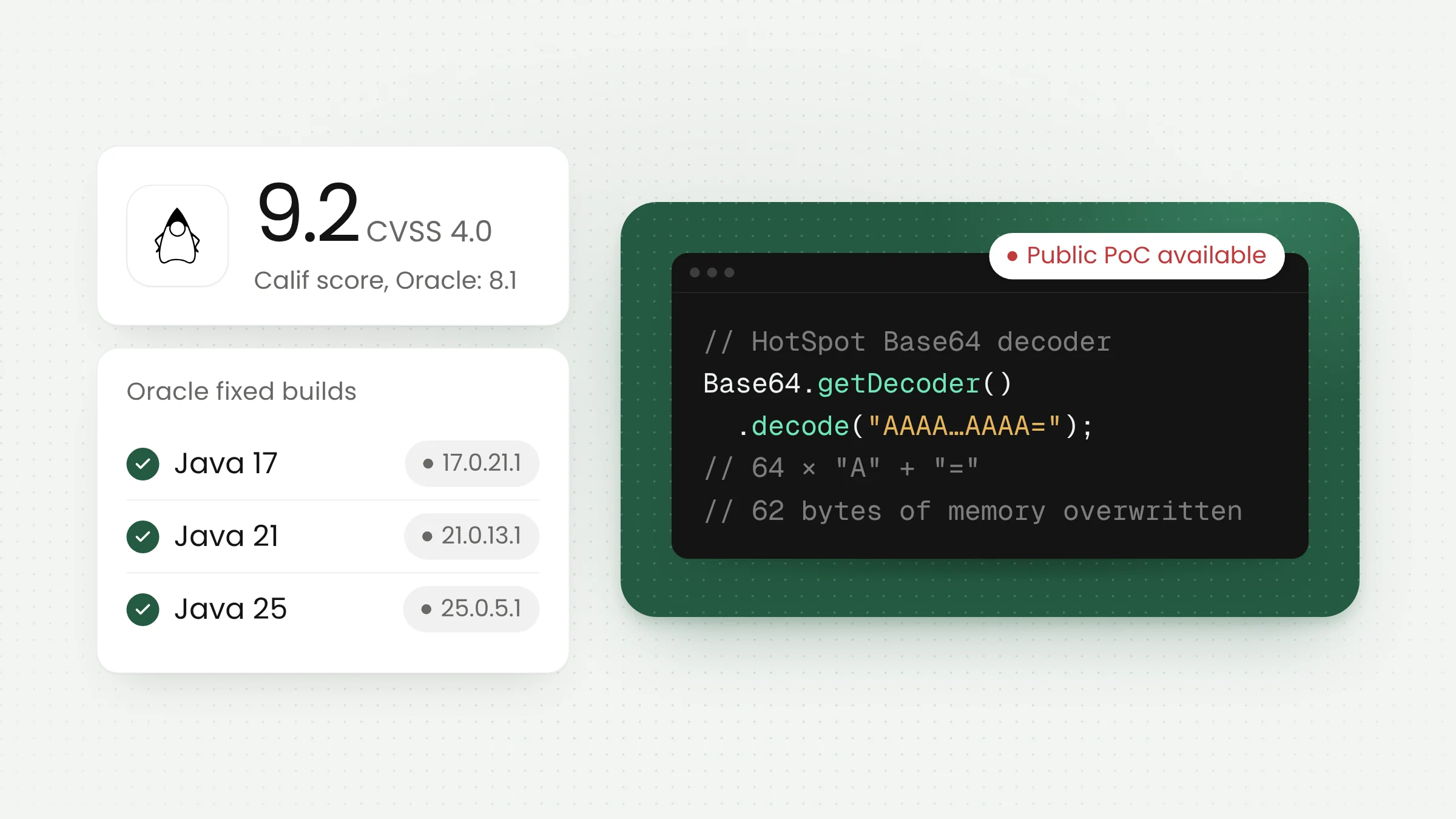
To speed that work up, the HotSpot virtual machine in OpenJDK uses a set of x86-64 instructions called AVX-512 VBMI, which process many bytes at once. According to the technical write-up from Calif, the security research firm that found the flaw, the bug sits in hand-written assembly that handles the last few characters of the input. Sixty-four “A” characters followed by a single ”=” make the routine miscalculate the output length and write 62 bytes past the end of the destination array.
Java does reject the malformed input, but too late. Neighboring objects in memory have already been overwritten. With careful memory grooming, Calif says the corruption can leak sensitive memory in the style of the 2014 Heartbleed bug, or lead to code execution on the server.
Products the researchers tested
Calif reports unauthenticated code execution against default configurations of Keycloak, Atlassian Jira, Atlassian Confluence, JFrog Artifactory, Jenkins, and PingFederate. Against Apache Kafka, Apache Solr, Elasticsearch, Gerrit, and Spinnaker, the attack required a logged-in account. Calif also demonstrated exploitation of sample applications built on Apache Struts and Spring Boot, plus a client-side scenario in which a Java program is compromised after opening a TLS connection to a malicious server.
Calif stresses that these lists are incomplete. Ordinary features such as authentication and file uploads can route attacker input to the vulnerable decoder, so in-house Java applications deserve the same scrutiny.
Affected Java versions and fixed builds
The OpenJDK advisory of November 17, 2026 lists CVE-2026-114938 in the hotspot/compiler component for the Java 17, 21, 25, and 27 release lines. Standard Java 8 and Java 11 are not listed. Calif adds that OpenJDK 17 is affected from version 17.0.6 onward.
On the Oracle side, the November 2026 Critical Security Patch Update names Oracle Java SE 8u511b33-perf, 17.0.21.0.3, 21.0.13.0.3, 25.0.5.0.3, and 27.0.1.0.3 as affected, along with Oracle GraalVM for JDK 17.0.21.0.3 and 21.0.13.0.3 and GraalVM Enterprise Edition 21.3.20.0.3. According to Tenable’s FAQ, Oracle’s fixed builds are 17.0.21.1, 21.0.13.1, 25.0.5.1, 27.0.1.1, and 8u513-perf for the Java 8 Enterprise Performance Pack.
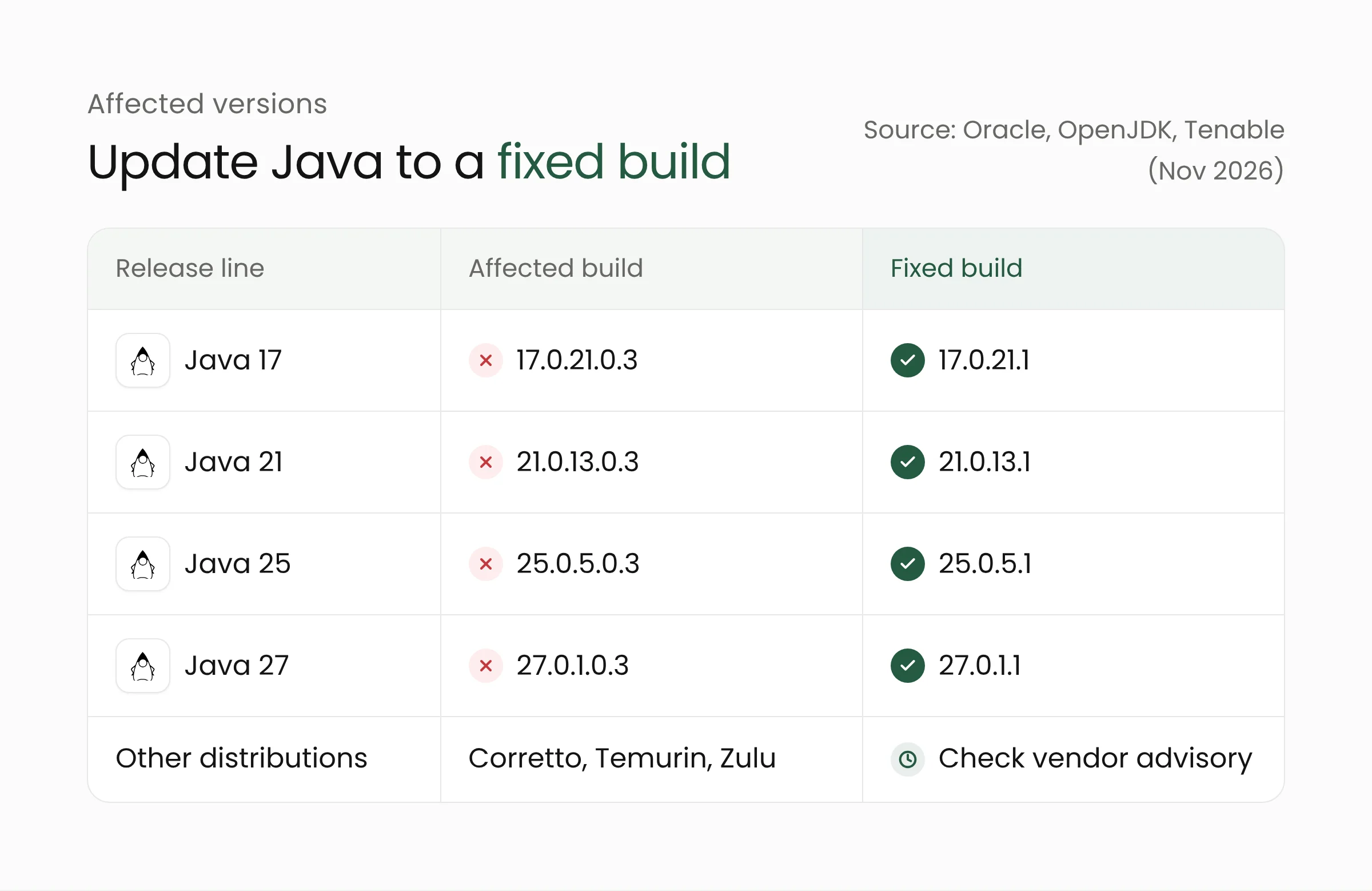
Because they are built from OpenJDK source, other distributions are affected too. Calif lists Amazon Corretto, Eclipse Temurin, Microsoft Build of OpenJDK, Azul Zulu, BellSoft Liberica, SAP SapMachine, Red Hat OpenJDK, Oracle OpenJDK, and Oracle GraalVM for JDK. Each vendor ships fixed builds on its own schedule, so match version numbers against your vendor’s advisory.
The processor requirement
The flaw only exists on x86-64 processors that support AVX-512 VBMI. Calif names Intel Xeon Ice Lake, Sapphire Rapids, Emerald Rapids, and Granite Rapids, as well as AMD EPYC and Ryzen chips based on Zen 4 or newer. ARM64 processors are not affected. That makes a processor check necessary on every host, including cloud virtual machines whose underlying CPU is chosen by the provider.
Exploitation status and two severity scores
Calif rates the flaw 9.2 out of 10 under CVSS 4.0, which is critical. Oracle gives it 8.1 under CVSS 3.1 and rates attack complexity as high. The gap comes from different scoring methods, and both agree the flaw can be exploited over the network without credentials.
As of November 17, 2026, Tenable was not aware of any exploitation in the wild, and CVE-2026-114938 was not in the CISA Known Exploited Vulnerabilities catalog. Calif has, however, published a proof of concept: a small Java program that only checks whether the decoder overwrites memory. On the product-specific attack chains, Calif wrote, “We are holding back the application-specific exploits for now.” The firm plans to release them once users have had a chance to upgrade.
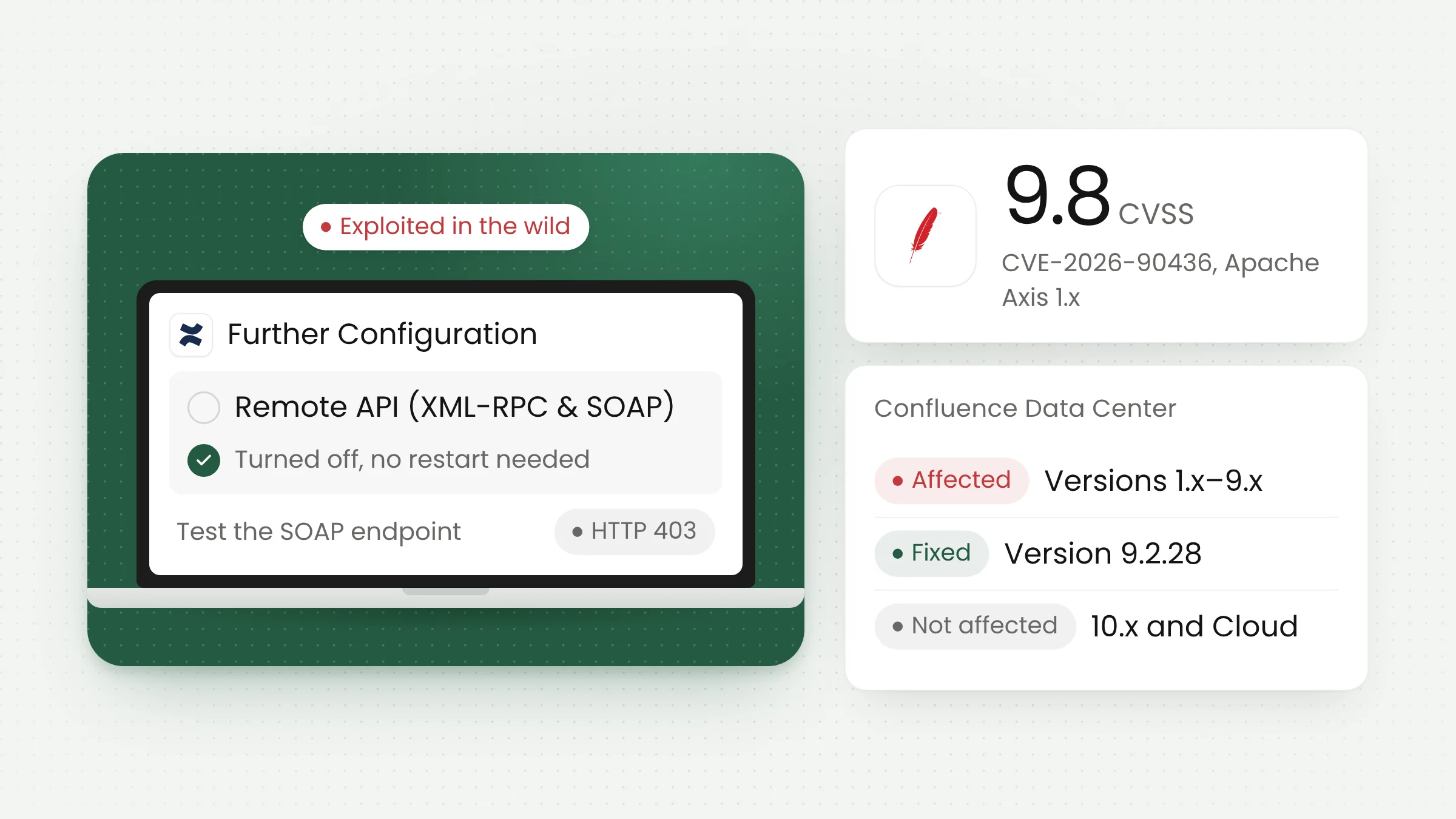
Calif also acknowledges there is no universal exploit, since each target needs its own tuning. At the same time, the firm says its researcher Quang Luong found the bug in one hour with the help of an AI tool and built the first working exploit in two more. The same team previously disclosed the PHP2Shell flaws in PHP. The recent Apache Axis flaw in Confluence, attacked about a week after disclosure, shows how short the window for patching can be.
What this means for your IT team
According to Calif, Java runs in nearly every critical sector, including banking and telecommunications. In Indonesian organizations, it can be found in core banking applications, public service systems at government agencies, university academic portals, and Keycloak-based single sign-on. A flaw in the runtime differs from a flaw in a single application: one server on a vulnerable Java build can expose every application running on top of it.
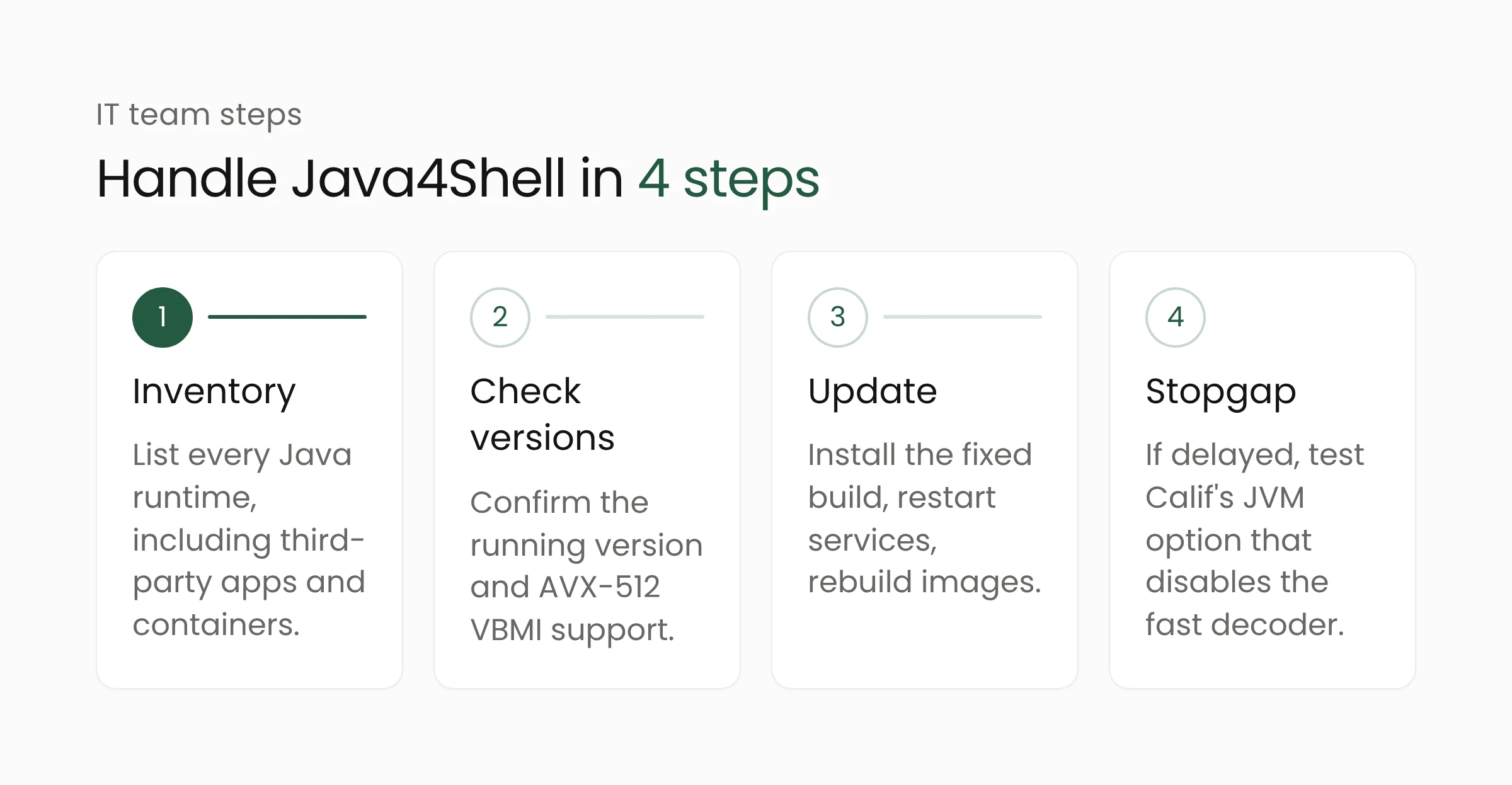
Inventory every Java runtime
List every place Java runs: application servers, CI servers such as Jenkins, single sign-on services, search engines such as Elasticsearch, and containers. Include third-party software and appliances that ship their own Java runtime. These bundled runtimes are often missed because the operating system’s package manager does not track them.
Check the version that is actually running
Confirm the version used by each running process. The server’s default Java installation may differ from the one an application actually uses. The command jcmd <pid> VM.version prints the runtime version of a Java process. To check the processor on Linux, Calif suggests the command below. If all four flags appear, the CPU meets the conditions for the flaw.
grep -m1 '^flags' /proc/cpuinfo | tr ' ' '\n' | grep -E '^(avx512f|avx512bw|avx512vbmi|bmi2)$'Update, restart, and rebuild images
Install the fixed build and restart every Java service, because a runtime update only takes effect once the process is relaunched. For containerized applications, rebuild images on a patched base image and redeploy them. Updating libraries inside an application does not replace a vulnerable runtime. Start with internet-facing servers, particularly those that accept tokens or file uploads from users.
Temporary mitigations if patching must wait
Calif lists two JVM startup options. -XX:-UseBASE64Intrinsics turns off the hardware-accelerated Base64 routines. -XX:UseAVX=2 disables AVX-512 entirely and may slow down other workloads. The second option should only be used on x86-64 hosts, because Java on ARM does not recognize it and will fail to start. Tenable notes that both mitigations come from Calif rather than Oracle or OpenJDK, so test them first and treat them as stopgaps.
Organizations without an asset inventory and a regular patch schedule can build one with a cybersecurity services partner, so the next flaw can be handled within hours.
Frequently asked questions
Are Java 8 and Java 11 safe from Java4Shell?
The OpenJDK advisory does not list standard Java 8 or Java 11 for CVE-2026-114938. The exception is the Oracle Java 8 Enterprise Performance Pack (8u511b33-perf), which is listed as affected. The same November advisory also fixes other flaws that affect Java 8 and 11, so updating is still recommended.
Are ARM servers affected?
No. According to Calif, the flaw only exists in the code path for x86-64 processors with AVX-512 VBMI, which ARM64 servers do not run. Updating is still advised because the same advisory includes other fixes.
Has our application already been attacked?
No real-world attacks had been reported as of November 17, 2026. Calif notes that a misplaced exploitation attempt can crash the JVM, so unusual JVM crashes are worth investigating alongside server access logs. The picture could change quickly once the attack chains are published.
Closing thoughts
Java4Shell is a reminder that runtimes nobody touches still belong on the regular patch list. Start with internet-facing Java servers, confirm they run 17.0.21.1, 21.0.13.1, or your vendor’s fixed build, and restart the services. If your team needs help mapping legacy Java applications and setting up a steady update process, Merakit’s web development team is ready to help.
Sources
- Calif: Java4Shell, Write once, RCE everywhere (November 17, 2026)
- OpenJDK Vulnerability Advisory 2026/11/17 (November 17, 2026)
- Oracle Critical Security Patch Update Advisory, November 2026 (November 17, 2026)
- Tenable: Java4Shell (CVE-2026-114938) Frequently Asked Questions (November 17, 2026)
- CISA Known Exploited Vulnerabilities Catalog (accessed November 18, 2026)