Blog AI Governance
SNI ISO/IEC 42001: Indonesia Adopts AI Management Standard
On this page· 7 sections
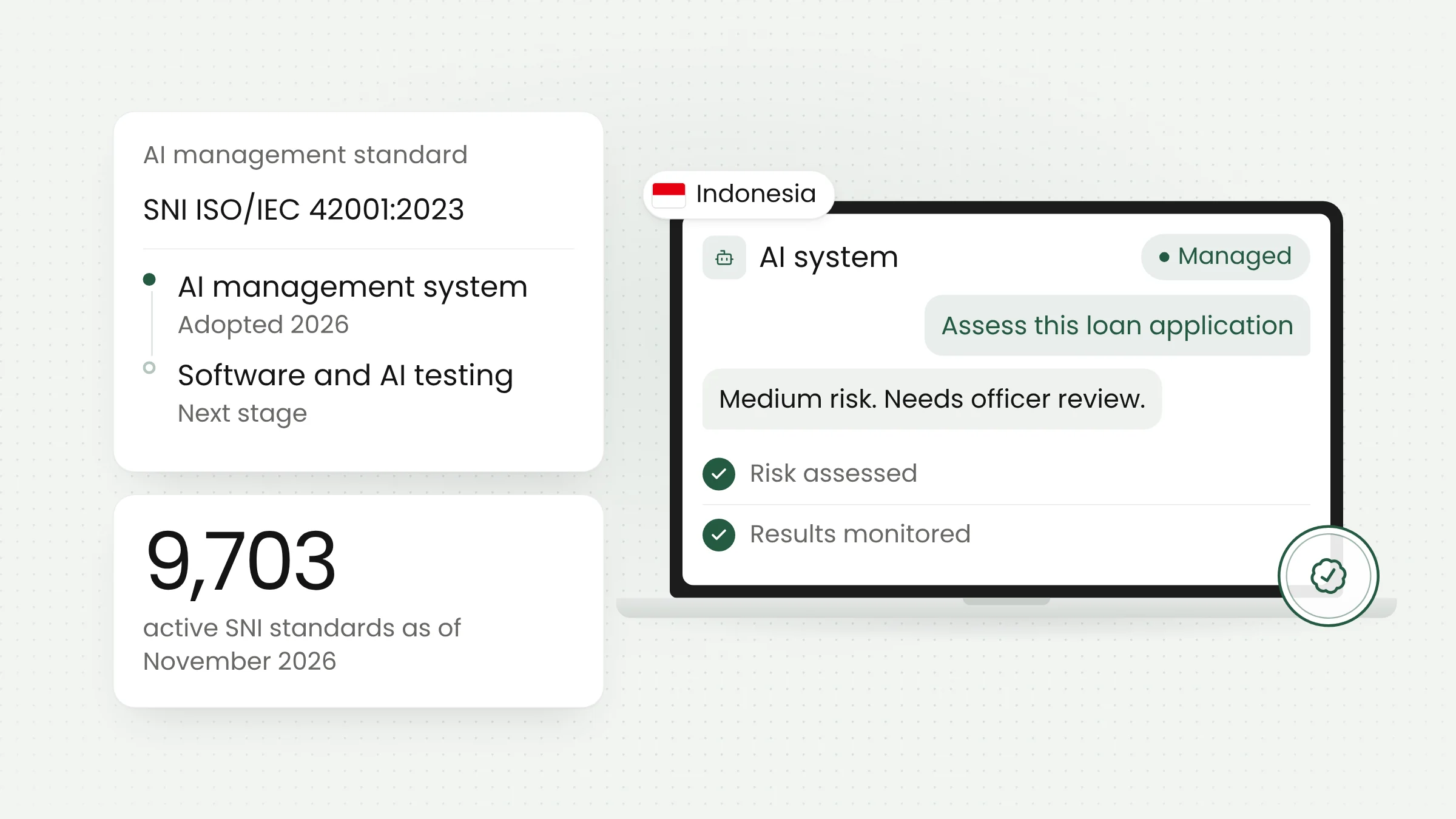
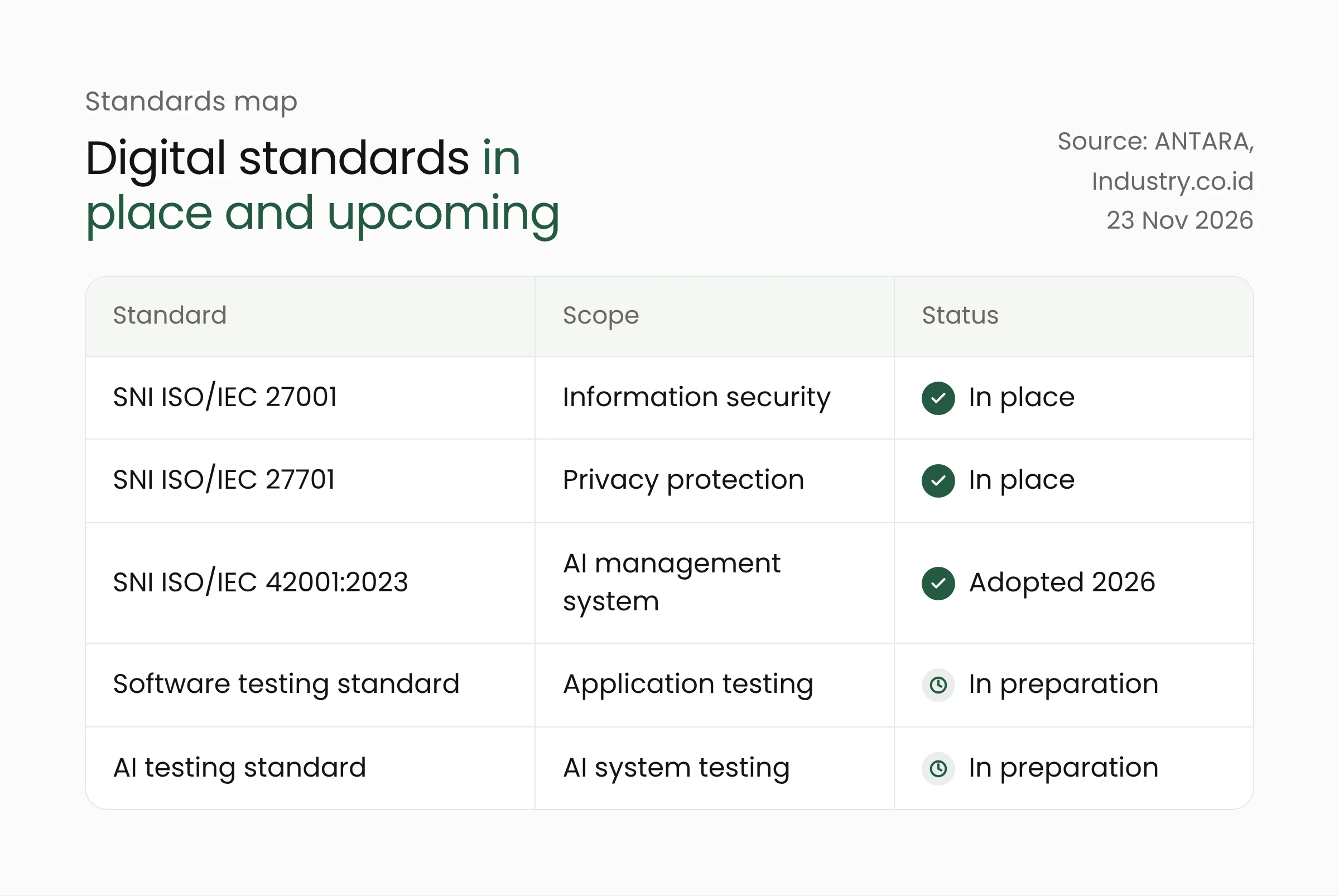
Indonesia now has a national standard for managing AI. The National Standardization Agency (BSN) adopted SNI ISO/IEC 42001:2023, the AI management system standard, in 2026. On 23 November 2026 BSN head Donny Purnomo said standards for software testing and AI testing would come next.
SNI ISO/IEC 42001 takes the stage at National Quality Month
The standard was discussed at a national standardization seminar held in Jakarta on Monday, 23 November 2026, by BSN and ALSI, the Indonesian association of conformity assessment bodies. The seminar was part of National Quality Month 2026 and focused on testing, inspection and certification for digital services.
According to ANTARA, the state news agency, BSN adopted SNI ISO/IEC 42001:2023 in 2026 under the title Information Technology, Artificial Intelligence, Management System. It gives organizations a framework for managing how they use and develop AI, including identifying, monitoring and evaluating risk. Coverage of the seminar did not give the adoption date or the number of the decree.
Donny said the agency chose to start with management. In a second ANTARA report, he said the next steps would be taken with the Ministry of Communication and Digital Affairs (Kemkomdigi): a standard for software testing, then AI testing, and eventually standards for the underlying infrastructure. No timetable has been announced for any of them.
The seminar also offered a snapshot of the national standards system. Industry.co.id reported that Indonesia had 9,703 active national standards as of November 2026 and 2,919 conformity assessment bodies accredited by the National Accreditation Committee (KAN). In UNIDO’s QI4SD index for 2026, the country ranked 31st of 170 with a score of 64.8.
What the AI management system standard covers
SNI ISO/IEC 42001:2023 adopts ISO/IEC 42001:2023, the international standard published on 18 December 2023. The IEC catalogue describes a 51-page document that sets requirements and guidance for establishing, implementing, maintaining and continually improving an AI management system within an organization.
A management system, in this sense, is the way an organization works: the policies, assigned responsibilities, processes and records that make its use of AI open to oversight. The standard does not grade how capable a model is, and it sets no minimum accuracy figure. It deals with more basic questions, such as who decides that an AI system may go into use, which risks were assessed beforehand, and how results are tracked once the system is running.
Its scope is broad. The IEC catalogue says the standard applies to any organization, regardless of size, type and nature, that provides or uses products or services built on AI systems. A bank that buys a credit scoring engine from a vendor falls within it, and so does a startup building its own chatbot.
Organizations that already run ISO/IEC 27001 for information security will recognize the pattern. Leadership sets policy, risks are assessed and treated, and the results are audited and improved on a regular cycle. The addition is an assessment of how an AI system affects the people subject to its decisions. ISO published separate guidance on that step, ISO/IEC 42005, in May 2025.
Certification is voluntary
A GAICC overview of the ISO/IEC 42000 family notes that ISO/IEC 42001 is the only member of the family that can be certified, and that certification is voluntary. The bodies that audit and issue those certificates are covered by another standard, ISO/IEC 42006, published on 7 July 2025, which adds requirements on top of ISO/IEC 17021-1.
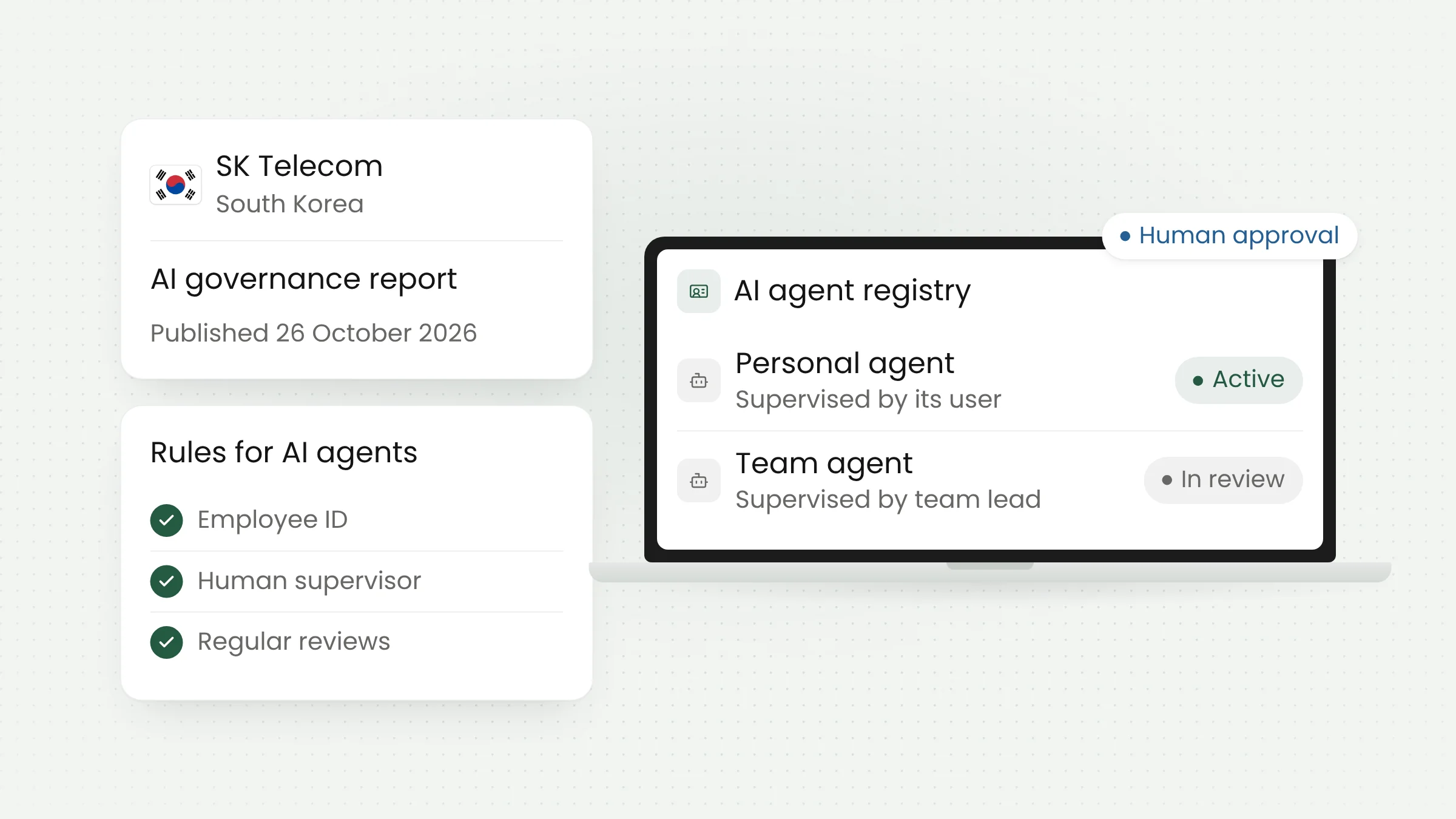
Other jurisdictions have taken the same route. GAICC records that Australia adopted the standard as an identical national standard in February 2024, and that the European standards body CEN approved the text unchanged on 13 March 2026. Some companies already hold the certificate. South Korea’s SK Telecom obtained it in 2024, as we noted in our article on SK Telecom’s AI agents with employee IDs.
AI testing standards are still in the works
A management standard governs how an organization works. Testing an AI system itself requires different standards and laboratories, and that part is unfinished.
Donny said the infrastructure for testing against AI standards has been built, but its accreditation is still general and has yet to cover AI specifically. BSN is working with several laboratories and tester associations to prepare the tooling. Information security standards are already in place, he added, while several cybersecurity standards are being drafted with Kemkomdigi.
On the government side, Wayan Toni Supriyanto, Kemkomdigi’s director general for digital infrastructure, acknowledged that the state’s testing centre for communications equipment does not yet handle AI. He told reporters that AI devices are outside its scope for now and that the ministry is waiting for the standards BSN will produce.
Vibizmedia reported that at the same seminar Wayan said AI standards must ensure the technology is used safely, transparently and accountably, and that it stays under human control. He also pointed to the Digital Test House in Tapos, Depok, which is expected to strengthen domestic capacity for testing digital devices.
The distinction matters when reading certification claims. An SNI ISO/IEC 42001 certificate will show that an organization manages AI in an orderly way. It will say nothing about whether a particular model has been tested and found safe, because the testing standards have yet to be issued.
What this means for banks and fintech firms
Financial institutions use AI for decisions that reach customers directly, including credit scoring, fraud detection and conversational service. The sector also has its own reference. Indonesia’s Financial Services Authority (OJK) launched its banking AI governance guidance, Tata Kelola Kecerdasan Artifisial Perbankan Indonesia, on 29 April 2025.
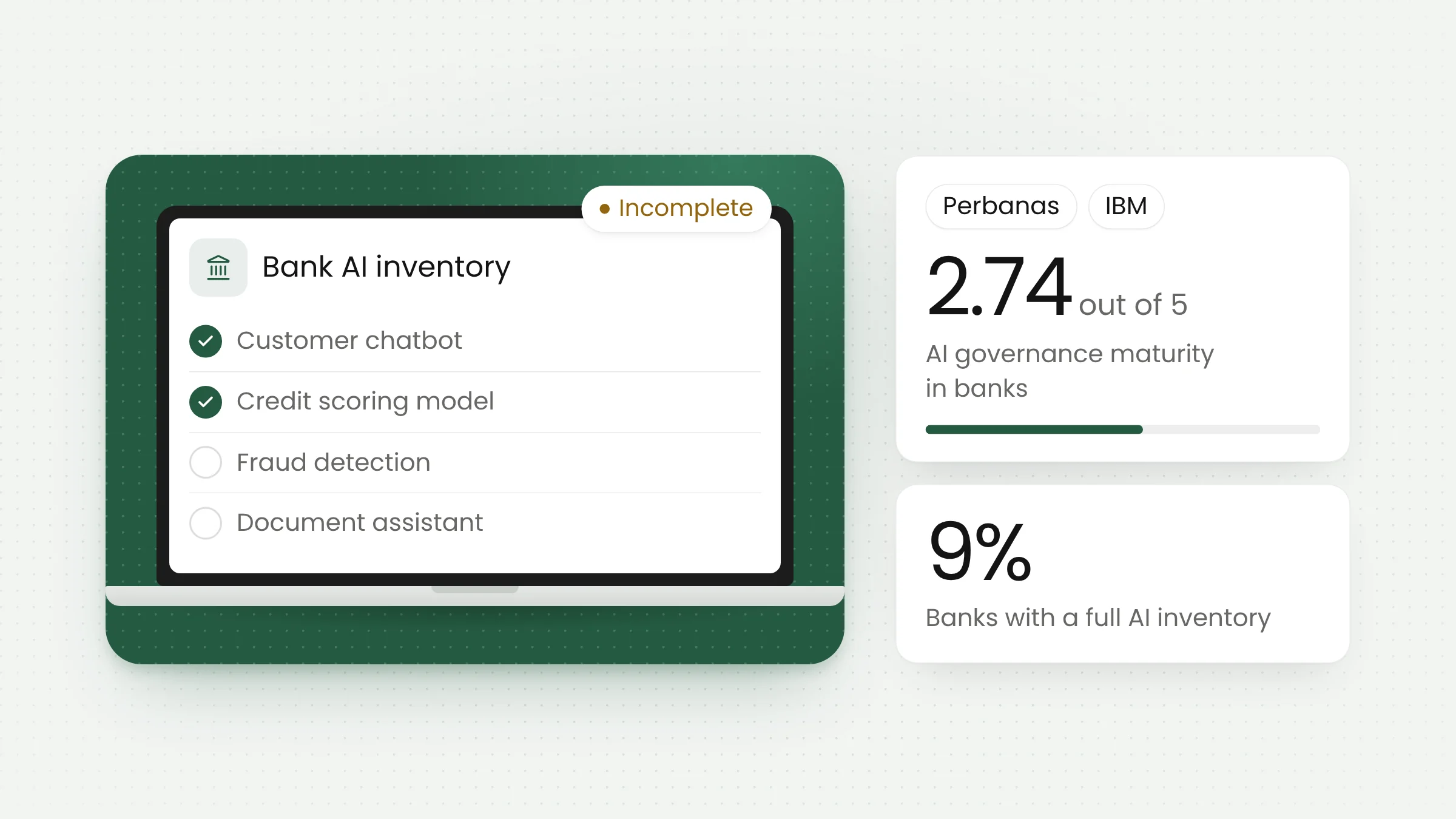
Readiness remains low. The Perbanas and IBM survey covered in our article on AI governance in Indonesian banks found an average maturity of 2.74 on a five-point scale, with only 9 percent of banks holding a complete AI inventory. SNI ISO/IEC 42001 gives banks, rural banks, cooperatives and fintech firms an auditable framework for closing that gap. Four steps can begin before any certification scheme is in place.
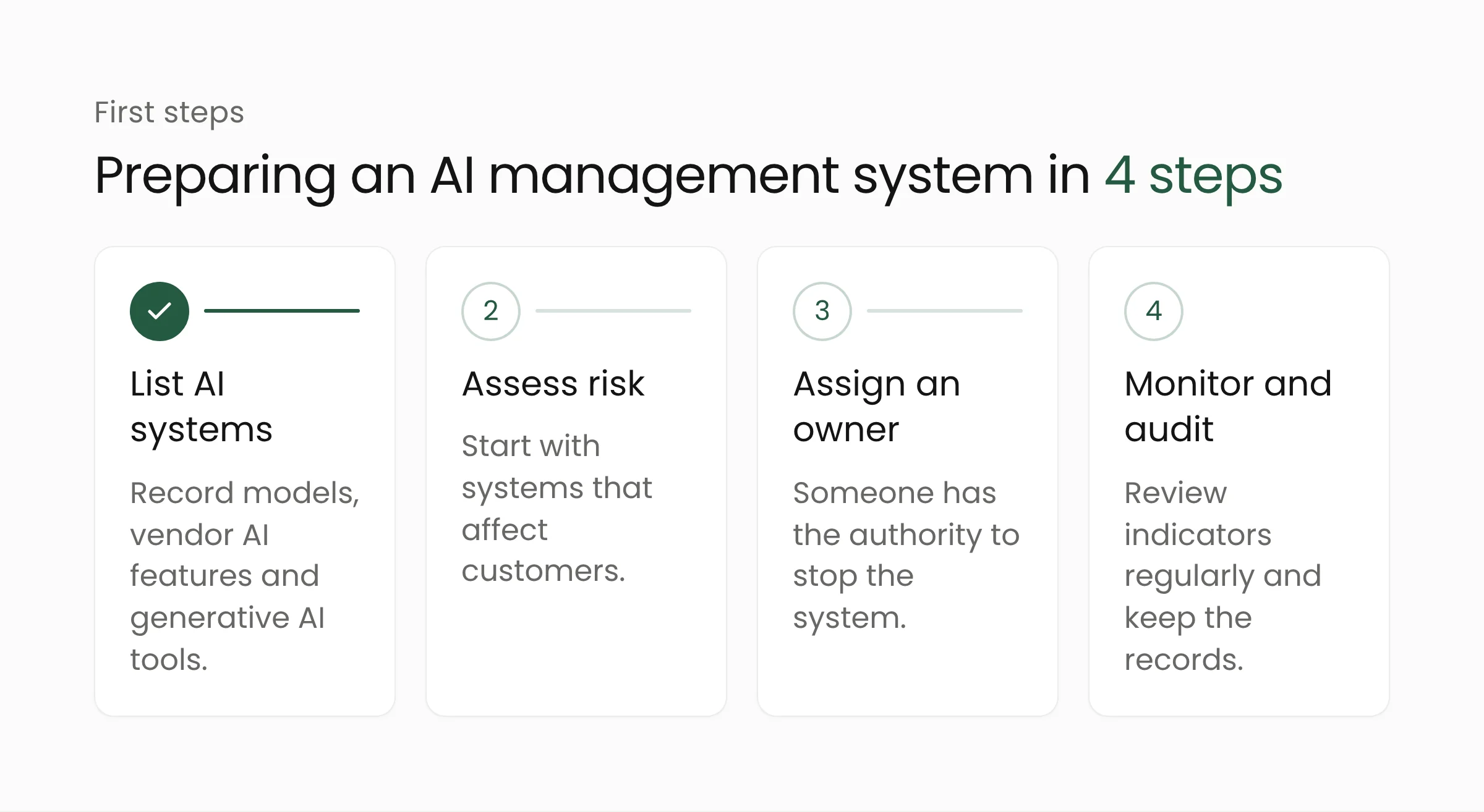
List every AI system in use. Record in-house models, AI features inside vendor applications, and the generative AI tools staff rely on. For each one, note its purpose, the data it processes and the unit that owns it. Everything else builds on this inventory.
Assess risk and impact. A system that approves loans or blocks transactions affects customers directly, so it needs a deeper assessment than an internal document summarizer. Record the potential for bias, error and data leakage, along with how each will be handled.
Assign an owner. Each AI system needs someone with the authority to switch it off when its output goes wrong. A cross-functional forum that brings in risk, compliance, legal and IT can sit within an existing committee.
Monitor and audit on a schedule. Model performance shifts as customer data shifts. Set indicators that are reviewed regularly, keep the records, and add AI to the internal audit plan.
Institutions already certified to ISO/IEC 27001 have a good starting point, because the cycle of policy, risk assessment and audit is already running. Teams building systems for financial services can also design in decision logging and audit trails from the outset, since adding them after launch is harder.
One caution applies to vendors. A claim of being “aligned with ISO 42001” without a certificate from an accredited certification body is a self-declaration. Ask for the scope of the certificate, because it may cover a single service and leave the rest of the company out.
Frequently asked questions
Is SNI ISO/IEC 42001 mandatory?
Coverage of the BSN seminar did not mention any obligation to apply it, and the international standard it adopts is voluntary. A requirement could arise if a sector regulator or a buyer makes it a condition, for example in procurement. Until such a rule exists, the standard serves as a reference and as evidence of sound governance.
How does it differ from ISO/IEC 27001?
ISO/IEC 27001 covers information security management, meaning how an organization protects the confidentiality, integrity and availability of information. ISO/IEC 42001 covers the management of AI systems, including risks specific to them such as bias, decisions that are hard to explain, and effects on people. Both follow a similar working pattern, so they can run side by side.
Can AI products already be tested and carry the SNI mark?
No. SNI ISO/IEC 42001 assesses organizations, while the standards for software testing and AI testing are still being prepared by BSN and Kemkomdigi. The BSN head said the testing infrastructure has been built but its accreditation does not yet cover AI specifically. No release date for the testing standards has been announced.
Closing
The adoption of SNI ISO/IEC 42001 gives organizations in Indonesia a shared vocabulary for managing AI, from inventory to audit. The testing standards will follow later, so the work that can start now is putting internal practice in order. If your institution is designing or reworking an AI-based system, the Merakit team is open to discussing a design that is easy to audit from day one.
Sources
- BSN perkuat ekosistem mutu nasional lewat transformasi layanan digital, ANTARA, 23 November 2026
- BSN siapkan standardisasi untuk manajemen AI di Indonesia, ANTARA, 23 November 2026
- BSN Perkuat Standar Pengujian dan Sertifikasi, Keamanan Ekosistem Digital Jadi Sorotan, Industry.co.id, 23 November 2026
- Dari QRIS hingga AI, Pemerintah Perkuat Standar Keamanan Teknologi Digital, Vibizmedia, 24 November 2026
- ISO/IEC 42001:2023, Information technology, Artificial intelligence, Management system, IEC catalogue, published 18 December 2023
- ISO/IEC 42000 Series: Status of Each AI Standard in 2026, GAICC, 7 October 2026
- Tata Kelola Kecerdasan Artifisial Perbankan Indonesia, Financial Services Authority (OJK), 29 April 2025