Blog AI Agents
SK Telecom Gives AI Agents Employee IDs and Supervisors
On this page· 7 sections
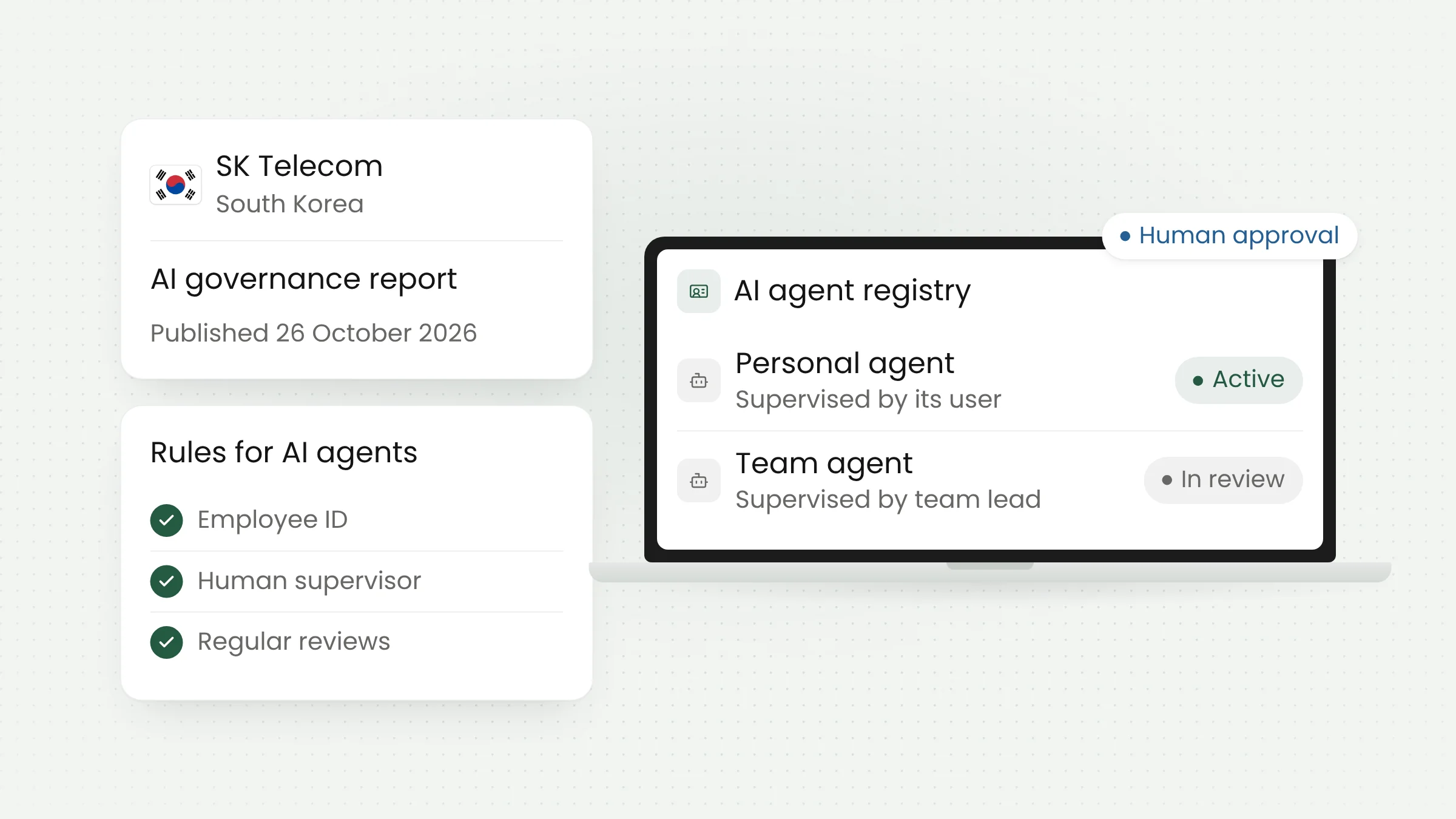
South Korean telecom operator SK Telecom published its first AI governance report on 26 October 2026. Under the framework it describes, every in-house AI agent that passes review receives an employee ID, a named human supervisor, limits on the data it can reach, and regular performance reviews, much like a member of staff.
What SK Telecom’s AI governance report covers
The AI Governance Report sets out the company’s governance principles, its accountability framework, implementation plans, and results so far. According to Digital Today, it also includes guidelines for managing AI agents, meaning AI programs that can make decisions and carry out tasks on their own.
The report works on two levels. The first is customer-facing AI services, whose management system has been certified since 2024. The second is the in-house agents that employees build or use in their daily work. The Financial News notes that the report now covers this second group in detail.
The whole system is run by Cha Ho-beom, SK Telecom’s chief privacy officer (CPO), who oversees both personal data protection and AI governance. Speaking to Korean media, Cha said AI governance becomes more important as agents begin to work with greater independence.
Rooted in the AX Innovation 2.0 program
The idea of treating AI agents like employees was first announced in June 2026. At the time, SBS reported that SK Telecom had launched a program called AX Innovation 2.0, under which agents receive employee IDs, departments, job functions, and access permissions, and are managed from onboarding through to offboarding.
The program followed a three-month pilot in parts of the company’s AI unit. In that pilot, a single employee could handle planning, development, and design at once with help from several agents. The October report describes how the company intends to keep that way of working under control.
How SK Telecom oversees its AI agents and services
Employee IDs only after review
Agents do not receive an employee ID automatically. Once an agent is built, its basic details are registered. Only agents that meet internal standards in a separate review are issued an ID. From then on, the company tracks each agent’s assigned tasks, the person responsible for it, the unit it belongs to, its operating status, and its performance.
The ID works as an identity record. Every action an agent takes can be traced back to a single entry, including the human who answers for it.
Supervisors matched to autonomy
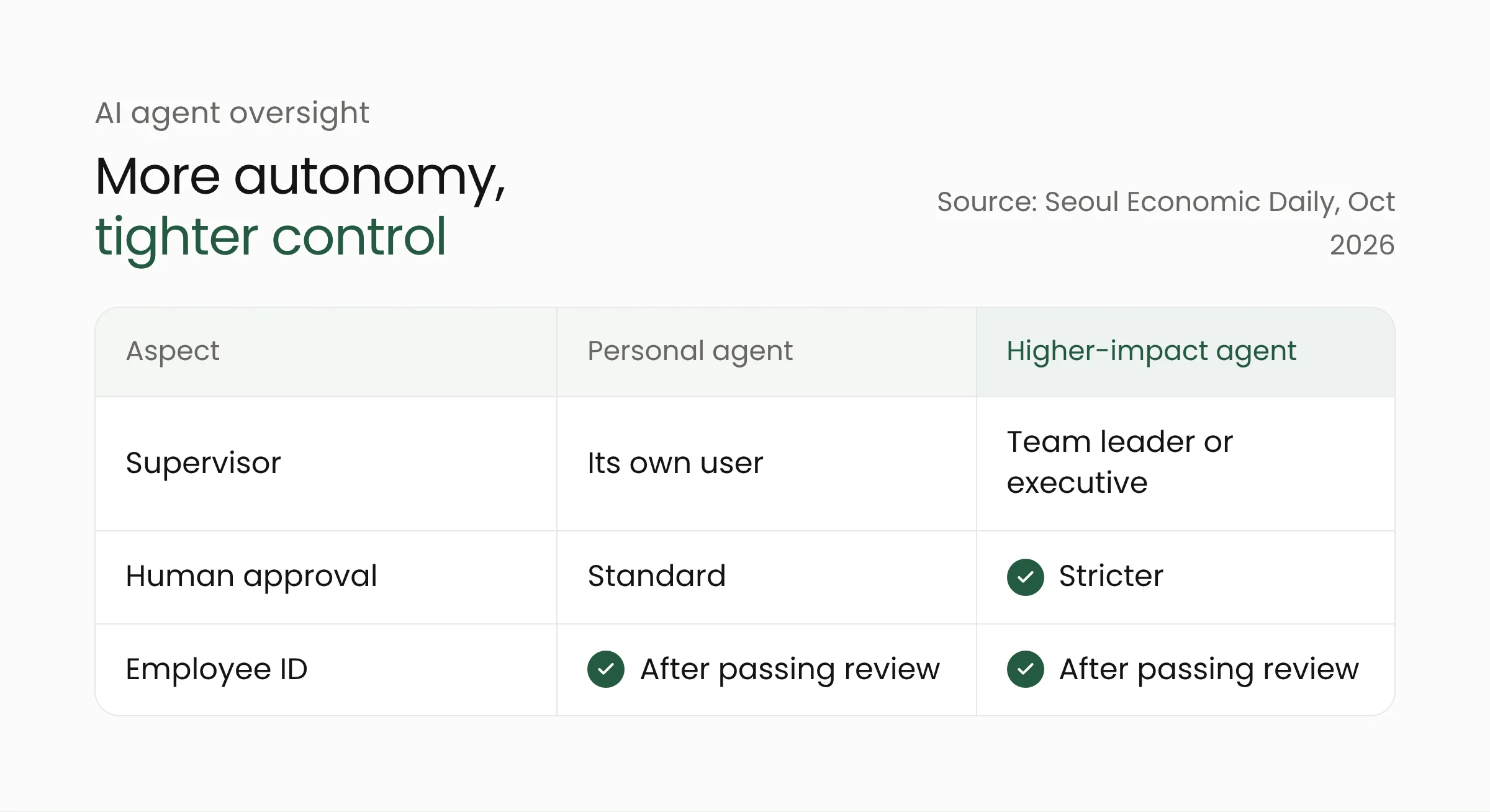
Who supervises an agent depends on its scope of impact and its level of autonomy. An agent that helps one employee with their own tasks is managed by that employee. According to the Seoul Economic Daily, agents with greater impact or more autonomy must be overseen by a team leader or an executive.
Access rights follow the same logic. The functions and data an agent can use are set by the nature of its work, and the more autonomy an agent has, the stricter the human review and approval steps that apply.
An agent OS and an audit trail
To manage agents built in different environments under one standard, SK Telecom uses what it calls an agent OS. The system records each agent’s execution status, usage, and change history, along with the AI models, tools, and task flows it relies on, so problems can be traced to their source.
If something abnormal happens, an agent’s execution can be halted and the related actions are logged. The Seoul Economic Daily adds that monitoring also covers token usage, the units of text an AI model processes, as well as each agent’s work records.
Performance reviews and retirement
Agents are assessed on task completion, scope of impact, how they access data, and their contribution. The results decide whether an agent is kept, improved, or shut down, and agents judged less necessary can be suspended or retired.
The company is also looking at ways to share agent performance with employees. Over the longer term, SK Telecom is considering reflecting agent results in organizational key performance indicators (KPIs). That idea is still under review.
Checks on customer-facing AI services
Services used by customers go through a separate process. According to The Financial News, each one is assessed for personal data protection, legal compliance, transparency, safety, and user control at every stage from planning and development to launch and operation.
Business units assess their own services first. Specialist teams then weigh risks and opportunities, after which privacy, legal, security, and AI governance teams review the results. SK Telecom says it will not launch services that carry risks that are hard to accept without mitigation.
The company applies privacy by design, which means personal data protection is considered from the planning stage. When a service that handles personal data uses an outside model or software library, its license and known security vulnerabilities are checked. Risk assessment records for each service are kept in an internal AI governance portal.
The 2026 to 2028 roadmap and ISO/IEC 42001
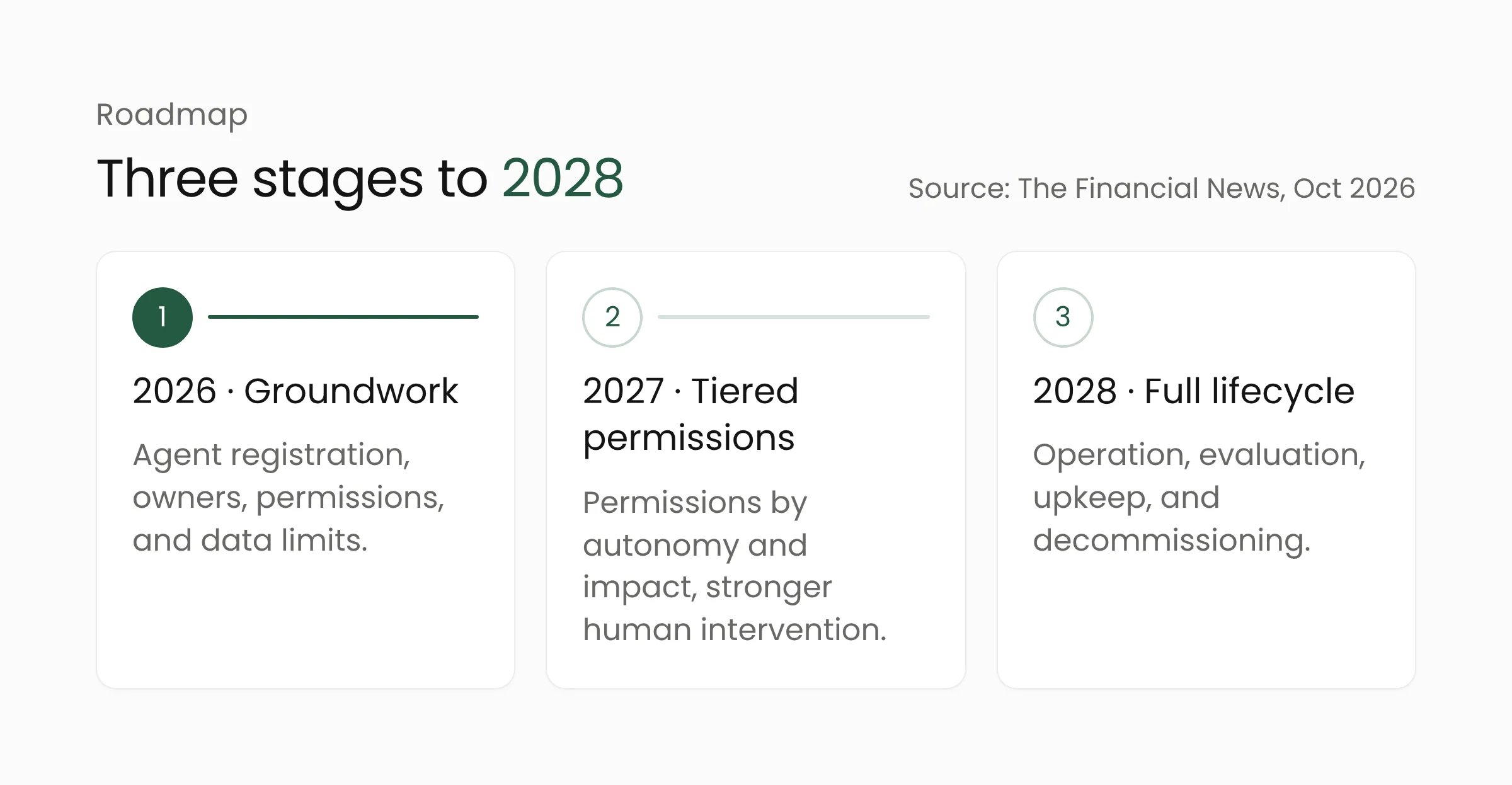
The Financial News reports a three-stage roadmap. In 2026 the company is laying the groundwork: pre-review standards, agent registration, owner designation, usage permissions, and data access limits. In 2027 it plans to differentiate permissions by autonomy and impact and to strengthen human review and intervention. By 2028 it aims to manage the full agent lifecycle, from operation and evaluation through to decommissioning.
Certification sits behind the report. SK Telecom earned ISO/IEC 42001, the international standard for AI management systems, in 2024 for its customer-facing AI services. Digital Today says it was the first South Korean telecom operator to do so. In October 2026, the scope of that certification was extended to its management system for in-house agents.
What this means for your organization
Indonesian organizations that try AI agents, such as a bank summarizing loan documents, a hospital drafting schedules, or an online store answering customer messages, will face the same question: who is accountable when an agent gets something wrong? SK Telecom’s approach offers a framework that can be copied on a smaller scale.
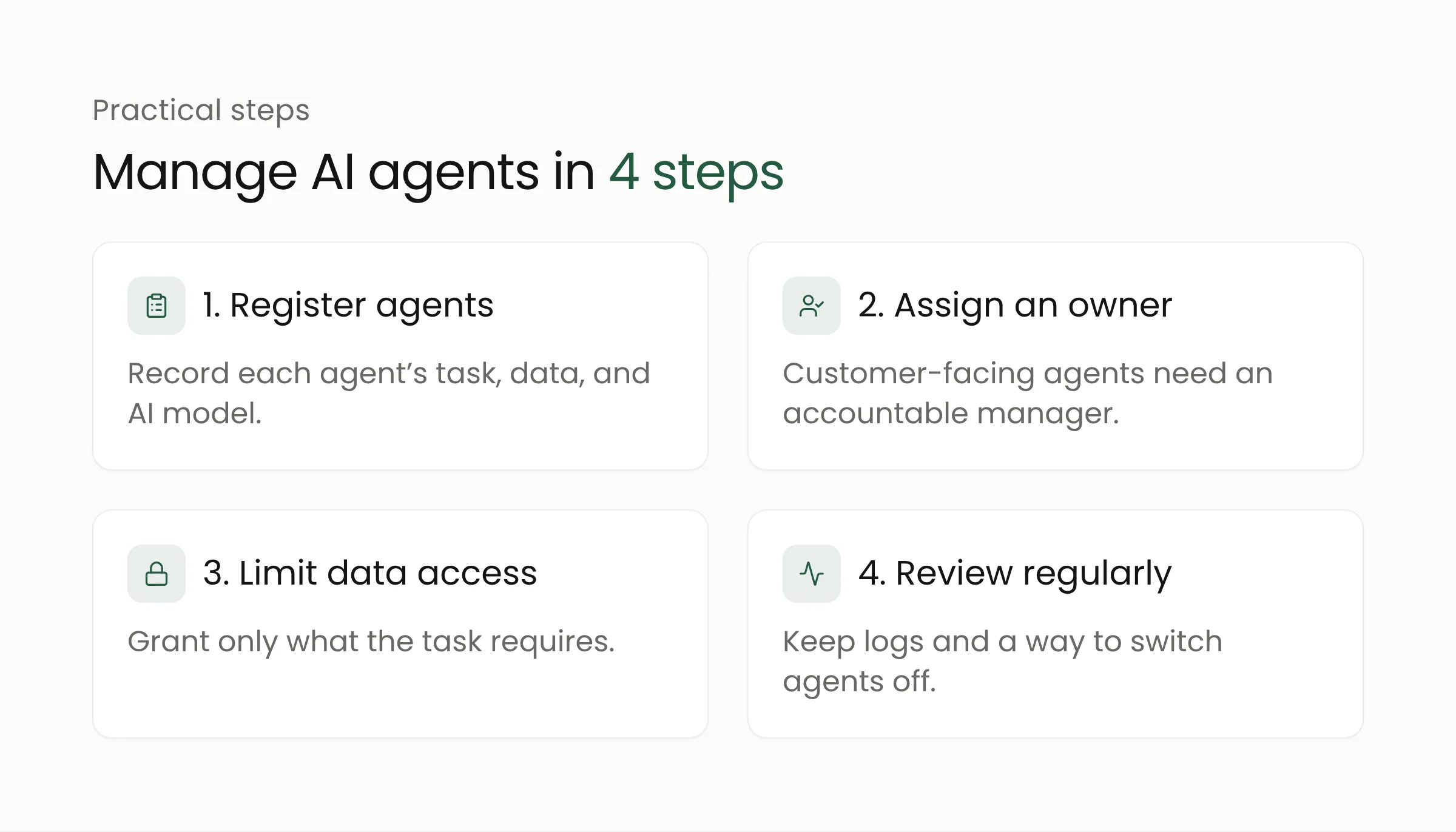
- Register every agent. List the agents already running, including those employees have built themselves inside workplace apps. Record each agent’s task, the data it touches, and the AI model it uses.
- Assign a human owner. A personal agent can be supervised by its user. Agents that deal with customers, patients, or transactions need an owner with real decision-making authority.
- Limit data access to the task. An agent that writes summaries does not need permission to change records. For organizations that process personal data, this also supports compliance with Indonesia’s Undang-Undang Nomor 27 Tahun 2022 tentang Pelindungan Data Pribadi (Personal Data Protection Law).
- Review and switch off when needed. Check agent performance on a schedule, keep logs of their actions, and have a quick way to stop an agent if it behaves abnormally.
The need is most pressing in finance, where agents can reach customer data and approval workflows. Teams building agents for financial services can design in agent registration, access limits, and action logs from the start. Our look at Notion’s agents that run for 24 hours shows that agents increasingly work for long stretches without direct supervision, which makes their audit trail all the more important.
Frequently asked questions
Are SK Telecom’s AI agents legally considered employees?
Nothing in the coverage suggests so. The employee ID is an internal management identity used to record an agent’s tasks, owner, access, and performance. Responsibility stays with the human assigned to supervise it.
Who is responsible when an AI agent makes a mistake?
Under SK Telecom’s framework, every agent has a human owner. Personal agents are supervised by their users, while higher-impact or more autonomous agents are overseen by a team leader or executive.
What is ISO/IEC 42001?
ISO/IEC 42001 is the international standard for AI management systems. It sets out how an organization defines policies, assesses risks, and oversees AI systems on an ongoing basis. SK Telecom has held the certification since 2024 and extended it to in-house AI agents in October 2026.
Conclusion
SK Telecom’s report shows that AI agents can be managed with tools organizations already understand: an identity, a supervisor, access rights, and performance reviews. Organizations adopting agents can apply the same principles before the number of agents grows. If your team is designing AI agents and the governance around them, Merakit Indonesia’s artificial intelligence services team is ready to talk.
Sources
- SK Telecom Issues First AI Governance Report, Seoul Economic Daily, 26 October 2026
- SKT to Assign Employee IDs to AI Agents and Manage Their Permissions and Responsibilities, The Financial News, 26 October 2026
- SKT publishes AI governance report to strengthen AI trust management, Digital Today, 26 October 2026
- SKT, AI 거버넌스 보고서 발간…AI 에이전트 관리 기준 담아, Newspim, 26 October 2026
- SK Telecom Assigns Employee IDs to AI, Ushering in the ‘Era of AI Colleagues’, SBS, 16 June 2026