Blog Mobile Networks
Starlink Mobile Picks Qualcomm for Its Ground 5G Network
On this page· 7 sections
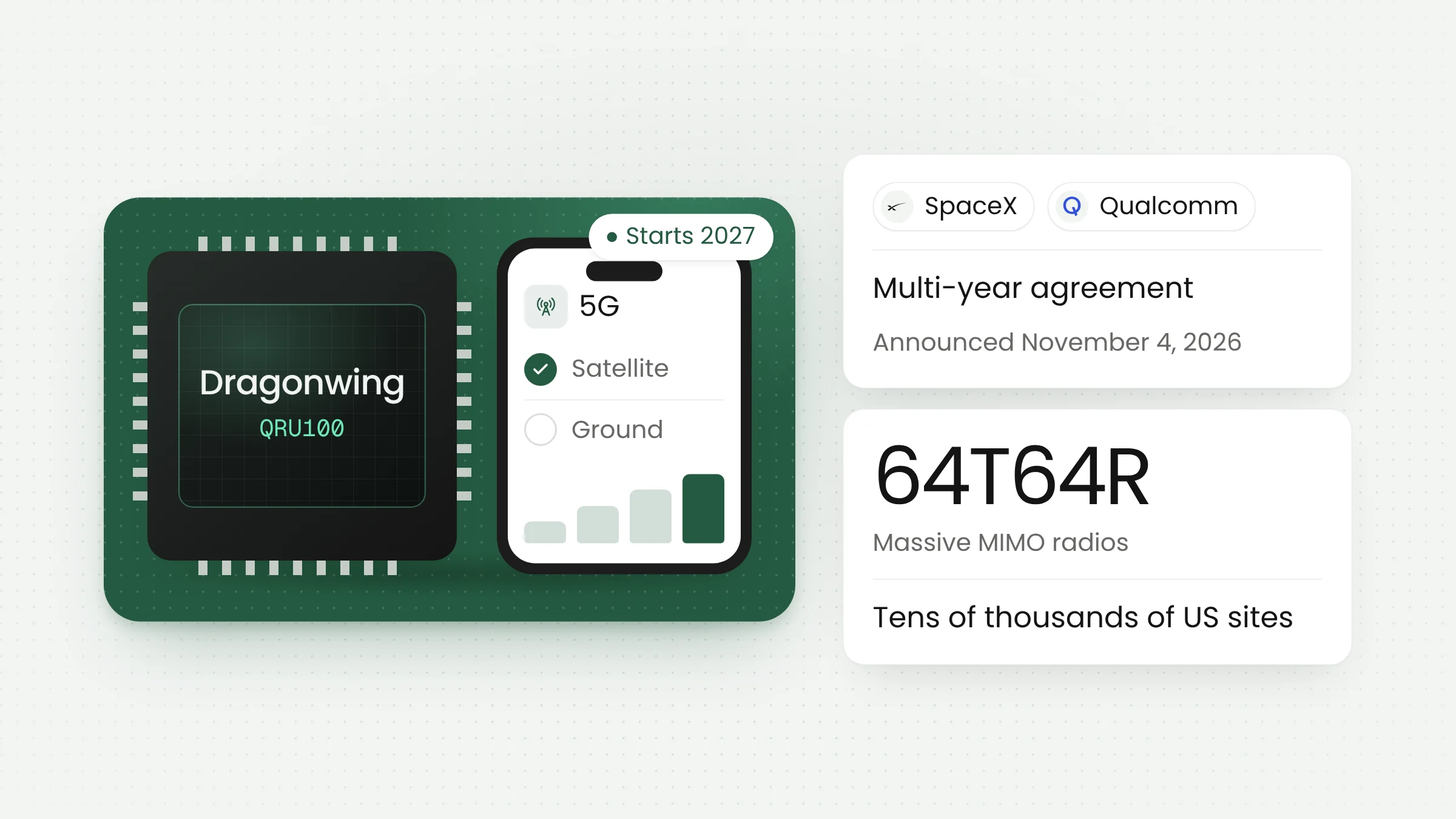
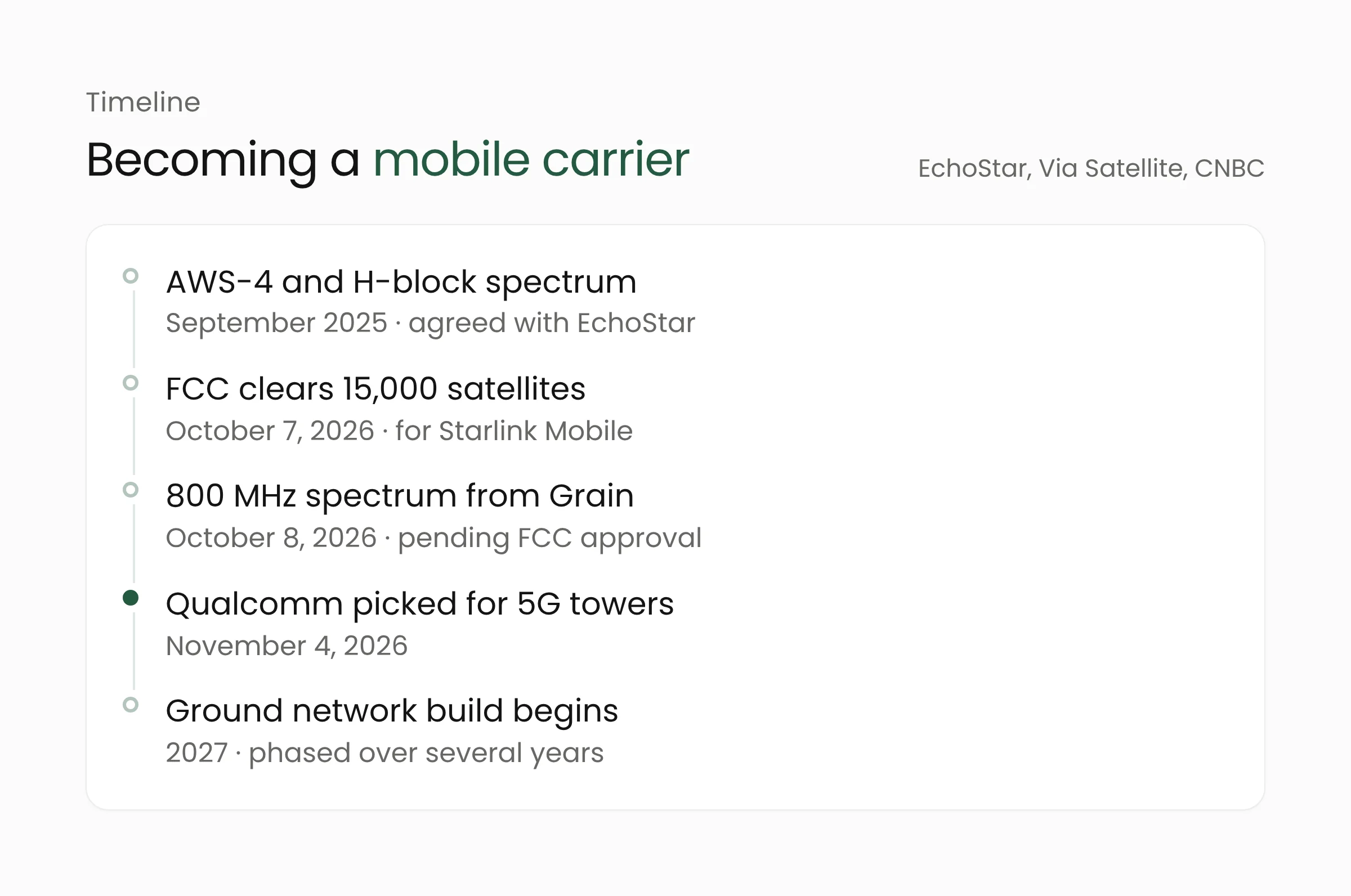
SpaceX has signed a multi-year agreement with Qualcomm to build the terrestrial 5G network behind Starlink Mobile in the United States. Announced on November 4, 2026, the deal covers equipment for tens of thousands of cell sites, with construction starting in 2027 to complement Starlink’s direct-to-phone satellite service.
Starlink is best known as a satellite internet provider. Adding ground towers moves SpaceX toward becoming a full mobile carrier that competes with AT&T, Verizon, and T-Mobile. The move also hints at where connectivity is heading for devices in hard-to-reach places, including in Indonesia.
What the SpaceX and Qualcomm deal covers
According to Reuters, Qualcomm will supply radio equipment, baseband units, and software for Starlink Mobile’s terrestrial 5G network. The gear will be installed at tens of thousands of macro cell sites across the US in phases starting in 2027. Qualcomm called it its biggest 5G deal so far. Financial terms were not disclosed.
The hardware comes from Qualcomm’s Dragonwing family. RCR Wireless broke it down into three parts:
- Dragonwing QRU100 handles processing inside the radio unit, the part of a tower that transmits and receives signals.
- Dragonwing QDU100 provides Layer 1 processing in the distributed unit. Layer 1 is the physical layer that turns radio signals into data.
- Commercial-grade Layer 1 software runs that physical layer.
The radio units use a 64T64R Massive MIMO setup, meaning 64 transmit and 64 receive paths in a single unit. With that many antenna paths, a tower can serve many phones at once by steering a separate beam toward each user.
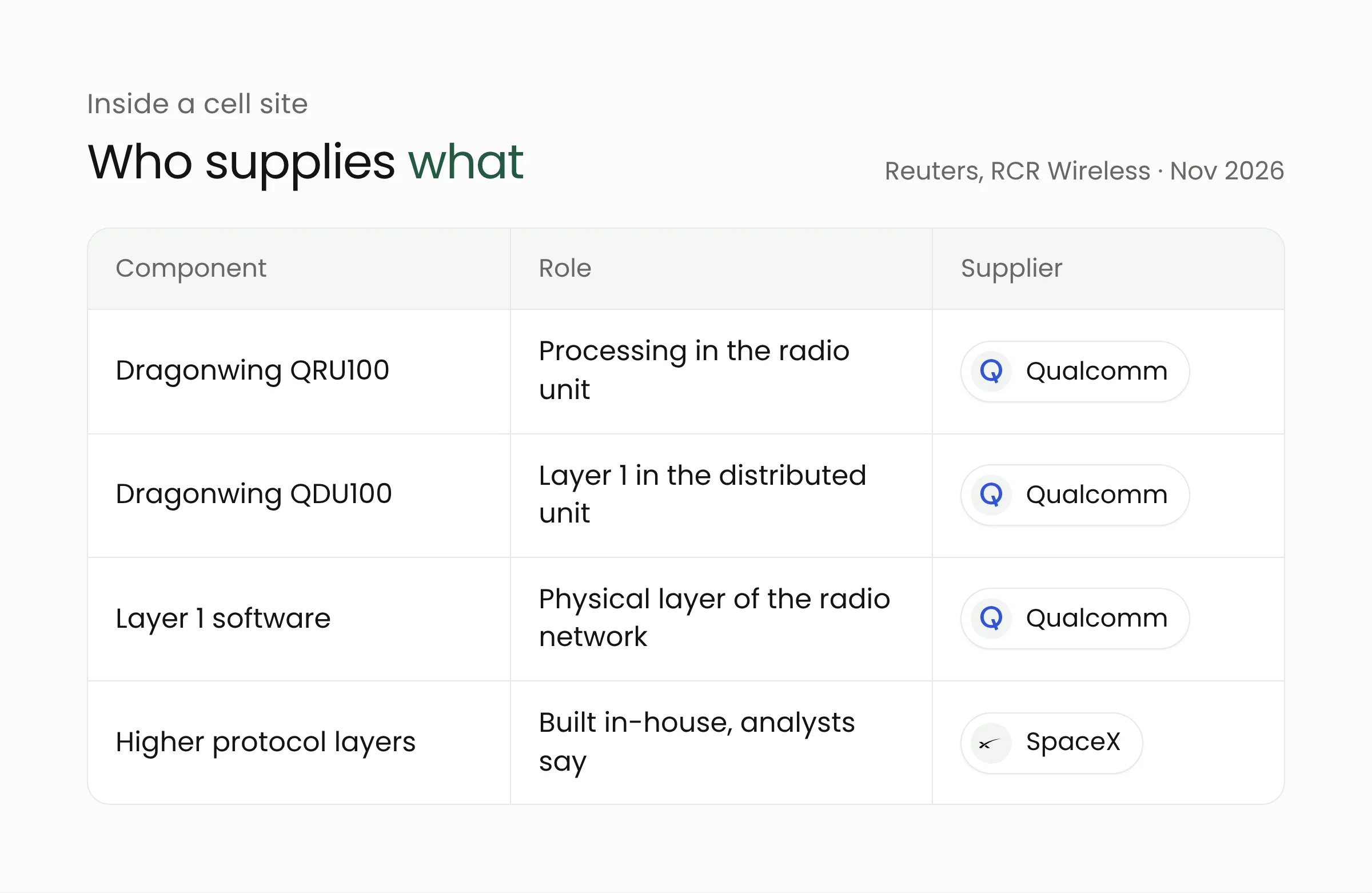
Michael Thelander of SRG Research, quoted by RCR Wireless, said SpaceX appears to be handling the higher layers of the protocol stack itself, with no other traditional infrastructure suppliers in sight. That is an analyst’s reading. SpaceX has not described the full architecture.
The contract matters for Qualcomm too. CNBC noted that Qualcomm, best known for phone modems and chips, only pushed into 5G infrastructure in 2020 and has previously worked with Verizon, Dish, and Vodafone. Reuters said Qualcomm competes with Marvell, Broadcom, and Intel for cell tower chips.
One network of satellites and towers
Starlink Mobile is designed around two paths. Low-orbit satellites reach places with no towers, while ground towers provide high capacity in dense areas. Qualcomm said the terrestrial network will complement Starlink’s satellite capabilities.
Michael Nicolls, senior vice president of Starlink, described the goal in a statement quoted by RCR Wireless: “Starlink is building the first fully-integrated nationwide satellite and terrestrial network”. Under this design, a subscriber’s phone can use a tower where one is in range and fall back on satellites where there is none.
The Qualcomm deal is one step in a sequence SpaceX has assembled over more than a year:
- On September 8, 2025, EchoStar announced the sale of its AWS-4 and H-block spectrum licenses to SpaceX for about $17 billion in cash and SpaceX stock. This 2 GHz spectrum is meant for the next generation of direct-to-phone satellite service.
- On October 8, 2026, SpaceX agreed to buy Grain Management’s nationwide 800 MHz portfolio, 14 MHz of paired spectrum. According to Via Satellite, the purchase still needs approval from the Federal Communications Commission (FCC).
- A day earlier, the FCC approved the deployment of 15,000 satellites for the Starlink Mobile constellation, also according to Via Satellite.
SpaceX describes its 2 GHz spectrum as the capacity layer and the 800 MHz band as a coverage layer that helps the Starlink Mobile signal get through walls and into buildings. SpaceX also said most phones on the market already support the 800 MHz band.
Challenges that remain
Analysts do not expect an easy build. Thelander explained that Massive MIMO does not raise peak data speeds, although it can add a lot of network capacity. He also said the technology does not fix SpaceX’s shortage of 5G spectrum, and that building a nationwide network will not be easy or fast.
Reuters noted that the plan’s feasibility is uncertain given the investment required. CNBC added that SpaceX has not named any tower company partners or said how many towers it needs. US carriers usually lease space on towers owned by American Tower and Crown Castle.
Starlink is the financial engine behind the effort. According to CNBC, Starlink accounted for 36% of SpaceX’s revenue and 85% of its operating profit in the third quarter of 2026. Those figures help explain why SpaceX is willing to spend heavily on a mobile business.
Where Indonesia stands on satellite-to-phone service
The Starlink Mobile service in this deal is aimed at the US market. In Indonesia, satellite service that connects directly to ordinary phones is still under government study.
In October 2025, the Ministry of Communication and Digital Affairs (Komdigi) opened a public consultation, a Call for Information, on using the 2 GHz band for Non-Terrestrial Network Direct-to-Device (NTN-D2D) and Air-to-Ground (A2G) services. According to Bisnis.com, Komdigi invited input from mobile operators, satellite providers, the aviation industry, device makers, academics, and the public until November 9, 2025. The study is part of Komdigi’s 2025–2029 Strategic Plan.
In early November 2025, Komdigi’s Director General of Digital Infrastructure, Wayan Toni Supriyanto, said direct-to-device service was still a study that the ministry would take to the International Telecommunication Union (ITU), as reported by Bisnis.com. We have not found a later official announcement on licensing such a service in Indonesia.
The 2 GHz band under study in Indonesia sits in the same frequency range as the spectrum SpaceX agreed to acquire from EchoStar. Indonesia’s decisions on this band will therefore shape whether a similar service can operate locally, and on what terms.
What this means for IoT teams in the field
For phone users in Indonesia, the SpaceX and Qualcomm deal has no direct effect yet. The more immediate relevance is for Internet of Things (IoT) devices installed far from cities: water quality sensors at shrimp ponds, weather loggers on plantations, river level gauges, and trackers on long-haul logistics trucks.
Devices like these often lose signal because the nearest tower is too far away. Starlink Mobile’s approach, a single service that combines towers and satellites, suggests that field devices should be designed for more than one connection path. Teams can apply several steps today with the networks already available:
- Measure signal at every install point. Test each operator’s signal strength on site before choosing a SIM card or module. Operator coverage maps may not match conditions in the middle of a plantation or a pond.
- Plan two communication paths. Use cellular as the main link and add a backup, such as a satellite terminal at the data collection point or a dual-SIM module with cards from different operators.
- Store data on the device when the signal drops. Devices should keep sensor readings and send them once the connection returns, so the data has no gaps.
- Monitor devices from a dashboard. Flag devices that have not reported for too long so field staff can check the site before too much data is lost.
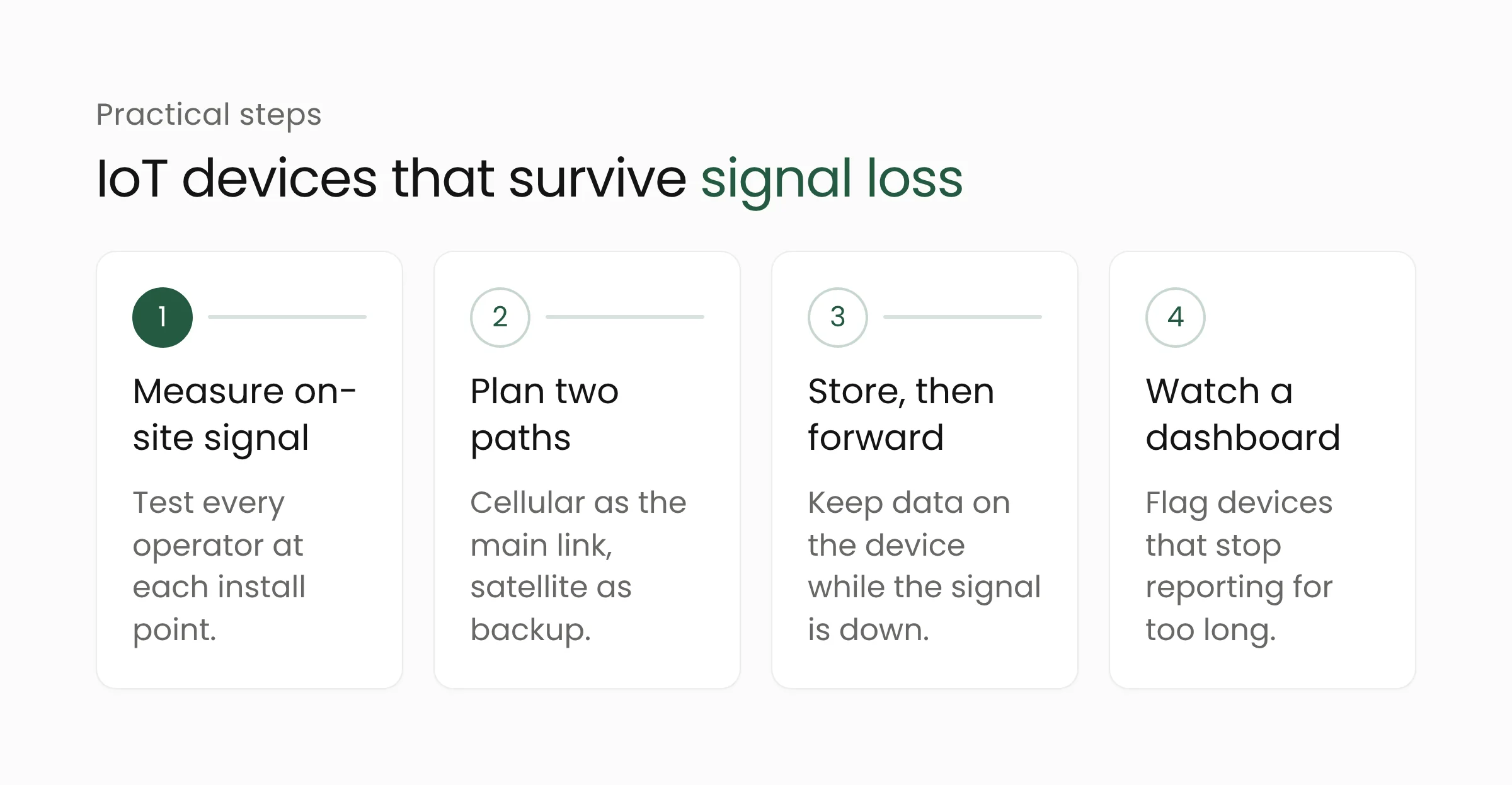
The third and fourth steps apply to any network, including direct-to-device satellite service if it eventually arrives in Indonesia. We covered similar design choices in our article on the NVS-03 navigation satellite and fleet tracking. To design devices, data pipelines, and monitoring dashboards, the Merakit team offers IoT development services tailored to field conditions.
Competition between satellite and mobile operators will keep shaping connectivity options over the next few years. Organizations that depend on field data can start preparing their devices now, and the Merakit team is ready to help plan the design.
Frequently asked questions
What is Starlink Mobile?
Starlink Mobile is SpaceX’s mobile service that combines low-orbit satellites with terrestrial 5G towers. SpaceX aims to compete with AT&T, Verizon, and T-Mobile in the United States. Construction of the ground network is scheduled to begin in 2027.
What is Qualcomm’s role in Starlink Mobile?
Qualcomm supplies radio equipment, baseband units, and software for Starlink Mobile’s 5G towers, specifically the Dragonwing QRU100 and QDU100 platforms and Layer 1 software. The equipment will be installed at tens of thousands of US sites. The contract value was not disclosed.
Will Starlink Mobile come to Indonesia?
There has been no announcement of Starlink Mobile for Indonesia. Komdigi has been studying the use of the 2 GHz band for direct-to-device satellite service since October 2025. Licensing and terms for such a service in Indonesia have not been announced.
Sources
- Qualcomm: SpaceX Selects Qualcomm to Accelerate Starlink Mobile’s Nationwide 5G Network (November 4, 2026)
- CNBC: SpaceX signs deal with Qualcomm to provide network technology for U.S. mobile service (November 4, 2026)
- Reuters via Investing.com: Qualcomm signs major 5G infrastructure deal with SpaceX for Starlink Mobile network (November 4, 2026)
- RCR Wireless: SpaceX taps Qualcomm for Starlink Mobile 5G network buildout (November 4, 2026)
- The Next Web: SpaceX signs multi-year Qualcomm deal for tens of thousands of 5G sites (November 4, 2026)
- Via Satellite: SpaceX Moves to Acquire Nationwide Low-Band Spectrum for Starlink Mobile (October 8, 2026)
- EchoStar: EchoStar Announces Spectrum Sale and Commercial Agreement with SpaceX (September 8, 2025)
- Bisnis.com: Komdigi Kaji Internet Satelit Langsung ke HP dan A2G Berbasis 2 GHz, Ini Pemainnya (October 22, 2025)
- Bisnis.com: Komdigi on direct satellite-to-phone links (Indonesian) (November 6, 2025)