Blog Industrial Automation
ABB Intelleqt: An Industrial Motor With Sensing Built In
On this page· 7 sections
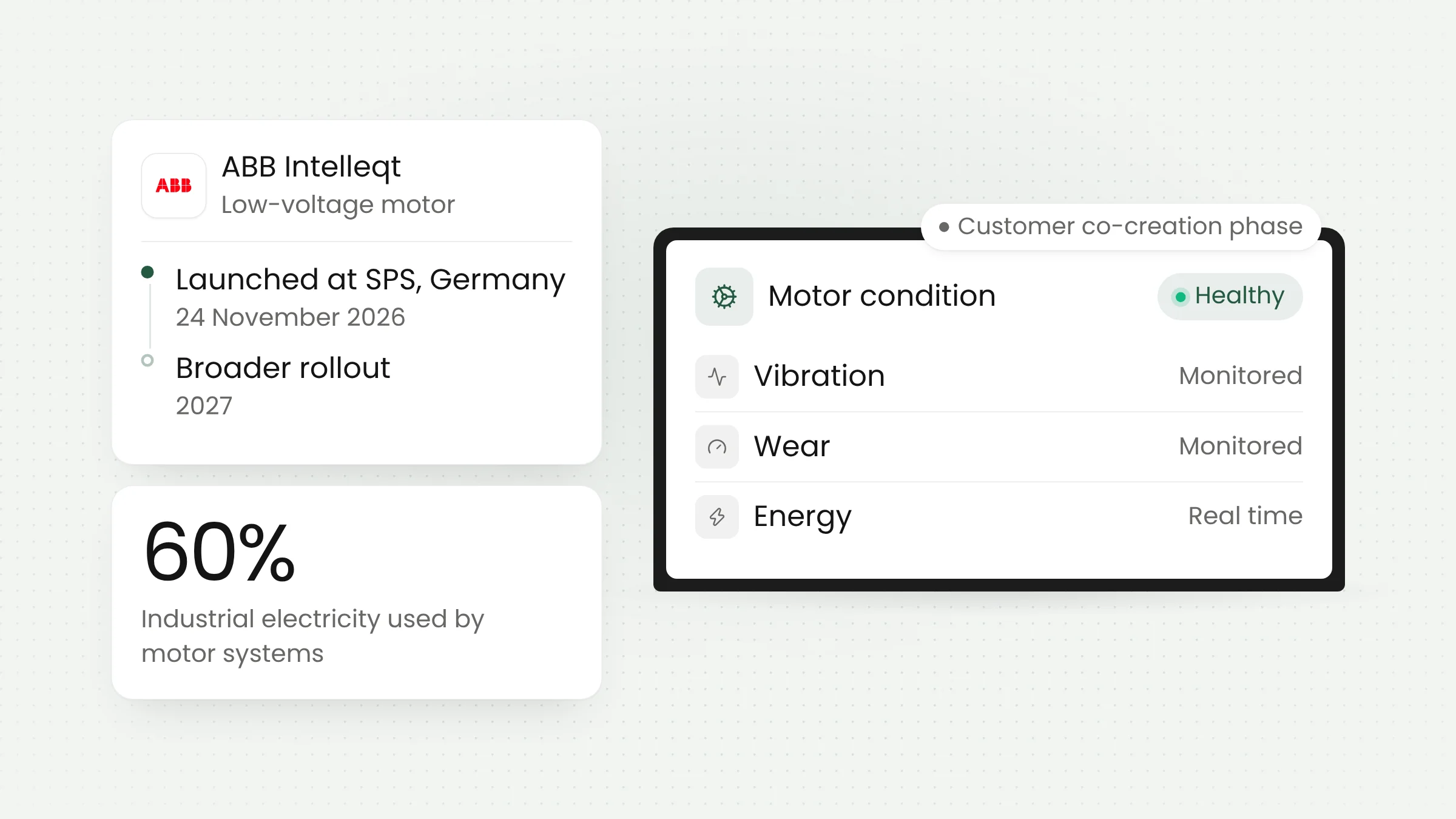
ABB Intelleqt launched on November 24, 2026 at the SPS automation trade fair in Germany. ABB describes it as the world’s first low-voltage motor with sensing, edge computing and connectivity fitted at the factory. The motor is not yet on general sale, and a broader rollout is planned for 2027.
A motor that leaves the factory with its own sensors
Electric motors drive the pumps, fans, compressors and conveyors in almost every plant. Most of them run for years without sending a single data point. Technicians learn about a problem when the sound changes, the casing runs hot, or the line stops.
In ABB’s press release, Intelleqt is presented as a low-voltage motor that ships with three things already inside: sensing, edge computing and connectivity. Edge computing means the data is processed on the device, next to the machine, instead of being sent to a data center first. ABB says the motor provides operational insights from its first rotation and works as a plug-and-play unit with no add-on sensor kit.
The “world’s first” label is ABB’s own and has not been checked by an independent party.
What the motor measures
ABB’s release does not name the sensors. The trade press adds some detail. Drives&Controls reports that the motor tracks wear and vibration, two signals that can reveal a potential failure weeks ahead. Energy use is monitored in real time.
The same outlet describes two ways to read the motor’s condition. A colour-coded LED on the motor shows its health, so a technician can run a local check with no cloud connection. A mobile app communicates with the motor, and live condition data can be passed to analytics platforms.
Open architecture and data ownership
ABB says Intelleqt has an open architecture. Customers can connect motor data to the digital platforms they already run and keep full ownership of that data. PT Review writes that the integration targets are SCADA, MES and industrial AI applications. SCADA systems supervise and control plant processes, and an MES manages production execution.
Several key details have not been announced: supported communication protocols, power range, efficiency class and price. Until the protocols are known, buyers cannot judge how easily the motor will connect to the systems already running in their plants.
Timing and launch markets
Intelleqt is entering what ABB calls a customer co-creation phase, in which the company works with original equipment manufacturers (OEMs) and end users to shape applications. The broader rollout is planned for 2027, starting in Europe, Japan, China and India.
Indonesia and the rest of Southeast Asia are not mentioned in the announcement. Timing for other markets has not been announced.
The numbers behind ABB’s claims
ABB frames the product as an answer to a wider problem: AI projects in factories struggle to grow because the machines themselves supply too little data. The release carries several figures, and the origin of each one matters.
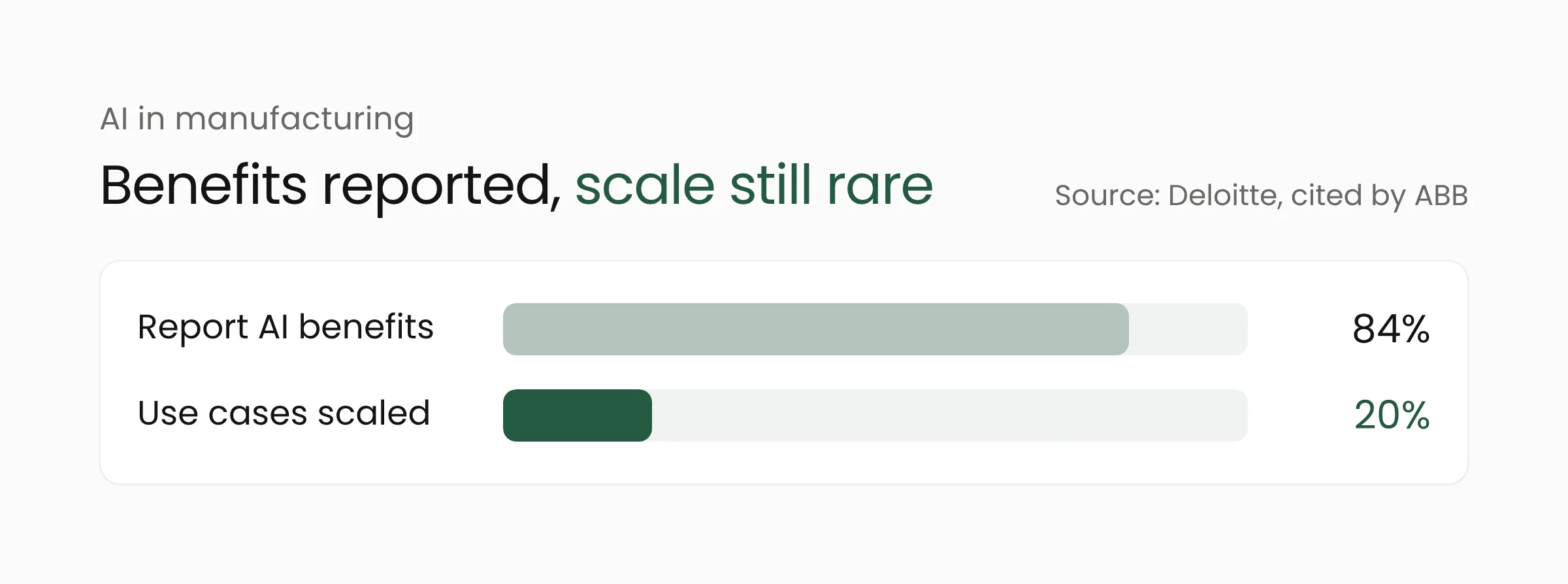
The first comes from a Deloitte report titled “AI in Manufacturing 2026”. As cited by ABB, 84% of manufacturers report benefits from AI, yet only 20% of AI use cases have been scaled successfully.
The second comes from the International Energy Agency (IEA). More than 300 million motor-driven systems operate worldwide and account for 60% of industrial electricity demand. ABB also cites the IEA for energy-saving opportunities of 30% or more.
The third concerns downtime. Citing McKinsey, ABB writes that early fault detection can reduce unplanned downtime by up to 50%. The company adds that a single failure can cost up to $1.5 million.
That $1.5 million figure is ABB’s own calculation. A footnote in the release sets out the assumptions: one critical 110 kW motor fails, production stops for 12 hours, and downtime is priced at a global median of $124,669 per hour. A plant whose hourly output is worth far less will arrive at a far smaller number.
The savings and downtime figures describe what condition monitoring can achieve in general, according to the IEA and McKinsey. They do not come from tests of Intelleqt. Robotics & Automation News covered the launch entirely through statements from ABB and its executive, with no customers or outside analysts. Real results can only be judged once the motor is in service.
Alternatives already on the market
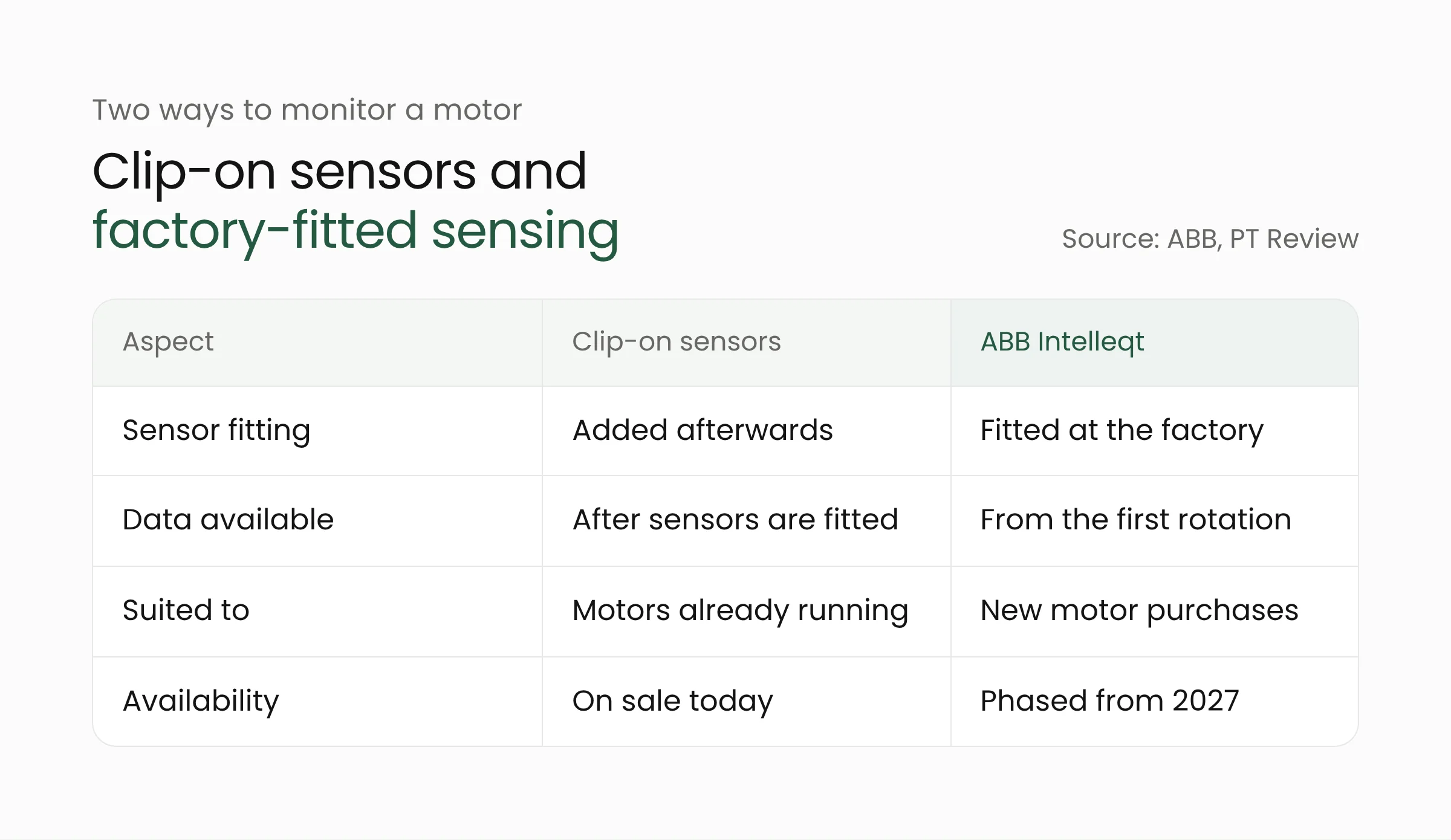
Condition monitoring for motors is not new. The most common route is a clip-on sensor, a small device attached to the housing of a motor that is already in service. PT Review lists several examples: ABB’s own ABB Ability Smart Sensor, Schaeffler OPTIME and SKF Enlight.
Other motor makers sell monitoring packages as well. According to PT Review, Siemens pairs its SIMOTICS motors with SIDRIVE IQ, and WEG pairs the W22 motor with WEG Motor Scan. What ABB highlights with Intelleqt is that sensing, computing and connectivity are assembled inside the motor during production, so the buyer does not purchase and fit a separate device.
For a plant owner, the difference lies in when and how the monitoring gets installed. Clip-on sensors suit the hundreds of motors already running that are not due for replacement. A motor with built-in sensing becomes relevant when the plant buys a new motor or a new machine from an OEM.
What this means for plants in Indonesia
There is nothing to buy today. Intelleqt is not on general sale and Indonesia is not part of the first wave. The announcement is still a useful signal that motor data will increasingly arrive as a standard machine feature. Plants that are ready to receive and use that data will benefit sooner.
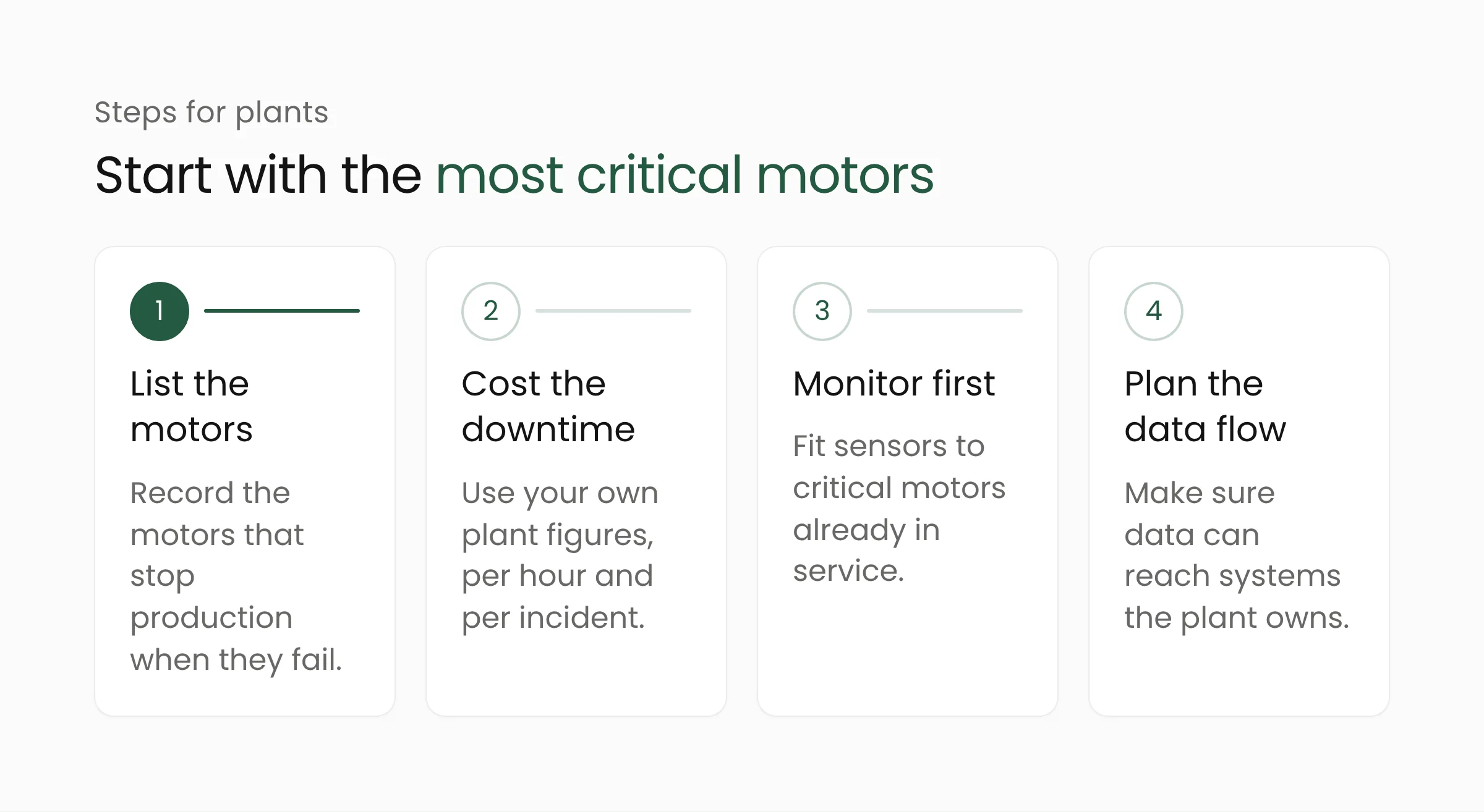
Several steps can start now with equipment that is already available:
- List the most critical motors. Record the motors that stop production when they fail, such as cooling water pumps, air compressors or the main line drive.
- Cost the downtime with your own figures. Work out the production value lost per hour and how long a typical repair takes. This number, more than any global median, decides whether monitoring pays for itself.
- Monitor critical motors already in service. Clip-on sensors and periodic vibration measurements already provide early warning. The readings also give you a baseline for assessing motors with built-in sensing later.
- Decide where the data goes. Vibration data that stays inside a vendor app is hard to combine with production schedules and maintenance records. Make sure it can reach systems the plant controls.
- Ask suppliers the right questions. Ask which protocols are supported, where data is stored, who holds the rights to it, and whether monitoring keeps working without an internet connection.
The fourth step is often the hardest. In industrial automation work, a new sensor starts to pay off once its data meets other data, such as maintenance schedules and production logs. For that reason, IoT devices on the shop floor are best designed together with the dashboards and workflows of the maintenance team from the start.
Plant managers who want to see comparable equipment in person can use the Manufacturing Indonesia Series 2026 at JIExpo Kemayoran, Jakarta, from December 2 to 5, 2026. The event includes Industrial Automation Indonesia. Whether ABB or Intelleqt will be on show there has not been announced.
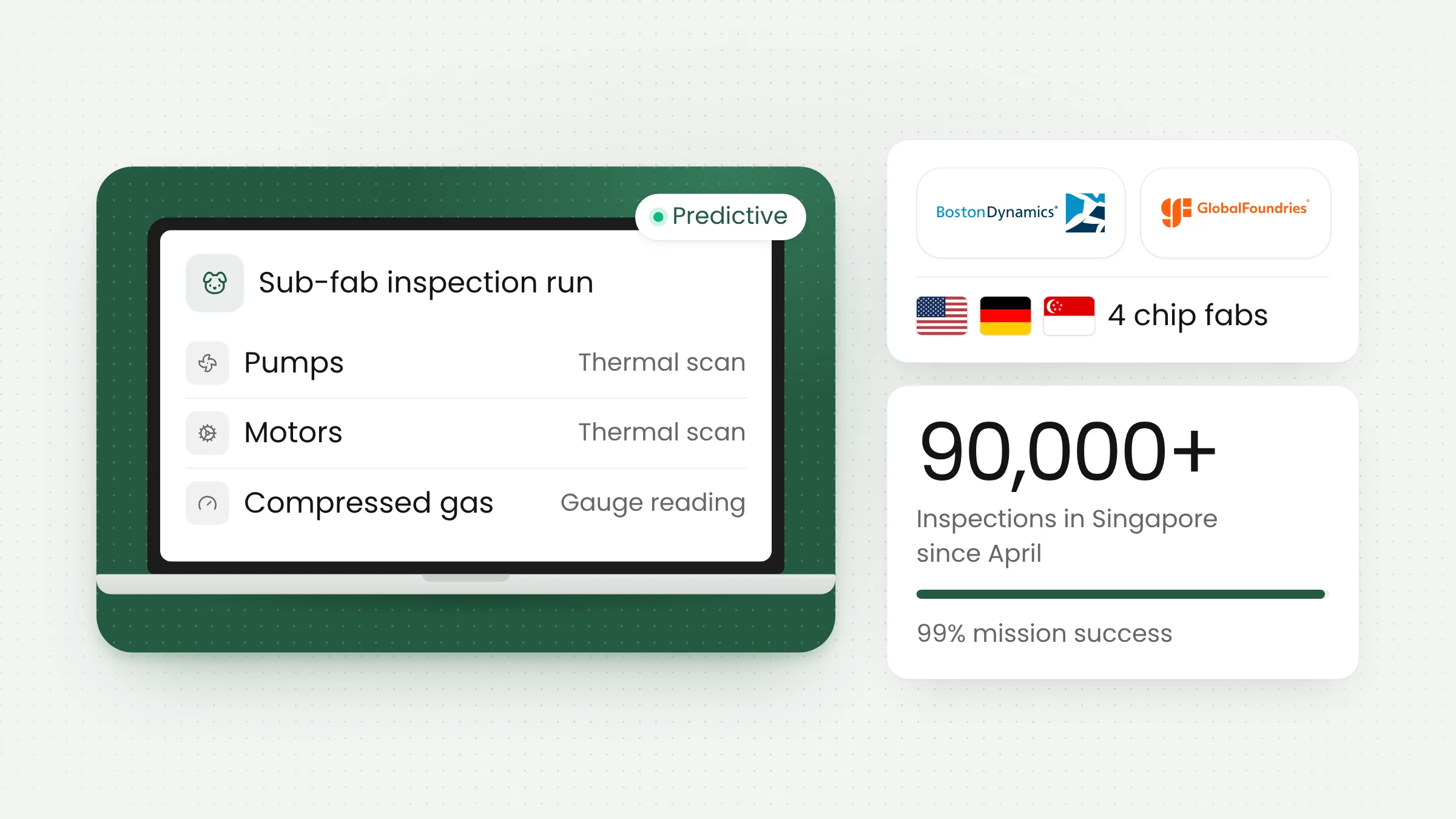
Motor monitoring can also be combined with mobile inspection. One example is covered in our piece on the Spot robot at GlobalFoundries chip fabs, which checks pumps and motors with a thermal camera.
Frequently asked questions
Can ABB Intelleqt be bought in Indonesia yet?
No. ABB says Intelleqt is still in a co-creation phase with OEMs and end users. The broader rollout is planned for 2027 and starts in Europe, Japan, China and India. Timing for Indonesia and pricing have not been announced.
How is this motor different from a sensor attached to an older motor?
A clip-on sensor is bought separately and fitted to a motor that is already operating. With Intelleqt, sensing, edge computing and connectivity are assembled inside the motor during production, so data is available from the first rotation. For motors that are not due for replacement, clip-on sensors remain a sensible choice.
Does the motor need a permanent cloud connection?
According to Drives&Controls, a colour-coded LED on the motor shows its condition and allows local checks with no cloud connection. ABB also says customers can send data to their own platforms. Technical details such as protocols and data storage have not been published.
Closing
Intelleqt shows where industrial equipment makers are heading: machines that arrive able to report their own condition. The product still has to prove itself in the field, and plants in Indonesia are waiting for an official schedule. The work of preparing motor data can begin earlier. If you would like to map your critical motors, choose sensors, or connect their data to a maintenance dashboard, the Merakit team is ready to talk.
Sources
- ABB helps scale industrial AI with world’s first motor featuring built-in intelligence, ABB press release via PR Newswire, November 24, 2026
- ‘World’s first motor with built-in intelligence’ could halve downtime, Drives&Controls, November 24, 2026
- ABB launches ‘world’s first’ industrial motor with built-in AI, Robotics & Automation News, November 24, 2026
- ABB Integrates Edge Computing into Low-Voltage Industrial Motors, PT Review, November 25, 2026
- Solusi Industri Manufaktur Indonesia ada di Manufacturing Indonesia Series 2026, Manufacturing Indonesia Series, accessed November 25, 2026