Blog Humanoid Robots
China's Humanoid Robot Standards: What L0–L5 Means
On this page· 7 sections
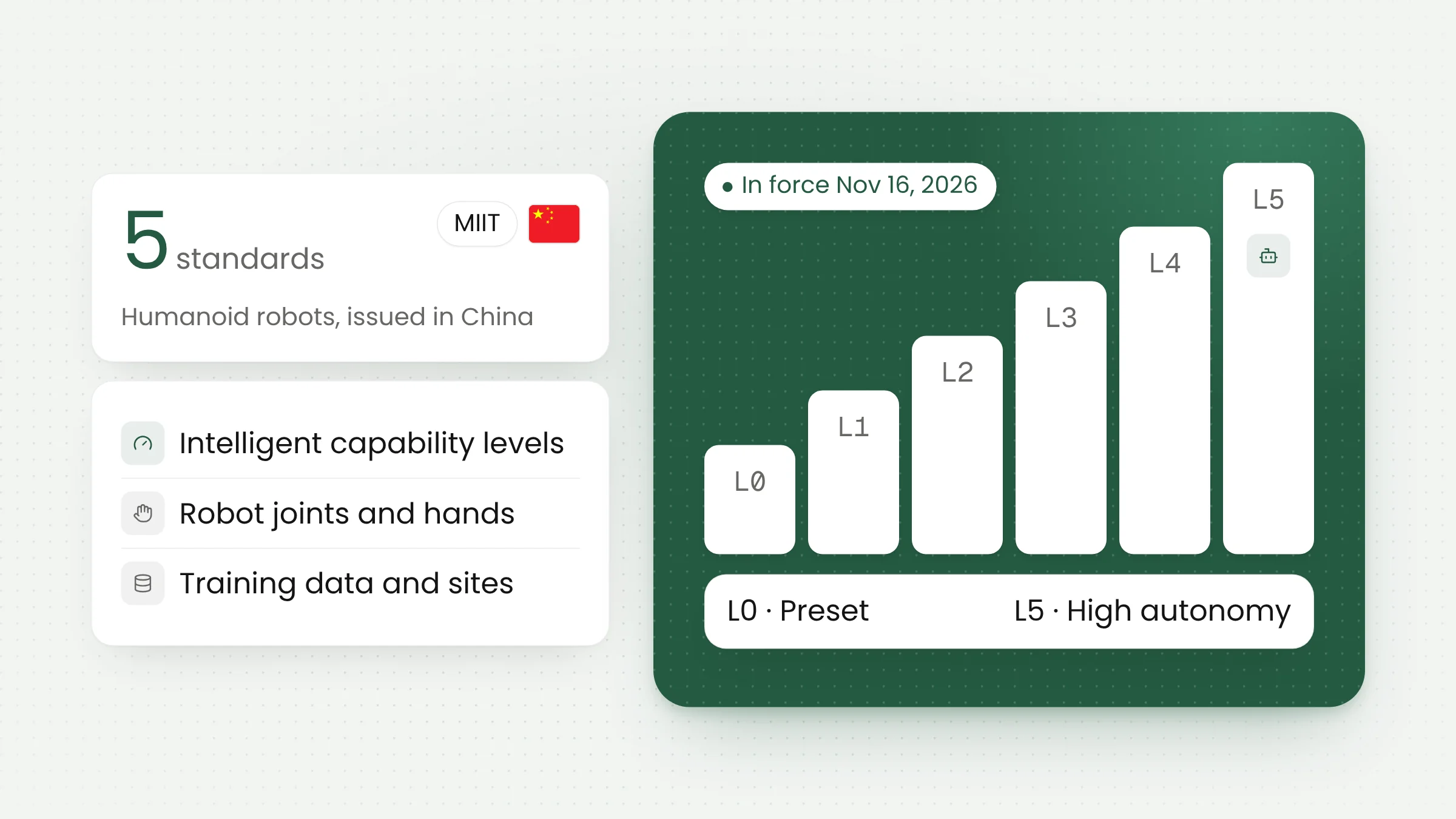
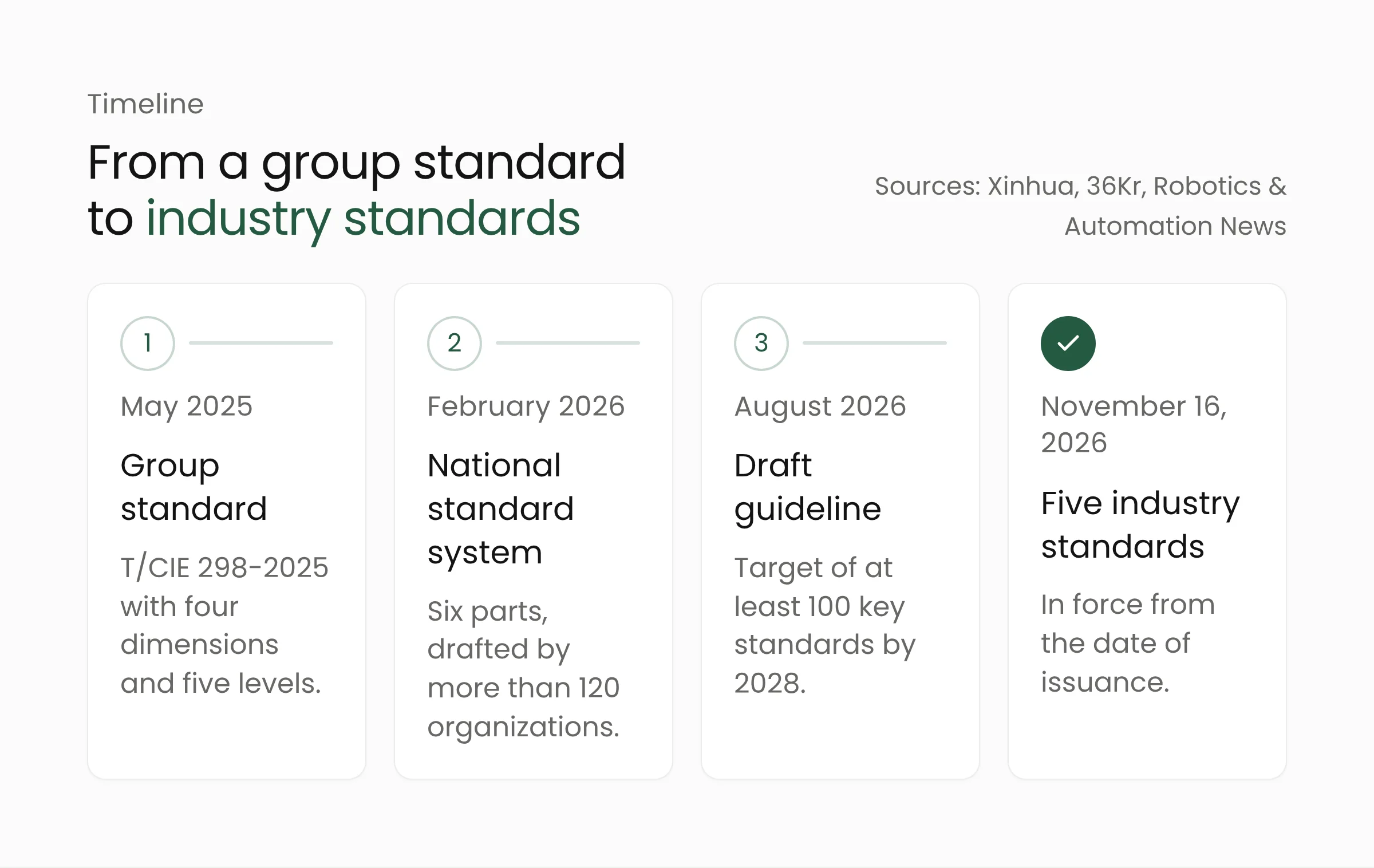
China issued five humanoid robot standards on November 16, 2026, and all of them took effect the same day. One sets a six-level scale for intelligent capability, running from L0 to L5. It gives robot buyers a shared yardstick for comparing products.
Five standards in force since November 16
The Ministry of Industry and Information Technology (MIIT) published the standards in its Announcement No. 30 of 2026. According to 36Kr, they apply from the date of issuance and are administered by MIIT’s standardization technical committee for humanoid robots and embodied intelligence, known as MIIT/TC8. Embodied intelligence is the industry’s term for AI that acts through a physical body such as a robot.
The five documents address three areas: how a robot’s capability is assessed, its key components, and the data and facilities used to train it. Chinese trade outlet znw.com.cn and Humanoid.guide report the same details.
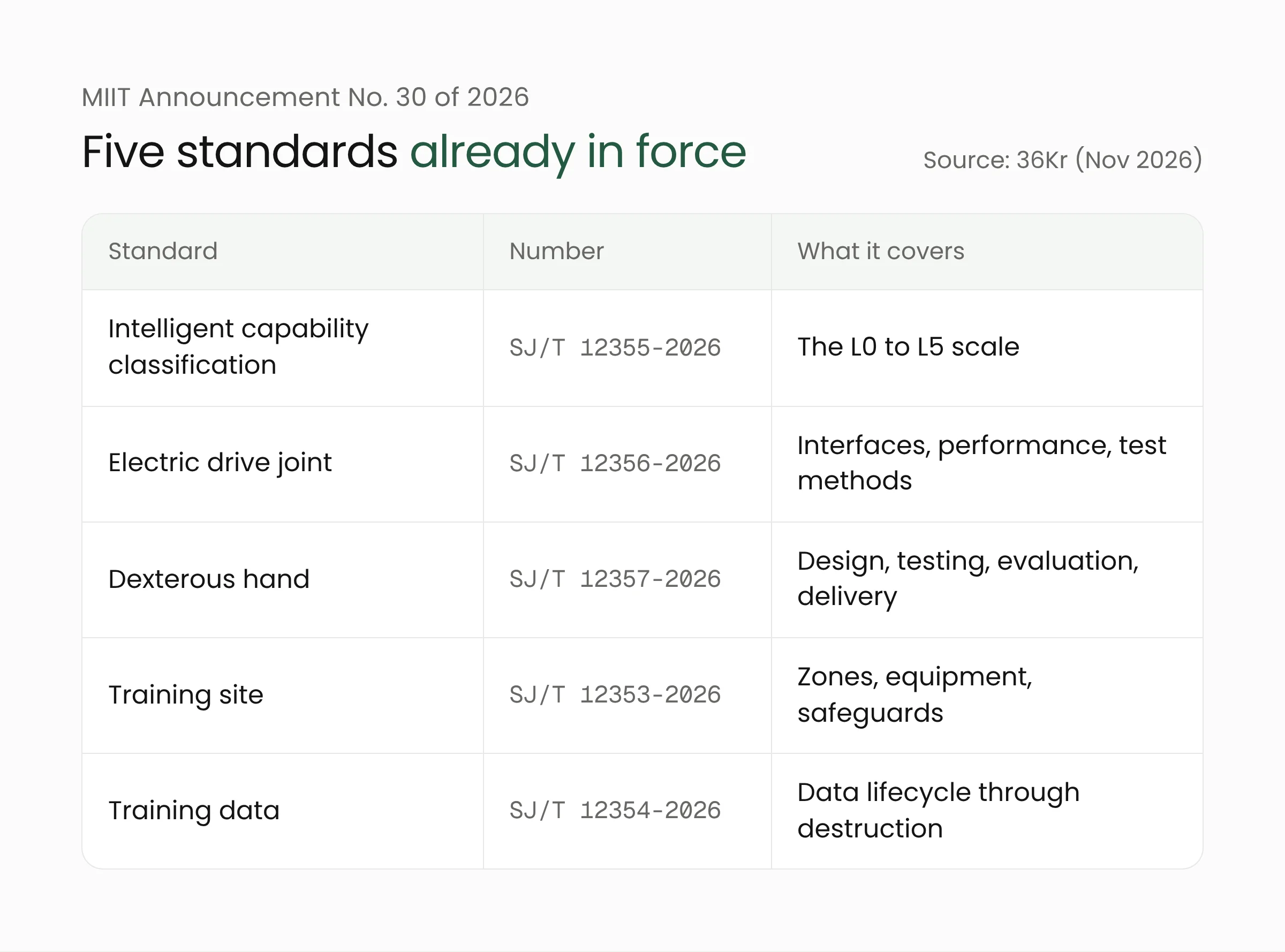
- Classification of intelligent capability (SJ/T 12355-2026). Defines the L0 to L5 scale and how assessment results are presented.
- Integrated electric drive joint (SJ/T 12356-2026). Unifies interfaces, performance indicators, and test methods for robot joints.
- Dexterous hand (SJ/T 12357-2026). Sets specifications for the design, testing, evaluation, and delivery of multi-fingered robot hands.
- Training site construction (SJ/T 12353-2026). Covers the principles, zoning, equipment, and safeguards of facilities where robots are trained.
- Training data management (SJ/T 12354-2026). Covers the full data lifecycle, from collection to destruction.
The SJ/T prefix marks a recommended standard for China’s electronics industry. They are a technical reference and not yet a legal condition for selling a robot.
Rules for training sites and training data
Humanoid robots learn from large volumes of recorded motion data. The znw.com.cn explainer describes SJ/T 12353-2026 as the first training-site standard written specifically for humanoid robots. It asks operators to divide a site into functional zones, including a scenario training area, a data center, a maintenance area, and a test area that combines simulation with real robots.
Safety is organized in three tiers. The physical tier covers collision prevention and emergency braking. The data tier covers the masking of personal information and encrypted transmission. The ethical tier prohibits training scenarios that do not comply with the rules.
The training data standard follows data from collection and annotation through storage, use, and destruction.
How the L0 to L5 scale rates a robot
The classification standard gives the industry common terms for something that has been hard to compare across products. According to 36Kr, the scale follows a robot’s degree of autonomy. L0 describes a robot that only carries out preset actions. L5 describes a robot with high autonomy and the ability to improve its own capabilities.
The reports we reviewed do not spell out the definitions of L1 through L4. The full text of the standard should be read before a level number goes into any procurement document.
Four dimensions of assessment
A robot is assessed on four dimensions:
- Perception and cognition, or how well it understands its surroundings.
- Decision-making and learning, or how well it plans tasks on its own.
- Execution performance, or how precisely it operates.
- Collaboration and interaction, or how well it works alongside people.
Three ways results are reported
The outcome is not reduced to a single number. The standard uses three forms of presentation. A capability profile, drawn as a radar chart, shows a robot’s strengths and weaknesses across the four dimensions. A basic level is used for broad classification and as a safety baseline. A comprehensive level reflects the overall balance of capabilities and supports comparison between products.
Tiered scales of this kind are familiar from the car industry. Robotics & Automation News cites SAE J3016, which divides driving automation into Levels 0 to 5, as a model for grading humanoid autonomy. The outlet also notes an earlier group standard, T/CIE 298-2025, published in May 2025 by the Beijing Humanoid Robot Innovation Center with a four-dimension, five-level structure.
Where the five standards sit in China’s plan
The five standards are one step in a program that has run through 2026. In late February, the MIIT/TC8 committee released the country’s first national standard system for humanoid robots and embodied intelligence at its annual meeting in Beijing. Xinhua reported that more than 120 research institutions, companies, and industry users took part in drafting it. The framework has six parts: basic commonality, intelligent computing, limbs and components, complete machines and systems, applications, and safety and ethics.
In August 2026, MIIT opened a draft guideline on the standard system for public comment. Xinhua reported two targets for 2028: at least 100 key standards, and more than 200 enterprises putting them into practice. The draft also calls for standards on ethical requirements and social-impact assessments.
The size of the industry explains the pace. MIIT says China has developed more than 400 humanoid robot models, over half the global total. In 2025, more than 140 domestic manufacturers released more than 330 models. Robotics & Automation News reported that Agibot built its 10,000th humanoid on March 30, 2026, and that UBTech plans 5,000 units in 2026.
Officials have also stressed implementation. At the committee’s plenary session in Shaoxing this year, MIIT Vice-Minister Ke Jixin said “standards must not remain on paper”, as quoted by China Daily.
Limits worth knowing
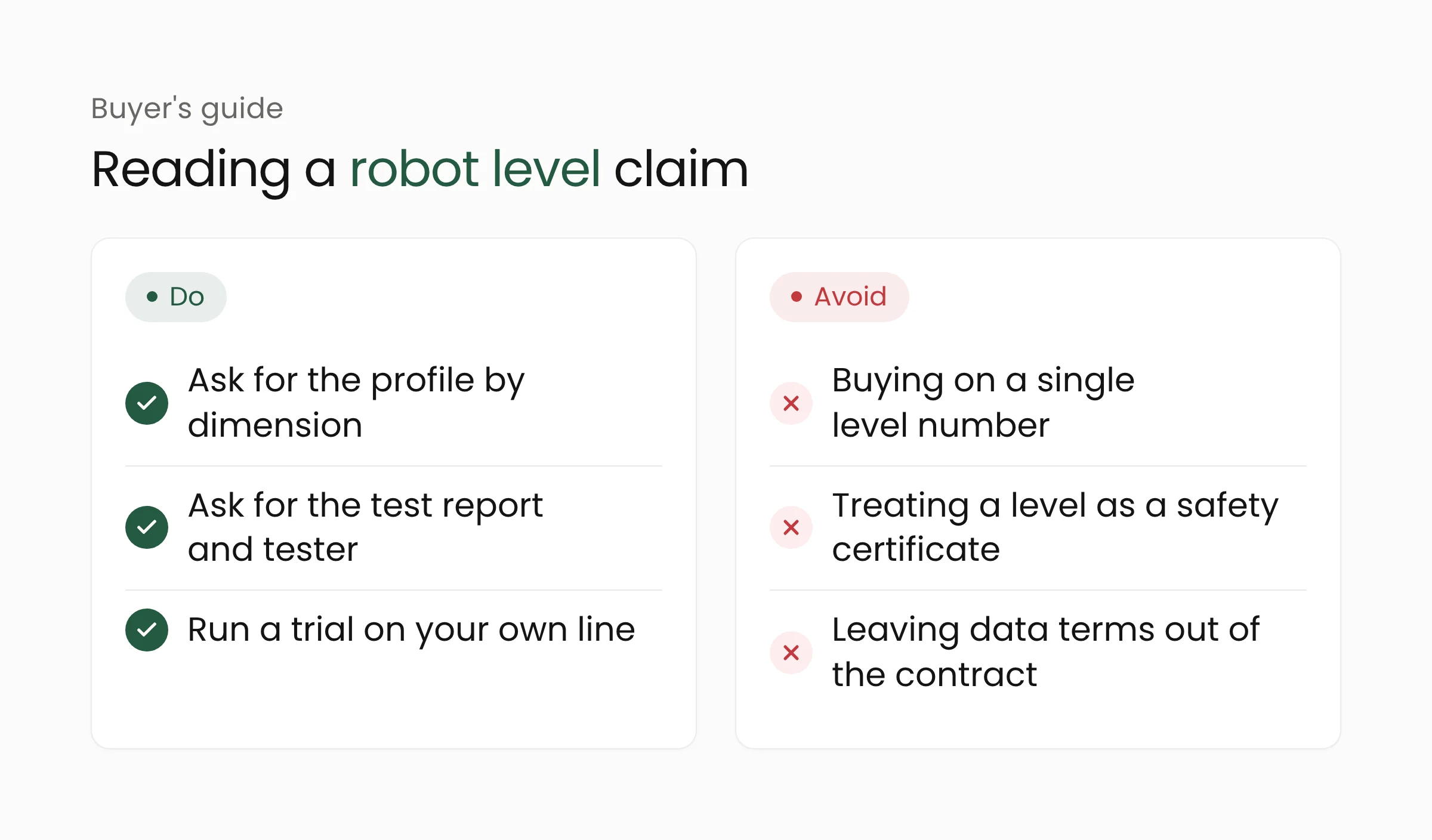
Three caveats apply. First, these are recommended Chinese industry standards, so manufacturers elsewhere are not bound by them. Second, the coverage so far does not say who tests a robot and assigns its level, whether an independent body or the maker itself. Third, an intelligent capability level is a different thing from machinery safety certification. A robot with a high level still has to meet the workplace safety rules of the site where it is installed.
What this means for factories and warehouses
China accounts for more than half of the world’s humanoid robot models, so L0 to L5 labels are likely to appear in brochures and quotations well beyond its borders, including in Indonesia. For plants and warehouses weighing industrial automation, several steps are worth taking now.
- Ask for the capability profile by dimension. A single level number is too little to go on. Ask how the robot scores on perception, decision-making, execution, and collaboration, then match that against the job.
- Ask who ran the test. Request the test report, the name of the testing body, and the version of the standard used.
- Check component interfaces. The joint and hand standards exist to make interfaces and test methods uniform. Ask whether the robot’s components follow them, because that affects spare-part availability and maintenance cost.
- Settle data terms in the contract. A robot retrained on your site will record workers’ movements and the plant layout. Decide who owns the data, where it is stored, and when it is destroyed. Footage that shows workers’ faces or identities is personal data under Indonesia’s Undang-Undang Pelindungan Data Pribadi (Personal Data Protection Law).
- Run a trial on your own line. Set measurable targets such as cycles per hour and the number of operator interventions. A team that builds artificial intelligence solutions or handles systems integration can help connect a robot to the production systems already in place.
We covered manufacturers’ plans in pieces on Toyota Robotics and early production of Tesla’s Optimus. China’s standards add a common measure of what a robot can do.
Frequently asked questions
What do L0 to L5 mean for a humanoid robot?
They are the six levels of intelligent capability in standard SJ/T 12355-2026. L0 marks a robot that only performs preset actions. L5 marks a robot with high autonomy that can improve its own capabilities.
Are the standards mandatory?
All five carry the SJ/T prefix, which denotes a recommended industry standard. They have applied in China since November 16, 2026 as a reference for development, testing, and product selection. Buyers in other countries can use them as a point of comparison, but they still have to follow their own safety and data protection rules.
Does a high level mean a robot is safe to use in a factory?
It does not follow automatically. A level describes capability and autonomy. Workplace safety depends on a site risk assessment, physical safeguards, emergency stop procedures, and operator training. The basic level in the standard does include a safety baseline, but the reports so far do not explain it in detail.
Closing
The five standards give buyers and makers a common vocabulary, and MIIT is aiming for at least 100 key standards by 2028. Factories in Indonesia can use the time to list tasks worth automating and write clear test criteria. To discuss data and production-system readiness before trialing a robot, talk to the Merakit team.
Sources
- MIIT Unveils 5 Humanoid Robot Industry Standards, 36Kr, November 19, 2026
- Explainer on MIIT’s five humanoid robot industry standards (in Chinese), znw.com.cn, November 19, 2026
- Report on China’s five humanoid robot standards, Humanoid.guide, November 21, 2026
- China proposes formulating at least 100 key standards for humanoid robots by 2028, Xinhua via People’s Daily Online, August 25, 2026
- China releases national standard system for humanoid robotics and embodied AI, Xinhua, March 1, 2026
- From factory tools to public risk: Why humanoid robot standards matter now, Robotics & Automation News, March 31, 2026
- Nation sets standards to propel humanoid robot industry toward mass production, China Daily, July 21, 2026