Blog Industrial Automation
Toyota Robotics Launches With a 400,000-Robot Plan
On this page· 7 sections
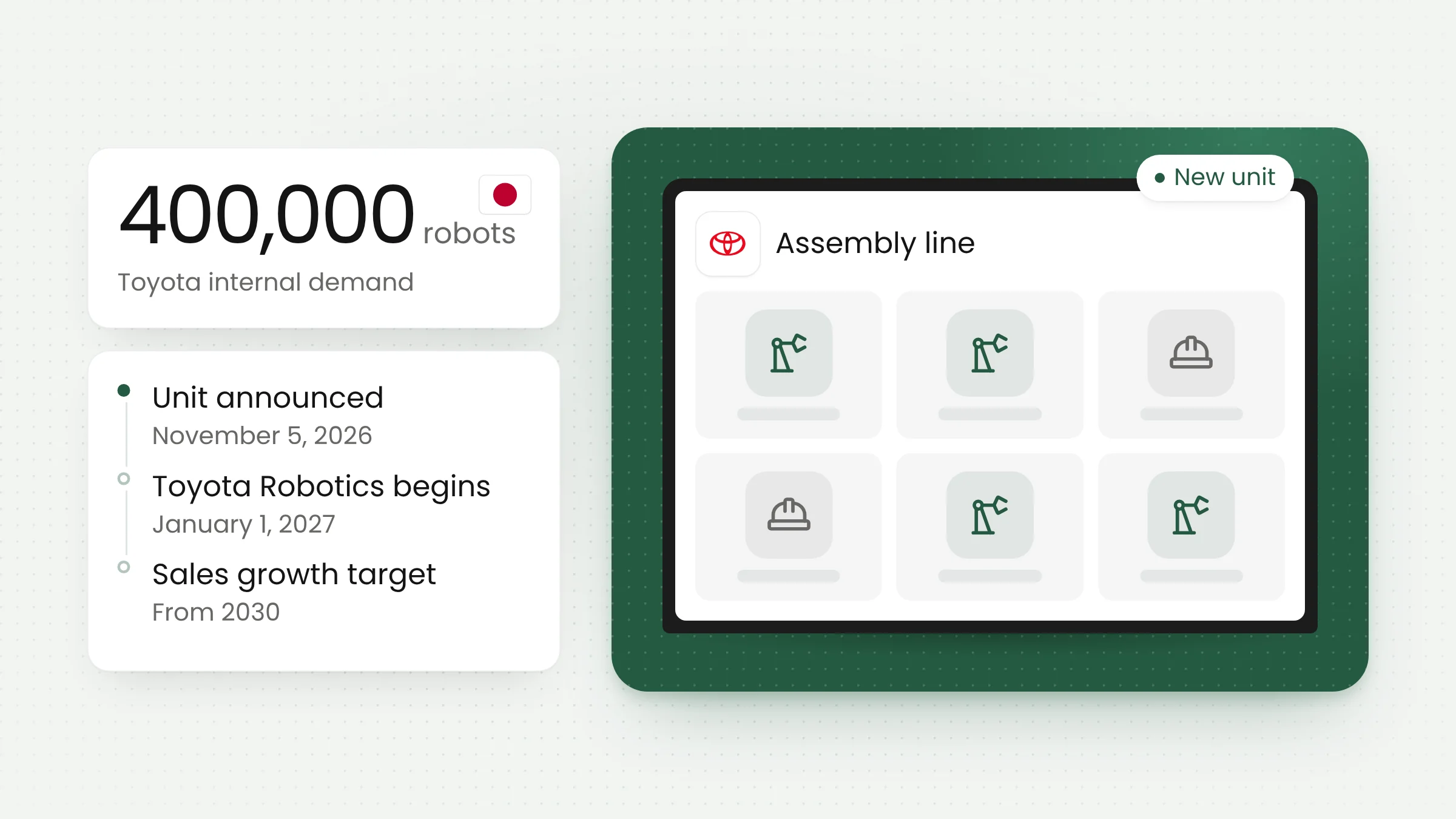
Toyota Motor Corporation is setting up Toyota Robotics, a company-wide robotics unit that starts work on January 1, 2027. At its November 5, 2026 earnings briefing, Toyota described internal demand for about 400,000 robots as the unit’s first market and said it is aiming for steady robotics sales growth from 2030.
A robotics unit reporting to headquarters
The unit is part of a set of organizational changes that Toyota announced in Toyota City on November 5, effective January 1, 2027. Toyota says robotics will become a key pillar of its future business, built on the engineering expertise and shop floor capabilities it has developed through making cars.
Toyota Robotics will be a company-wide organization under direct corporate oversight. It will be led by Takefumi Shiga, Toyota’s Operating Officer and Chief Production Officer, who keeps his current roles. His first task is to bring together the robotics expertise, people, and functions that are currently spread across the company.
The release frames the robots as helpers for workers. Toyota says it wants to introduce robots into society “not as machines that take away people’s jobs, but as partners that stand alongside them and expand their potential.” The new unit will work with development departments and draw on problems found at the genba, Toyota’s term for the shop floor, to speed up the practical use, commercialization, and deployment of robots.
Part of a wider reorganization
Toyota Robotics arrives alongside several other changes. The Carbon Neutral Engineering Development Center will be abolished, and its functions will move into the Powertrain Company with a focus on hybrid systems. The Frontier Research Center will also close, with its work folded into the Advanced R&D and Engineering Company and the Software Development Center.
Toyota is also creating a Toyota Philosophy and Education Group led by Chairman Akio Toyoda, and a Kanri Group that combines general administration, human resources, and accounting. At the regional level, Toyota will appoint new CEOs for North America, China, and Asia.
400,000 robots as the first customer
The most quoted figure came from Toyota’s fiscal second-quarter earnings call. According to the call transcript, Chief Financial Officer Yoichi Miyazaki pointed to internal demand for about 400,000 robots and an annual requirement of about 1 trillion yen to replace aging equipment. Toyota wants to turn both from costs into a business opportunity.
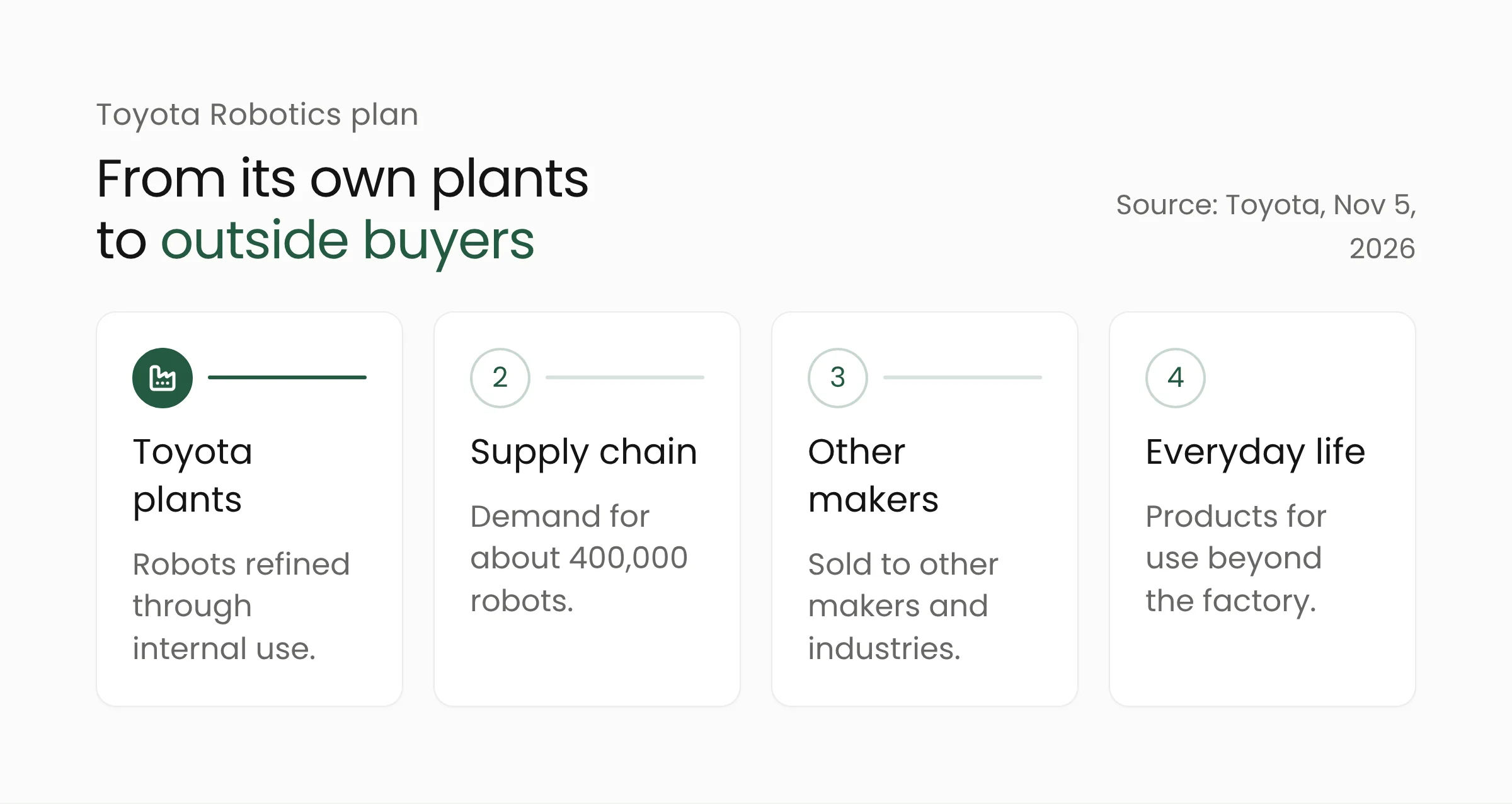
The plan moves in stages. Toyota will first refine its robots through internal use, then sell to other manufacturers and industries, and later offer products for everyday life. Miyazaki said Toyota Robotics is being created to secure steady sales growth from 2030 onward. Toyota will also speed up robot deployment at Woven City.
The 400,000 figure is an internal projection
The 400,000 figure deserves careful reading. Citing Nikkei Asia, Motor1 reported that it covers both humanoid and non-humanoid machines, including replacements for aging equipment as well as new installations. Motor1 also noted that the number is an internal projection and that Toyota has not said how long any such program would run.
The announcement comes while Toyota’s finances are strong. According to Automotive Manufacturing Solutions, Toyota raised its full-year operating profit forecast from 3.4 trillion yen to 3.9 trillion yen.
What Toyota brings from its production lines
Miyazaki listed six strengths that Toyota believes will set its robotics business apart. The first is the Toyota Production System (TPS). Under that approach, waste has to be removed from a process before automation is added. Toyota describes its robots as a digital, automated form of TPS, so they are meant to fit into a cleaned-up process instead of being bolted onto a messy one.
Another strength is shop floor data. Miyazaki said 18,000 skilled workers across 60 Toyota plants worldwide carry out continuous improvement every day, and Toyota plans to use the data from that work to speed up robot development. Toyota is also counting on reliable hardware and a core robot model designed to help robots learn workers’ skills efficiently.
On the software side, Toyota plans to use Arene, its autonomous driving software platform, together with a factory control platform so robots can be deployed and coordinated across whole plants. That matters because a factory robot rarely works alone. It needs to know the production schedule, the status of nearby machines, and where people are standing.
Competition in industrial robotics
Toyota has worked on robots for years. According to American Machinist, Toyota Research Institute and Boston Dynamics partnered in 2024 to accelerate work on general-purpose humanoid robots, combining Toyota Research Institute’s Large Behavior Models with the Atlas robot.
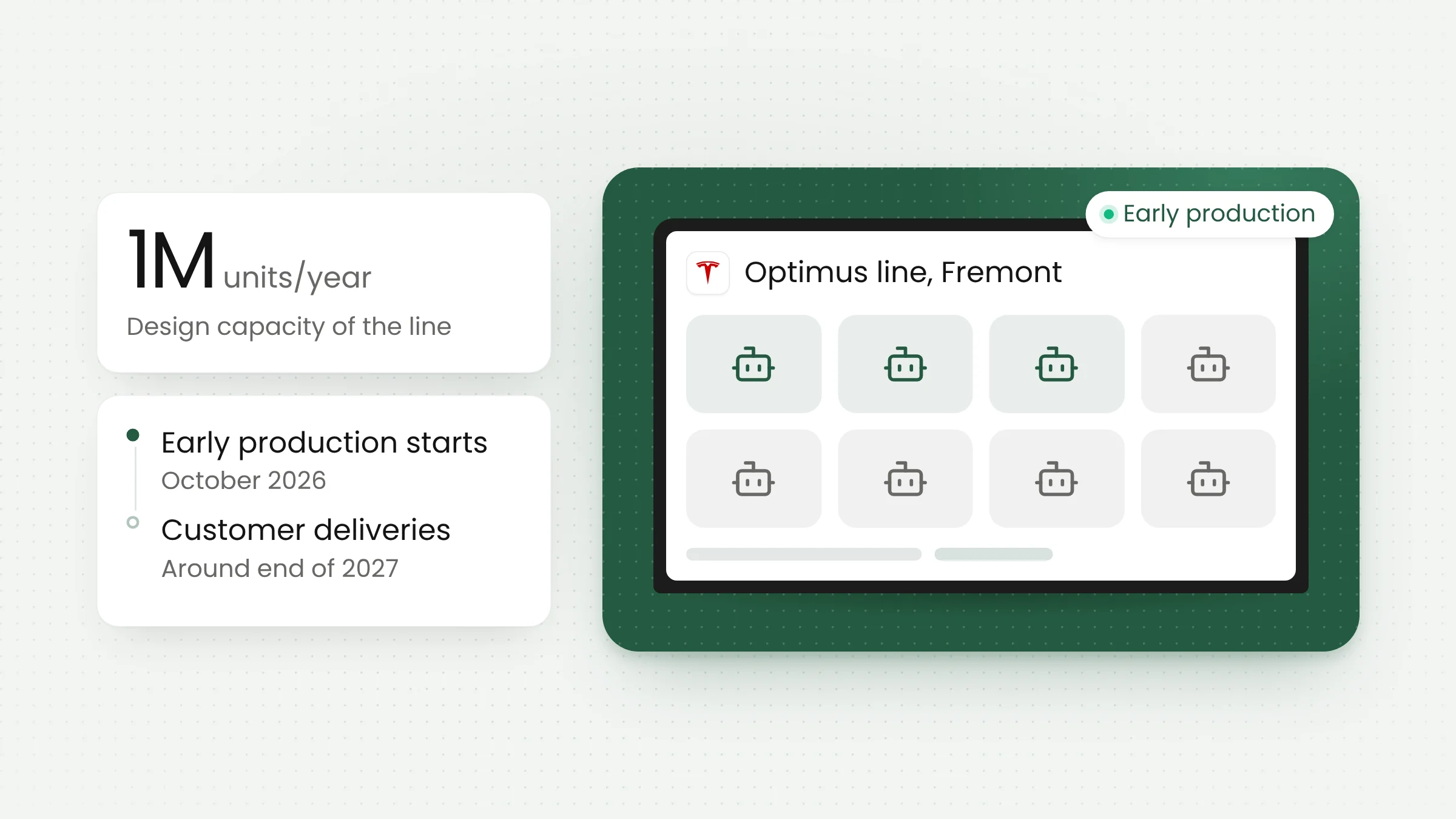
The move also follows a wider trend among carmakers. Gasgoo noted that Honda and Nissan are expanding their robotics efforts, while BYD, XPENG, and NIO are exploring humanoid robots. Tesla has taken a similar route by making its own factories the first users of its robot, as covered in our piece on early Tesla Optimus production.
What this means for factories in Indonesia
Most Indonesian factories will never install hundreds of thousands of robots. Still, the way Toyota has structured its plan offers lessons that apply at any scale, from auto parts suppliers to food and beverage plants.
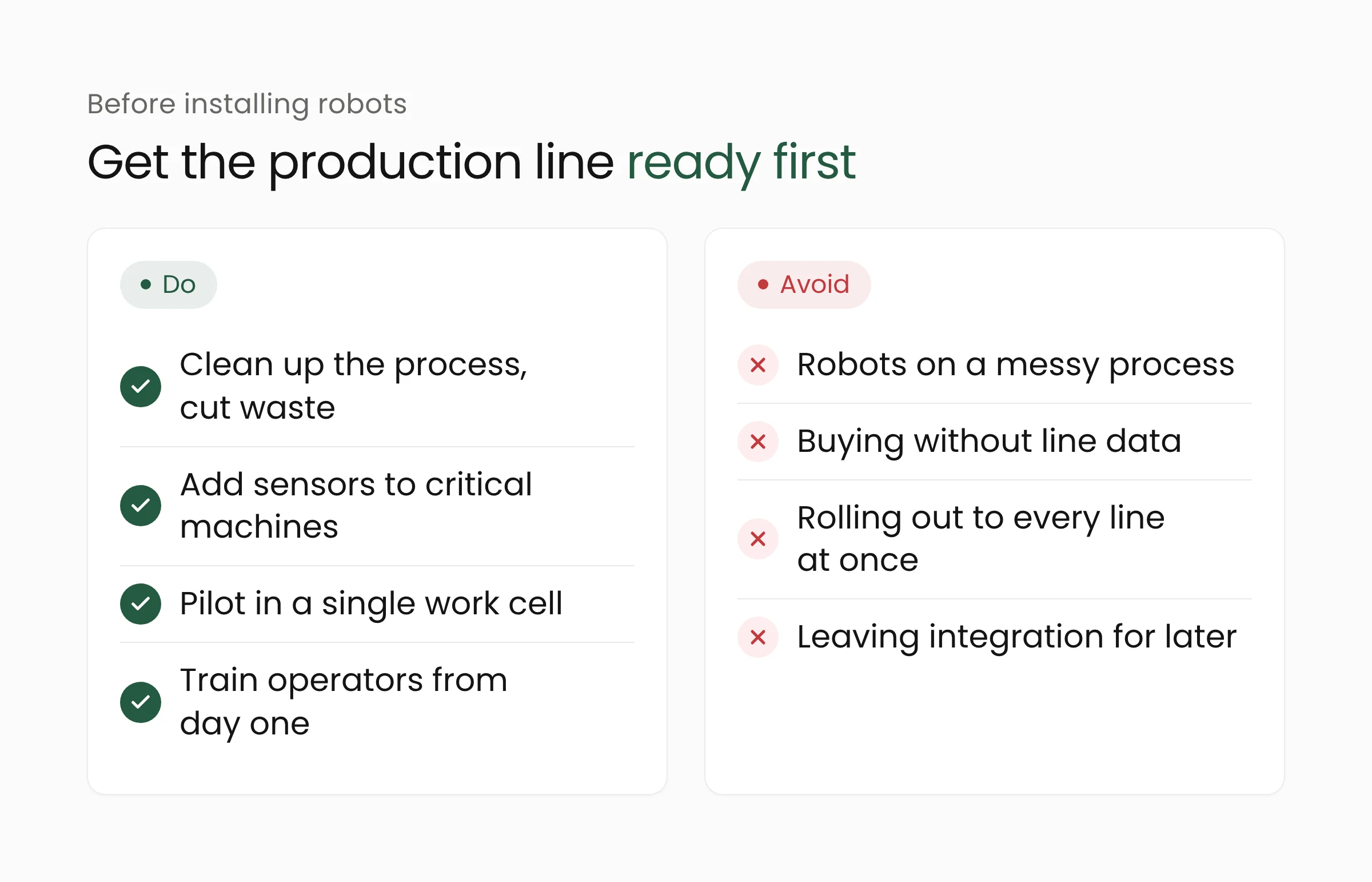
First, fix the process before buying a robot. The TPS principle Miyazaki described applies to small plants too. Map repetitive steps, waiting time, and rework. A robot installed on a wasteful process will only produce that waste faster.
Second, collect production line data early. Toyota relies on data from dozens of plants and thousands of workers. A factory in Indonesia can start with sensors on critical machines, downtime logs, and a daily production dashboard. That data shows which robot is worth buying and which line will benefit most. An IoT services team typically helps at this stage, for example by connecting older machines to a monitoring system.
Third, start with one work cell and measure the results. Toyota is proving its robots in its own plants before selling them. Other manufacturers can follow the same pattern by running a pilot in a single cell, setting clear success measures such as cycle time or defect rate, and expanding only when those numbers improve.
Fourth, involve operators from the start. Toyota positions robots as partners for workers. On the shop floor, operators who know the process are often the best source of data for teaching a robot. Plan retraining and explain how roles will change before the robot arrives.
Fifth, plan integration from day one. A robot has to connect with production schedules, warehouse systems, and quality reports, and integration added later usually costs more. Our industrial automation solutions page covers this in more detail.
Frequently asked questions
When does Toyota Robotics start operating?
Toyota Robotics will be formally established on January 1, 2027, as part of the organizational changes Toyota announced on November 5, 2026. It will be led by Takefumi Shiga, Toyota’s Chief Production Officer.
Will Toyota sell robots to other companies?
Yes, in stages. According to CFO Yoichi Miyazaki, Toyota will first refine its robots for internal use and then sell them to other manufacturers and industries. Toyota is targeting steady robotics sales growth from 2030. Pricing and specific products have not been announced.
Are all 400,000 robots humanoids?
No. Citing Nikkei Asia, Motor1 reported that the figure includes both humanoid and non-humanoid robots, as well as replacements for older equipment. It is also an internal projection, so it is not a purchase commitment.
Conclusion
Toyota is treating its own plants as both a testing ground and the first market for the robots it builds. For manufacturers in Indonesia, the most useful lesson is the order of work: clean up the process, gather data, test in one cell, then scale. If your team is mapping which production lines are ready for automation, we would be glad to help plan the first steps.
Sources
- TMC Announces Changes to Organizational Structure and Executive and Senior Professional / Senior Management Employee Positions (Toyota Motor Corporation, November 5, 2026)
- Toyota Motor (TM) Q2 2027 Earnings Call Transcript (The Motley Fool, November 5, 2026)
- Toyota puts robotics at heart of manufacturing strategy with new division (Automotive Manufacturing Solutions, November 6, 2026)
- Toyota Centralizes Robotics in a New Corporate Strategy (American Machinist, November 6, 2026)
- Toyota establishes robotics division, opens “second front” (Gasgoo, November 6, 2026)
- Toyota Is Installing 400,000 Robots, But Humans Still Matter (Motor1)