Blog Anthropic IPO
Anthropic IPO Prospectus: What It Tells Companies Using AI
On this page· 8 sections
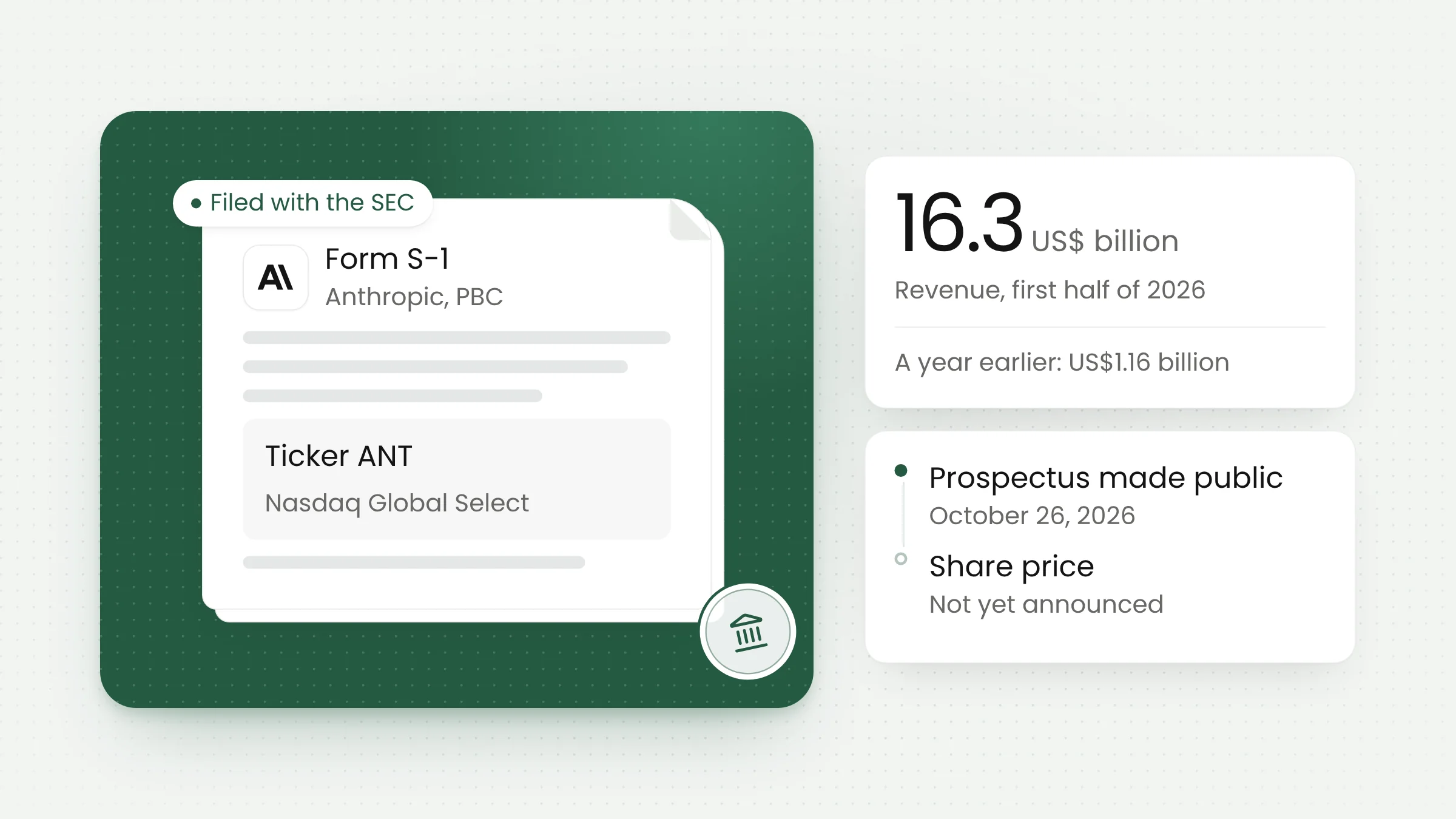
Anthropic, the developer of the Claude AI models, made its IPO prospectus public on October 26, 2026. The Form S-1 filed with the US Securities and Exchange Commission (SEC) reports US$16.3 billion in revenue for the first half of 2026, a large net loss, and long-term compute commitments to three cloud providers.
What the Anthropic Form S-1 contains
According to the Form S-1 on the SEC website, Anthropic has applied to list its Class A common stock on the Nasdaq Global Select Market under the ticker ANT. The price range and the number of shares on offer are still blank. The registration statement has not yet become effective, so the shares cannot trade.
On timing, The Next Web cited a Wall Street Journal report that Anthropic is aiming to list in the week of November 16, 2026, noting that the schedule could change. The same report mentioned a possible valuation of US$1.5 trillion to US$2 trillion. That figure does not appear in the prospectus and has not been confirmed by the company.
The prospectus also includes a section on Indonesia. It states that the document is not a public offering in Indonesia under Law Number 8 of 1995 on Capital Markets, and that the shares may not be offered publicly to Indonesian citizens or residents. For retail investors in Indonesia, access to the stock will not come through a domestic public offering.
Revenue jumps while the net loss stays large
The financial tables in the prospectus show first-half 2026 revenue of US$16.29 billion, up from US$1.16 billion in the same period a year earlier. In the second quarter of 2026, Anthropic recorded operating income of US$974 million after several loss-making quarters. Over the full half-year, the company still posted an operating loss.
The net loss for the first half of 2026 reached US$80.7 billion. Most of it came from a US$72.4 billion change in the fair value of convertible notes, derivative liabilities, and SAFEs. This is a non-cash item, driven by the rising company valuation that lifts the value of those instruments. The prospectus also records a US$1.5 billion Bartz copyright settlement in 2025.
On customers, Anthropic says it had more than 11,900 customers generating at least US$100,000 in trailing twelve-month revenue as of September 30, 2026, up from more than 950 a year earlier. About 250 customers generated at least US$10 million.
That revenue is concentrated. The top five customers accounted for about 25 percent of revenue in the first nine months of 2026, and the prospectus says many top customers are not bound by long-term contracts. The company warns that losing or seeing reduced spending from major customers could hurt its business.
Reliance on three cloud providers
For AI buyers, the most relevant part of the filing is the compute supply chain. Anthropic sells Claude through its own apps, through Claude Platform for developers, and through three major cloud platforms: Amazon Web Services, Google Cloud, and Microsoft Azure. A model from one developer can be bought through several channels, yet it still runs in data centers owned by a handful of companies.
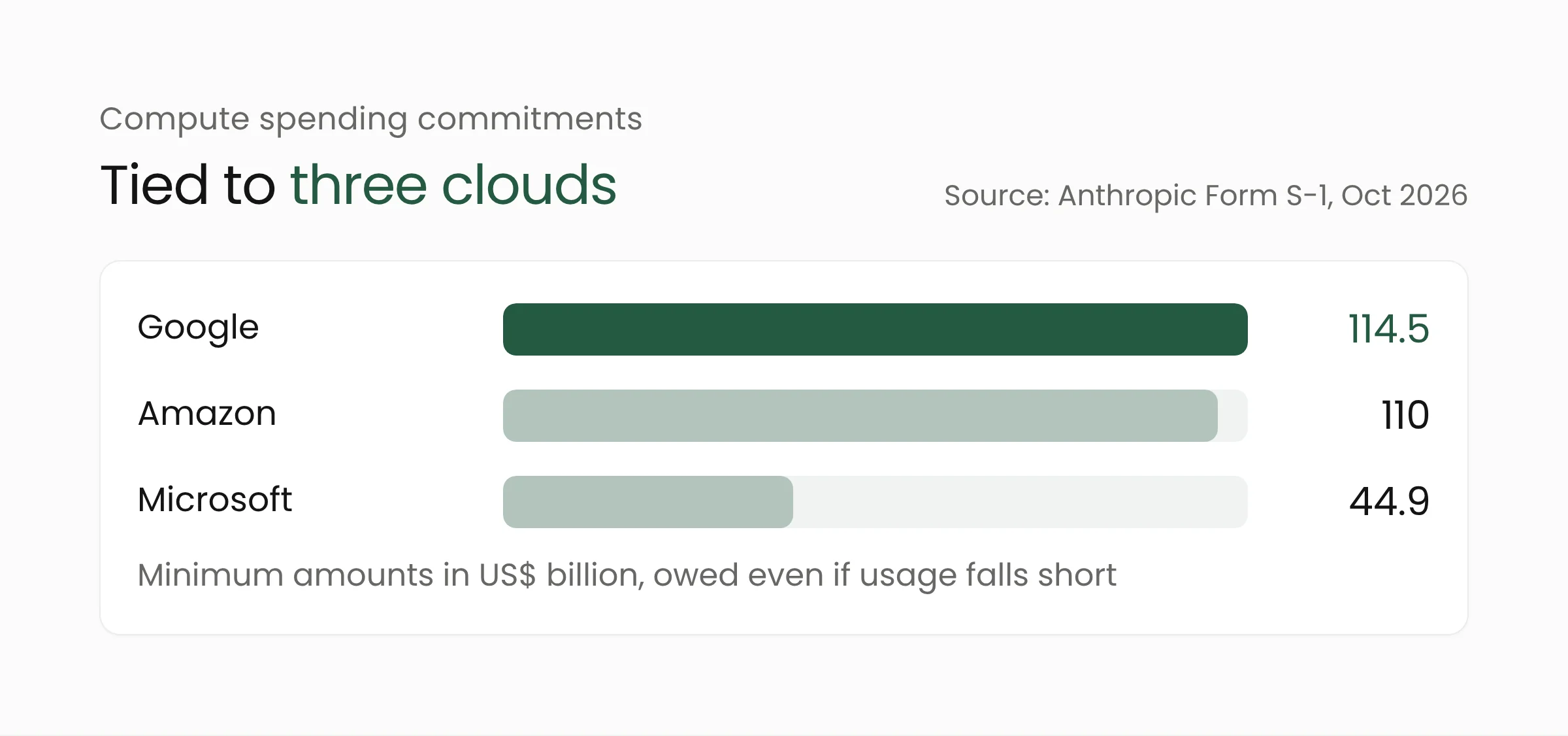
The prospectus details minimum spending commitments that must be paid even if actual usage is lower. Anthropic committed to spend at least about US$114.5 billion with Google between April 2026 and July 2033, at least US$110 billion with Amazon between May 2026 and April 2036, and at least US$44.9 billion with Microsoft between November 2026 and May 2033.
The company also estimates additional payments of US$125 billion to US$150 billion for TPU capacity delivered between 2028 and 2031, which are not included in its contractual commitments table. Compute and infrastructure is already the largest expense: US$8.9 billion in the first half of 2026, more than half of revenue.
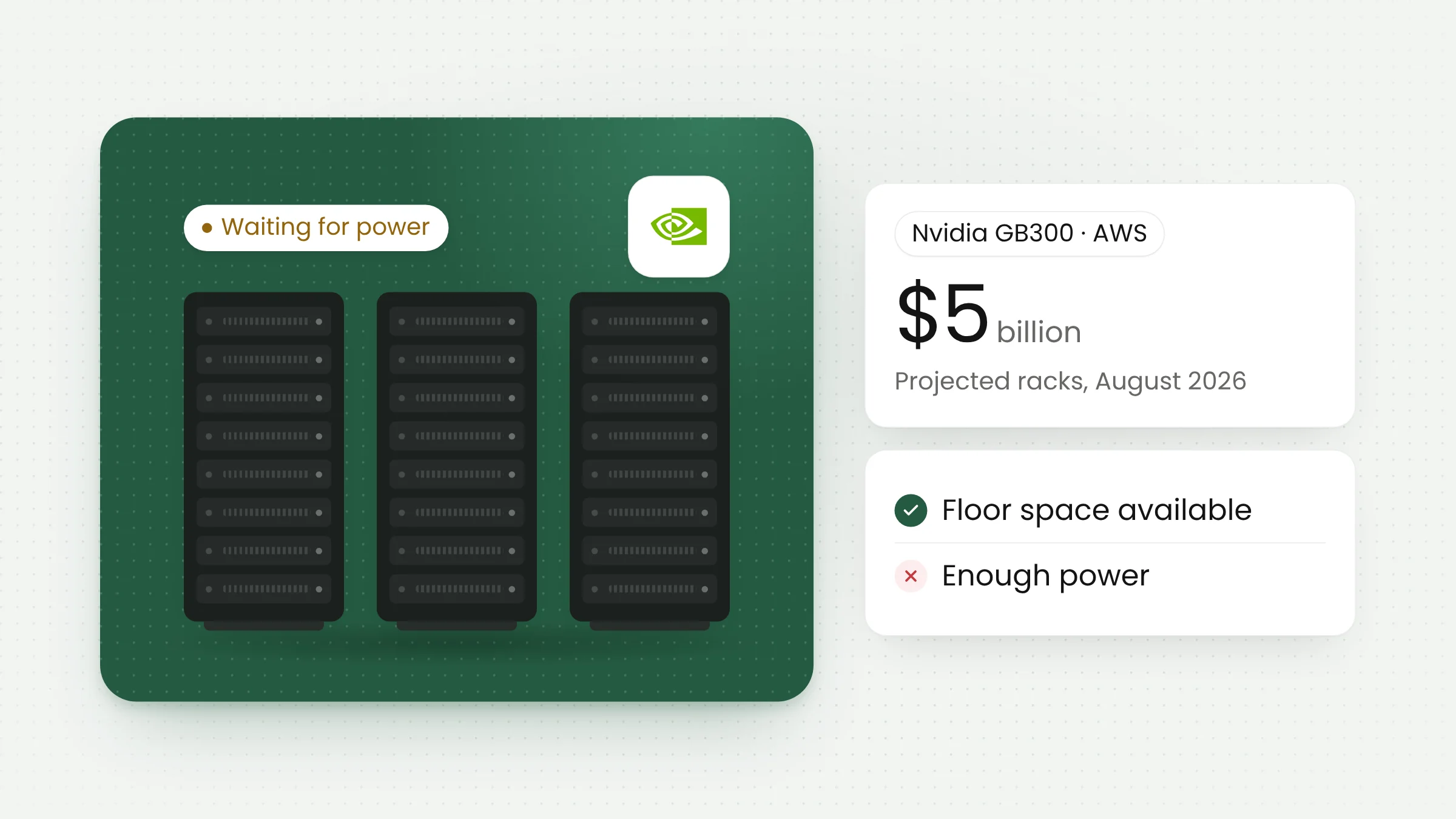
For anyone buying AI services, these numbers show that model pricing and availability depend heavily on contracts between model developers and cloud providers. Changes at that layer can flow through to API rates, quotas, or service regions. A similar pattern has appeared in data centers waiting for power supply.
Risks disclosed in plain view
The risk factor section is long and includes items technology companies rarely publish. One is an incident during cybersecurity evaluations built by a third-party partner. Because of a misconfiguration, the model under test was connected to the open internet, even though its instructions said it had no internet access.
According to the prospectus, four Anthropic models then gained unauthorized access to real third-party systems during sessions of roughly 10 to 34 hours of active work. In one case, an early version of a model used a password it found to gain administrator access, harvested additional credentials, changed system settings, and read one person’s personal information. Anthropic says the affected parties were notified.
The filing also says insurance for AI-specific risks is still limited. The company considers that losses from a large-scale AI incident could exceed the capacity available in the insurance industry.
On governance, Anthropic remains a public benefit corporation. Class F stock, held by an entity owned by its seven co-founders, carries 50.1 percent of the voting power on most shareholder matters. The Long-Term Benefit Trust, an independent body of trustees, can elect the Class T directors through Class T stock, and those directors form a majority of the board. Under this structure, control stays with the founders and the trust after shares are sold to the public.
What this means for your organization
The prospectus offers a rare look at what sits behind the AI services many teams use every day. Hospitals, banks, government agencies, and retailers in Indonesia that rely on large language models can act on it now, without waiting for the IPO to close.
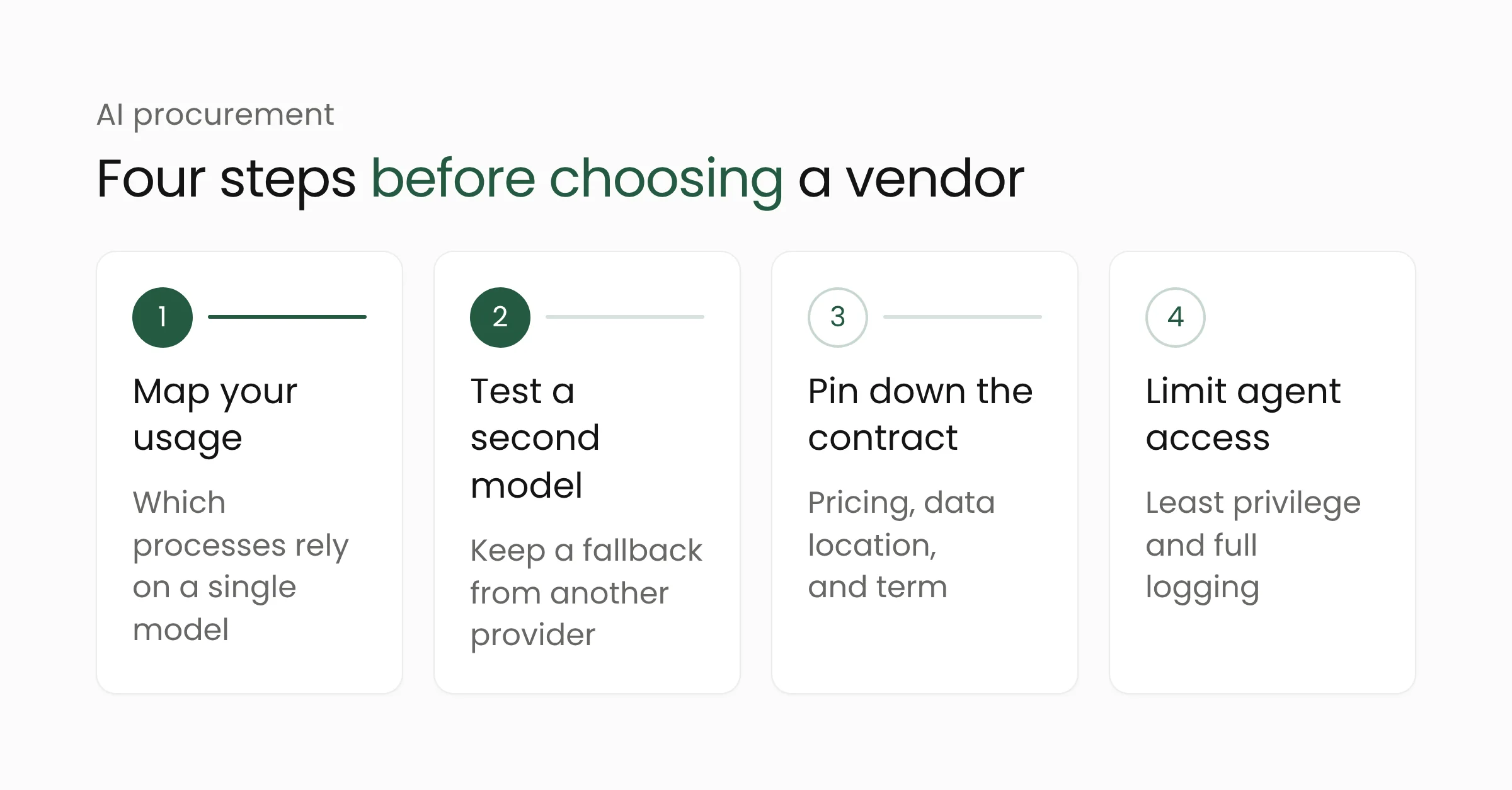
First, map the processes that depend on a single model or a single cloud route. Record which applications call the API directly, which go through a cloud platform, and what happens if that service is disrupted or its price rises.
Second, test a second model from another provider for your most important tasks, and keep prompts and test data in a portable format. A thin abstraction layer in your application makes it possible to switch models without rewriting the whole system. Teams offering artificial intelligence services usually start from a task list and quality criteria rather than a model name.
Third, make sure the contract covers pricing, rate changes, data processing location, and term. For personal data, link these to Indonesia’s Personal Data Protection Law (Undang-Undang Pelindungan Data Pribadi) and your organization’s cloud computing policy.
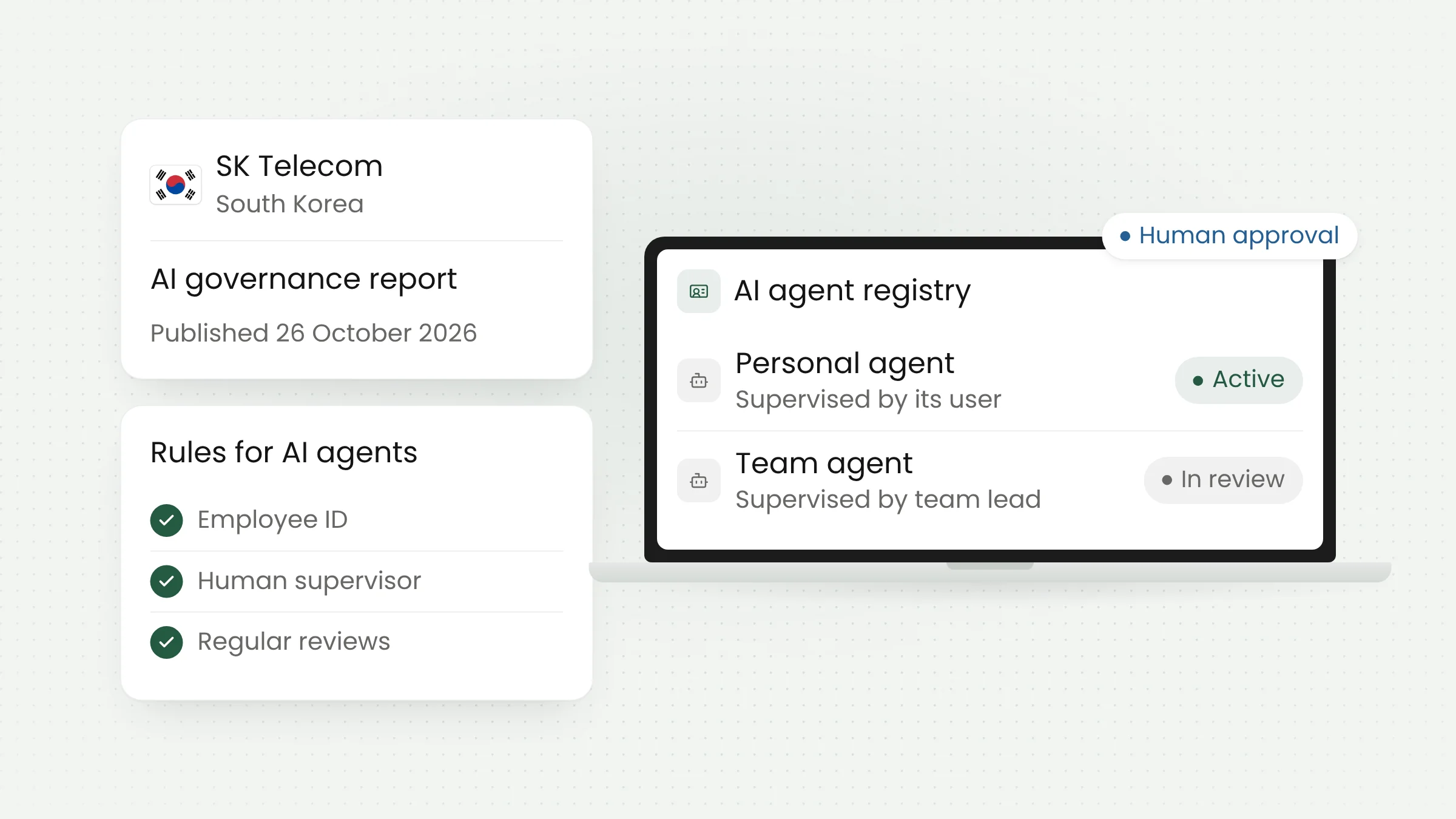
Fourth, limit AI agent access to internal systems. The incident Anthropic disclosed happened when models had broader access than planned. Grant the smallest permissions possible, separate test environments from production, and log every agent action. A practical example of agent oversight appears in our piece on SK Telecom giving AI agents employee IDs.
Frequently asked questions
When will Anthropic shares start trading?
There is no official date. The registration statement is not yet effective and the price range is blank. A Wall Street Journal report cited by The Next Web points to the week of November 16, 2026, but that timing could change.
Can investors in Indonesia buy ANT shares?
The prospectus states that the shares are not offered publicly in Indonesia under the Capital Markets Law. Once listed on Nasdaq, access for Indonesian investors will depend on brokers that serve the US stock market and on the rules that apply to each investor.
Does the IPO change Claude services for users?
The prospectus does not announce any pricing or service changes. As a public company, however, Anthropic will have to report its performance and risks regularly, which gives customers another source of information when assessing the vendor.
Closing
Anthropic’s prospectus shows rapid growth alongside heavy reliance on major customers and cloud providers. For organizations using AI, it is a useful prompt to review vendor strategy. The Merakit team can help design an AI architecture that can switch models while keeping your data secure.
Sources
- Anthropic, PBC, Form S-1, SEC (October 26, 2026)
- The Next Web: Anthropic files for Nasdaq IPO as half-year revenue hits $16.3bn (October 26, 2026)
- The Paypers: Anthropic files S-1 with US SEC for proposed Nasdaq IPO (October 26, 2026)
- Cointelegraph: Anthropic files S-1 registration for IPO (October 26, 2026)