Blog Cloud Computing
Amazon's Dark GPUs: Nvidia Racks Wait for Data Center Power
On this page· 7 sections
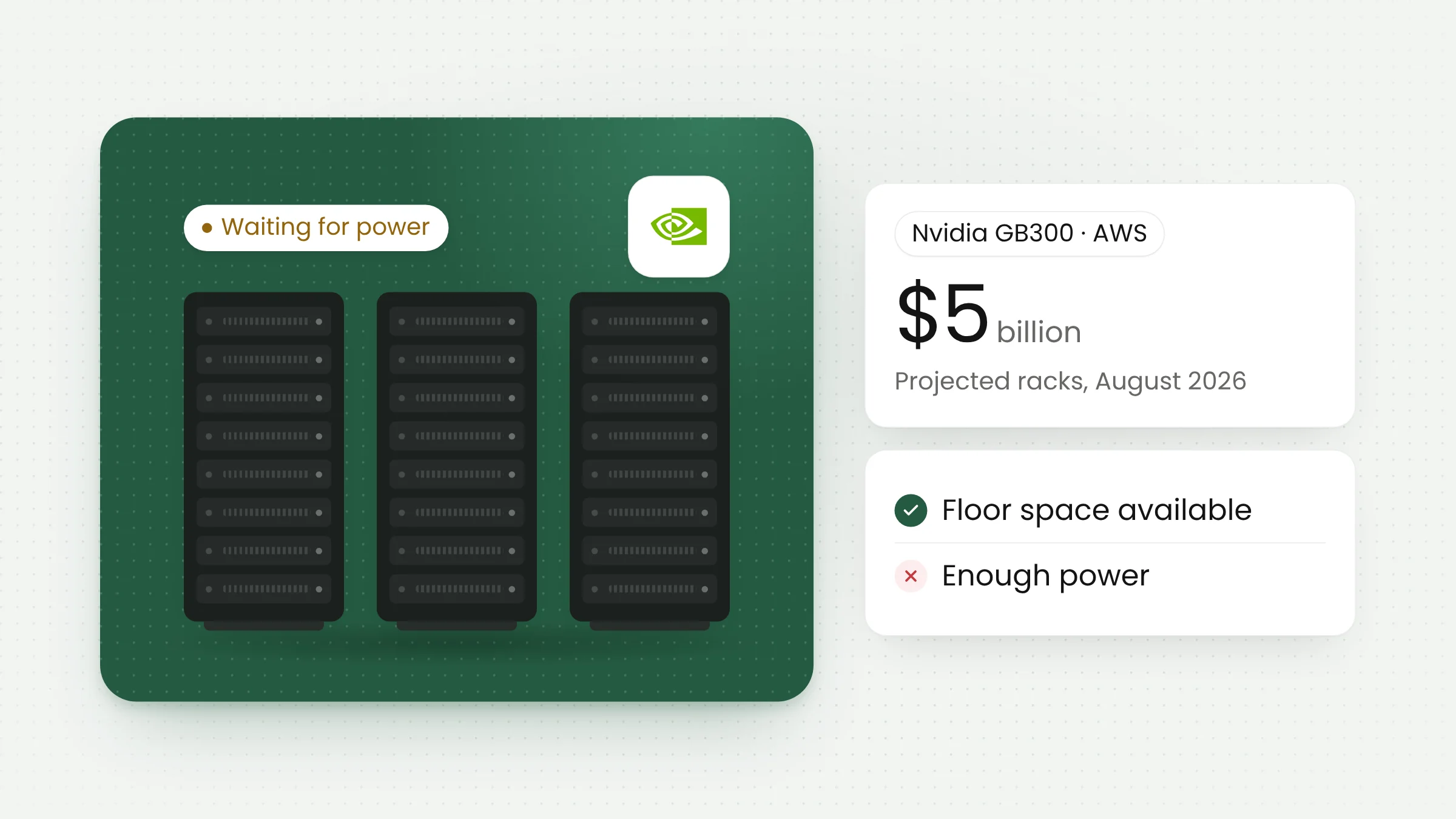
Amazon Web Services (AWS) expected to take about $5 billion worth of Nvidia GB300 AI server racks in August 2026, even though some of its data center sites did not yet have the power to switch them on. Amazon’s dark GPUs, chips that are bought but not yet running, show that electricity has become the main limit on the AI buildout.
Nvidia racks that arrive before the data center is ready
The details come from internal Amazon emails seen by Business Insider and reported on October 20, 2026. According to a summary by TechSpot, Amazon runs a process it calls “Early Rack Receipt.” Under it, AWS takes ownership of racks before they reach their final installation site.
The emails projected about $5 billion of GB300 racks for August 2026, followed by roughly $3 billion more each month. These are projected deliveries described in the emails. The reporting does not say how much equipment is sitting in storage today.
The problem sits at the installation end. Some AWS facilities in the United States had floor space for more racks but not enough available power to run them, so finished racks were held in intermediary warehouses until the sites were ready. In the same emails, one Amazon team noted that there was no clear forecast for when all of the GPUs bought each month would actually be installed.
Before the AI boom, AWS took ownership of racks only after they were finished and delivered to a data center. It now commits cash earlier in the supply chain to lock in hardware that many companies are competing for.
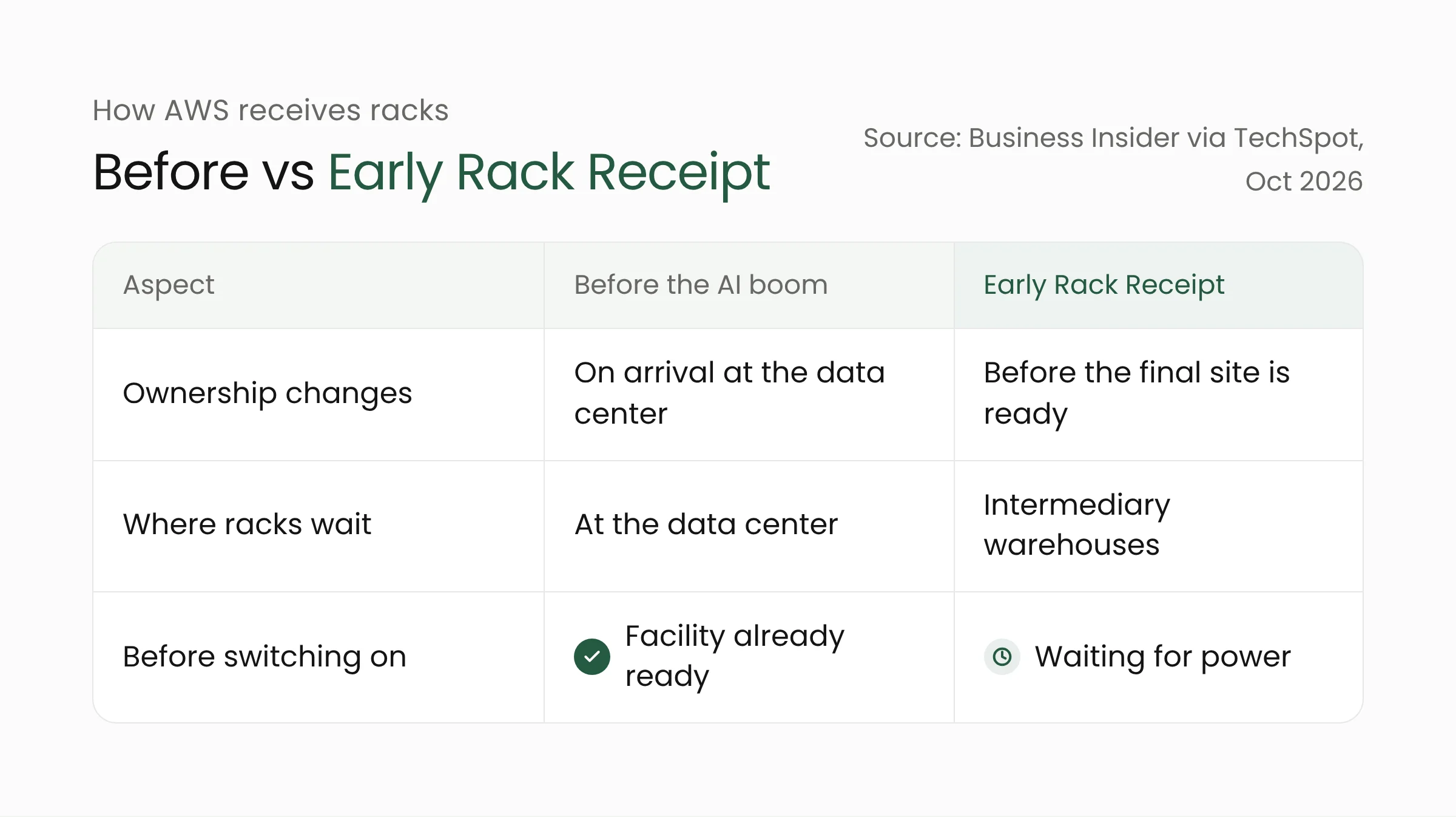
The reporting has limits. It does not disclose how many racks are in storage, which sites are affected, or how long the equipment has been waiting. An unnamed Amazon spokesperson described storing finished racks in a warehouse as “best business practice.”
Power is the new limit on AI buildouts
“Dark GPUs” is the industry term for AI chips and servers that have been purchased but sit idle, usually because power or facilities are not ready. TechSpot summed up the Amazon case in one observation: chips are relatively easy to buy, while power is not.
A modern AI server rack holds dozens of GPUs working together, so it draws far more power than a conventional server rack and needs matching cooling. Empty floor space in a data center does not mean a rack can be switched on, because the grid connection, substations, and cooling have to be in place first.
Large grid connections take longer to build than hardware takes to ship. Companies that can afford to buy chips in bulk still have to wait for the infrastructure around them. The Amazon case shows that even a provider the size of AWS runs into this constraint.
For cloud customers, the effect shows up in capacity. When a provider cannot power every GPU it has bought, the GPU capacity available to rent can grow more slowly than planned.
Cost pressure and a warning from Gartner
Hardware purchases at this scale are visible in Amazon’s finances. In its second-quarter 2026 results, released on July 30, 2026, Amazon reported a free cash outflow of $7.6 billion for the trailing twelve months, compared with an inflow of $18.2 billion a year earlier. The company attributed the drop mainly to a $66.1 billion year-over-year increase in purchases of property and equipment.
Free cash flow is the cash left after a company pays for its operations and capital spending. A negative figure means Amazon is currently spending more on capital projects than its business generates in cash. TechSpot puts Amazon’s expected capital expenditure for this year at about $220 billion.
Research firms are also asking whether the spending will pay off. In an October 14, 2026 release, Gartner estimated that more than $3.5 trillion of AI infrastructure spending could be exposed to impairment by the end of 2030 if the current pace of capital spending continues.
As summarized by CRN Asia, Gartner calculates that AI data center owners would need $8.5 trillion in cumulative revenue through 2030 to earn a 12% return. It forecasts that AI revenue attributable to those data centers will reach no more than $3.6 trillion over the same period.
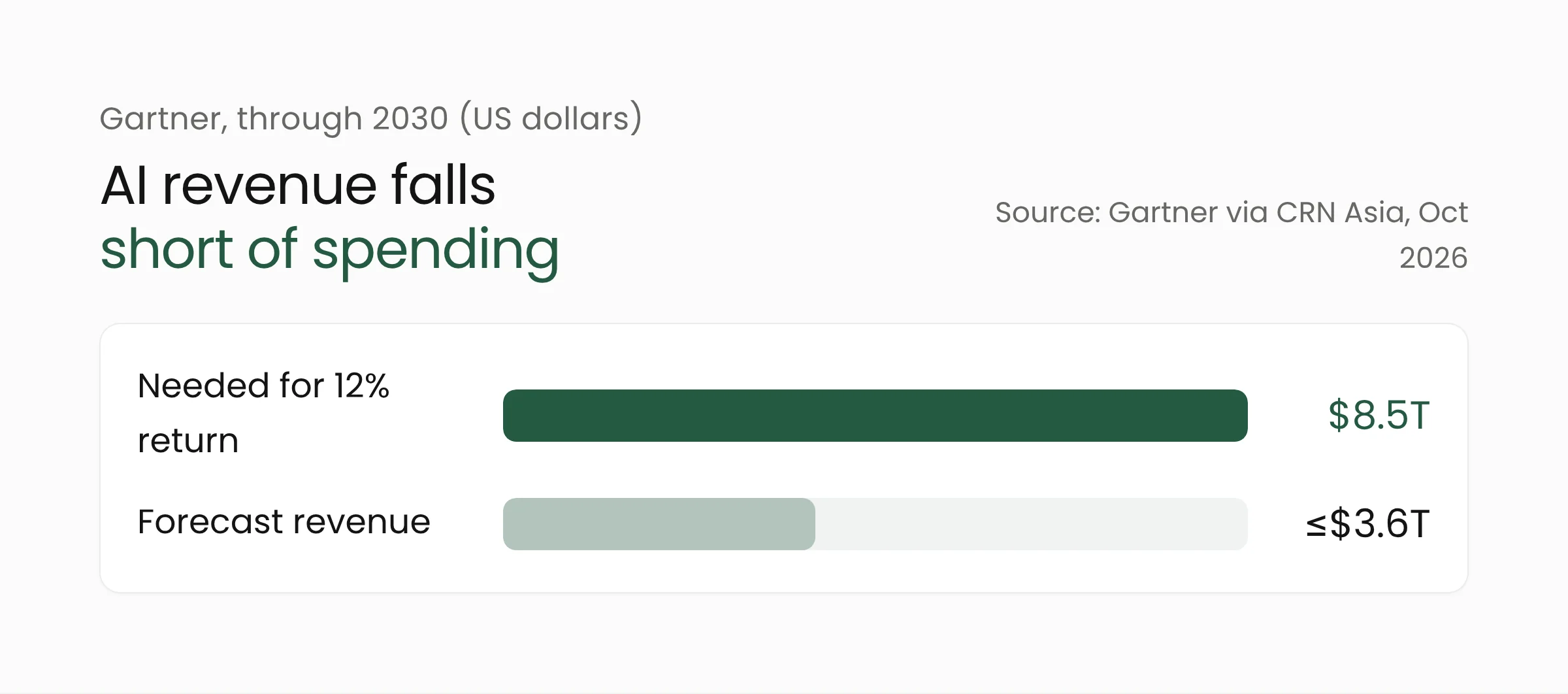
Some commentators have read the warehoused racks as a sign of weakening AI demand. The Business Insider reporting does not draw that conclusion. The available evidence points more to a sequencing problem, with hardware arriving faster than the power and buildings it needs.
What this means for your organization
Most organizations in Indonesia are not buying GPU racks by the thousand. Still, a bank preparing a fraud detection model, a hospital testing AI to read radiology images, or a startup training a language model faces a smaller version of Amazon’s question: will the compute actually be available when the project needs it?
The case offers three practical lessons for planning cloud computing services and AI projects.
Size the workload before buying
Start with the workload, then work out the hardware. Model training, daily inference, and periodic analytics need different GPU types and quantities. Many inference needs can be met by smaller models, which are easier to find capacity for and cheaper to run.
Check power readiness for on-premises servers
Organizations that run servers in their own server rooms or in colocation facilities should confirm per-rack power, cooling, and backup power before ordering equipment. GPU servers that arrive before the power is ready become a small-scale dark GPU problem: the capital is spent, but nothing is running yet.
Line up alternative cloud capacity
Cloud users should ask their provider about availability of the specific GPU type they need in their chosen region, including expected wait times. Keep a fallback in another region or with another provider, and review usage commitments in the contract before reserving long-term capacity.
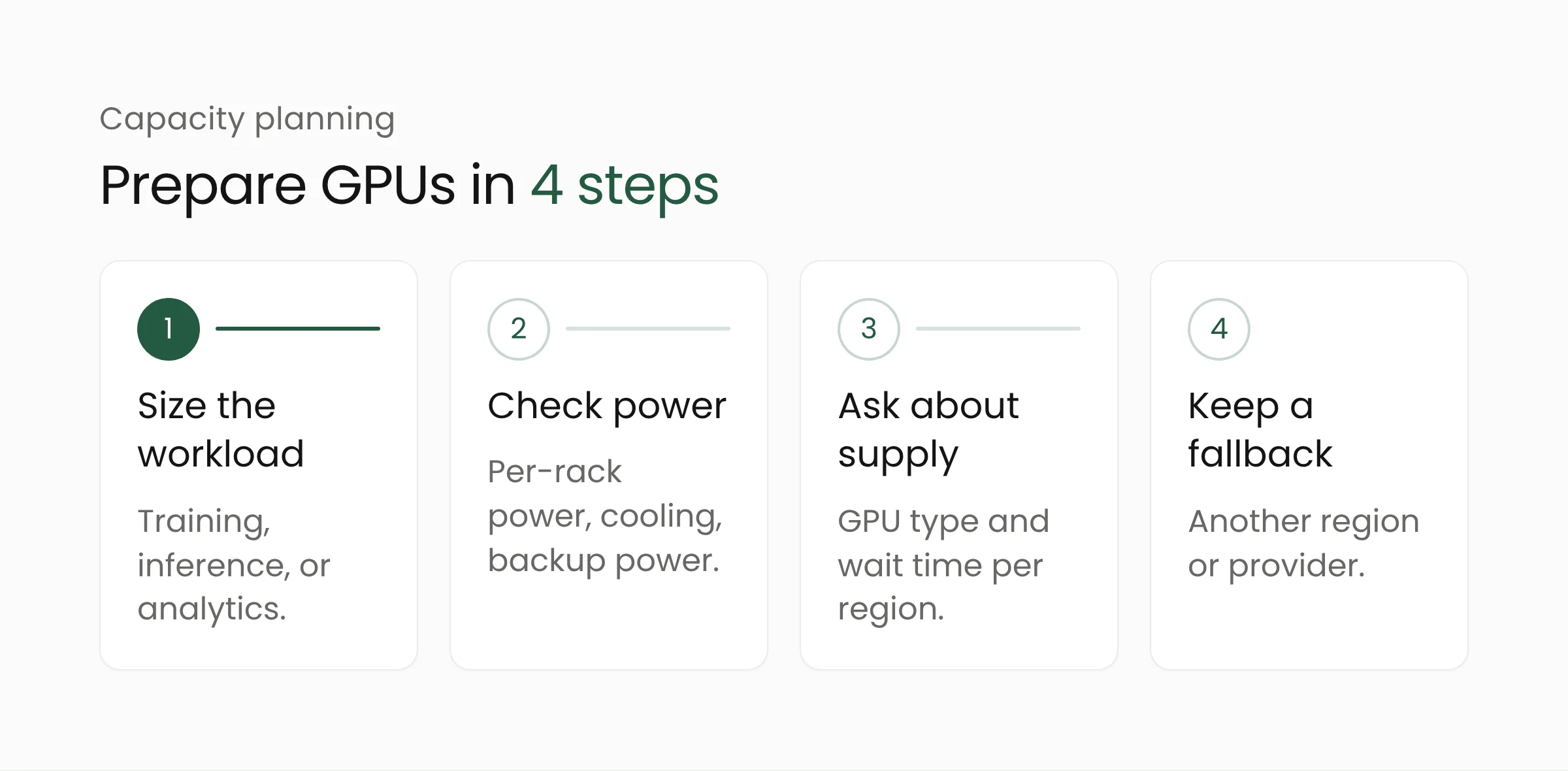
The same applies to teams preparing artificial intelligence projects in any sector. Project schedules should include time to secure infrastructure alongside time to develop the model. Domestic data center availability also shapes the options, as covered in our piece on regional data centers and national capacity.
Frequently asked questions
What are dark GPUs?
Dark GPUs are GPUs or AI servers that have been bought but are not yet running. The most common reasons are a lack of power and data center facilities that are not ready. The term can also describe hardware that is installed but rarely used.
Are AWS services in Indonesia affected?
The Business Insider reporting refers only to AWS facilities in the United States and does not name specific sites. There is no official information about effects on other AWS regions. Customers who need a particular GPU type should check availability directly with their provider.
Does this mean AI demand is falling?
No data so far shows that. The available reporting describes hardware arriving ahead of power readiness. Gartner does question the overall return on AI infrastructure spending, but that is a long-range forecast through 2030.
Conclusion
Nvidia racks waiting for power in Amazon’s warehouses show that AI capacity depends on chips, buildings, and electricity at the same time. For organizations in Indonesia, careful capacity planning from the start helps AI projects stay on schedule and on budget. If you are drawing up a cloud or AI infrastructure plan, the Merakit Indonesia team can help you work out what you need.
Sources
- Report on AWS Nvidia racks and power shortages, Business Insider, October 20, 2026
- “Dark GPUs” at Amazon show the limits of the AI buildout: chips are easy to buy, power is not, TechSpot, October 24, 2026
- Amazon.com Announces Second Quarter Results, Amazon (Form 8-K exhibit, SEC), July 30, 2026
- Gartner Says Over $3.5 Trillion of AI Infrastructure Spending Could Be Exposed to Impairment by the End of 2030, Gartner, October 14, 2026
- Gartner: 80% of neoclouds to lose independence by 2030 as AI infrastructure spending outpaces revenue, CRN Asia, October 2026