Blog Game Industry
Indonesia Plans Game Industry Incentives for Local Studios
On this page· 8 sections
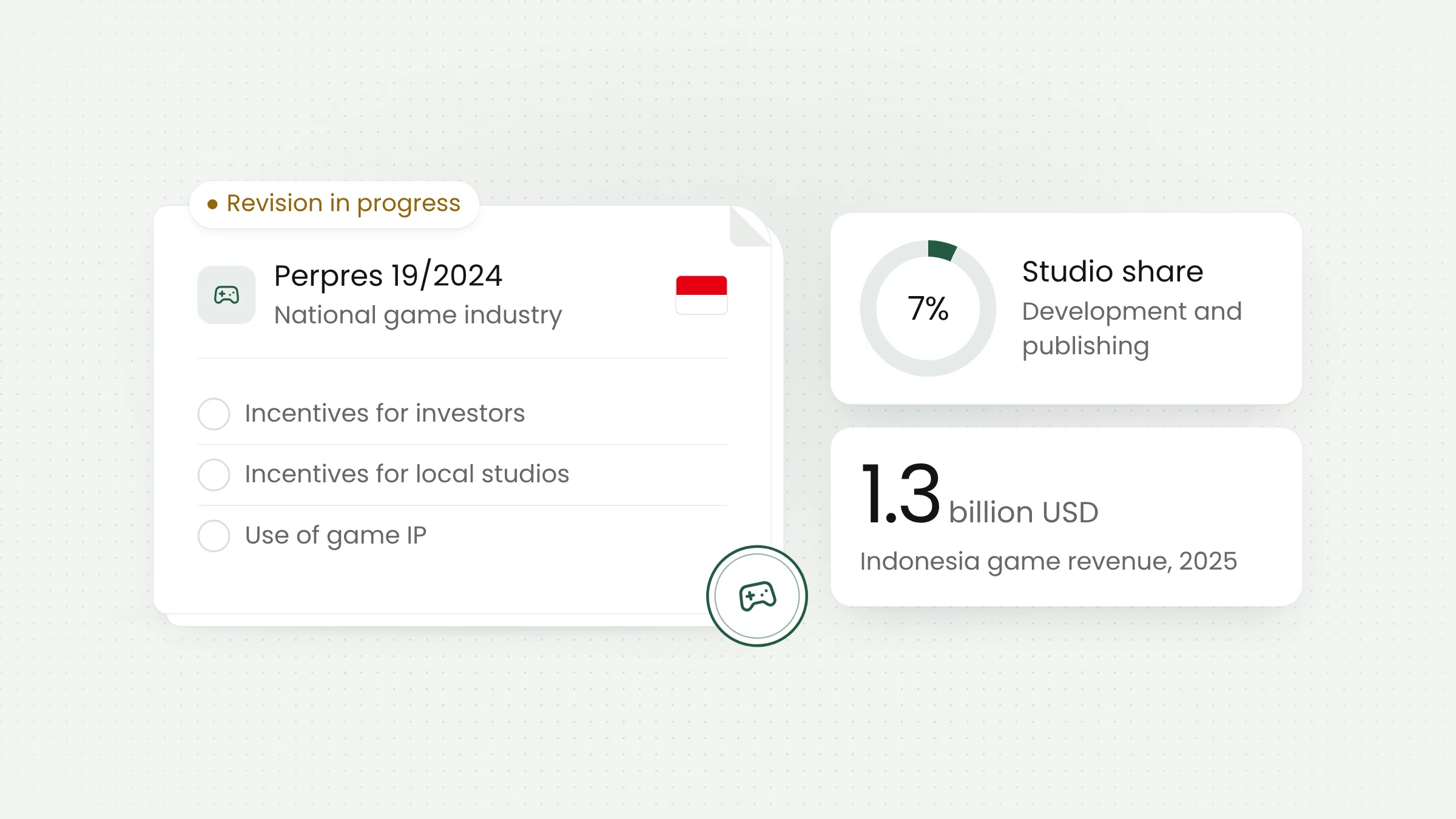
Indonesia’s Ministry of Creative Economy (Kemenekraf) is preparing a revision of Presidential Regulation 19 of 2024, Peraturan Presiden Nomor 19 Tahun 2024 tentang Percepatan Pengembangan Industri Gim Nasional (on accelerating the national game industry), to add incentives for investors and local game studios. The plan comes as new research shows game development and publishing account for only 7 percent of Indonesia’s game industry revenue.
The ministry is drafting incentive recommendations
Luat Sihombing, Director of Games at Kemenekraf, outlined the revision during the launch of a Tencent research paper at the World Conference on Creative Economy (WCCE) 2026 in Jakarta. According to ANTARA, the biggest change is a set of incentive recommendations meant to support investment, help domestic studios grow and raise capital, and attract foreign investors.
The current regulation already lists incentives as one of its acceleration strategies. As Katadata reported, however, it does not spell out what those incentives are. The revision is expected to define incentive mechanisms for two groups: investors and local game studios.
The revised rules will also address the use of game intellectual property (IP). Kemenekraf wants ministries, government agencies, and state-owned enterprises to use local game IP more often. The government is still collecting input from developers and other industry players.
The process will take time. Luat said the ministry aims to have the incentive recommendations ready next year. Kemenekraf then plans to discuss them with the Ministry of Finance and the Coordinating Ministry for Economic Affairs. The type, size, and eligibility rules for the incentives have not been announced.
Rising chip and RAM prices squeeze developers
The ministry gave a concrete reason for the push. Luat told Katadata that chip and RAM prices have been rising for the past two years and that this affects game development. Studios need high-end computers to create art assets, compile builds, and test games across many devices, so higher component prices hit their budgets directly.
The same memory price pressure is visible in consumer devices, as we covered in our piece on global smartphone shipments falling during the memory crisis. For small studios, costlier hardware can slow production or force teams to delay buying test devices.
Large revenue, a small share for developers
The supporting data comes from a white paper by Tencent and Access Partnership, The Video Game Industry: Unlocking the Next Level of Economic and Social Development in Southeast Asia. It was launched at WCCE 2026 and covers five countries: Indonesia, Malaysia, Thailand, the Philippines, and Singapore.
According to ANTARA, Indonesia’s game industry generated $1.3 billion in revenue in 2025, or about Rp23 trillion. It supported 257,400 jobs and contributed 0.12 percent of gross domestic product.
The revenue mix shows the problem the government wants to address. Hardware and peripherals accounted for 47 percent, esports for 24 percent, and retail for 22 percent. Game development and publishing, the core work of studios, made up only 7 percent.
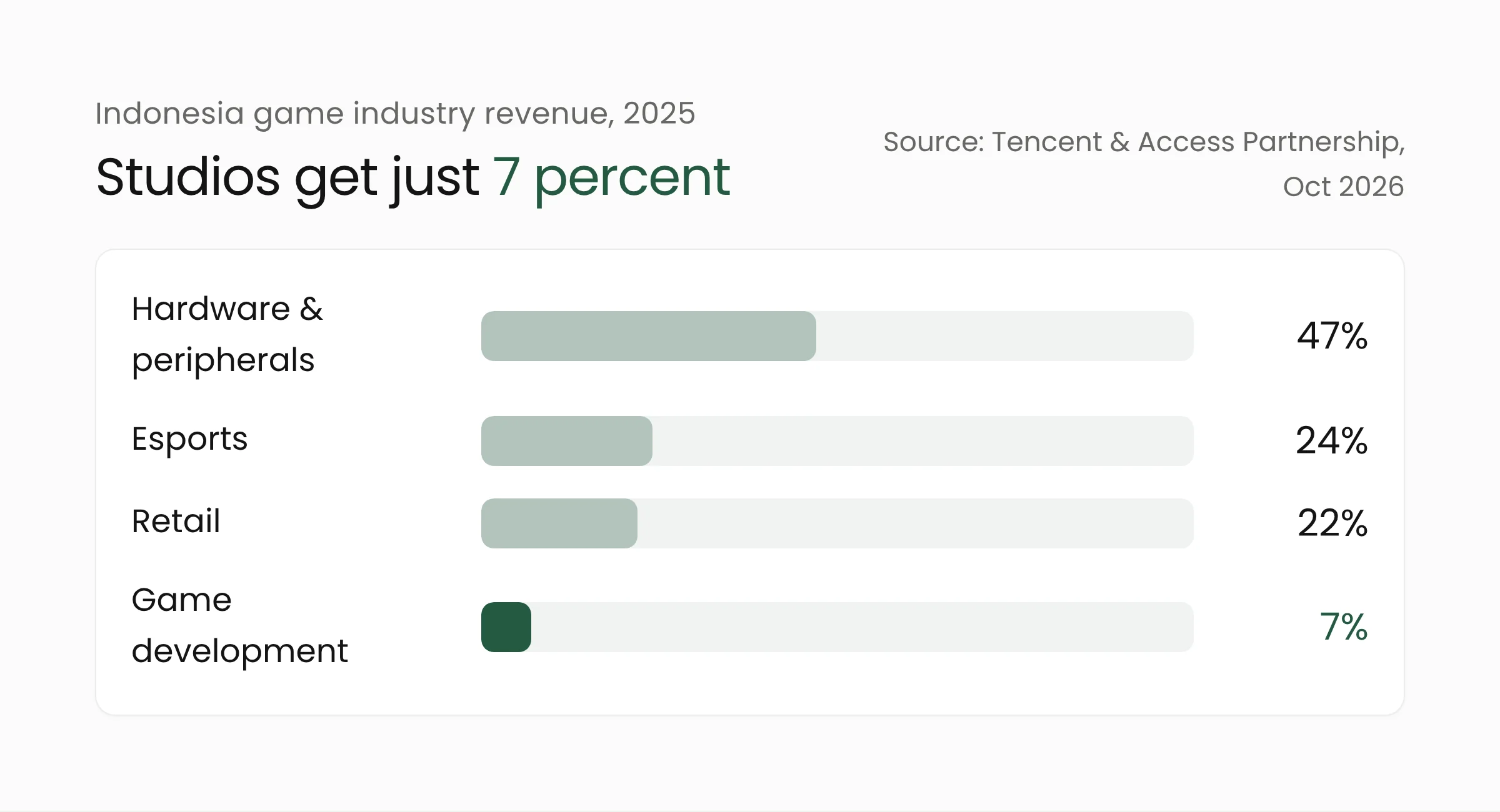
In other words, most of the money in Indonesia’s game industry flows to device sales, tournaments, and stores, while the studios that make games receive a small slice. The paper projects that the industry’s contribution could reach $3.3 billion, about Rp59 trillion, with 476,600 jobs by 2030. That figure applies to an accelerated scenario in which the government takes targeted policy action.
Across the region, Access Partnership puts the game industry’s 2025 revenue in the five countries at $9.1 billion, supporting about 646,800 jobs. Indonesia and Thailand each account for 21 percent of the regional contribution, behind Malaysia at 31 percent.
The paper makes three recommendations. The first is wider access to financing for local studios through prototype grants, co-funding, and low-interest loans. The second is simpler processes for registering, valuing, and financing IP. The third is talent development tied to industry needs and international markets.
A Tencent agreement and IGDX 2026
On the sidelines of WCCE 2026, Kemenekraf and Tencent signed a memorandum of understanding on October 21, 2026. According to Esports.id, the three-year agreement covers local IP development, training in areas such as game design, IP monetization, AI, cloud computing, and cybersecurity, and the use of games and esports to support the creative economy. Both sides are still working out how the programs will run and which ones come first.
The same week, the Indonesia Game Developer Exchange (IGDX) 2026 took place from October 21 to 23 at the Bali Beach Convention in Sanur. Organized by the Ministry of Communication and Digital Affairs and the Indonesian Game Association, the event was part of Bali Tech Week 2026, whose agenda we covered in our Bali Tech Week 2026 report.
Gimbot reports that IGDX 2026 brought studios together with 66 publishers as well as investors from 31 countries, and that 543 Business Pass holders took part in business matching. Media outlets reported different studio counts, 244 and 339. The value of investments or publishing deals signed at the event has not been announced.
What this means for local game studios
The new incentives are unlikely to arrive soon. Still, the drafting period is a good time for studios to prepare and make their needs heard. Several steps can start now.
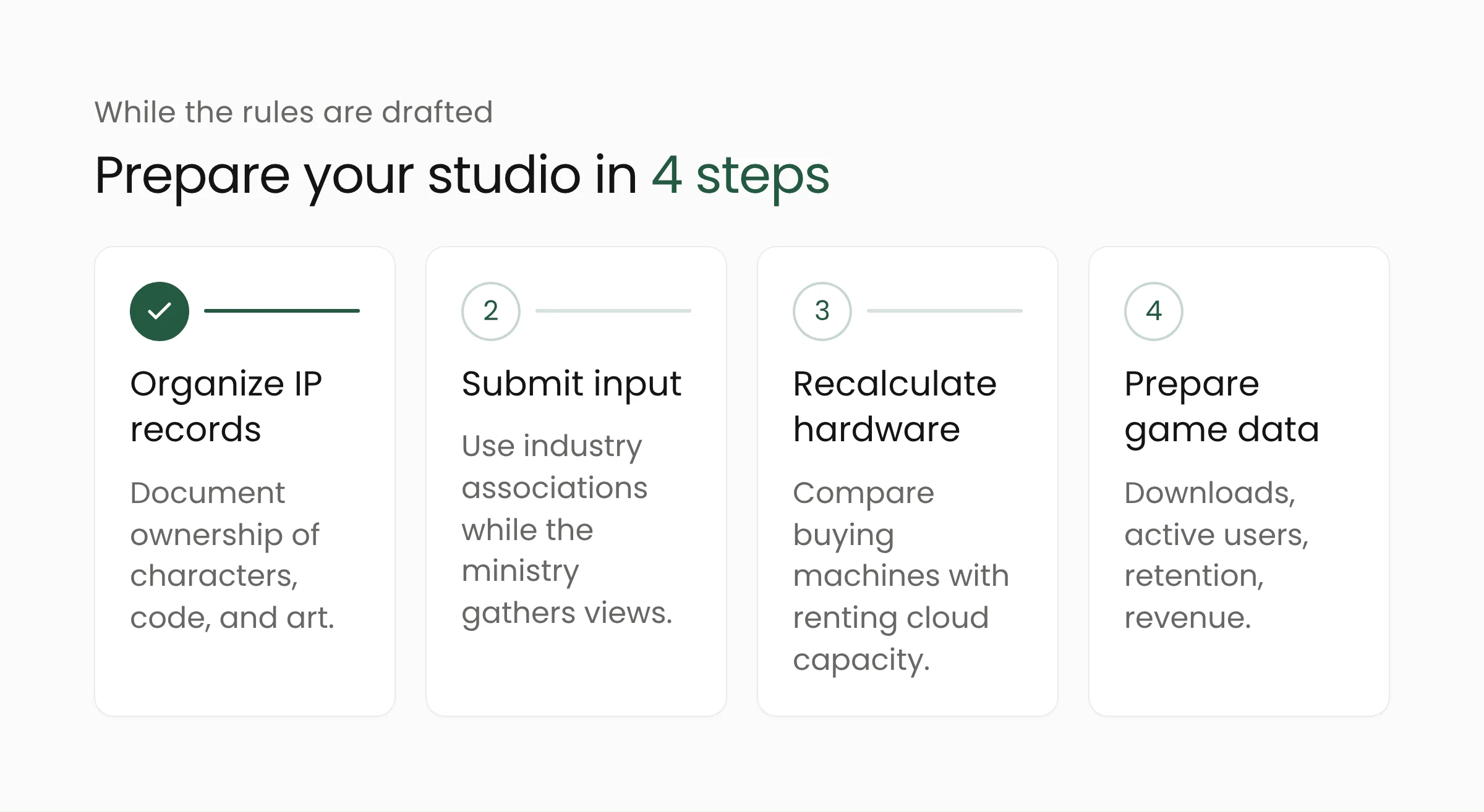
- Organize your IP records. Both the planned revision and the Tencent paper focus on using and financing IP. Document ownership of characters, stories, code, and art, including contracts with freelancers, so your IP is ready for valuation if IP-based financing becomes available.
- Submit input while the rules are drafted. Kemenekraf says it is gathering input from developers. Industry associations can carry the most pressing needs to the ministry, such as prototype funding or relief on equipment costs.
- Recalculate hardware costs. With chip and RAM prices rising, compare the cost of buying new machines with renting cloud capacity for heavy work that does not run every day, such as compiling builds or load-testing online game servers. That approach is often cheaper for workloads that rise and fall.
- Prepare game performance data. Investors and lenders usually ask for downloads, active users, retention, and revenue. Studios that already collect this data in a consistent way will find it easier to apply for funding.
For online and mobile games, early technical decisions also shape long-term costs. Game servers, player data storage, and update systems should be designed to scale when the player base grows. Merakit supports this kind of work through its cloud computing services and mobile app development.
For regional governments and state-owned enterprises, the plan to use local game IP opens new room for collaboration. Educational games for public programs or service campaigns can be commissioned from domestic studios, provided the goals, target players, and success measures are clear from the start.
Frequently asked questions
When will the game industry incentives take effect?
There is no firm date. Kemenekraf aims to finish its incentive recommendations next year and then discuss them with the Ministry of Finance and the Coordinating Ministry for Economic Affairs. The incentives will only apply once the revised regulation is signed.
Who will be eligible for the incentives?
According to Katadata, the incentives are aimed at investors and local game studios. Eligibility rules, incentive types, and amounts have not been announced.
How big is Indonesia’s game industry today?
The Tencent and Access Partnership paper puts Indonesia’s 2025 game industry revenue at $1.3 billion, supporting 257,400 jobs. Under the accelerated scenario, its contribution is projected to reach $3.3 billion by 2030.
Conclusion
The revision of Perpres 19/2024 is a chance to shift more of the game industry’s revenue toward the studios that actually build games. The outcome depends on incentive details that are still unknown, but studios can start preparing their IP, data, and infrastructure now. If your team is designing an online game or a companion app, Merakit Indonesia can help plan the technical architecture.
Sources
- Revisi peraturan industri gim diupayakan mencakup ketentuan insentif, ANTARA, October 22, 2026
- Industri gim Indonesia diproyeksikan sumbang Rp59 triliun pada 2030, ANTARA, October 22, 2026
- Industri Gim Tertekan Kenaikan Harga Cip, Kementerian Ekraf Siapkan Insentif, Katadata, October 23, 2026
- Unlocking the Next Level of Economic and Social Development in Southeast Asia, Access Partnership, October 22, 2026
- Tencent dan Kemenekraf Teken MoU, Buka Peluang IP Gim Lokal Tembus Pasar Global, Esports.id, October 22, 2026
- IGDX 2026 di Bali Kumpulkan Developer dan Publisher dari 31 Negara, Gimbot, October 25, 2026
- Perpres Nomor 19 Tahun 2024 tentang Percepatan Pengembangan Industri Gim Nasional, BPK legal database