Blog Service Outage
Apple Ties iCloud Outage to Internal Update, Lessons for IT
On this page· 7 sections
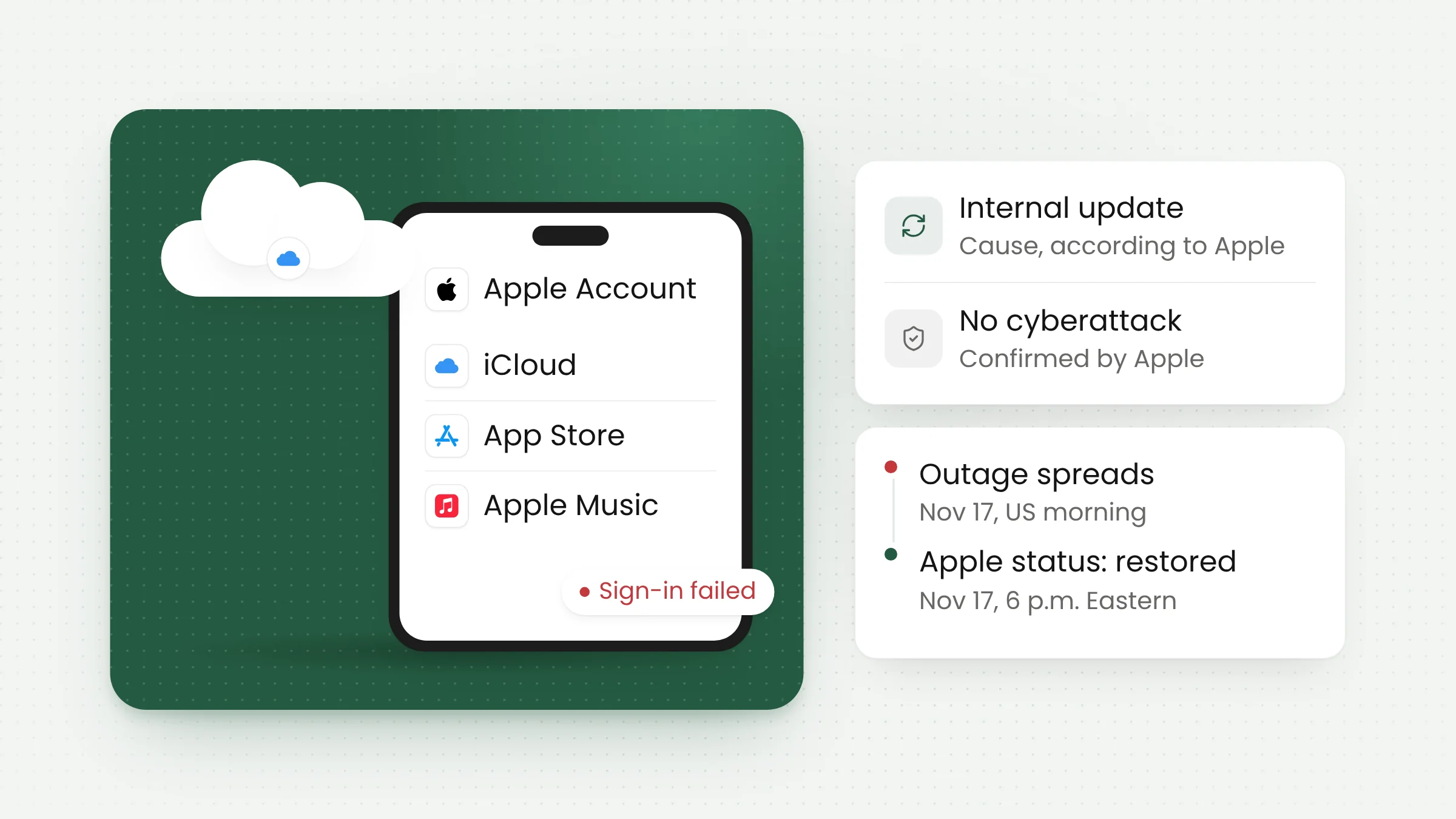
An iCloud outage on Tuesday, November 17, 2026 (US time) signed many Apple users out of their accounts, blocked them from signing back in, and stopped App Store downloads. Apple said an internal update caused the disruption and that it was not the result of a cyberattack.
In Indonesia, the outage was already under way around midnight and was listed as resolved by early morning on November 18, Western Indonesia Time (WIB). The impact was broad because the Apple Account is the entry point to nearly every Apple service, from photo backups to activating a new iPhone. The incident is also a clear example of what can happen when a system change reaches every user at once.
Timeline of the November 17 outage
The first reports came in on Tuesday morning US time. By the time 9to5Mac published its report at 9:33 a.m. Pacific time (00:33 WIB on November 18), users were already describing connection failures, trouble signing in, and an App Store that would not load or download apps.
The most common complaint was being signed out of iCloud unexpectedly on iPhone and Mac. When users tried to sign back in, verification failed or an unexplained error appeared. Some people also could not activate new iPhones.
According to 9to5Mac, the tracking site Downdetector was already showing a spike in reports across Apple services while Apple’s own System Status page still listed those services as available. Apple later confirmed the problems on both its general status page and its developer status page.
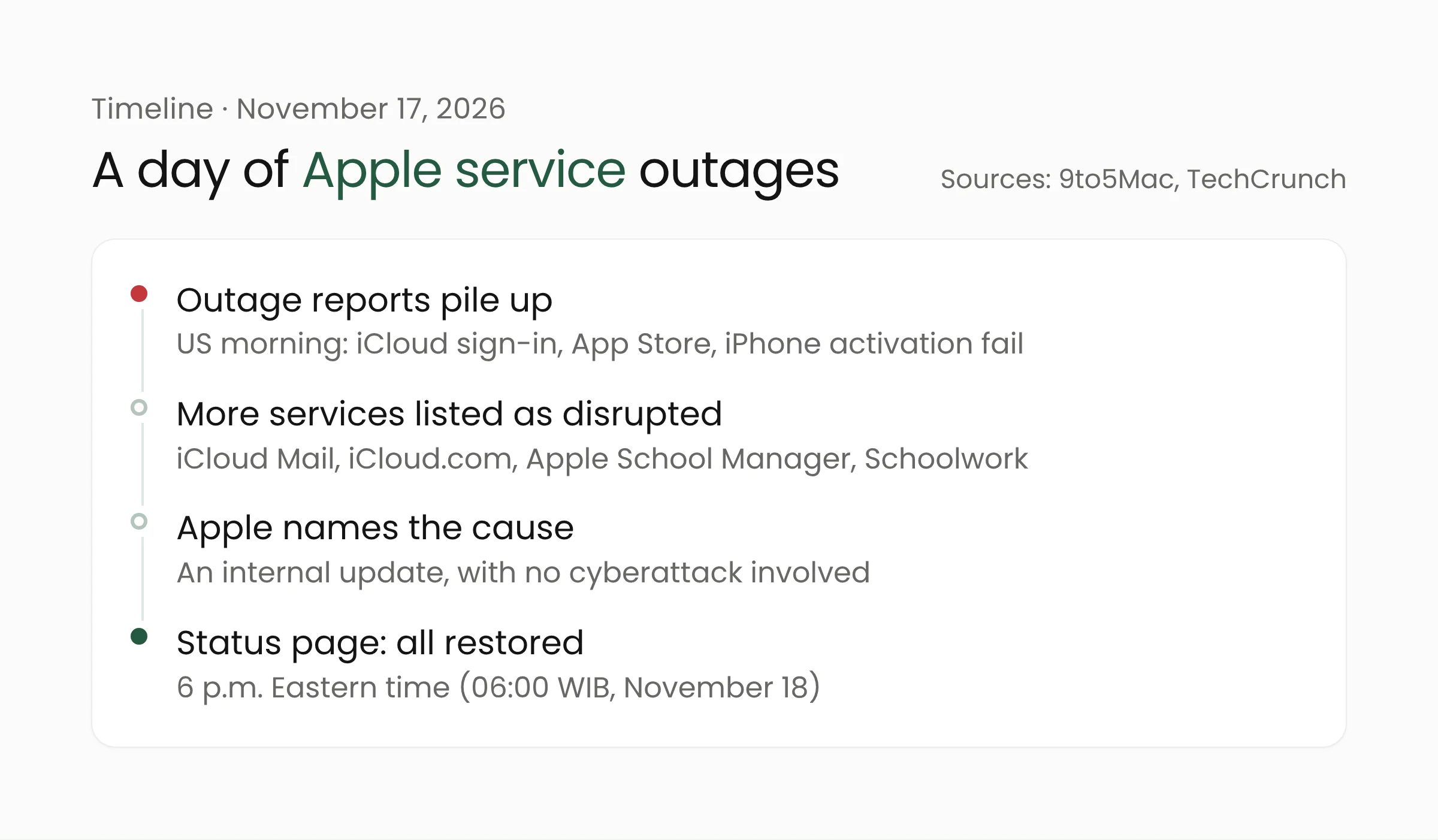
TechCrunch reported that by 6 p.m. Eastern time on Tuesday (06:00 WIB on November 18), Apple’s status page showed all outages resolved. A report from The Apple Post on Tuesday evening said iCloud-related issues were still listed on the status page and that Apple had not declared the whole outage over. The gap likely reflects reports written at different times, so users should keep checking the official status page.
Affected services and symptoms
At first, Apple’s status page listed problems with iCloud Account & Sign In, marked as affecting all users, along with the App Store, AppleCare on Device, and Apple Music, according to TechCrunch. The list later grew to include Apple School Manager, iCloud Mail, iCloud Web Apps (iCloud.com), Schoolwork, and the Volume Purchase Program.
9to5Mac also noted reported problems with Apple Pay, Apple Support, iPhone activation, and App Store Connect, the portal developers use to manage their apps on the App Store. The Apple Post cautioned that reports about Apple Pay did not necessarily mean contactless payments in stores had stopped working.
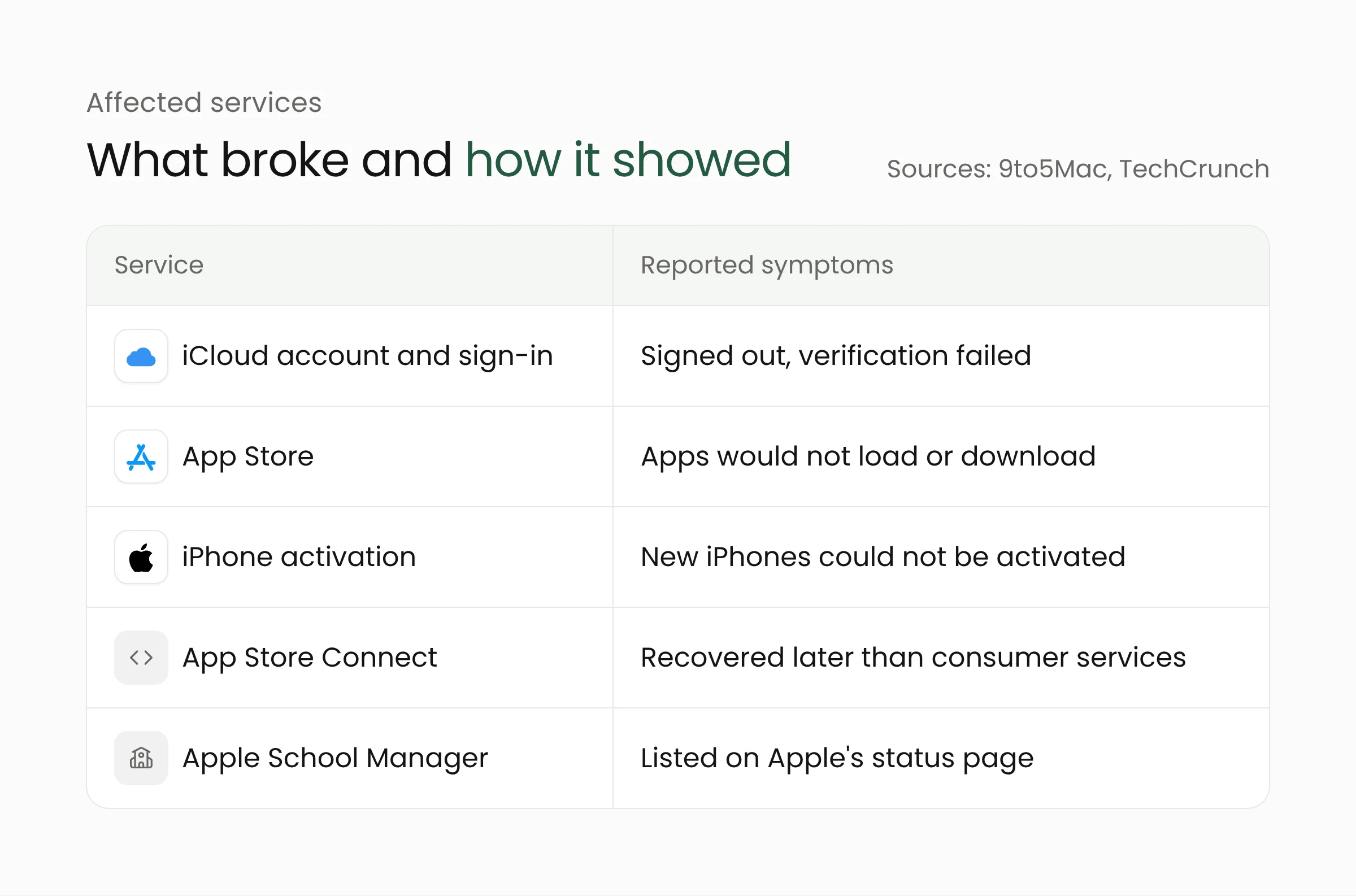
The outage shows how heavily Apple’s services rely on a single account system. Once sign-in breaks, services that look separate, such as mail, music, the app store, and device activation, go down with it.
A week earlier, on November 10, MacRumors reported an outage affecting iCloud Calendar, iCloud Contacts, iCloud Mail, iWork for iCloud, and Game Center that began at 5:49 p.m. Eastern time. Mail, calendar, and contacts were listed as resolved by 7:22 p.m., after which Photos and iCloud sign-in ran into problems. Apple did not give a cause for that incident.
Apple’s explanation and the wider lesson
In a statement to TechCrunch, Apple said, “Many of our systems are back up and running after an internal update caused some outages this morning.” The company added that it was working to bring the remaining systems back online as soon as possible and stressed that the outage was not caused by a cyberattack.
According to 9to5Mac’s updated report, consumer services recovered first, while developer-facing services took longer. As of those reports, Apple had not said which systems were updated or why the change had such a wide effect.
Even a brief explanation carries a useful lesson. Major cloud outages can start with routine changes on the provider’s side. In the Google Cloud outage in London, Google’s final report pointed to a misconfigured generator control system. When a change touches an identity system that every service depends on, such as the Apple Account, a single mistake can spread across many products at once.
TechCrunch also listed other outages in the same week, including the Microsoft 365 outage that hit Outlook and Teams. In that case, ITdaily reported that Microsoft rolled back a network configuration change that coincided with the start of the disruption. TechCrunch said none of the outages that week had been attributed to a cyberattack.
What this means for IT teams and developers
Outages like this are outside an organization’s control. Still, there are steps that reduce the impact, especially for schools, offices, clinics, and stores that manage large numbers of iPhones, iPads, and Macs.
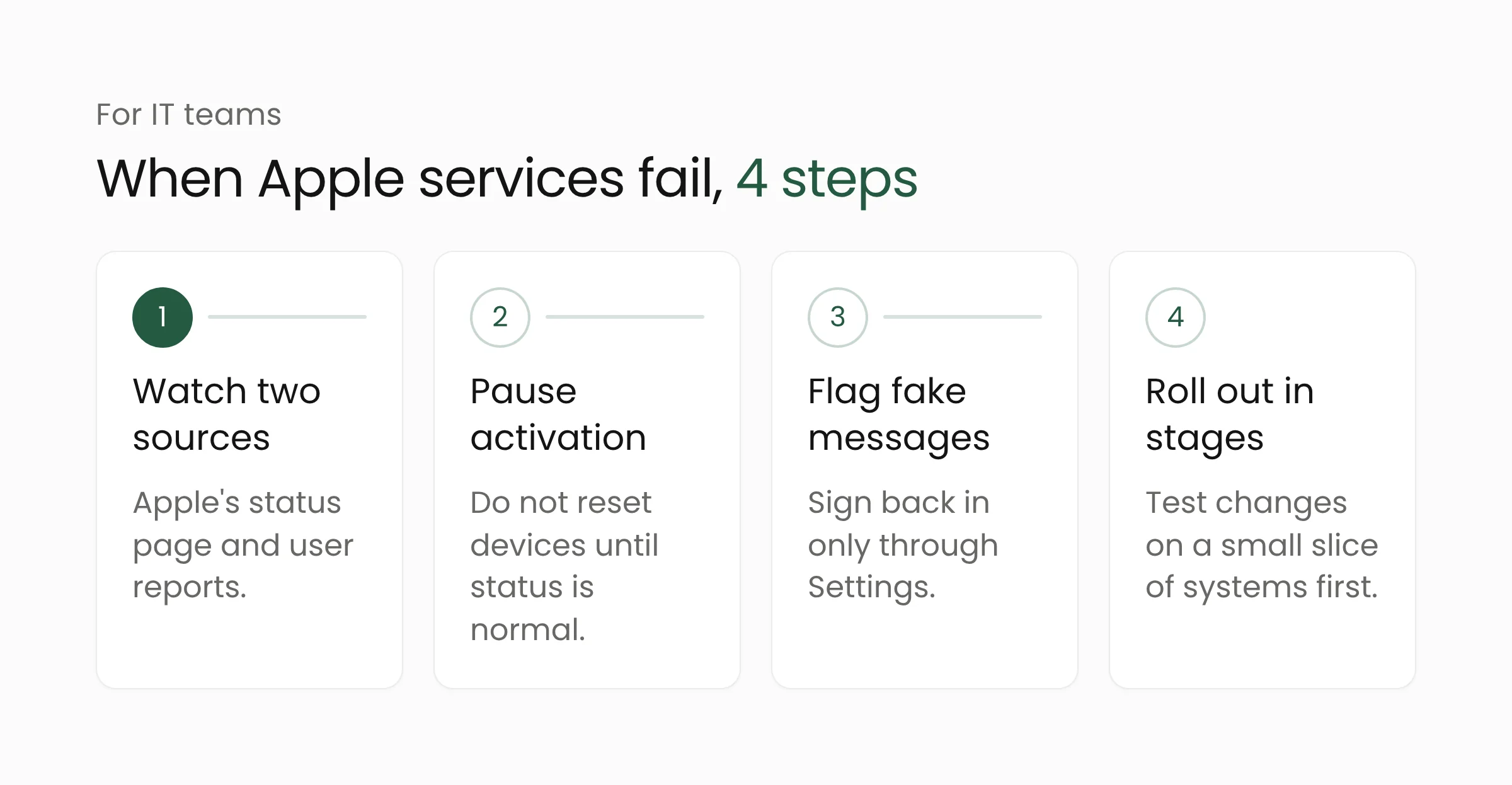
Watch two sources at once. Apple’s System Status page and developer status page are the official references, but November 17 showed they can lag behind user reports. IT teams should also track reports from internal users and independent monitoring sites before concluding that the problem sits in the office network.
Pause device activation and resets. While activation and sign-in are down, freshly wiped or newly purchased devices cannot be set up. Plans to hand out devices to staff or students should wait until the official status returns to normal.
Warn users about fake messages. When many people are suddenly signed out, scammers can send emails or texts asking users to “re-verify” their Apple Account through a link. Remind users to sign back in only through Settings on the device or Apple’s official website.
Apply the same lesson to your own systems. For teams running applications and infrastructure in the cloud, Apple’s outage is a reminder to roll out changes in stages. Test an update on a small share of servers or users first, monitor it, and then expand. Keep a rollback procedure ready and rehearse it regularly. Merakit’s cloud computing services team helps organizations design staged releases, monitoring, and recovery plans of this kind.
App developers should also think about their dependence on third-party services. If an app lets people sign in with an Apple or Google account, offer an alternative sign-in method and clear error messages so users do not assume your app is broken. This can be designed in from the start in mobile app development.
Frequently asked questions
Was any iCloud data lost in the outage?
No source has reported lost user data. The reported symptoms were accounts signing out on their own, failed verification, and services that could not be reached. Apple also said the outage was not caused by a cyberattack.
What should I do if my iPhone signed me out of iCloud?
Check Apple’s System Status page first. If the outage is still listed, wait until the status is back to normal instead of trying to sign in again and again. Once services recover, sign back in through Settings and ignore any message or email asking you to verify through a link.
What does Apple mean by an internal update?
Apple has only said the outage came from an internal update and has not explained what was changed. The term usually refers to a software or configuration change on Apple’s servers, as opposed to an iOS update installed by users.
Closing thoughts
The iCloud and App Store outage on November 17 was fixed within hours, yet it showed how many services hang on a single account system. For organizations in Indonesia, it is a good prompt to review plans for third-party service outages and the way changes are released on their own systems. If you want to build staged releases and more reliable monitoring, the Merakit team is ready to talk.
Sources
- 9to5Mac: iCloud, App Store, and other Apple services hit by ongoing outage (November 17, 2026)
- TechCrunch: Apple services, including iCloud, App Store, and Apple Music, hit by outage (November 17, 2026)
- The Apple Post: Apple confirms what caused widespread outage (November 17, 2026)
- MacRumors: iCloud Mail, Calendar, Contacts and More Experiencing Outage (November 10, 2026)
- Apple System Status