Blog AI Chips
US AI Chip License Rule Covers Indonesia and Data Centers
On this page· 7 sections
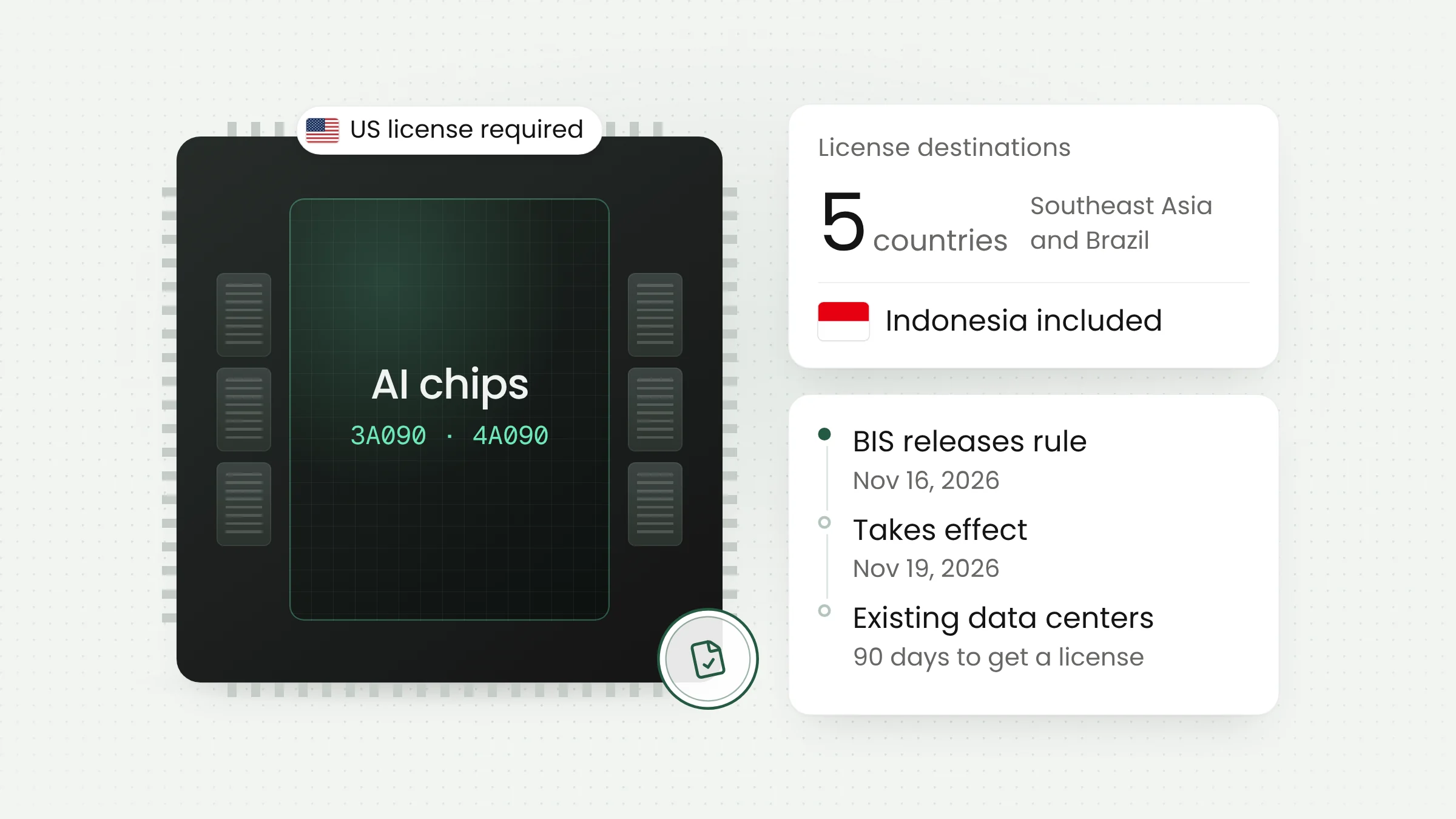
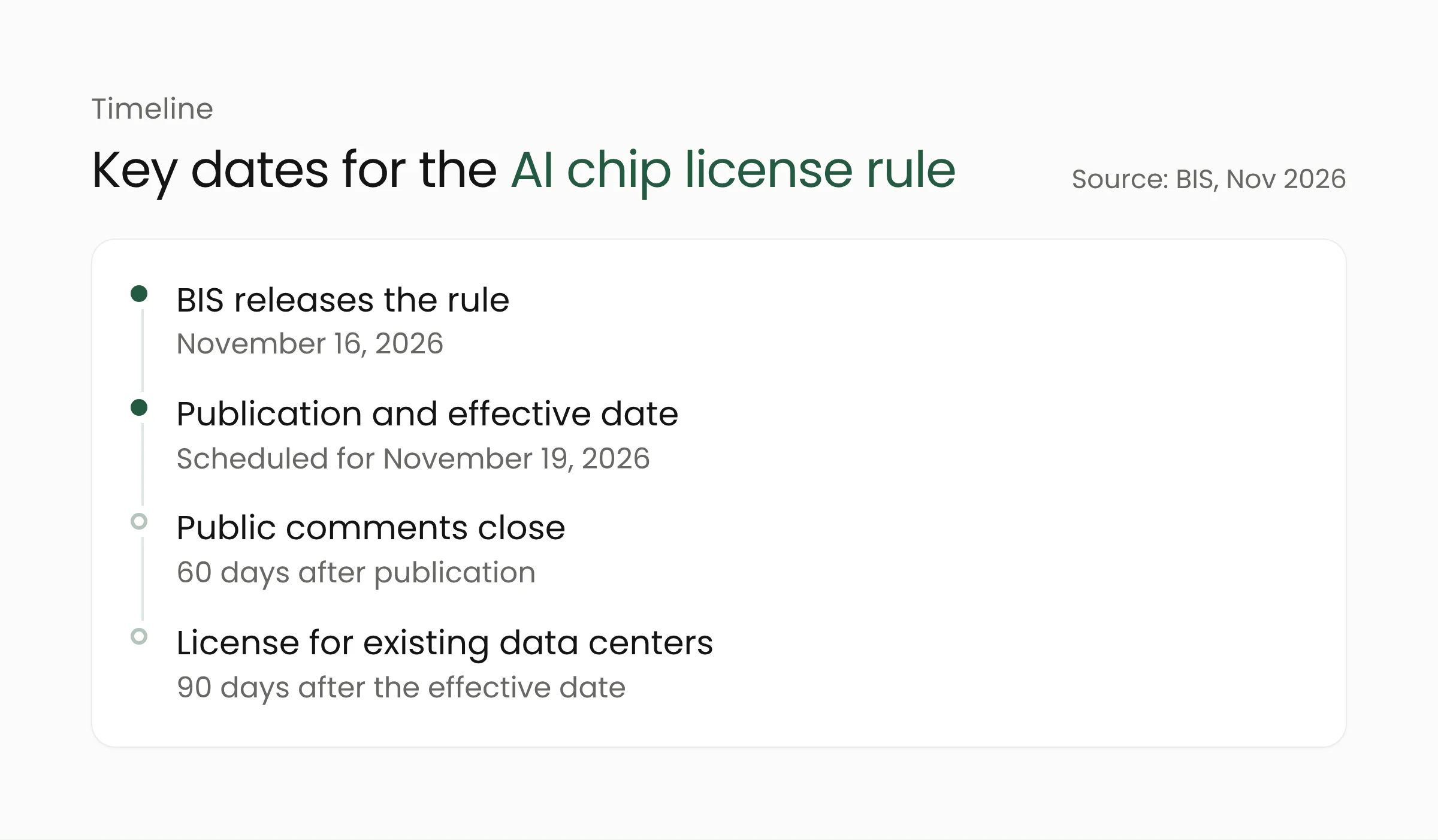
Shipments of advanced US-made AI chips to Indonesia now require a license from the US government. The Commerce Department’s Bureau of Industry and Security (BIS) released an interim final rule on November 16, 2026 that adds Indonesia, Malaysia, Singapore, Thailand and Brazil to the list of destinations that need a license for AI chips.
The same rule restricts data centers anywhere in the world that rent large amounts of computing power to companies headquartered in China and other countries under a US arms embargo. For Indonesia, where data center capacity is growing, the rule affects two things at once: the supply of AI hardware and the way cloud providers vet their customers.
What the new BIS rule says about five countries
The rule is titled Addressing Remote Access to Advanced Semiconductors (RIN 0694-AK50). According to the BIS press release, it was written by and at the direction of the Treasury Department and the National Security Council, and issued in the Commerce Department’s name. BIS said the rule is designed to ensure that “existing restrictions on access to sensitive American technology cannot be circumvented through remote computing arrangements involving data centers in third countries.”
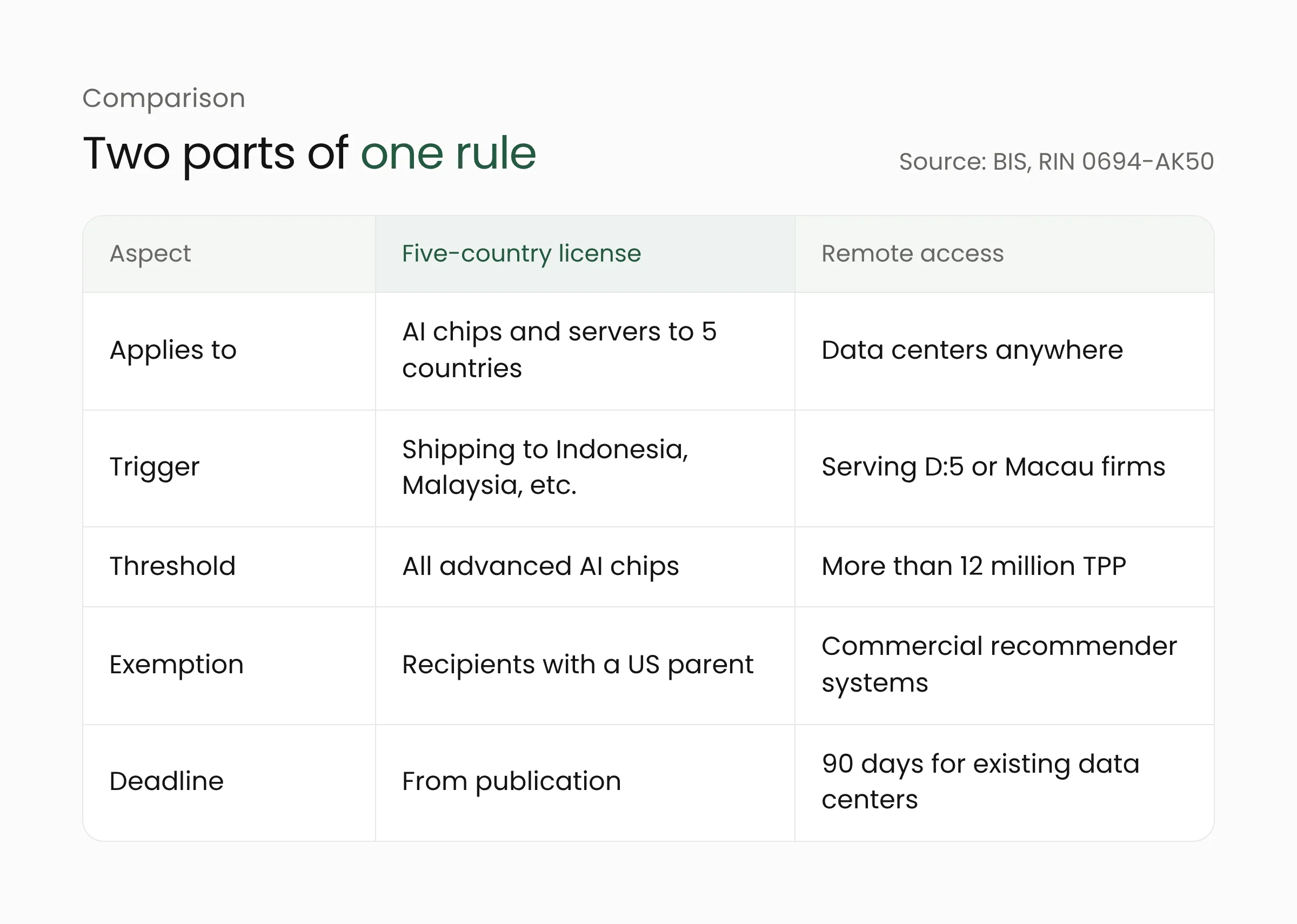
Under the rule text filed with the Federal Register, a license is now required to export, reexport or transfer advanced AI chips and the servers that contain them (ECCNs 3A090 and 4A090) to or within the five countries. BIS describes them as countries with a higher-than-normal risk of diversion. The Secretary of Commerce can add more countries to the list.
License applications will be reviewed case by case. According to the rule, each destination will be judged on how well its export control regime works and how closely it cooperates with BIS on enforcement.
There is one significant exemption. The five-country license requirement does not apply when the recipient is headquartered in the United States, or its ultimate parent company is. The exporter must then file monthly reports with BIS, due on the first business day of the month after each transaction.
The rule is scheduled to appear in the Federal Register on November 19, 2026 and takes effect on that date. Public comments are accepted for 60 days after publication through regulations.gov under docket BIS-2026-0628. Shipments already en route on the publication date may proceed under the old terms if they are completed within 30 days.
Limits on remote access through data centers
The second part of the rule applies worldwide. US AI chips and servers need a license when the exporter knows they will be used in a data center that provides large-scale computing access to companies headquartered in Macau or a Country Group D:5 destination, or whose ultimate parent is. TechCrunch noted that the group covers China, Russia, Iran, North Korea and 18 other countries.
The 12 million TPP threshold
The trigger is access to more than 12,000,000 “aggregate TPP”. TPP, or total processing performance, is the computing metric used in US export rules. TechCrunch put the figure at roughly the maximum compute of about 750 Nvidia H100 or H200 GPUs.
The threshold is measured at a single facility or across linked data centers, including sites that are connected digitally and share workloads. Data centers that already served such companies before the rule must obtain a license within 90 days of the effective date if they want to continue.
Customer checks and the recommender carve-out
Exporters are expected to obtain “know your customer” information from the receiving data center, including whether any customers are directly or indirectly owned or controlled from Macau or a D:5 country. If a data center declines or is unable to provide that information, the rule treats it as a red flag that presumptively gives the exporter knowledge of a violation.
The rule exempts “commercial recommender systems,” such as those that online retailers and social media platforms use to rank or suggest products. The definition is narrow. Systems that generate new text, images, audio, video or code are excluded from the carve-out, as are recommender systems that incorporate a generative model.
The rule also formally rescinds the AI Diffusion Rule published on January 15, 2025. BIS said the Biden-era framework was never enforced and that it had announced the rescission in May 2025.
Where Indonesia stands in the regional data center market
In its summary, BIS said it will monitor countries that tolerate evasion of the rule. The possible consequences it lists include import restrictions, new license requirements, a downgrade of the country’s status in the US export control regime, and Entity List designations for the parties involved.
The Register cited Counterpoint analyst Neil Shah, who said the rule shifts the compliance burden from hardware makers to cloud operators and compared it to know-your-customer obligations in banking. The publication added that operators in the region will now need to show their customers and workloads are compliant.
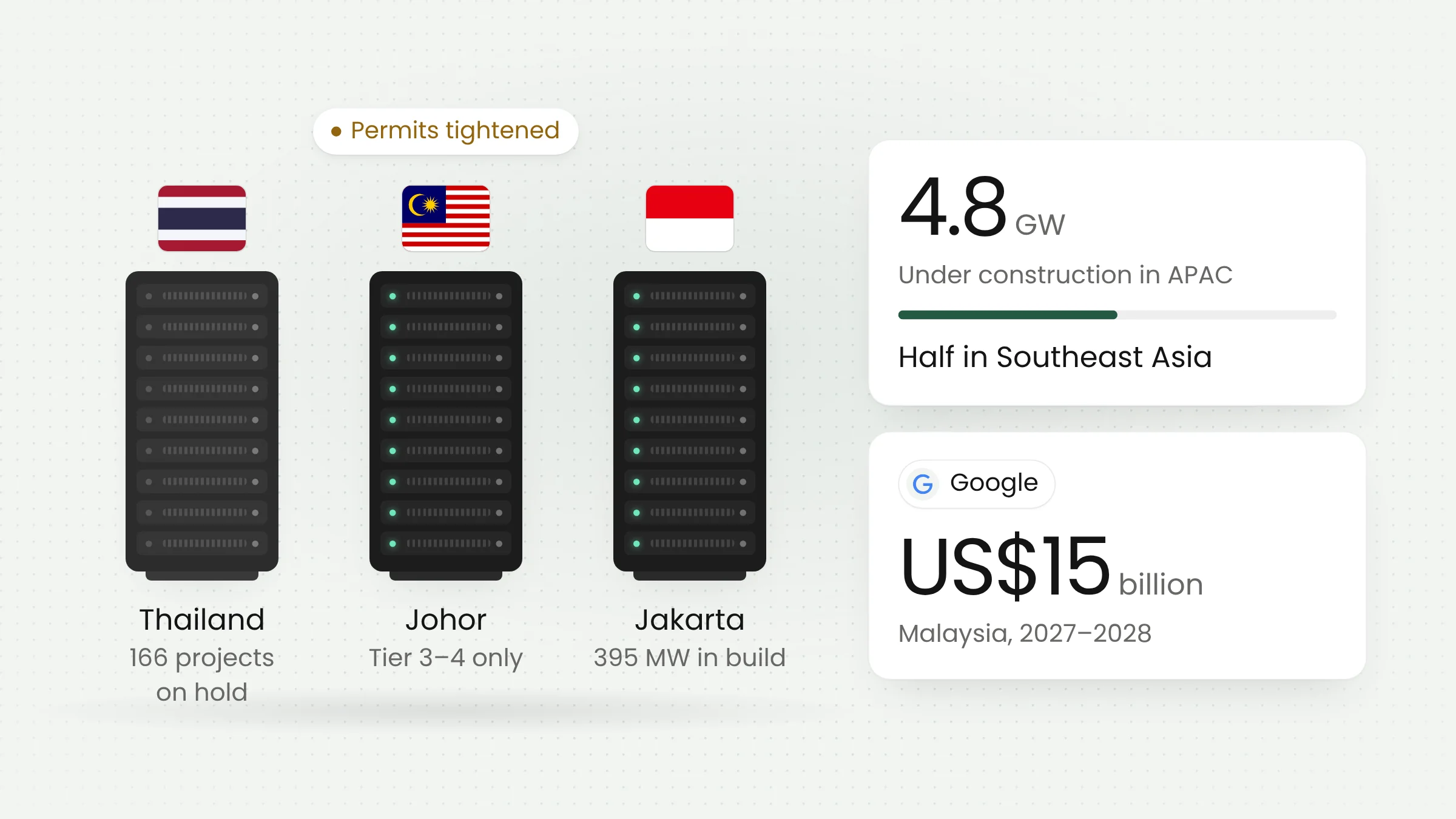
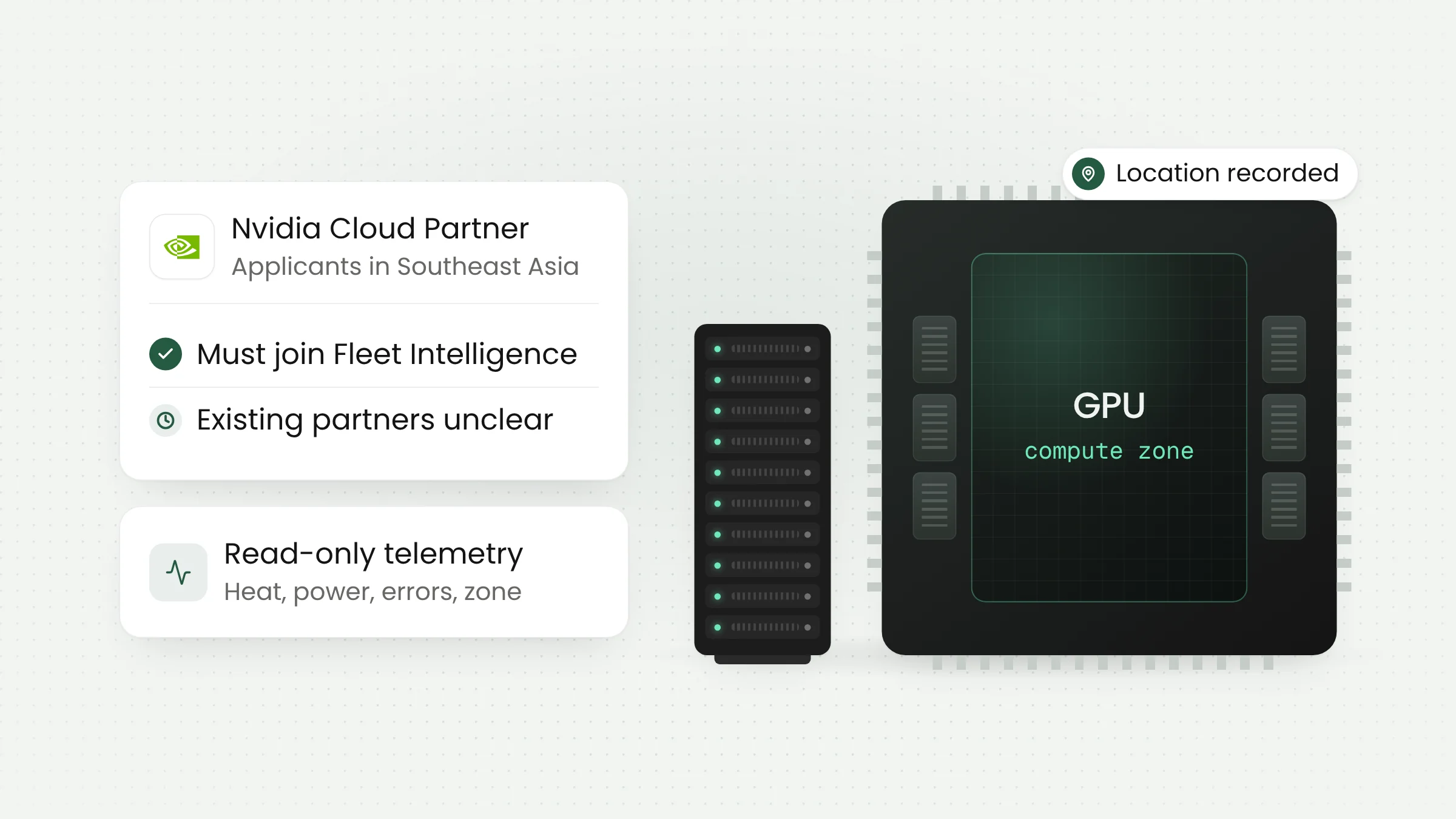
The rule follows Nvidia’s move earlier this month to require GPU tracking for prospective cloud partners in Southeast Asia. Nvidia’s condition is a company policy, while the BIS rule binds every exporter of advanced US AI chips. Neighboring countries are also tightening data center approvals through power, water and permitting rules.
As of November 17, 2026, we had not found an official response from the Indonesian government. CNA Indonesia reported that Indonesia is among the five countries rated as higher-risk routes for chip smuggling into China.
What this means for cloud providers and users
Indonesia is still allowed to buy AI chips from the United States. What changes is the procedure: shipments of advanced AI chips and servers to Indonesia now go through case-by-case license review, unless the recipient has a US parent and the reporting conditions are met.
For data center operators and GPU providers
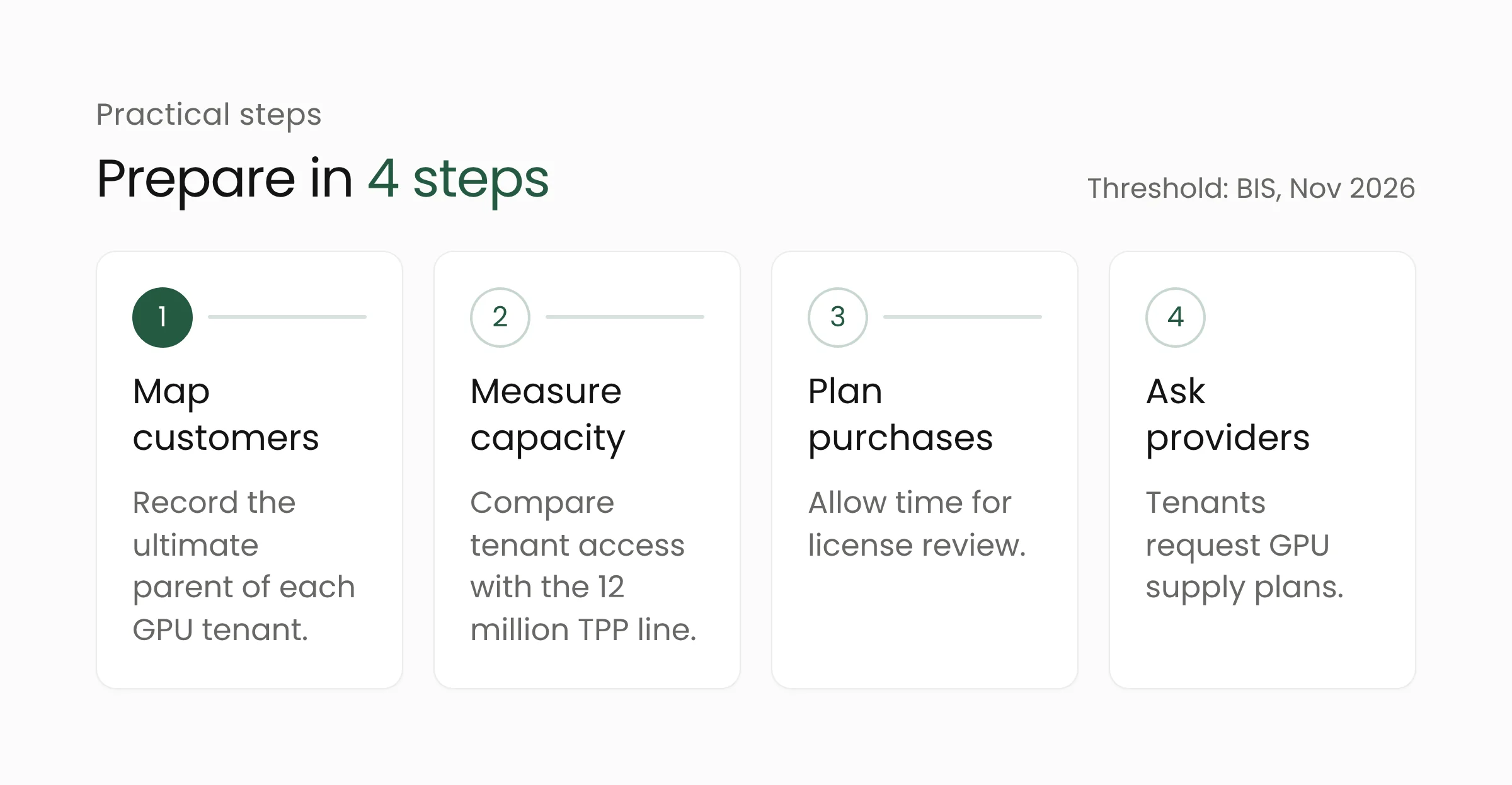
Providers planning to add GPU servers should build extra time into procurement schedules, since every shipment to Indonesia now depends on a licensing decision. Distributors and server vendors are likely to ask for more information, because the rule expects exporters to collect customer due diligence from the receiving data center.
Operators also need to map who ultimately owns their customers. Tenants owned or controlled from Macau or a D:5 country count toward the 12 million TPP threshold, whether at one site or across linked facilities.
For organizations that rent GPUs
A hospital training medical imaging models, a bank running fraud detection models or a university using GPUs for research is unlikely to be a direct target of the rule. The effect arrives through providers: how much new capacity is available, when GPUs are added, and more detailed compliance questions at contract time.
There are three things you can do now. Ask your cloud provider how its GPU supply plans will change once the rule takes effect. Prepare ownership information about your organization, because providers may request it for customer checks. For AI projects that depend on GPUs, draw up a fallback plan, such as another cloud region or a model that needs less compute. Merakit’s cloud computing team can help map GPU requirements and sourcing options.
Frequently asked questions
Is Indonesia banned from buying US AI chips?
No. The rule adds a license requirement, and applications are reviewed case by case. Shipments to recipients headquartered in the United States, or with a US ultimate parent, are exempt as long as the exporter files monthly reports with BIS.
When does the rule take effect?
BIS released the rule on November 16, 2026. It is scheduled for publication in the Federal Register on November 19, 2026, which is also its effective date. Data centers already serving companies from Macau or D:5 countries have 90 days to obtain a license.
Are product recommendations in online stores affected?
Commercial recommender systems that only rank, filter or suggest products and content are exempt from the remote access restriction. The exemption does not cover chatbots or other systems that generate new content.
Conclusion
The BIS rule makes export compliance part of AI infrastructure planning in Indonesia. Chip supply remains open, but it now passes through stricter procedures and requires more detailed customer data. If your organization is planning AI or cloud projects for next year, the Merakit team can help you weigh the options.
Sources
- BIS: BIS Issues Rule Addressing Remote Access to American Super Intelligence Technology (November 16, 2026)
- Federal Register (Public Inspection): Addressing Remote Access to Advanced Semiconductors, document 2026-23529 (scheduled for publication November 19, 2026)
- TechCrunch: US tightens AI chip export controls to deter Chinese companies from accessing compute remotely (November 16, 2026)
- The Register: US extends chip sale restrictions to more Asian countries to reduce risk of ‘diversion’ to China (November 17, 2026)
- CNA Indonesia: AS perketat akses China ke cip AI, Indonesia ikut terdampak (November 17, 2026)
- Nixon Peabody: BIS targets remote access to advanced chips through overseas data centers (November 16, 2026)