Blog Financial Services
Ashikaga Bank Puts Face Verification in All 134 Branches
On this page· 7 sections
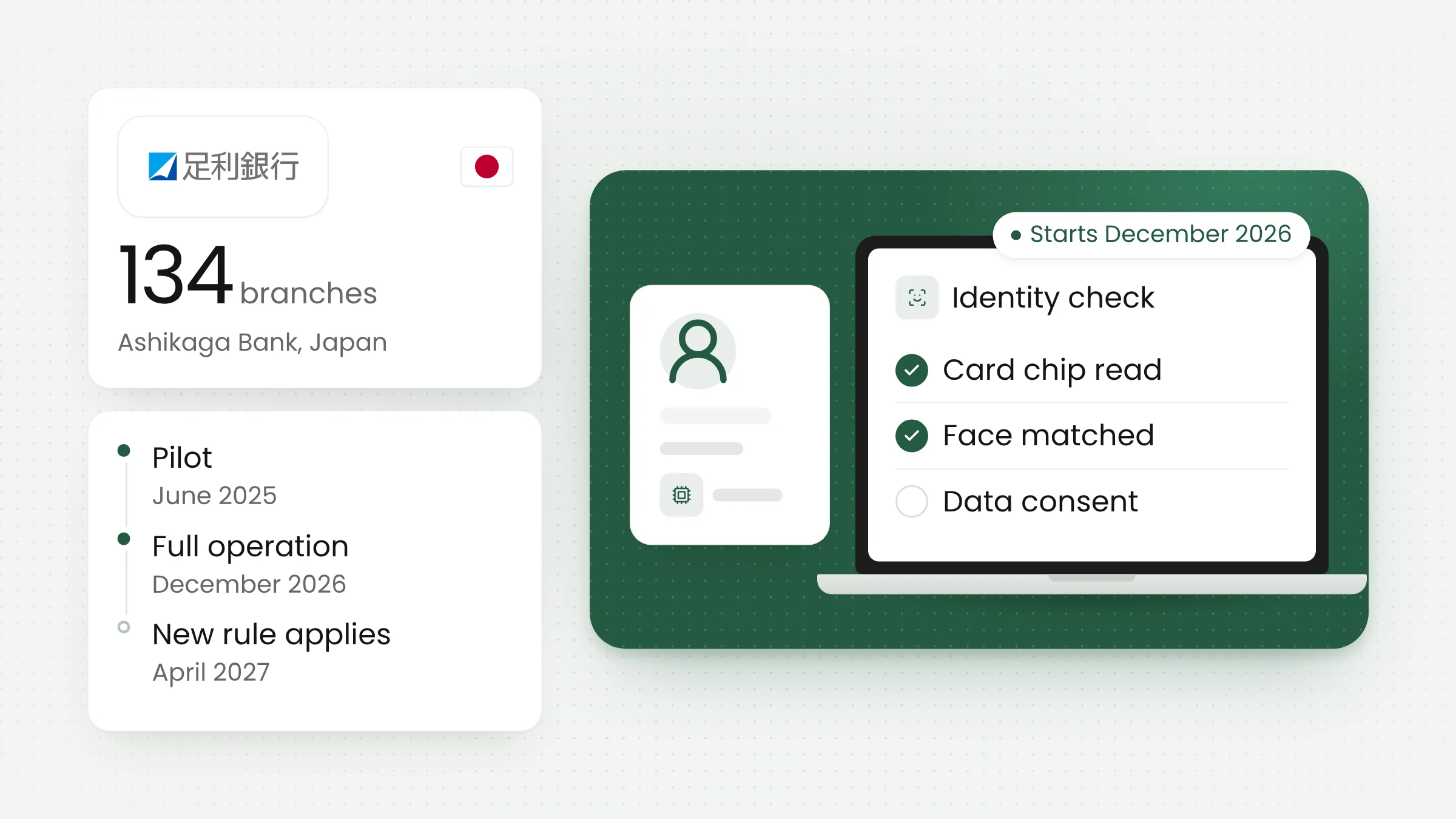
Ashikaga Bank, a Japanese regional lender, is installing self-service face verification terminals at all 134 branches, with full operation starting in December 2026. Customers read the chip in their own ID card at the counter, and a camera matches their face to the chip photo. The move precedes a Japanese rule change due in April 2027.
What Panasonic Connect and Ashikaga Bank announced
The news came from the supplier. In a press release dated November 25, 2026, Panasonic Connect said its “Self Identity Verification Service” is going into all 134 Ashikaga Bank locations, covering both branches and sub-branches. The bank is headquartered in Utsunomiya, Tochigi Prefecture.
Ashikaga Bank has tested the face verification workflow at selected branches since June 2025. According to the release, the pilot produced enough of an effect to justify a network-wide deployment, though no pilot figures were published.
Panasonic Connect lists three problems with the old process. Tellers inspect ID cards by eye, which makes accuracy hard to guarantee. Data from the card cannot flow into the core banking system and has to be typed again into a separate one. Checks on residence cards held by foreign customers take longer because staff must review the expiry date and residence status.
How the self-service terminal works
The setup has two parts. According to IT Leaders, a counter PC runs an identity verification application, and a camera-equipped card reader connects to it over USB. The reader has the same specification as the face recognition card readers Panasonic Connect sells to hospitals and pharmacies.
The customer operates the terminal in four stages. They place an ID card on the reader, which pulls data from the card’s chip. The camera compares the customer’s face with the portrait stored on the chip. Once the face matches, the screen asks the customer to consent to handing their personal details to the bank. The data is then read and the time of the check is logged.
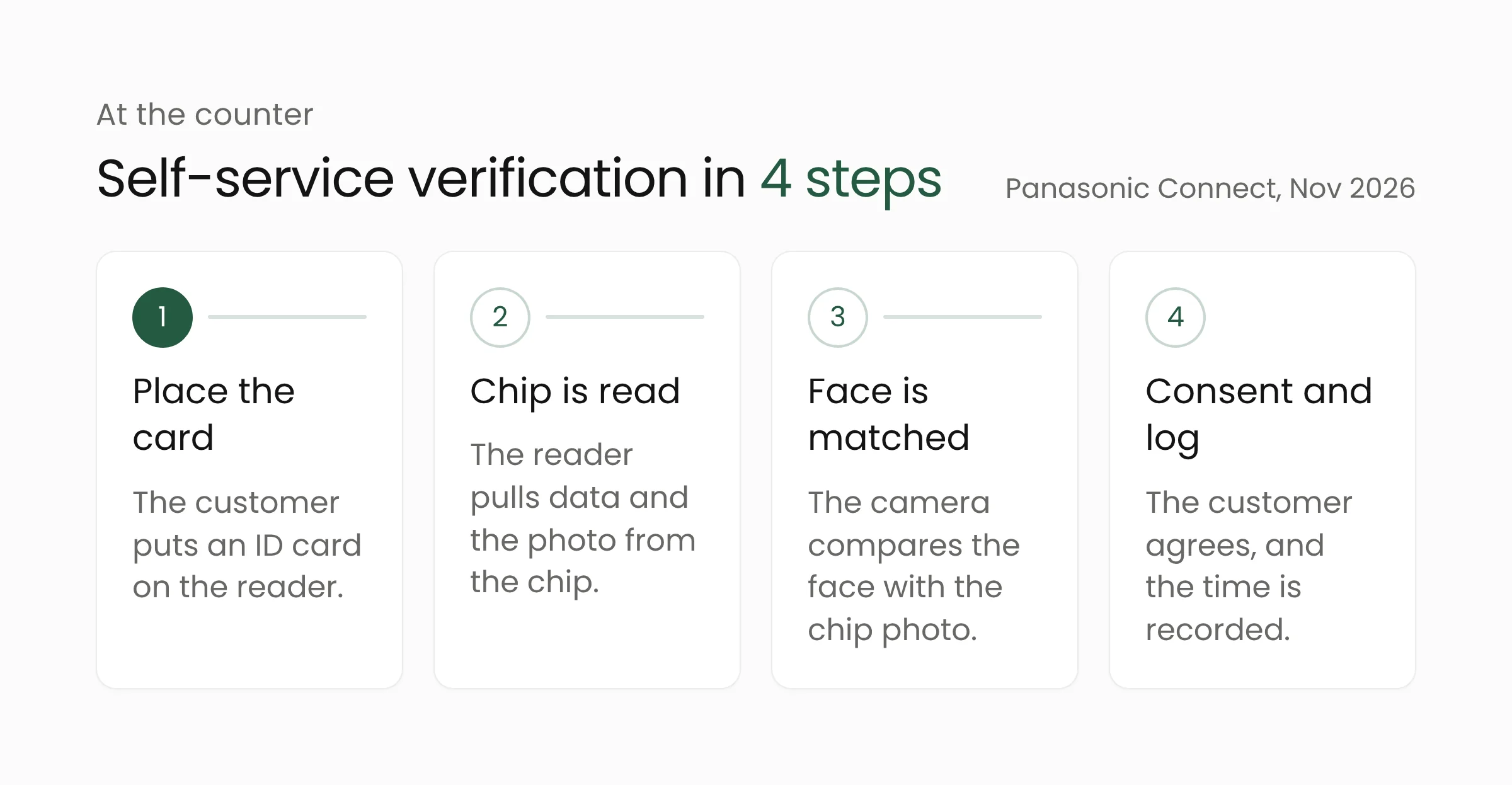
This is a one-to-one match. The customer’s face is compared with a single image, the photo on their own card, so no advance face enrollment is needed. That differs from searching a face against a database of many people, which carries a larger risk if the data leaks.
Supported documents and the data that is read
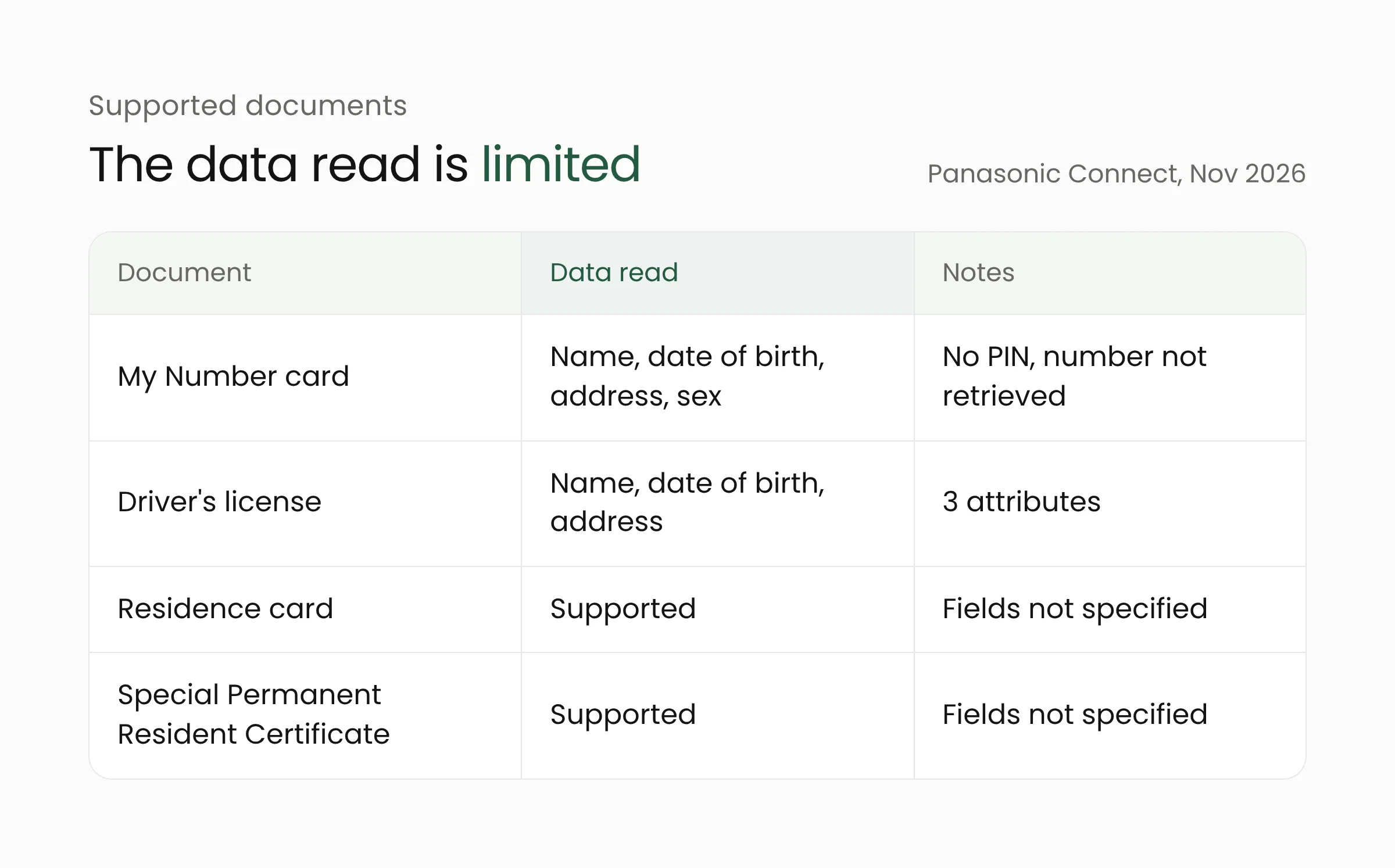
The terminal reads four document types: the My Number card (Japan’s national ID card), driver’s licenses, residence cards for foreign nationals, and Special Permanent Resident Certificates.
The data pulled is limited. From a My Number card, the system reads four basic attributes: name, date of birth, address and sex. The customer does not enter a PIN, and the My Number itself is not retrieved. From a driver’s license, the system reads name, date of birth and address. The release does not specify which fields are read from the other two documents.
Panasonic Connect says the timestamp on each check improves traceability, and that digital records reduce the need to store photocopies of ID cards. The company also says shipments of its face recognition card readers for hospitals and pharmacies had reached 127,000 units as of May 19, 2026. That figure covers the shared hardware line. Ashikaga Bank’s own order size has not been announced.
The Japanese rule that takes effect in April 2027
The main driver is a revision to Japan’s Act on Prevention of Transfer of Criminal Proceeds, the country’s anti-money-laundering law. IT Leaders reports the revision takes effect on April 1, 2027, while Panasonic Connect’s release says only April 2027.
According to IT Leaders and ID Tech, reading the chip in a photo ID will become mandatory for in-person transactions. Until now, electronic verification applied only to online account opening, and at the counter a teller could look at the printed card. Under the new rule, the chip data must be shown on a screen and checked against what is printed on the card.
Face matching goes beyond that requirement. IT Leaders notes it was added to tighten identity checks. In Panasonic Connect’s terms, the customer is verified with two elements, an official document and their own face. A stolen card with a genuine chip could pass the chip check, but should be stopped at the face match.
Open questions after the announcement
Several questions are left open in the announcement and the coverage we read. The release does not say where the camera image is processed, how long it is kept, or when it is deleted. Procurement cost, the number of terminals per branch, and the match failure rate during the pilot are also undisclosed.
On accuracy, Panasonic Connect points to face recognition tests run by NIST, the U.S. standards body, which ranked its technology first in certain categories. Those lab results evaluate the algorithm. Performance at a bank counter depends on lighting, the quality of the chip photo, and how old that photo is. A direct link to the core banking system does not exist yet. Business+IT reports that the bank plans to study it, so manual re-entry has not fully gone away.
What this means for banks and financial institutions in Indonesia
Indonesia has similar building blocks. The national ID card, KTP-el, stores data on a chip, and the civil registry directorate (Dukcapil) offers user institutions five ways to verify population data: card readers, a web service, a web portal, face recognition, and the IKD digital ID app. Dukcapil Director General Teguh Setyabudi listed them on May 12, 2026, as reported by Republika, adding that roughly 7,500 institutions had data-use agreements in place. We covered the latest figures in our article on Indonesia’s IKD digital ID passing 25 million users.
Photocopying the KTP is still routine at many bank, cooperative and consumer finance counters. The Ashikaga case offers several practical pointers for institutions that want to move away from it.
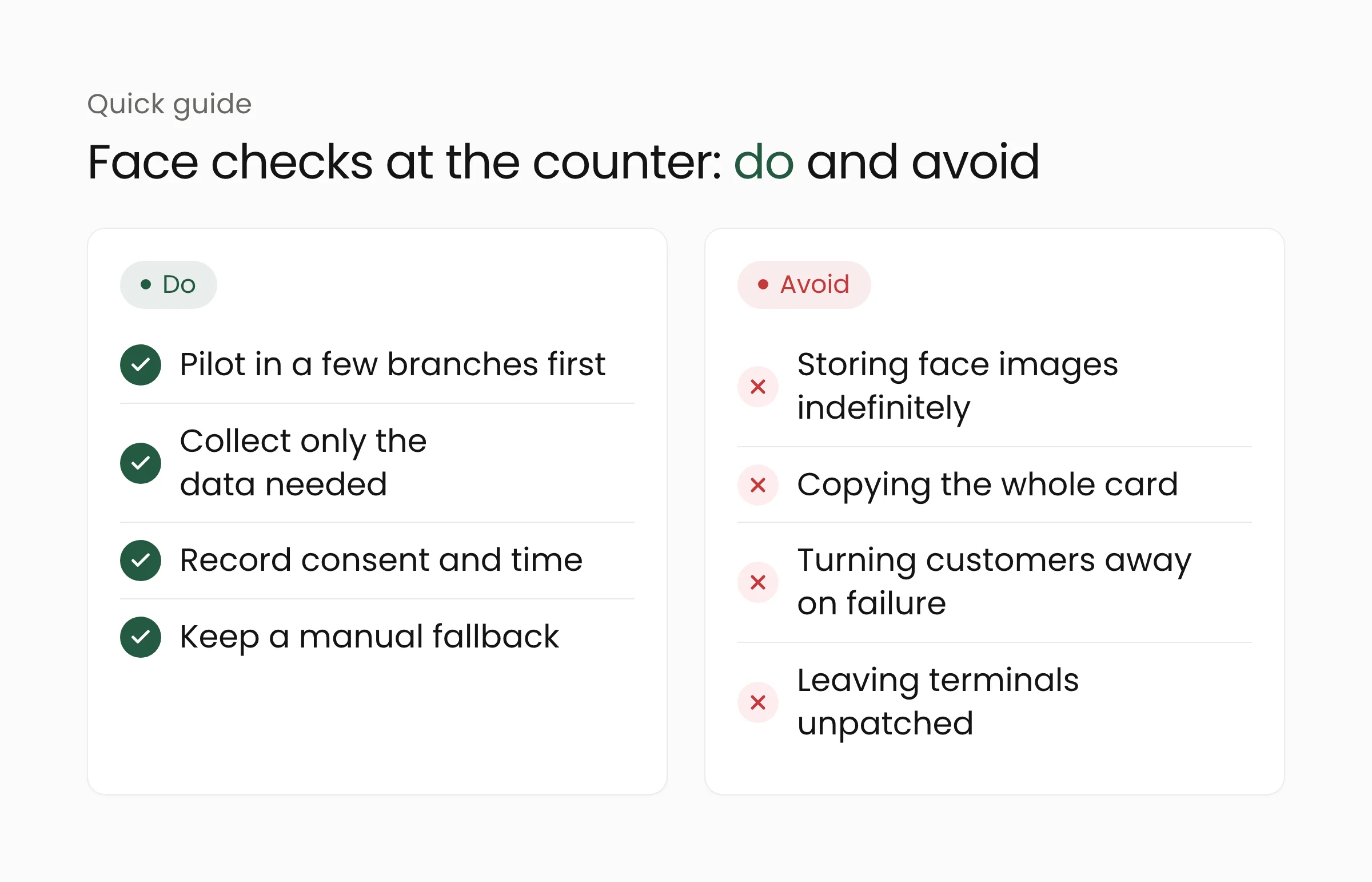
Start with one workflow in a few branches. Ashikaga Bank tested its system for about a year and a half before expanding it. New account opening is a sensible first workflow because volumes are measurable and the identity check is at its most complete.
Limit the data you take. The Japanese terminal reads four basic attributes and leaves the national ID number alone. The same principle applies in Indonesia. Collect what the service requires, and avoid copying the whole card because the data is available.
Decide what happens to the face image up front. Indonesia’s Undang-Undang Nomor 27 Tahun 2022 tentang Pelindungan Data Pribadi (the Personal Data Protection Law) classifies biometric data as specific personal data. A one-to-one match allows the camera image to be deleted as soon as the result is returned. Decisions on storage, retention period and access rights should be written down before any device is installed.
Ask for consent on screen and log the time. The Ashikaga sequence is easy to copy: the customer agrees to share data on the terminal, then the system records when the check happened. That record helps during audits.
Keep a fallback path. Chips fail, an old photo can look very different from the person at the counter, and some elderly customers need help. Tellers still need a clear manual procedure so nobody is turned away because the device failed.
Connect it to the core system. The biggest gain arrives when chip data fills the account opening form directly. This is the integration work we usually handle within our financial services solutions, and Ashikaga Bank itself has not finished it.
A counter terminal is also a new endpoint to protect. The PC and card reader that process identity data should be locked against other software, patched regularly and monitored. That work falls under cybersecurity services.
Frequently asked questions
Do customers have to enroll their face first?
No. The Ashikaga Bank system compares the customer’s face with the photo already stored on the chip of their ID card. Panasonic Connect says prior face enrollment is not required.
Is the national ID number read?
Not for the My Number card. The system retrieves only name, date of birth, address and sex. The My Number itself is not retrieved, and the customer is not asked for the card PIN.
Could a similar approach work with Indonesia’s KTP-el?
The basic ingredients are there. KTP-el has a chip, and Dukcapil names card readers and face recognition among the verification methods available to user institutions. An institution that wants to use them needs a data-use agreement with Dukcapil and has to follow its technical requirements. Costs and conditions are best confirmed with Dukcapil directly.
Closing
Ashikaga Bank is moving identity checks from the teller’s eyes to the card chip and a camera, with limited data and recorded consent. The real results will show once full operation is under way and the April 2027 rule applies. For financial institutions in Indonesia weighing a similar step, the Merakit team is open to a conversation about verification workflows and how they fit into existing systems.
Sources
- Panasonic Connect: identity verification solution deployed at all 134 Ashikaga Bank branches (press release, November 25, 2026)
- IT Leaders: Ashikaga Bank installs face recognition card readers at all 134 branches (November 26, 2026)
- Mynavi News TECH+: Ashikaga Bank begins face-based identity verification at branch counters (November 25, 2026)
- Business+IT via Yahoo Japan News: about four months before the revised law (November 27, 2026)
- ID Tech: Ashikaga Bank Deploys Panasonic Connect Face Readers Across 134 Branches (November 26, 2026)
- Republika: Dirjen Dukcapil Klarifikasi Kabar Larangan Fotokopi dan Check In Pakai KTP-El (May 12, 2026)
- Undang-Undang Nomor 27 Tahun 2022 tentang Pelindungan Data Pribadi