Blog Digital Tax
SPP-TDLN Explained: Indonesia's Bank-Collected Digital VAT
On this page· 7 sections
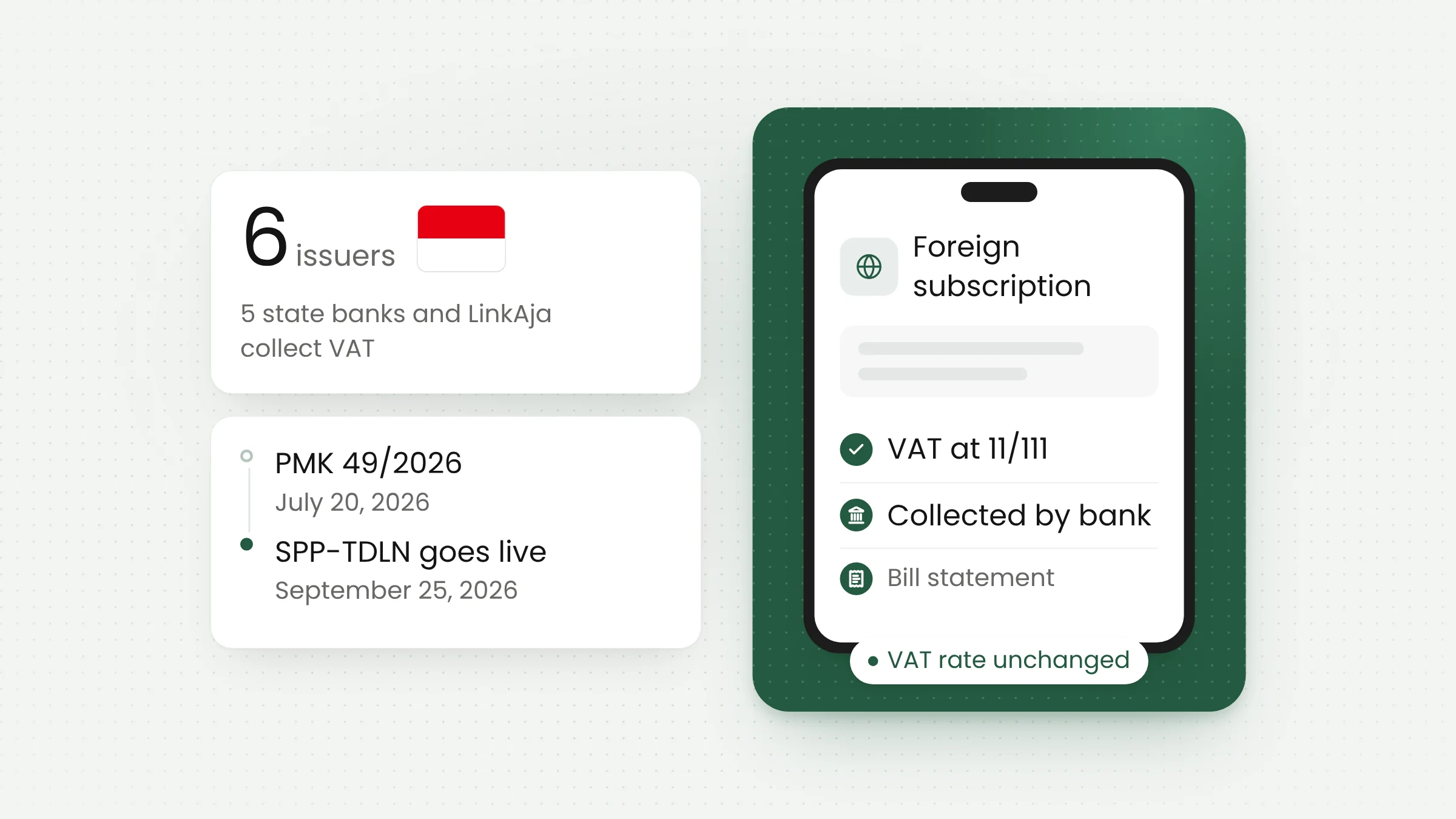
Indonesia’s SPP-TDLN collects value added tax (VAT, or PPN) on foreign digital services at the point of payment, through the banks and fintechs that process them. It has run since September 25, 2026 with six initial collectors. On November 2, the tax office explained it again after claims spread that bank transfers would be taxed from November 9.
PMK 49/2026 and the payment issuers
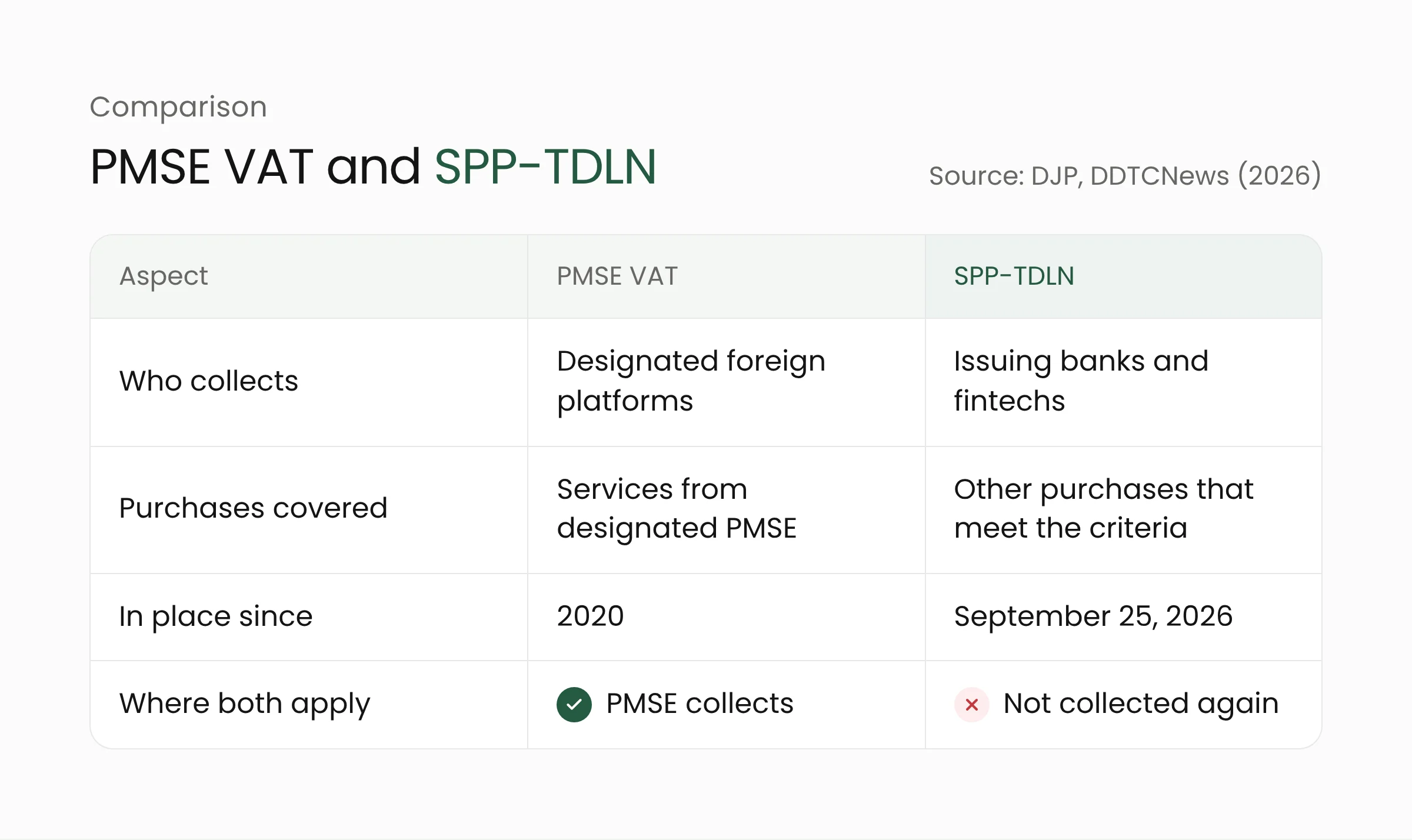
Until now, VAT on digital services bought from abroad has been collected by foreign sellers that the Directorate General of Taxes (DJP) designates as electronic commerce operators, known locally as PMSE. That approach depends on overseas platforms registering and collecting the tax themselves. Purchases from foreign sellers that have not been designated fall outside it.
The government closed that gap with Finance Minister Regulation (PMK) No. 49 of 2026. According to a DDTCNews explainer, the regulation took effect when it was promulgated on July 20, 2026 and implements Presidential Regulation No. 68 of 2025. The system is operated by PT Jalin Pembayaran Nusantara, a payments company within Indonesia’s state-owned enterprise group.
The design differs from the PMSE scheme. Under SPP-TDLN, the tax is collected by the issuer of the payment instrument the consumer uses, meaning a bank or a non-bank payment institution. The two mechanisms run side by side. Transactions on which a designated PMSE has already collected VAT are excluded from SPP-TDLN.
DDTCNews reports that PMSE VAT receipts from 2020 to June 30, 2026 reached Rp42.01 trillion. The figure gives a sense of how much Indonesians spend on foreign digital services.
Six initial collectors and more to come
DJP press release SP-22/2026 names the six issuers that started collecting when the system went live: BRI, Bank Mandiri, BNI, BTN, BSI, and the e-wallet LinkAja (PT Fintek Karya Nusantara). Before designation, each issuer went through sandbox testing and a stabilization period covering system readiness, data exchange and integration.
Other issuers are still in that process. Director General of Taxes Bimo Wijayanto, quoted by DDTCNews on October 12, said coverage would soon extend to other banks, fintechs and payment gateways. DJP has not given a number or a date.
The range of services in scope is broad. Kontan lists software and app purchases, cloud services, streaming and digital entertainment, AI-based services, digital information, and online games.
How SPP-TDLN works in four stages
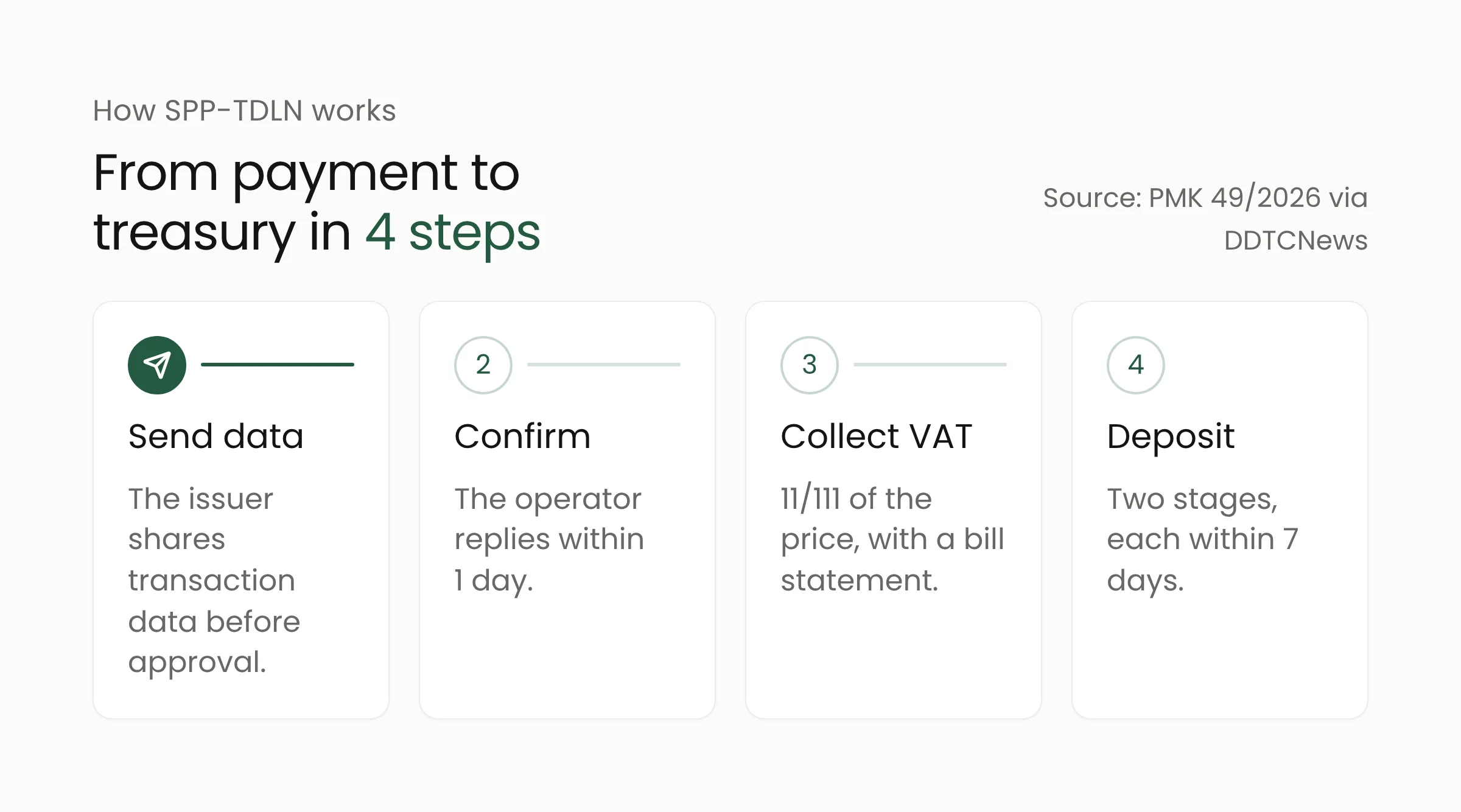
The process happens behind the scenes when a consumer pays for a foreign subscription or digital purchase with a card or e-wallet. Based on the PMK 49/2026 provisions summarized by DDTCNews, it has four stages.
Data goes out before the payment is approved
Before authorizing a payment, the issuer sends transaction data to the operator for confirmation. DDTCNews lists 11 data fields for foreign digital transactions, including the reference number, amount and currency, the merchant’s name and country code, payment type, and transaction time. Issuers also submit domestic fund transfer and remittance data for mapping and analysis.
Confirmation within one day
The operator must confirm within one day of the request. VAT becomes payable at the moment the operator confirms that the transaction is subject to VAT. Transactions that do not meet the criteria are not taxed.
VAT at 11/111 of the price
The issuer collects 11/111 of a price that already includes VAT. As a worked example, a Rp111,000 bill carries Rp11,000 of VAT. Foreign currency amounts are converted to rupiah at the Finance Minister’s exchange rate in force at the time of confirmation.
Two seven-day deposit windows
The issuer deposits the collected VAT through the operator within seven days of the confirmation date. The operator then pays it into the state treasury within seven days of receiving it and reports it in its monthly VAT return.
As proof of collection, the issuer provides a designated document treated as equivalent to a tax invoice, such as a bill statement. It shows the identities of the issuer, the merchant and the user, the collection date, a reference number, the tax base, and the VAT collected.
The November 9 claim and DJP’s response
The November 9 date came from remarks by the chair of the advisory board of Kadin, Indonesia’s chamber of commerce, at the chamber’s national leadership meeting on October 29, 2026. The remarks circulated as a claim that banks, fintechs and platforms would have to collect digital tax from that date, and some readers took it to mean a tax on bank transfers.
DJP responded on November 2. Inge Diana Rismawanti, the agency’s director of counseling, services and public relations, said the policy in question is SPP-TDLN, which has been running since September 25. “Perlu dipahami bahwa tidak semua transaksi luar negeri dikenai PPN,” she said, as quoted by ANTARA. In English: not every foreign transaction is subject to VAT.
DJP made three points in statements carried by ANTARA, CNN Indonesia and Republika. SPP-TDLN does not create a new tax and does not change the VAT rate. Fund transfers and remittances, including personal and family transfers, are not automatically subject to VAT. Transactions already taxed by a designated PMSE are not taxed again.
In those statements, DJP did not announce any new rule taking effect on November 9. According to Aktual.com, additional issuers will be announced through official DJP channels once all preparation stages are complete.
What this means for banks, fintechs and businesses
For financial institutions, SPP-TDLN is mostly a systems integration job. Issuers must send data before authorization, wait for confirmation, collect, deposit and issue proof of collection, all on tight deadlines. Points worth preparing:
- Test the authorization path. The confirmation request adds a step before a payment is approved. Test response times and the fallback when a confirmation is delayed, so customer payments are not held up.
- Reconcile daily. A seven-day deposit window calls for routine matching of transactions, VAT collected and deposits. A monitoring dashboard that surfaces mismatches early helps finance and compliance teams.
- Review data governance. Domestic transfer and remittance data are shared for mapping. Access controls, logging and the legal basis for processing should be reviewed with legal teams under Indonesia’s Personal Data Protection Law.
- Plan for refunds. PMK 49/2026 covers refunds when a transaction is cancelled or VAT is collected in error. Give customers a clear complaint path in the app and through support.
Banks and fintechs preparing this kind of integration can look at Merakit’s financial services solutions, including API development and data analytics for reconciliation.
Companies that subscribe to foreign services, such as cloud platforms or workplace apps, should note one practical detail. VAT shown on an SPP-TDLN collection document can be credited as input tax if the user’s email or phone number is registered with DJP and the other crediting conditions are met. Finance teams should make sure company cards or accounts use registered contact details and keep bill statements as supporting documents.
Frequently asked questions
Will ordinary bank transfers be taxed from November 9?
No. DJP says fund transfers and remittances are not automatically subject to VAT. SPP-TDLN only collects VAT on foreign digital transactions that meet the criteria for VAT.
Could a foreign app subscription be taxed twice?
It should not be. If a designated PMSE has already collected VAT, the transaction is not taxed again through SPP-TDLN. If tax is collected in error, PMK 49/2026 provides for refund requests through the issuer or the operator.
Which institutions collect VAT through SPP-TDLN today?
According to DJP’s October 1, 2026 press release: BRI, Bank Mandiri, BNI, BTN, BSI and LinkAja. DJP says other issuers will be designated after completing their stabilization period and announced through official channels.
Closing thoughts
SPP-TDLN moves the collection point for VAT on foreign digital services from the platform to the payment channel. For consumers, the rate stays the same. For banks and fintechs, it adds integration, reconciliation and data protection work that is best designed carefully from the start. If your team is building this kind of integration or a compliance dashboard, Merakit would be glad to talk it through.
Sources
- DJP: Press Release SP-22/2026, Government Begins Implementing SPP-TDLN (October 1, 2026)
- DDTCNews: PMK 49/2026, VAT on Foreign Digital Transactions via SPP-TDLN (July 28, 2026)
- DDTCNews: VAT Collected via SPP-TDLN, the Data Required (July 25, 2026)
- Kontan: Five Banks and One Fintech Become Digital VAT Collectors (October 2, 2026)
- DDTCNews: DJP to Add More VAT Collectors Under SPP-TDLN (October 12, 2026)
- ANTARA: DJP Says Digital Tax Does Not Automatically Make Fund Transfers Subject to VAT (November 2, 2026)
- CNN Indonesia: DJP Responds to Claims Bank Transfers Face Digital Tax from November 9 (November 2, 2026)
- Republika: DJP Says Overseas Money Transfers Are Not Automatically Taxed (November 2, 2026)
- Aktual.com: DJP Says Bank Transfers Not Automatically Subject to VAT from November 9 (November 2, 2026)