Blog Digital Government
Indonesia's IKD Digital ID Passes 25 Million Users
On this page· 7 sections
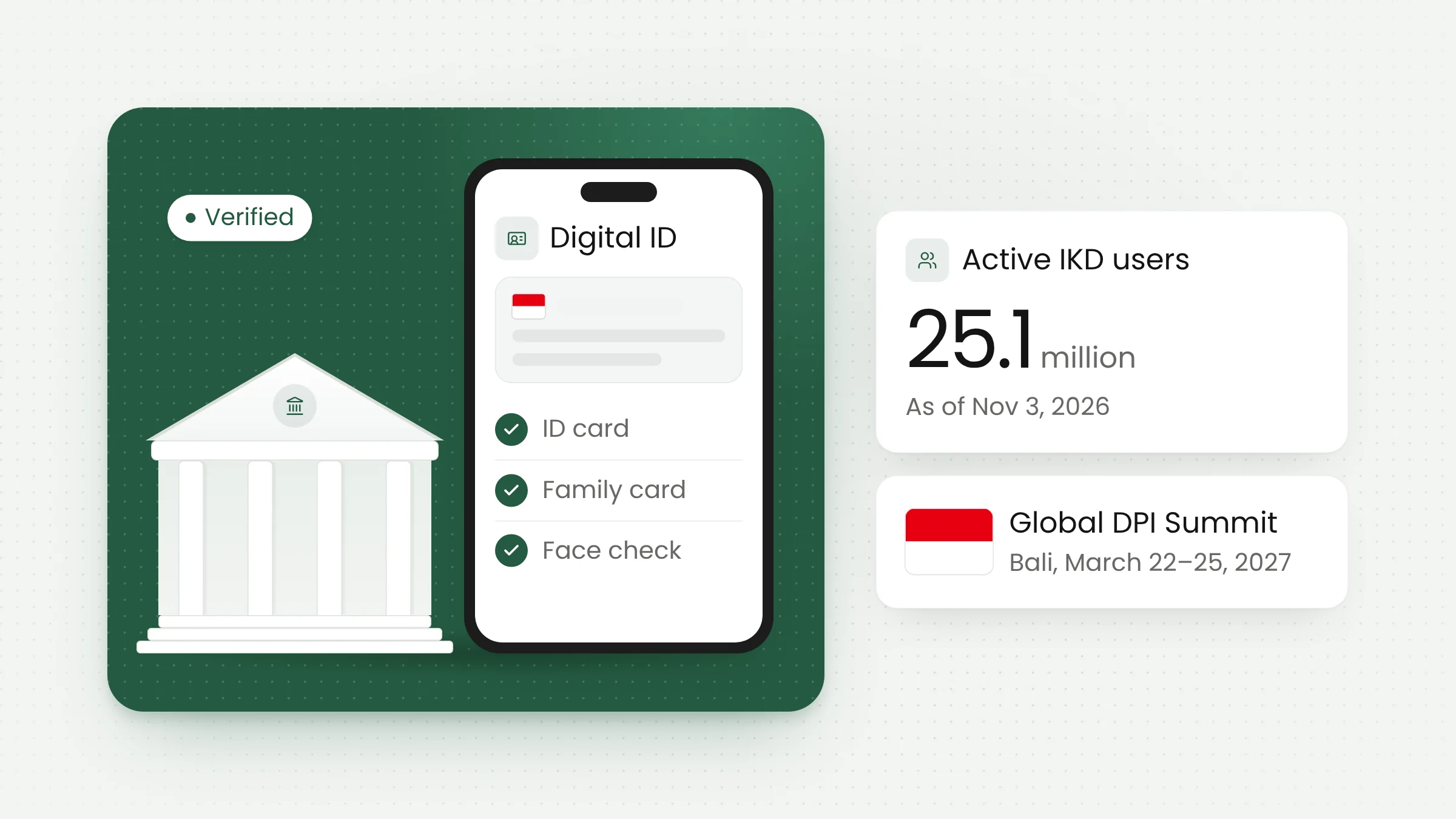
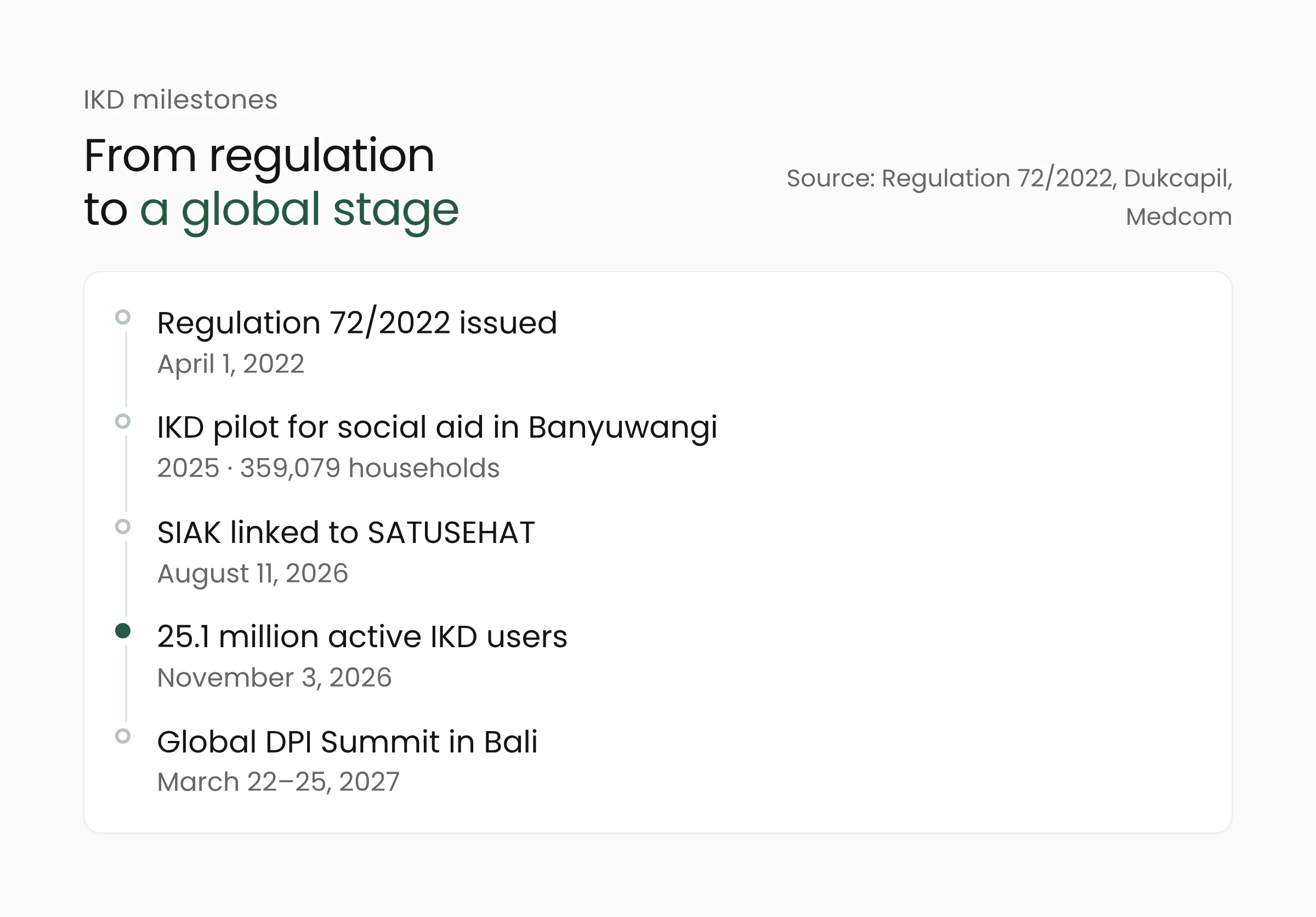
Indonesia’s digital population identity app, known as IKD (Identitas Kependudukan Digital), had 25,181,292 active users as of November 3, 2026, according to the Directorate General of Population and Civil Registration (Dukcapil) at the Ministry of Home Affairs. Dukcapil also plans to showcase IKD at the Global DPI Summit in Bali on March 22–25, 2027.
Dukcapil released the figures on November 9, 2026, and summit preparations were reported two days later. For agencies, hospitals, banks, and schools that serve the public, the numbers suggest that digital identity is becoming a real entry point to public services.
How IKD works and its legal basis
IKD is Dukcapil’s official app for carrying population documents in digital form. Its legal basis is Minister of Home Affairs Regulation No. 72 of 2022 (Peraturan Menteri Dalam Negeri Nomor 72 Tahun 2022 tentang Standar dan Spesifikasi Perangkat Keras, Perangkat Lunak, dan Blangko Kartu Tanda Penduduk Elektronik serta Penyelenggaraan Identitas Kependudukan Digital, on electronic ID card standards and the operation of digital population identity), issued on April 1, 2022. The regulation defines IKD as electronic information that represents population documents and related data in a digital app on a personal device.
In practice, IKD stores a citizen’s electronic ID card (KTP-el) and family card (Kartu Keluarga). According to Dukcapil data reported by Garuda TV, the app can also be used to request a printed family card, a relocation certificate, a birth certificate, and changes to education records. Medcom reports that at least 11 Dukcapil services are now available through IKD.
For other institutions, the most important function is verification. The national identity number (NIK) is the primary key used to match citizen records. Organizations with a Dukcapil agreement can verify identities through four channels: a web service, a web portal, facial recognition, and the IKD app. According to detikcom, one of IKD’s stated goals is to prevent identity fraud, along with cutting the cost of printing population documents.
The latest numbers and the role of NIK verification
Dukcapil’s data as of November 3, 2026 contains three key figures. Beyond the 25.18 million active IKD users, NIK verification transactions have reached 21.04 billion, averaging about 8 million a day. Data-sharing agreements are in place with 7,833 institutions, including government agencies, banks, transport operators, schools, and health facilities.
Director General Teguh Setyabudi described the benefit of connected data to reporters on November 9. “Keterhubungan data tersebut memungkinkan instansi pengguna memastikan identitas masyarakat secara lebih efektif dan mendukung peningkatan kualitas pelayanan,” he said, as quoted by Disway. In English, he said connected data lets user institutions confirm citizens’ identities more effectively and supports better service quality.
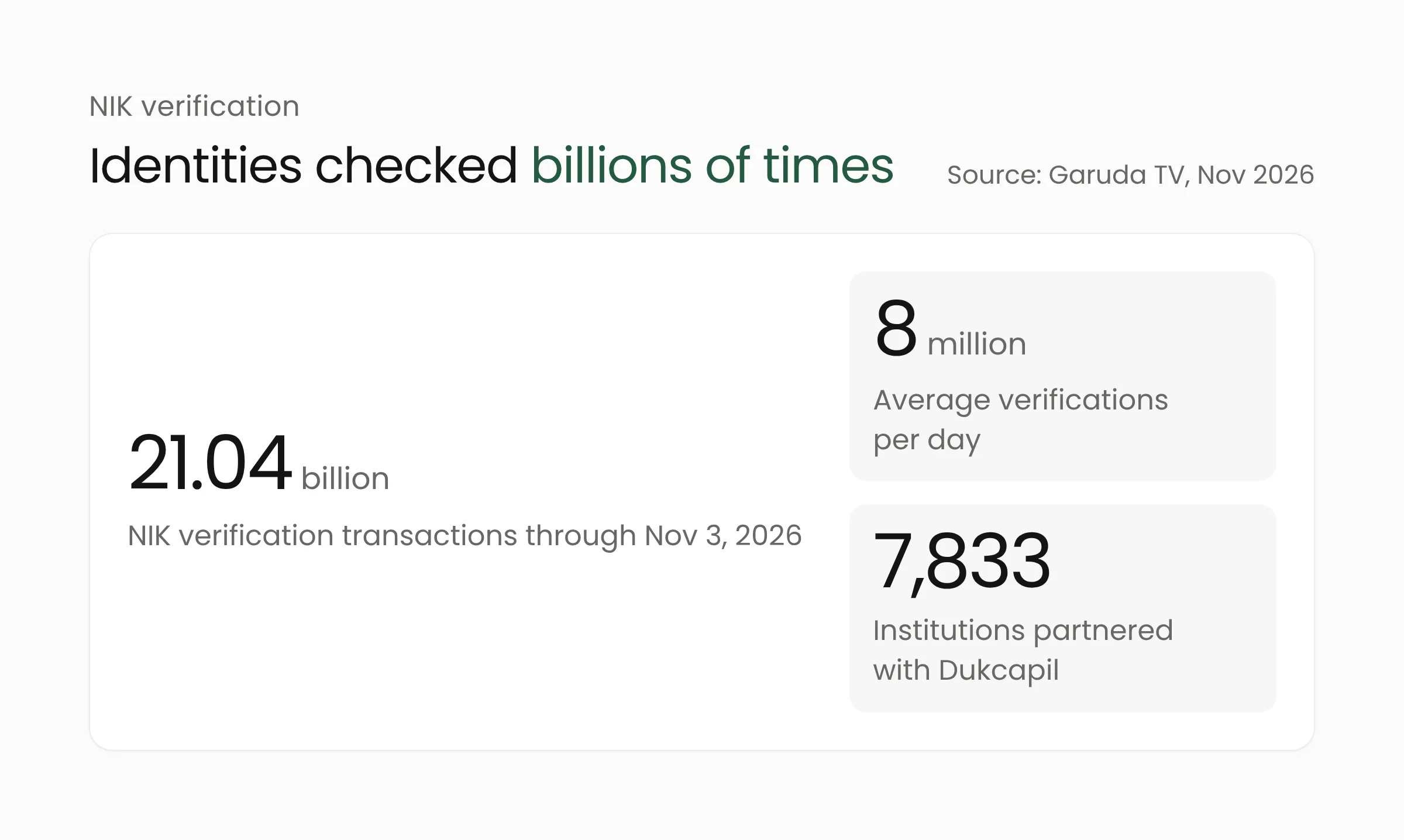
User growth has been visible over the past two months. On September 9, 2026, Dukcapil recorded 22,342,339 IKD users, or about 10.69 percent of residents required to hold an electronic ID card. Even after adding roughly 2.8 million users by early November, most Indonesians still rely on the physical card alone.
Social protection is one of the services pushing adoption. IKD connects to the Social Protection Portal (Perlinsos) through single sign-on, facial recognition, and NIK validation. A 2025 pilot in Banyuwangi Regency covered 359,079 heads of household. Merakit has previously explained how face verification for digital social aid relies on this Dukcapil data.
Health is another area of integration. Dukcapil’s civil registration system (SIAK) was linked to the Ministry of Health’s SATUSEHAT platform on August 11, 2026. Birth certificate processing can now begin at the facility where the baby is born, so parents no longer need to make repeated trips to the local civil registry office.
IKD Plus for field activation
Activation remains the main bottleneck. To speed it up, Dukcapil built IKD Plus, a mobile app for Dukcapil officers, operators, and verified agents. With it, authorized registrars can verify and activate a citizen’s IKD account on the spot using facial recognition and QR code scanning.
According to kumparan, officers no longer need to carry laptops, cameras, card readers, and other biometric devices. Local governments have been asked to map low-activation areas and open activation points at public events, schools, campuses, and social aid sites.
Dukcapil is also preparing liveness detection for online onboarding, which is designed to tell a real face apart from a deepfake. Load testing and data security measures are being prepared with the National Cyber and Crypto Agency (BSSN).
Digital identity at the Global DPI Summit 2027
Digital public infrastructure (DPI) is the shared foundation that many services build on: digital identity, data exchange between agencies, and digital payments. Indonesia will host the Global DPI Summit 2027 at the Bali Nusa Dua Convention Center on March 22–25, 2027.
According to the official summit website, the event is co-hosted by Co-Develop, the International Telecommunication Union (ITU), the UN Office for Digital and Emerging Technologies, UNDP, and the World Bank, with Indonesia’s Government Digital Transformation Acceleration Committee (KPTDP) as host and the Asian Development Bank as regional co-host. Organizers expect more than 1,200 leaders from over 90 countries.
The ministerial meeting, chaired by KPTDP head Luhut Binsar Pandjaitan, covered policy alignment across ministries, the formation of a national committee, the agenda and communiqué, and which countries and partners to invite. tvOnenews reported that Dukcapil will present its civil registration innovations in the exhibition area. Dukcapil also took part in the two previous editions, in Cairo, Egypt (2024), and Cape Town, South Africa (2025).
What this means for agencies and service providers
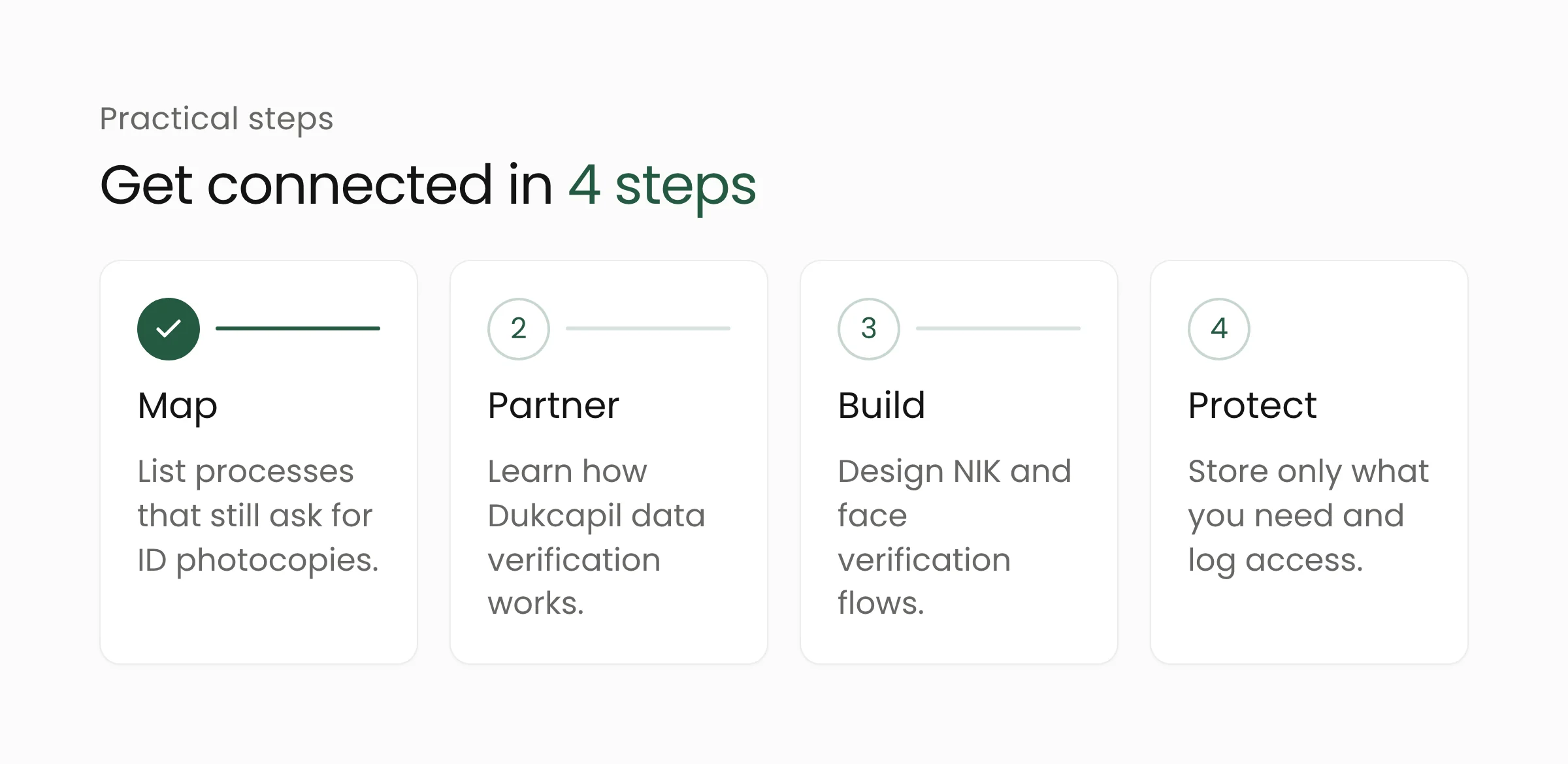
For local agencies, hospitals, banks, schools, and transport operators, IKD and NIK verification change how citizen identity is checked. The following steps are worth considering now.
- Map every identity check. List each process that still asks for a photocopy of the ID card or family card, such as registering new patients, opening bank accounts, admitting students, or applying for permits. These processes gain the most from NIK verification.
- Understand how to partner with Dukcapil. Access to population data verification is granted to institutions with a cooperation agreement. Choose the channel that fits your systems: the web service for existing applications, or facial recognition for in-person and online services.
- Build applications that can connect. Service applications should be able to call the verification service, store only the results they need, and keep working when the connection to the central system is down. Mobile sign-up flows should leave room for face verification and QR code scanning.
- Protect personal data from the start. Store NIK numbers and face images only when necessary, limit who can view them, and log every access. Law No. 27 of 2022 on Personal Data Protection (Undang-Undang Nomor 27 Tahun 2022 tentang Pelindungan Data Pribadi) applies to all of this processing.
Local governments can also help with activation. District and city civil registry offices can use IKD Plus to reach residents in villages, schools, and social aid sites. The effect will be stronger if other local services, such as permits and health care, also accept IKD as a sign-in method.
Such integration touches many systems at once. Merakit helps agencies design and connect these systems through its digital government solutions, including verification flows that respect personal data protection rules.
Frequently asked questions
Can IKD replace the physical electronic ID card?
Regulation No. 72 of 2022 treats IKD as a digital representation of population documents, so the physical card remains valid. Whether IKD is accepted in place of the physical card depends on the agency or institution providing the service, so it is safest to carry the physical card unless told otherwise.
How do I activate IKD?
Activation is currently done mostly with help from Dukcapil officers, either at a local civil registry office or at activation points that officers open with IKD Plus, such as public events, schools, campuses, and social aid sites. Dukcapil is also preparing liveness detection to support online sign-up. Official information is available through the HALO DUKCAPIL 168 hotline.
Is data in IKD secure?
Director General Teguh Setyabudi has stressed that data security and public trust must be maintained. For the Perlinsos expansion, Dukcapil is preparing load tests and data security measures with BSSN, along with liveness detection to prevent misuse through fake faces. Users should still protect their phones with a screen lock and avoid sharing IKD codes or screenshots with unknown parties.
Conclusion
With more than 25 million IKD users and NIK verifications in the billions, digital identity is becoming a foundation for public services in Indonesia. The Global DPI Summit 2027 will put these results on an international stage, but citizens will feel the benefit only when more local and private services are actually connected. If your organization is preparing a service app that links to digital identity, Merakit’s team can help through its mobile app development services.
Sources
- Aktivasi IKD Tembus 25,1 Juta, Verifikasi NIK Capai 21 Miliar Kali (Garuda TV, November 9, 2026)
- Data Kependudukan Jadi Penghubung Layanan Publik, Dukcapil Perkuat Pemanfaatan Identitas Digital (Disway, November 9, 2026)
- Kemendagri Perluas Jangkauan IKD, 7.833 Lembaga Sudah Kerja Sama (JawaPos, November 10, 2026)
- Pemerintah Matangkan Persiapan Global DPI Summit 2027 di Bali (Medcom, November 11, 2026)
- Lewat Identitas Digital Dukcapil, Indonesia Bakal Unjuk Gigi di DPI Summit 2027 (tvOnenews, November 11, 2026)
- IKD Jadi Pintu Masuk Digitalisasi Perlinsos, Dukcapil Pastikan Sistem Siap Diperluas (Dukcapil, Ministry of Home Affairs, September 10, 2026)
- IKD Plus Dorong Dukcapil Lebih Proaktif Percepat Aktivasi Identitas Digital (kumparan, September 23, 2026)
- IKD Identitas Kependudukan Digital: Fungsi, Fitur, Syarat-Cara Aktivasi (detikcom, October 24, 2026)
- Global DPI Summit 2027 (official organizer website)
- Permendagri No. 72 of 2022 (regulation text)