Blog Cloud Computing
AWS Interconnect for Azure Is Live: Regions, Costs, Limits
On this page· 7 sections
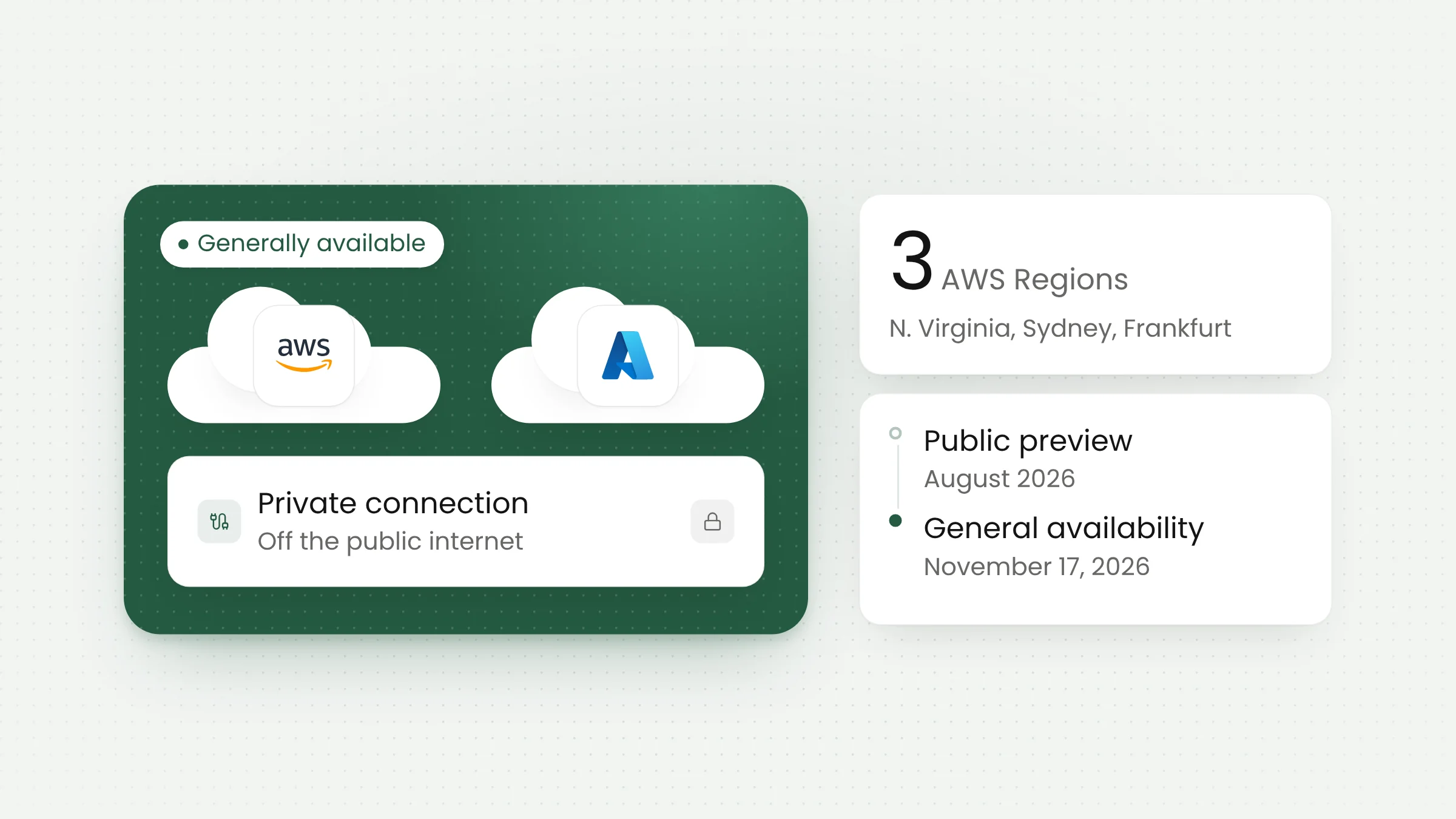
AWS Interconnect now officially connects AWS with Microsoft Azure. On November 17, 2026, both companies announced that the managed private connection between the two largest clouds had reached general availability, following a public preview that began in August. The service is live in three AWS Regions so far: N. Virginia, Sydney and Frankfurt.
A private path between AWS and Azure
AWS Interconnect - multicloud is a managed private connectivity service that joins a customer’s virtual network on AWS (a VPC) to its virtual network on another cloud provider. According to the AWS announcement, customers now get the same experience when connecting workloads to Microsoft Azure, Google Cloud and Oracle Cloud Infrastructure (OCI).
Until now, organizations running on two clouds had to assemble the link themselves. The AWS News Blog describes that work as managing VPN tunnels, coordinating with colocation facilities and configuring third-party network fabrics.
Microsoft made the matching announcement from its side. In an Azure Networking Blog post dated November 17, 2026, the company said Azure Multicloud Interconnect with AWS is generally available. The service is built on Azure ExpressRoute and operated cooperatively by the two companies. Microsoft also opened a public preview of a similar connection with Google Cloud.
Igor Sakhnov, Corporate Vice President of Azure Networking at Microsoft, summed up the division of roles in that post: “Customers keep control of their networks, and the providers remove friction.”
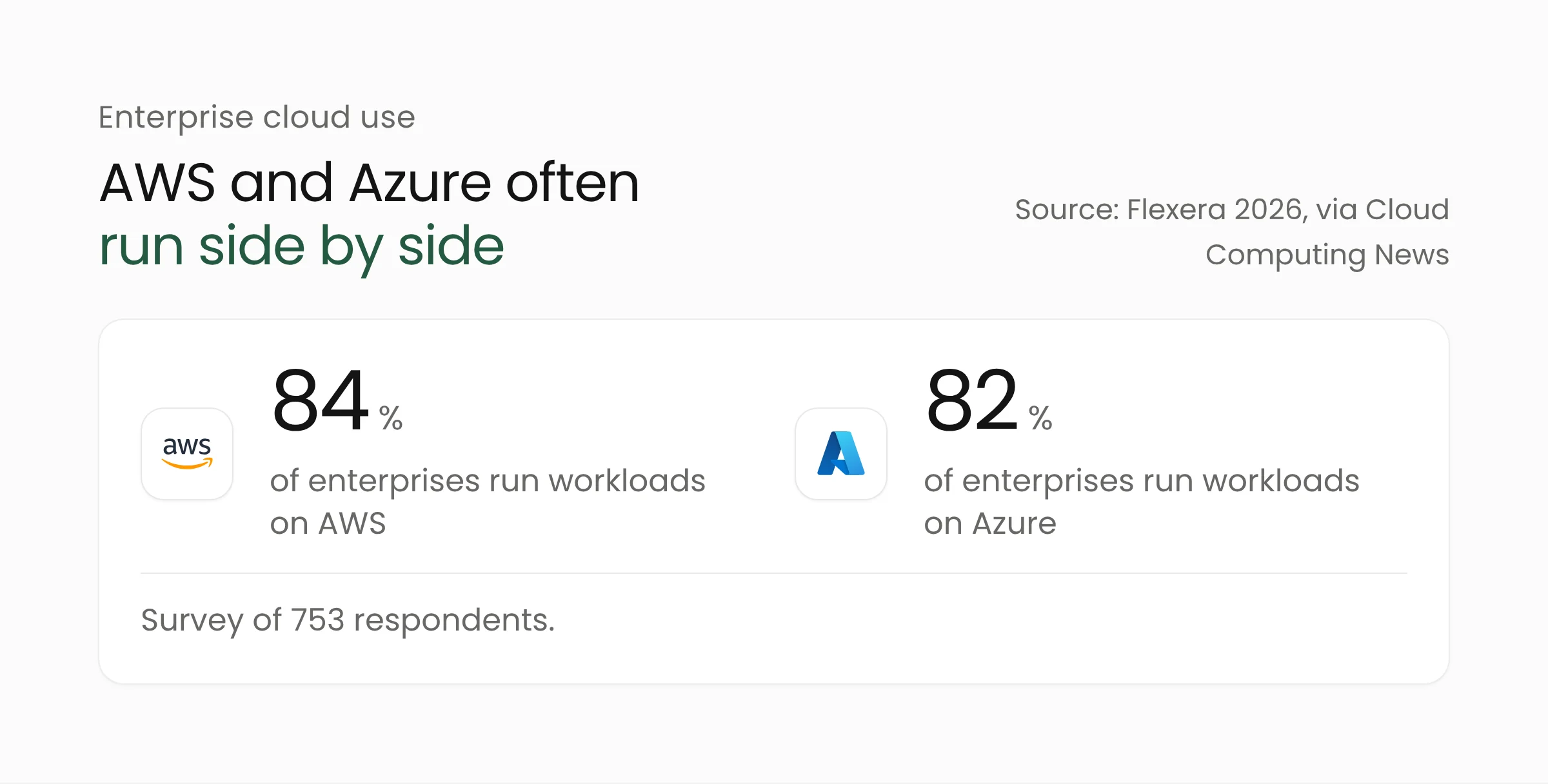
Demand for such a link is substantial. Cloud Computing News cites the Flexera 2026 State of the Cloud report, a survey of 753 respondents, which found that 84% of enterprises run workloads on AWS and 82% on Azure.
How AWS Interconnect works
The connection operates at Layer 3, the layer where IP addresses and routes are handled. AWS says traffic flows entirely over the AWS global backbone and the partner cloud’s private network, so it does not cross the public internet.
Encryption and redundant paths
Every connection uses MACsec encryption (IEEE 802.1AE) on the physical links between AWS routers and the partner provider’s routers at the interconnection facilities. AWS adds one important caveat: each provider manages encryption independently on its own backbone, so customers should review both sets of encryption documentation to confirm their compliance requirements are met.
Resiliency is included as well. Each connection spans multiple logical links spread across at least two physical facilities, so the failure of a single device or building does not cut the link. For monitoring, AWS bundles a Network Synthetic Monitor in Amazon CloudWatch that tracks round-trip latency and packet loss.
Four steps to create a connection
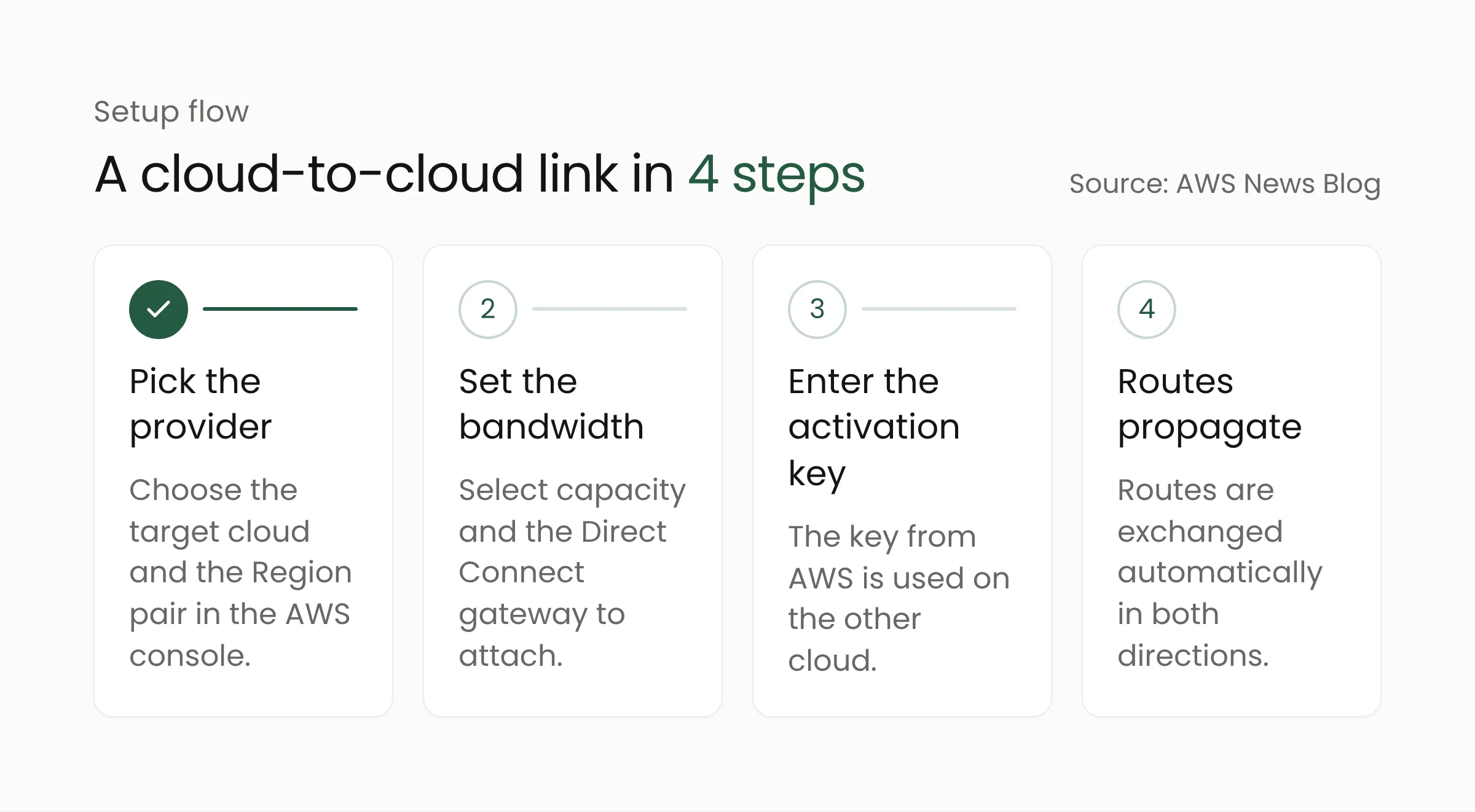
In the AWS News Blog walkthrough with Google Cloud, setup starts in the AWS Direct Connect console. The user selects the target cloud provider, the Regions on both sides, the bandwidth and the Direct Connect gateway to attach. AWS then issues an activation key, which is entered on the other cloud. After that, routes are exchanged automatically in both directions.
AWS lists three technical conditions in that walkthrough. The IP address ranges of the two networks cannot overlap, the choice of IPv4, IPv6 or both must be the same on each side, and the MTU (the largest packet size sent without fragmentation) must match.
From Google Cloud to Azure in seven months
AWS Interconnect first became generally available on April 14, 2026, with Google Cloud as the initial partner across five Region pairs. According to Cloud Computing News, OCI entered preview in May and reached general availability in July 2026, while Azure entered public preview in August 2026.
All three use the same specification, which AWS has published on GitHub under the Apache 2.0 license.
Regions, bandwidth and cost
Azure support is available in three AWS Regions: us-east-1 (N. Virginia), ap-southeast-2 (Sydney) and eu-central-1 (Frankfurt). Jakarta and Singapore are not on the list. For organizations in Indonesia, Sydney is currently the nearest point.
The technical blog Classmethod, which inspected the service through the AWS CLI after launch, recorded the paired Azure locations as eastus, australiaeast and germanywestcentral.
During the preview, connections were limited to 1 Gbps. Classmethod found eight bandwidth options at general availability, from 500 Mbps to 100 Gbps.
The numbers for a 10 Gbps connection
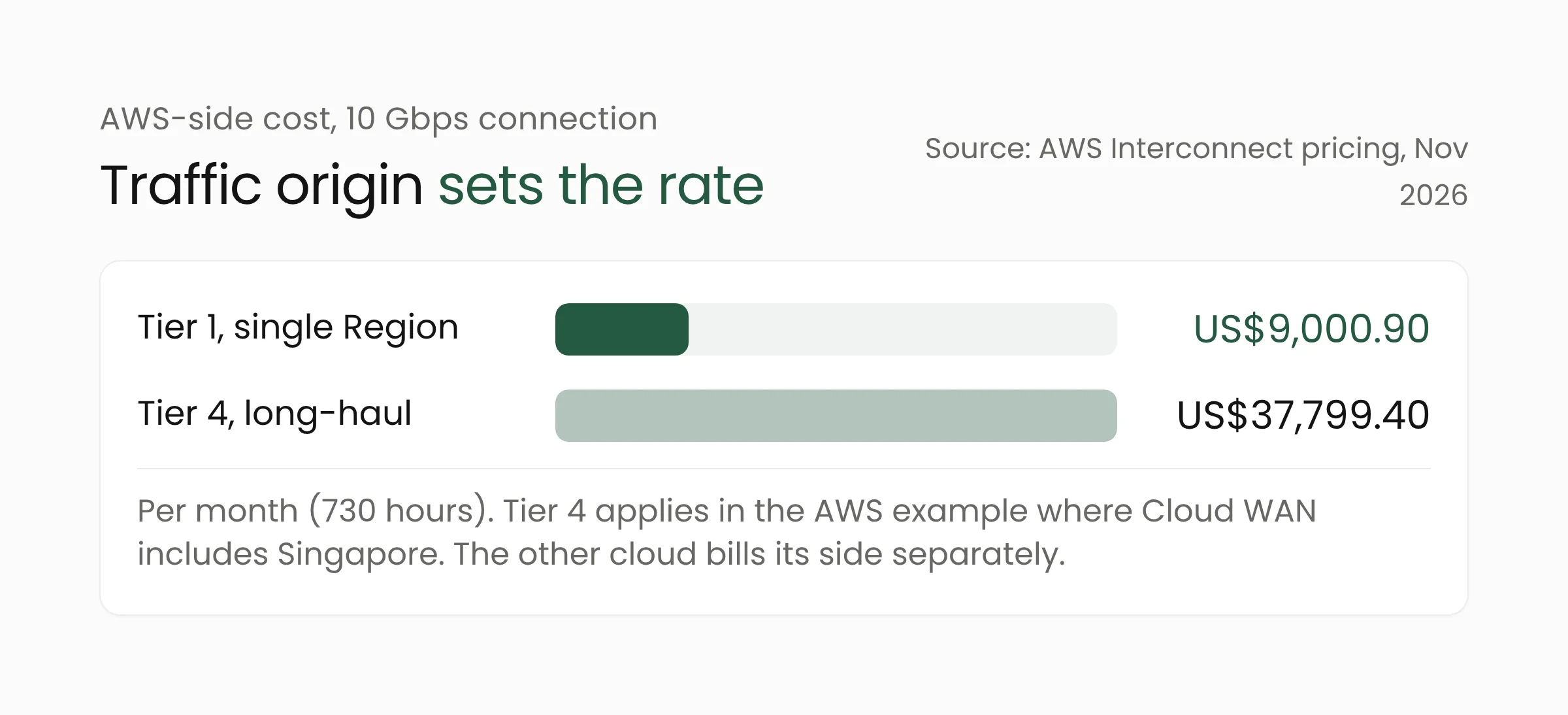
According to the AWS Interconnect pricing page, the AWS side is billed hourly based on bandwidth and a pricing tier, with no per-gigabyte data transfer charges. There are five tiers. The tier depends on the distance between the Regions where traffic originates and the interconnect’s local Region.
AWS gives two examples for a 10 Gbps connection. When traffic originates only in the same Region as the interconnect, Tier 1 applies at US$12.33 per hour, or US$9,000.90 over a 730-hour month. When an interconnect in N. Virginia is attached to an AWS Cloud WAN network that also includes Singapore, the whole interconnect moves to Tier 4 at US$51.78 per hour, nearly US$37,799.40 a month.
That is only one side of the bill. AWS states that the other cloud provider sets and charges its own prices. Classmethod, drawing on Azure’s retail pricing API, reports that the Azure side is billed monthly and includes inbound and outbound data transfer. For 10 Gbps with the Local option in Zone 1 the figure is US$9,490 a month, which brings the two-sided total in the cheapest scenario to US$18,490.90 a month.
AWS also offers one free 500 Mbps interconnect per cloud provider per Region. On the Azure side, according to Classmethod, the free 500 Mbps tier applies to the Local option only, with one connection per subscription, no SLA and a 90-day limit.
What remains unanswered
Microsoft’s general availability post does not state an SLA figure. During the preview, Cloud Computing News reported that AWS designed the architecture for 99.99% availability and Microsoft targeted a 99.99% SLA, though none applied in preview.
Neither company has announced a schedule for more Regions. The Azure-side prices and the bandwidth list come from a third party’s check of official APIs, so verify them against both providers’ pricing pages before budgeting.
What this means for IT teams in Indonesia
Running on two clouds is already common here. A bank may run core applications on AWS and use identity or analytics services on Azure. Hospitals, local governments and retailers often end up in the same position. Five tasks are worth completing before deciding whether to adopt the service.
- Map the data flows between clouds. List the applications that call each other across AWS and Azure, the monthly data volume and the path in use today, such as a VPN over the internet.
- Check where the workloads sit. The service is cheapest when both sides are in a supported Region. A Jakarta workload routed through Sydney covers a longer path, so latency and the pricing tier need to be worked out from the AWS tier table.
- Compare with current data transfer costs. AWS Interconnect pricing is a flat hourly rate and is not metered per gigabyte. That favors organizations that move large volumes regularly, such as database replication. For small flows, an existing VPN can remain cheaper.
- Test with the free tier. The free 500 Mbps interconnect can support a trial in a non-production environment, keeping in mind the 90-day limit and the absence of an SLA on the Azure side.
- Read the data location and encryption terms. Organizations bound by data residency rules need to check which Regions the traffic passes through. Security teams should read both providers’ encryption documentation, because MACsec covers only the physical links between routers.
For financial institutions, a dependable link between clouds ties directly into disaster recovery planning. We examined that risk in our piece on the Google Cloud London outage report, when a problem at one site disrupted services for hours. A private path to a second cloud makes replication easier, but the recovery design still has to be tested regularly.
Network design of this kind is part of Merakit’s cloud computing services. For regulated sectors, we weigh these choices alongside each organization’s financial services requirements.
Frequently asked questions
Is AWS Interconnect available in the Jakarta Region?
Not for connections with Azure. AWS names three Regions at general availability: N. Virginia, Sydney and Frankfurt. Organizations in Indonesia can use the Sydney interconnect, after calculating the distance and pricing tier.
Is traffic between AWS and Azure encrypted?
AWS says every connection uses MACsec encryption on the physical links between its routers and the partner provider’s routers. Inside each backbone, the provider manages its own encryption. Sensitive applications should still use application-level encryption such as TLS.
How is this different from a VPN between clouds?
A cloud-to-cloud VPN runs over the public internet, so latency and throughput can vary with network conditions. AWS Interconnect uses a private path with dedicated bandwidth and redundant links across at least two facilities.
Closing
With Azure now supported, the link between the two largest clouds has become a service that can be ordered from a console. If your organization runs on more than one cloud and wants to assess the most sensible path, the Merakit team is ready to help with the numbers.
Sources
- AWS announces general availability of AWS Interconnect - multicloud connectivity with Microsoft Azure, AWS What’s New, November 17, 2026
- Connecting clouds and the last mile with Azure, Azure Networking Blog, November 17, 2026
- AWS Interconnect - multicloud Pricing, AWS, accessed November 21, 2026
- AWS Interconnect is now generally available, with a new option to simplify last-mile connectivity, AWS News Blog, April 14, 2026
- AWS Interconnect - multicloud Is Now GA with Microsoft Azure, So I Checked Out the AWS CLI and Pricing, Classmethod DevelopersIO, November 2026
- AWS and Microsoft launch multicloud link between AWS and Azure, Cloud Computing News, September 3, 2026