Blog Data Centers
Google Buys Superhot Geothermal Power for Its Data Centers
On this page· 7 sections
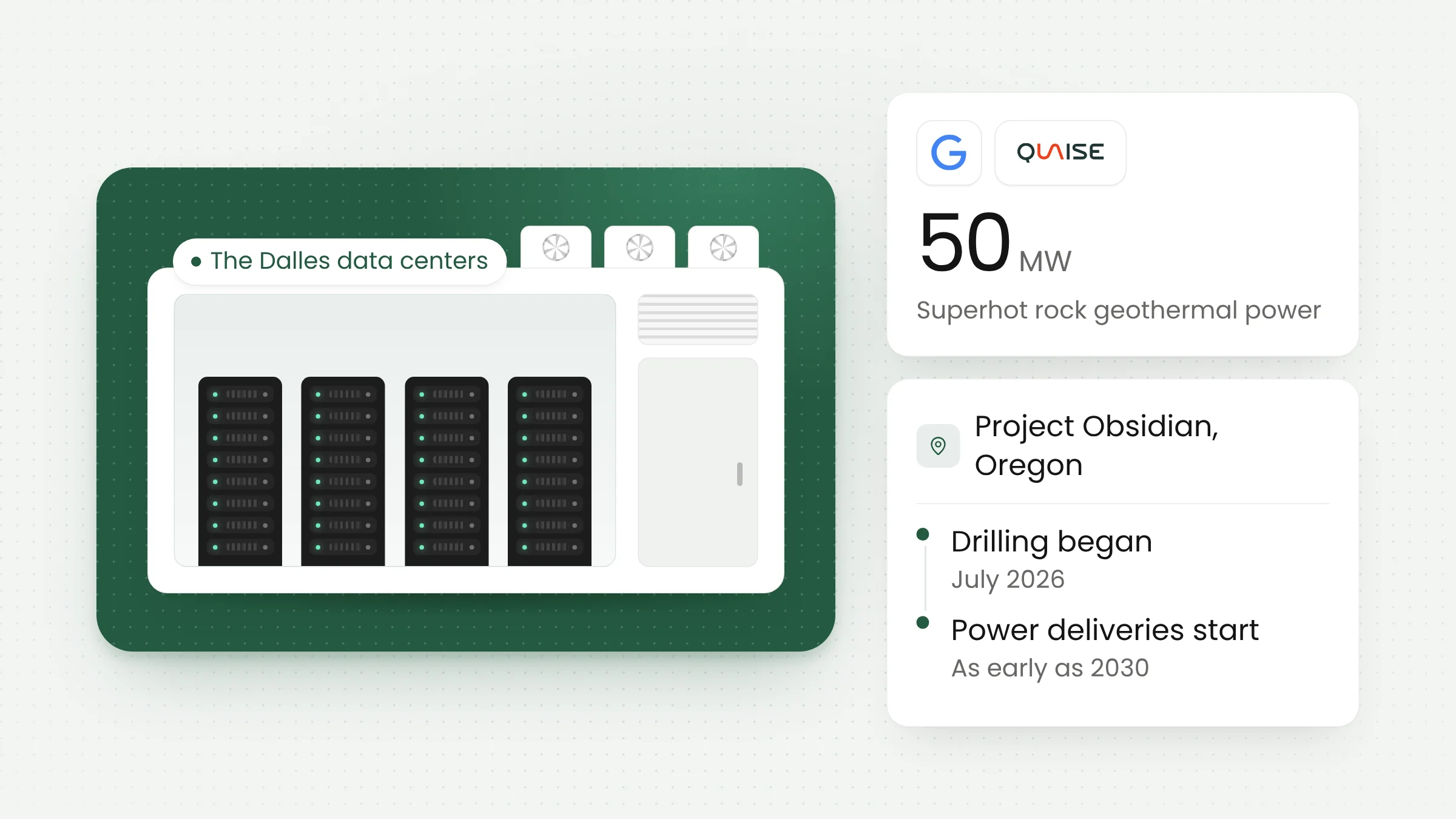
Google has signed a contract to buy 50 megawatts (MW) of superhot rock geothermal power from Quaise Energy, a U.S. startup. Announced on November 17, 2026, the deal is meant to supply Google’s data centers in The Dalles, Oregon, as early as 2030. Local media describe it as the world’s first commercial purchase of this kind of geothermal energy.
A 50 MW contract on the flank of Newberry Volcano
The electricity will come from Project Obsidian, Quaise’s first commercial-scale project, on the southern flank of Newberry Volcano in central Oregon. According to the Quaise press release, the contract is a power purchase agreement that supports Google’s existing data center operations in The Dalles and the surrounding region.
Reports on the value differ. OPB, Oregon’s public broadcaster, wrote that the companies did not disclose the sale price. Quaise told Utility Dive and Canary Media that the agreement is worth more than US$500 million. The project itself is expected to cost about US$350 million to build.
OPB puts 50 MW at roughly the demand of 50,000 average households. Google says it signed nearly 35 gigawatts (GW) of clean energy agreements between 2010 and 2025.
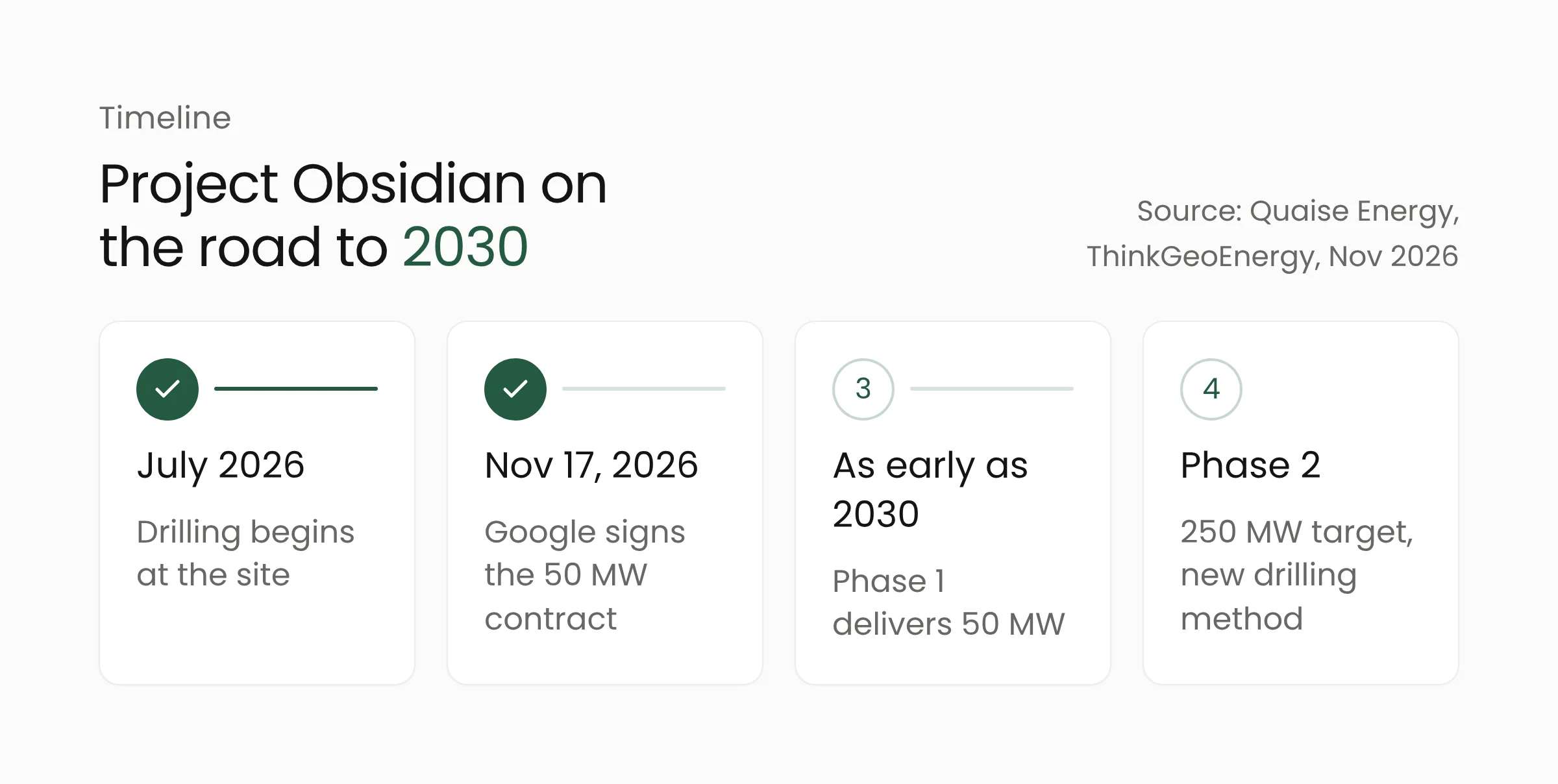
Project Obsidian will be built in two phases. ThinkGeoEnergy reports that drilling at the site began in July 2026. Phase one is a 50 MW development that uses conventional oil and gas drilling rigs to reach about 2.5 miles down, or roughly 4 kilometers, according to Canary Media. Phase two targets 250 MW and is planned around Quaise’s own drilling technology.
How superhot rock geothermal works
Geothermal plants operating today depend on natural pockets of hot water or steam that sit relatively close to the surface. Quaise says these reservoirs rarely exceed 600°F, about 316°C.
Superhot rock geothermal takes a different route. Developers drill much deeper until they reach very hot rock, inject water into it, and use the steam that returns to the surface to spin a turbine. Because the heat source is the rock itself and no natural reservoir is required, far more locations become candidates.
Rock above 400°C
The Clean Air Task Force (CATF), a nonprofit that studies the technology, uses a threshold of about 400°C. At that temperature water becomes a supercritical fluid, a state that carries far more energy than ordinary hot water. CATF expects a superhot well to produce five to ten times the energy of one of today’s commercial geothermal wells, which average about 7 to 8 MW of electricity.
Other reports use lower figures. Canary Media cites rock above 572°F (300°C) as Quaise’s goal, and OPB cites temperatures near 800°F.
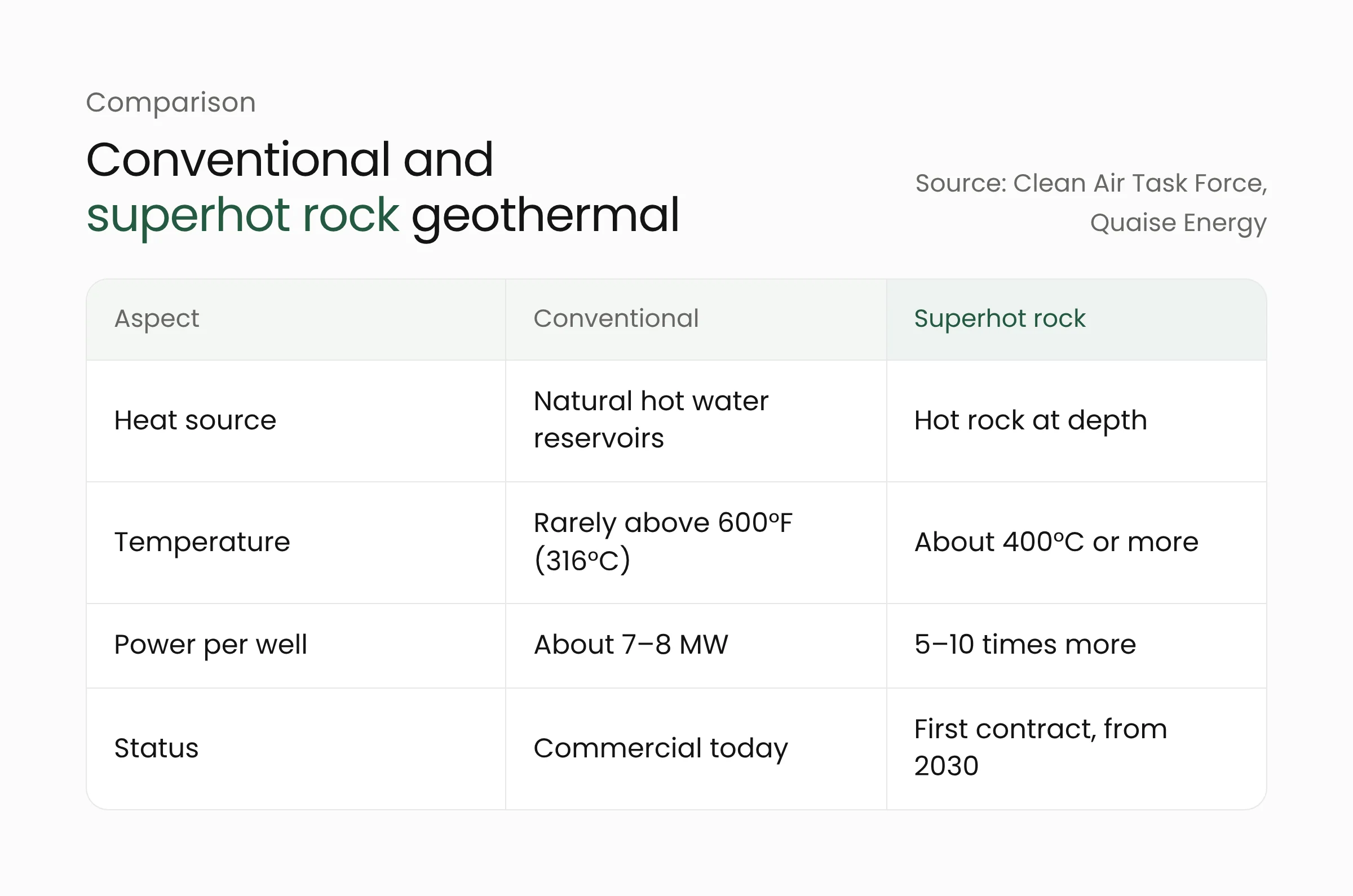
Power per well matters because drilling is a major cost. TechCrunch notes that drilling accounts for roughly 25% to 30% of the cost of building a geothermal plant.
Two ways to drill very hot rock
The core problem is the drill bit. At these temperatures metal bits wear out quickly and the electronics at the end of the drill string begin to fail.
Quaise is developing a millimeter-wave drill. It fires high-frequency beams that melt and vaporize rock without physical contact, so there is no bit to replace again and again. According to Utility Dive, Quaise reported drilling through 118 meters of granite at its Texas test site and is working toward 1 kilometer.
Mazama Energy keeps the mechanical drill but changes how it is cooled. A day before the Google announcement, the company introduced Carbon Chill. Liquid carbon dioxide is pumped down the center of the drill string, then expands through a valve near the bit, cooling rapidly and absorbing heat from the bit and its electronics.
Mazama’s CEO, Sriram Vasantharajan, told TechCrunch that the rate of penetration rose 20% with this method. That claim has not been independently tested. Mazama says its most recent well has passed 700°F (about 371°C), and hopes to complete a single well capable of up to 15 MW in 2027.
Cost, transmission and unproven technology
No superhot rock geothermal plant sells electricity commercially yet. Canary Media cautions that next-generation geothermal technologies still have to prove themselves at commercial scale, including how well the systems hold up over long periods.
The power is not cheap either. Lucia Tian, Google’s head of advanced energy technologies, acknowledged to OPB that the technology carries higher costs and said the hope is to drive those costs down. A TechCrunch analysis on November 20 said Google is paying a premium, in line with its habit of backing energy suppliers early.
The third obstacle is transmission. Quaise must build a 10-mile line, about 16 kilometers, from Newberry Volcano to the nearest substation in La Pine before its power can move up the grid to The Dalles. The federal entity that owns about 75% of the region’s lines added only one mile of new line between 2020 and 2025.
OPB counts at least 20 companies worldwide developing ways to reach deep heat. Fervo Energy, another next-generation geothermal developer, began selling power from an initial 33 MW unit at Cape Station in Utah in September 2026 and already holds a contract for nearly 400 MW with Google. The U.S. Department of Energy, through its research agency ARPA-E, has also announced up to US$30 million for superhot geothermal research.
What this means for data center operators and industry in Indonesia
Electricity supply has become a limit on data center growth. We have written about Amazon’s GPU racks waiting for power, and the same pressure hangs over data center zones in Indonesia, alongside the water question we covered in the Kabil SWRO project in Batam. The Google contract points to one path that is relevant to countries with large geothermal reserves.
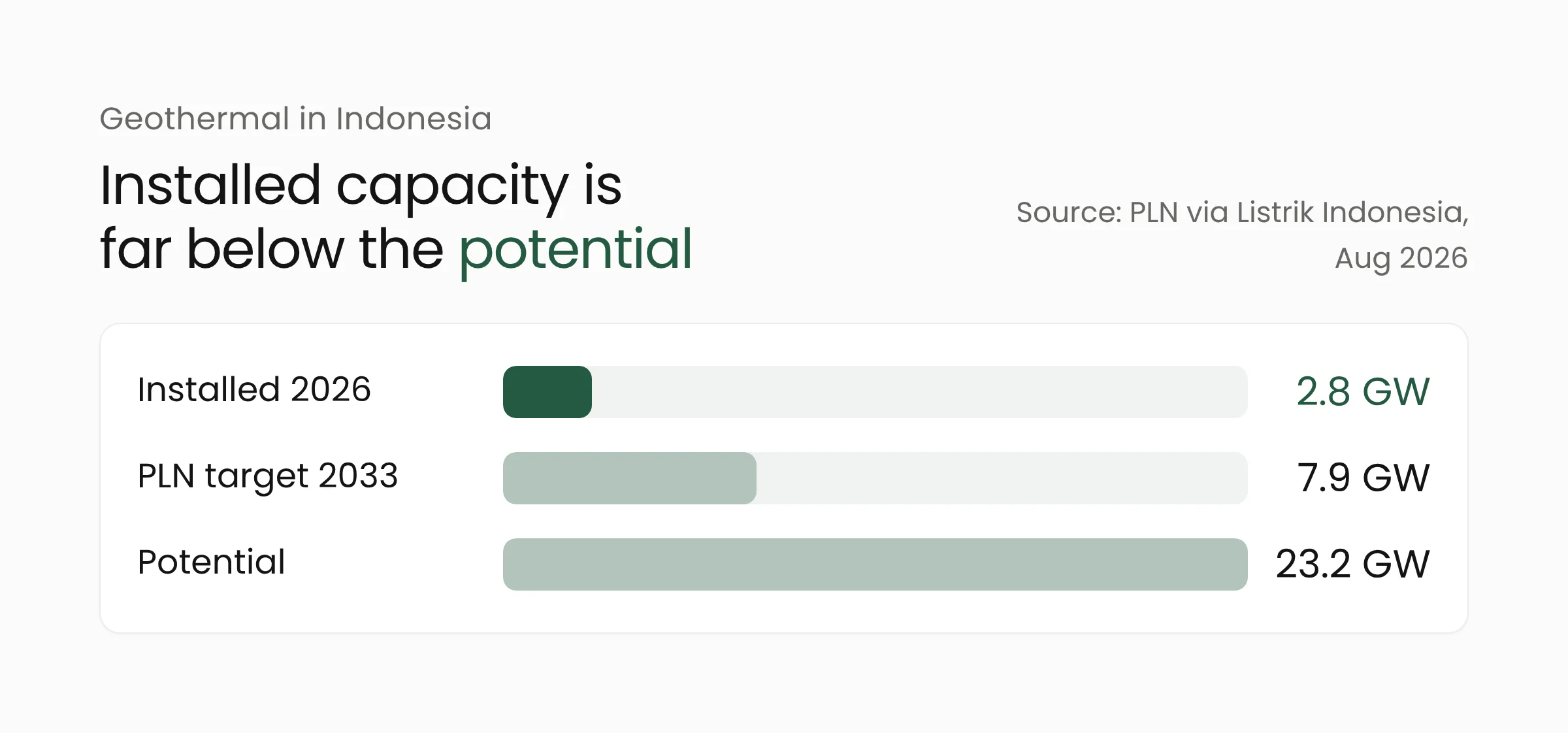
Indonesia is one of them. Republika, citing August 2026 data from the Geological Agency of the Ministry of Energy and Mineral Resources, reports 2,776 MW of installed geothermal capacity, about 11.6% of an estimated 24 GW of potential spread across 368 locations. State utility PLN uses a potential figure of 23.2 GW and, according to Listrik Indonesia, aims to raise geothermal capacity from about 2.8 GW to 7.9 GW by 2033.
All of those figures refer to conventional geothermal. No superhot project has been announced in Indonesia, and technology from Oregon will not necessarily suit local geology or tariff schemes. Several considerations still apply today.
- Treat the power source as a site selection criterion. Organizations renting colocation space or cloud capacity can ask providers about their electricity mix and energy plans. Geothermal generates around the clock, which fits server loads that never switch off.
- Think in long-term contracts. Google has locked in supply that will start flowing in four years at the earliest. Operators of industrial estates and data centers that plan to grow need to discuss supply with PLN or independent power producers well before the capacity is needed.
- Put transmission in the plan. Geothermal working areas are often in the mountains, far from industrial zones.
- Design monitoring from the start. Wells at several hundred degrees, pumps and turbines need sensors and control systems that tolerate harsh conditions. Experience from industrial automation in factories carries over to power plants, where temperature, pressure and vibration data are read continuously to prevent equipment damage.
- Record the emissions of digital workloads. The choice of cloud region and colocation provider shapes that number, and the calculation belongs in planning for cloud computing services.
Frequently asked questions
What is superhot rock geothermal?
Superhot rock geothermal generates electricity from rock at very high temperatures, about 400°C or more under the Clean Air Task Force definition. Water injected into that rock returns as a high-energy fluid that drives a turbine.
When will Project Obsidian start supplying Google’s data centers?
In 2030 at the earliest, according to Quaise and Google. The second phase, which targets 250 MW with millimeter-wave drilling, has no announced operating date.
Can the technology be used in Indonesia today?
No superhot rock geothermal project has been announced in Indonesia. The country has large potential and has drilled for geothermal energy since the KMJ-3 well at Kamojang in 1926, but adopting this newer technology still awaits commercial proof from projects such as Obsidian.
Closing
Google’s contract with Quaise marks the first time superhot rock geothermal has secured a commercial buyer, though the technology remains to be proven. For organizations in Indonesia, the lesson that applies right away is to bring the electricity source into digital infrastructure decisions. The Merakit team is glad to talk if you are planning workload placement or monitoring systems for an industrial facility.
Sources
- Quaise Energy Signs 50 MW Geothermal Power Purchase Agreement with Google, Quaise Energy, November 17, 2026
- Google announces world’s first deal to buy commercial superhot rock geothermal energy from Central Oregon, OPB, November 17, 2026
- Google signs 50 MW superhot geothermal PPA with Quaise Energy, Utility Dive, November 19, 2026
- Coverage of the Google and Quaise contract for Oregon data centers, Canary Media, November 17, 2026
- Quaise Energy signs 50-MW PPA with Google for superhot geothermal power, ThinkGeoEnergy, November 17, 2026
- Super-hot rock geothermal could end data center energy woes, TechCrunch, November 20, 2026
- Mazama Energy has a solution for geothermal’s biggest drilling problem, TechCrunch, November 16, 2026
- Superhot Rock Geothermal, Clean Air Task Force, accessed November 21, 2026
- Funding announcement of up to US$30 million for superhot geothermal, ARPA-E, U.S. Department of Energy, accessed November 21, 2026
- Panas Bumi RI Melimpah, Kenapa Baru 11,6 Persen Dimanfaatkan?, Republika, October 26, 2026
- PLN Pasang Target 7,9 GW Geothermal pada 2033, Listrik Indonesia, August 21, 2026