Blog Cybersecurity
Azure API Management Classic Flaw: Rotate Your Credentials
On this page· 7 sections
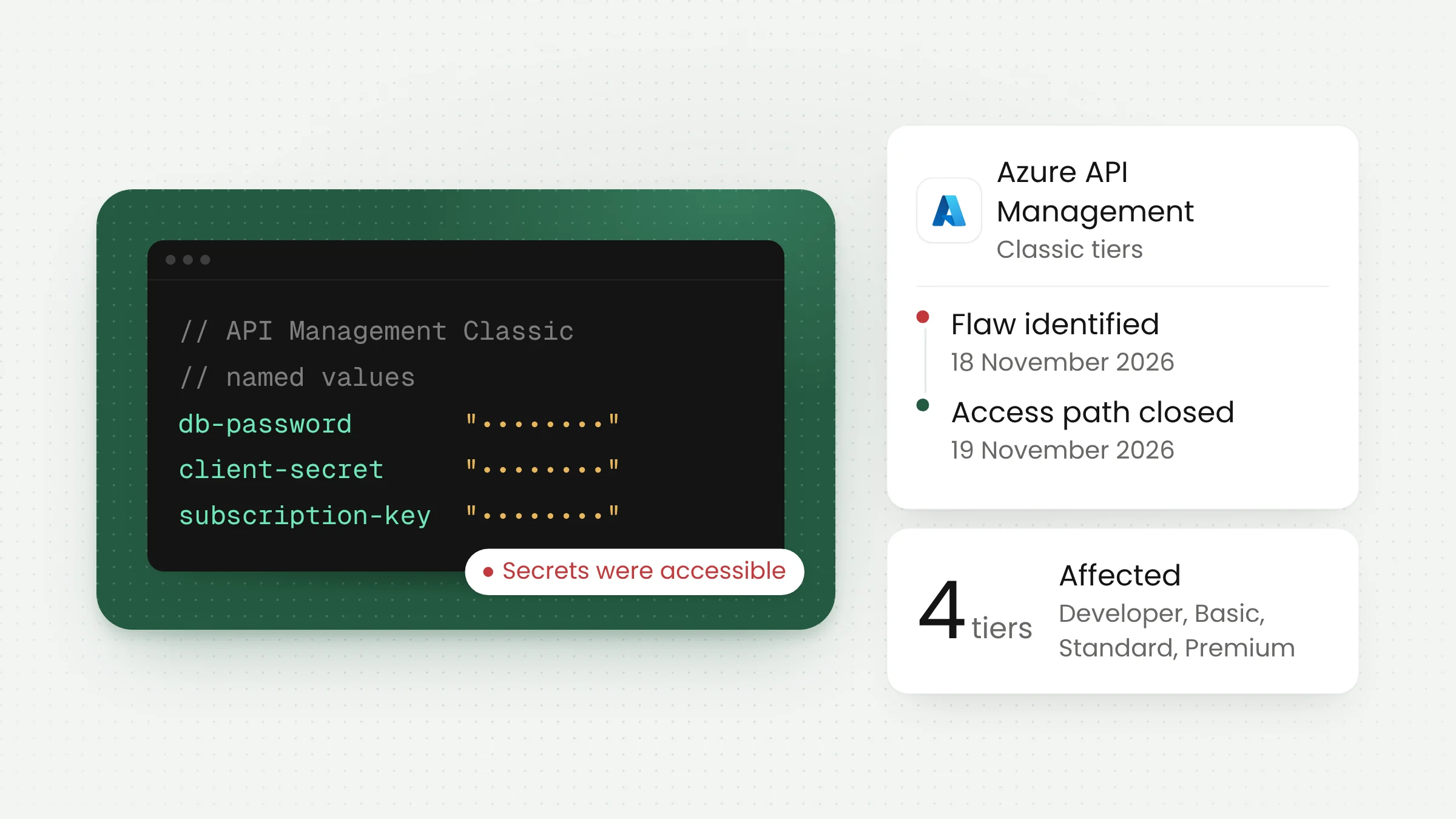
An unknown actor used a flaw in Azure API Management Classic to reach secrets stored in customer instances. Microsoft closed the access path on 19 November 2026, but any credential taken before that date keeps working until its owner replaces it.
How the Azure API Management Classic flaw came to light
Azure API Management (APIM) is Microsoft’s API gateway service. Requests from client applications pass through it before reaching the systems behind, which is why an APIM instance usually holds a large collection of keys, tokens and passwords for other services.
The first sign came from Norway. At 18:55 local time on 17 November 2026, energy company Equinor reported an ongoing cyberattack against some of its IT systems. Three days later, on 20 November, Equinor said the attack had been stopped, production was running as normal and there was no indication that data had been stolen or altered.
According to BleepingComputer, Microsoft identified the flaw on 18 November and closed the unauthorized access path the next day. Customers were notified through Azure Service Health under tracking ID MZK9-GH0. The Register, which saw the notice, described it as a critical advisory. As of 24 November, none of the sources we read gave a CVE number or a CVSS score.
Norway’s National Security Authority (NSM) published an official warning on 20 November and updated it on 23 November. NSM said an unknown actor had actively targeted access tokens, secrets and named values in APIM. It named Equinor and hydropower company Skagerak Energi among the affected organizations. Skagerak Energi, BleepingComputer reported, disclosed an attempted attack that had no operational impact.
NSM added that the flaw affects several sectors in Norway and abroad, and that the extent of exploitation is still unclear. Microsoft has not said how many customers were exposed and has not published a technical root cause.
Affected tiers and exposed secrets
Microsoft told BleepingComputer the flaw affects the Developer, Basic, Standard and Premium tiers of APIM Classic. The Consumption tier of APIM Classic and every APIM v2 tier are outside its scope.
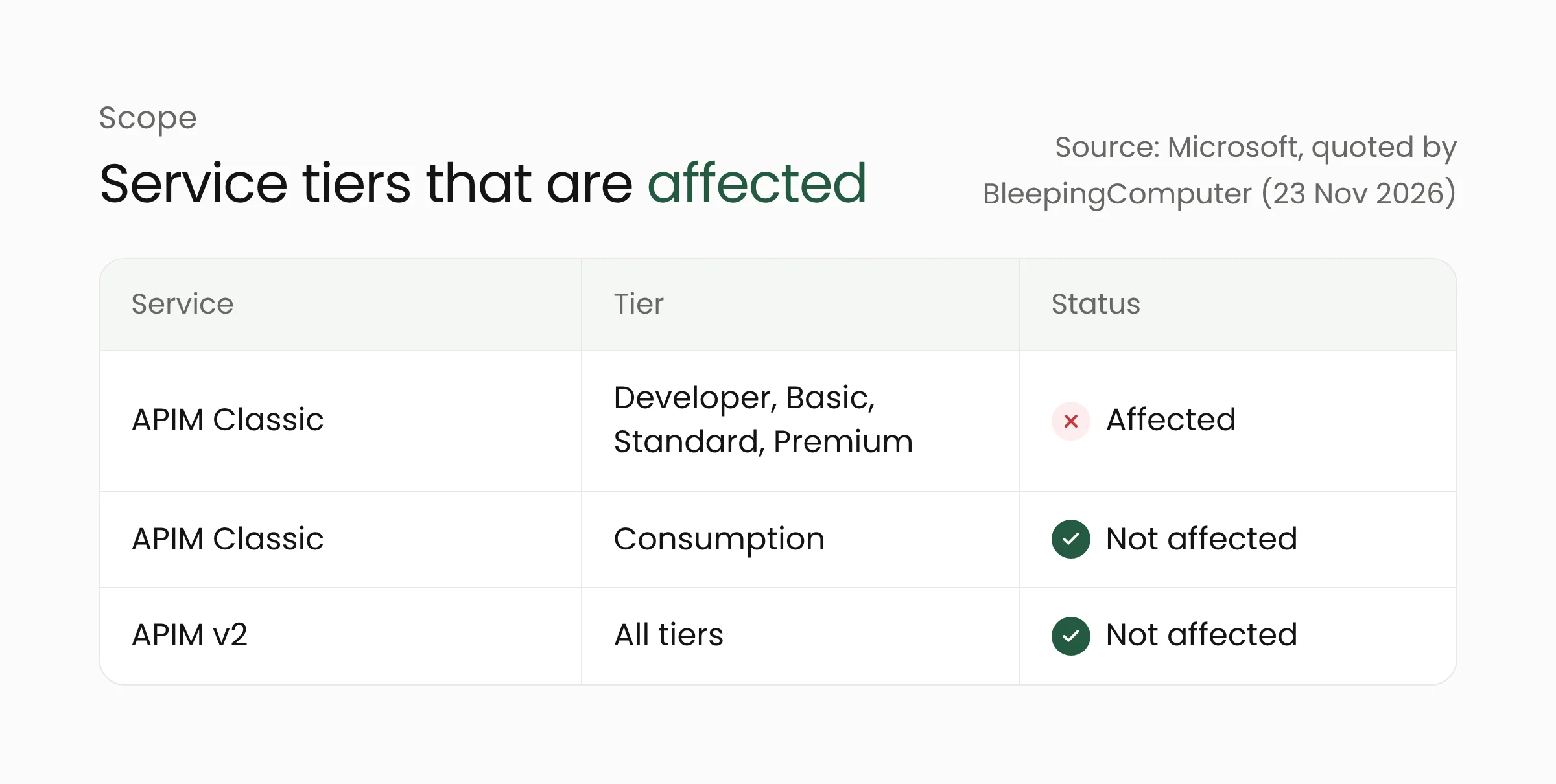
Microsoft’s explanation is that unauthorized access to certain management functionality was possible on Classic instances that were not configured according to recommended security practices. From there an attacker could perform administrative operations, including reading stored secrets. The Register added that Microsoft tied the exposure to instances that did not follow its network security guidance or that stored secrets directly in APIM instead of referencing Azure Key Vault.
Microsoft’s notice lists the secrets that may have been exposed:
- secrets stored as named values, the name and value pairs used across API configuration;
- client secrets for identity providers and OpenID Connect providers;
- subscription keys, which client applications present when calling an API;
- tokens used to call direct management APIs.
The list explains why the impact reaches beyond APIM. A database password or third-party service key kept as a named value can be used directly against the service that issued it, with no need to go through the gateway.
How to check your API Management instances
The first check is an inventory of every APIM instance in every Azure subscription, including test and development instances that nobody has touched in a long time. The Register noted customers’ concern that such instances are easy to forget. Microsoft’s rotation guide includes Azure CLI commands to list instances (az apim list) and named values (az apim nv list), with a flag showing which secrets already point to Key Vault.
The second check is the runtime version. NSM asks operators to open https://<gateway-hostname>/internal-status-0123456789abcdef and read the RuntimeVersion value:
- version 0.52.x is patched if the last number is 31936 or higher;
- version 0.53.x is patched if the last number is 31938 or higher;
- other patterns, such as 0.53.4608.0 or 0.52.4150.0, indicate a v2 or Consumption instance that is outside the flaw’s scope;
- a lower number means the instance is still vulnerable, and NSM asks its operator to contact the service provider.
The two accounts differ on this point. Microsoft told BleepingComputer that the 19 November fix was fully deployed to Microsoft-hosted instances and required no customer action. It did not explain why NSM still recommends checking the runtime version. The check takes a few minutes, so it is worth doing.
What this means for IT teams and API owners
Azure is widely used in Indonesia and runs a local region, Indonesia Central. APIM commonly sits in front of banking APIs, public services, mobile apps and business-to-business integrations. None of the sources we read name an Indonesian organization as a victim, but NSM is clear that the impact crosses borders. Any organization that ran APIM Classic on an affected tier before 19 November should work through the following steps.
Assume the secrets are exposed. NSM tells every APIM user to start from the assumption that their secrets and named values are in someone else’s hands, and to rotate all tokens and secrets. Microsoft said its remediation “does not automatically invalidate credentials that may have been accessed before the fix was deployed.” Microsoft rotated the keys it controls. Keys that belong to customers are the customers’ job.
Rotate in the right order. Changing a value in APIM does nothing to revoke the old credential at its issuer. Microsoft’s guide gives a four-step order that keeps services running during the switch.
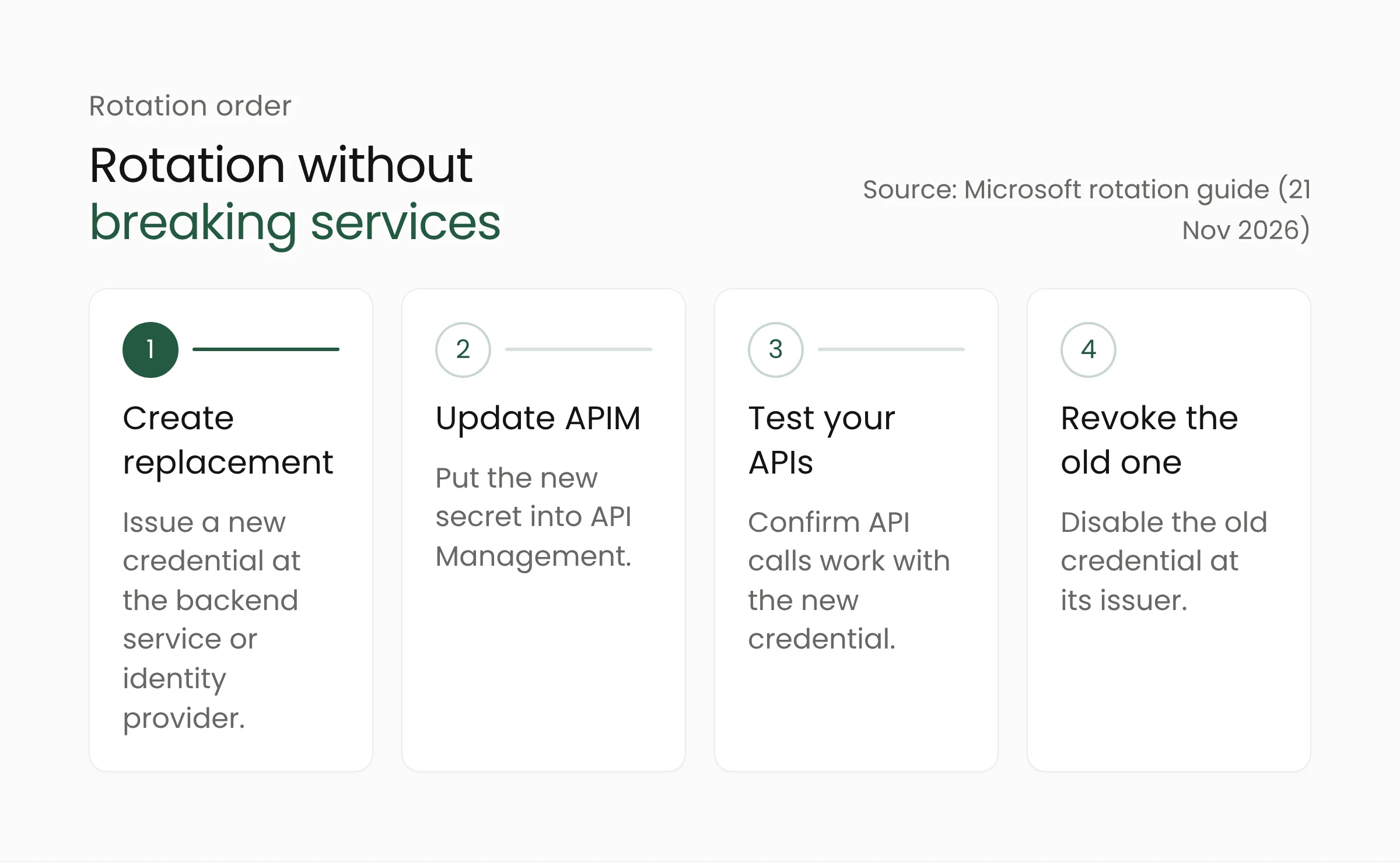
For subscription keys, the guide suggests moving callers to the secondary key, regenerating the primary key, verifying, and then regenerating the secondary. The same guide covers a wider set of credentials than the incident notice does: backend credentials in headers, query parameters and client certificates, OAuth 2.0 client secrets, connection strings for Event Hubs loggers, and credentials written directly into policies. Microsoft advises testing every command in a non-production instance first.
Map what sits behind the gateway. NSM asks organizations to work out what information each APIM instance can reach. That map defines how far an investigation has to go if signs of compromise turn up.
Review downstream logs. Microsoft asks customers to investigate suspicious activity in systems reachable with those credentials and to review available logs. In practice that means Key Vault access logs, backend API logs and sign-in records at the identity provider for the period before 19 November. Security researcher Anders Kristiansen has published threat-hunting queries to help with this work, BleepingComputer reported.
Move secrets into a key vault. Microsoft’s documentation recommends named values that reference secrets in Azure Key Vault. A secret updated in Key Vault is updated in API Management within four hours, provided its identifier was entered without a version. The rotation guide also recommends managed identities in place of keys and connection strings wherever they are supported.
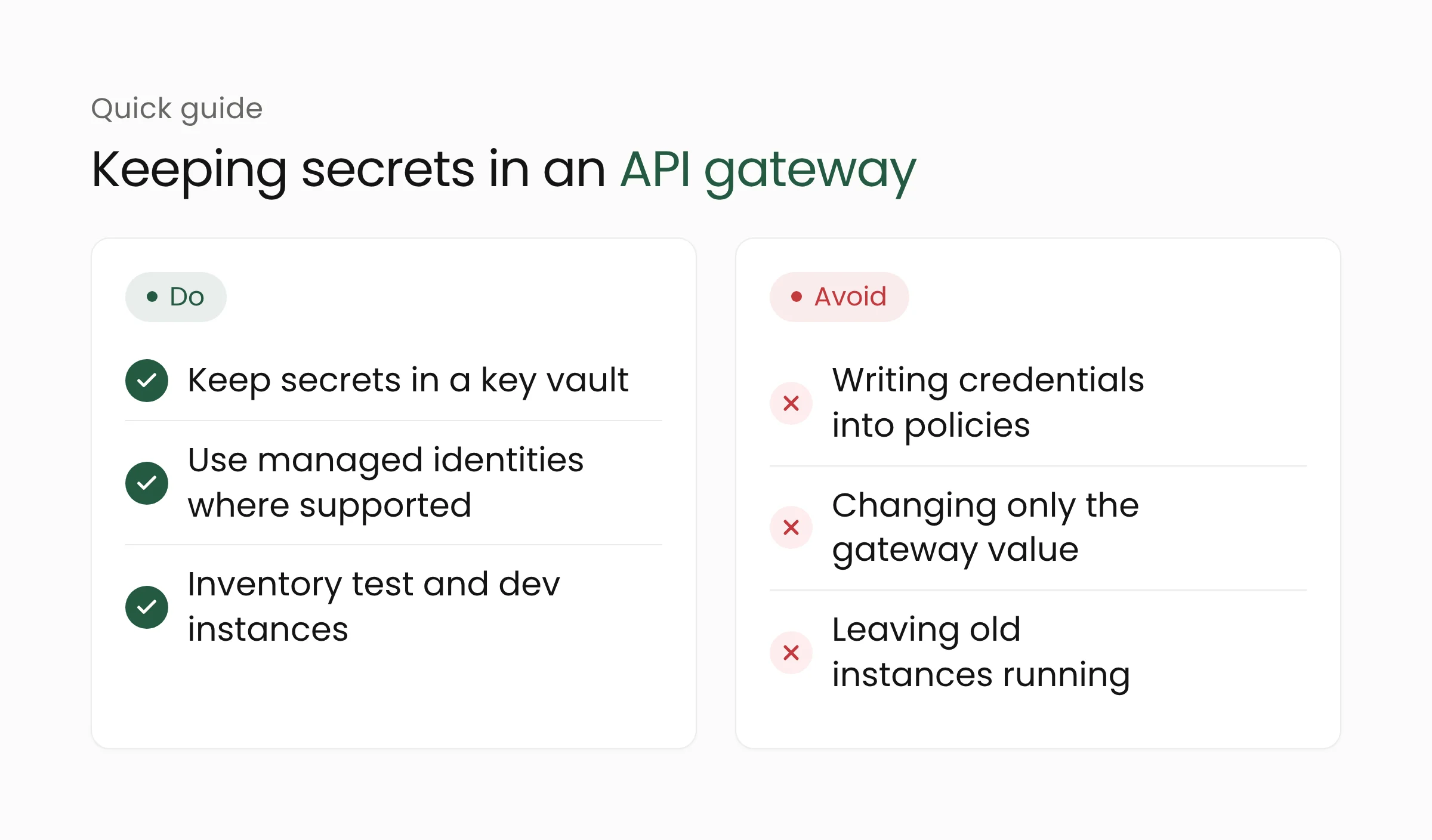
The wider lesson, on any cloud, concerns where secrets live. An API gateway from any provider tends to accumulate credentials, so a single flaw there opens many doors at once. A regular audit of stored secrets, the permissions attached to each credential and their expiry dates is a basic part of sound cybersecurity services, and it belongs in the design from the day an API is first built.
Frequently asked questions
Do I need to install an update for Azure API Management?
According to Microsoft, no. The fix was applied on Microsoft’s side on 19 November 2026 for the instances it hosts. NSM still recommends checking RuntimeVersion and contacting the service provider if the number is below the threshold. The main work for customers is rotating credentials and reviewing logs.
Are APIM v2 and the Consumption tier safe from this flaw?
Microsoft says all APIM v2 tiers and the Consumption tier of APIM Classic are unaffected. Organizations that use only those have no rotation to do because of this incident. It is still worth checking whether an old Classic instance used for testing remains in another subscription.
How can I tell whether my secrets were taken?
There is no definitive way to tell from APIM itself, which is why NSM asks every user to assume exposure. Signs of misuse have to be found downstream, in the services that accept those credentials, by reviewing their access logs for the period before 19 November 2026.
Closing
Microsoft has closed the flaw, and the remaining work sits with customers: take inventory, rotate credentials in the right order and review the logs. If your organization runs APIs in the cloud and wants to rethink how secrets are stored, the Merakit team is open to a conversation about cloud architecture that keeps credentials out of the API gateway.
Sources
- NSM deler tiltak mot sårbarhet i Azure API Management, Norwegian National Security Authority (NSM), 20 November 2026, updated 23 November 2026
- Rotating credentials in Azure API Management, Microsoft Azure Integration Services Blog, 21 November 2026
- Microsoft Azure flaw exploited to steal customers’ API credentials, BleepingComputer, 23 November 2026
- Norway links energy firm cyberattacks to critical Azure API Management flaw, The Register, 23 November 2026
- Equinor detected cyber-attack, Equinor, 17 November 2026, updated 20 November 2026
- How to use named values in Azure API Management policies, Microsoft Learn
- Microsoft patches actively exploited vulnerability in Azure API Management, Techzine, 24 November 2026